

What Is NAOOA Seal Program?
If you want a simple answer: the NAOOA Seal Program is a bottle label used in the U.S. and Canada to show that an olive oil brand takes part in repeat store-bought testing and that the oil meets extra virgin or other stated grade rules.
Here’s the part that matters most to me as a shopper:
- NAOOA buys samples from store shelves, not from brands
- Brands are tested at least 2 times per year
- Extra virgin oils must pass both lab checks and taste panel review
- The seal helps me check whether the bottle matches its label
- The seal does not confirm organic status, source, or how the oil was stored after bottling
That matters because some past testing found that 73% of samples from top-selling imported brands failed international sensory rules for extra virgin olive oil.
So when I see the seal, I can treat it as a first filter. Then I still need to check the bottle date, packaging, and source before I buy.
| What the seal helps with | What it does not help with |
|---|---|
| Label grade check | Organic claims |
| Purity check | Source claims |
| Repeat store sampling | Storage after bottling |
| Sensory review for extra virgin | Whether I’ll like the taste |
Below, I’d break it down as a simple shopping tool, not a full guarantee.
NAOOA Webinar
sbb-itb-4066b8e
What the NAOOA Seal Program Is and Why It Exists
The NAOOA Certified Seal Program is a voluntary certification for olive oils sold in the U.S. and Canada. Its job is simple: check that the oil matches what the label says and meets IOC grade standards.
To get the seal, a brand has to follow NAOOA’s program rules. That includes being an active NAOOA member, paying a licensing fee, and agreeing to repeated independent testing.
A Certification for Quality and Authenticity
The program looks at two things. First, it checks authenticity - whether the product is in fact olive oil, not oil diluted or swapped with cheaper vegetable or seed oils. Second, it checks whether the oil meets the chemical and sensory rules for the grade shown on the label.
That distinction matters. An oil can be pure olive oil and still fail the extra virgin grade if it shows oxidation or rancidity. For extra virgin oils, IOC-recognized panels of 8–12 trained tasters look for fruitiness, bitterness, and pungency, and they confirm that no defects are present. To keep the seal for that grade, an oil has to pass both lab testing and sensory review.
Why Repeated Verification Matters
This isn’t a one-and-done approval. The NAOOA program is built around repeated verification. Brands in the program agree that NAOOA can buy their oils straight from retail shelves several times each year, and the rules call for at least two authenticity and quality tests per year for each brand.
That point is easy to miss, but it’s a big deal. Because NAOOA purchases samples at different times, the seal points to continued compliance, not just one batch that passed once. NAOOA backs up those standards through retail sampling and lab review.
How NAOOA Tests Olive Oil
Off-the-Shelf Sample Collection from Retail Stores
NAOOA tests the oil shoppers actually pick up in stores, not hand-picked samples sent in by brands. That’s a big deal. The program starts with random shelf sampling of participating brands, bought from retail stores through independent samplers or third-party agencies to help avoid bias.
Lab Tests and Sensory Panels
Once the samples are collected, they go to independent labs for chemical testing. These checks look at two main things: purity and freshness.
| Test Parameter | What It Reveals |
|---|---|
| Free Fatty Acidity (FFA) | Shows olive handling and freshness. NAOOA often uses a tighter extra virgin mark of ≤0.5%, compared with the standard ≤0.8% IOC limit. |
| Peroxide Value (PV) | Shows oxidation level. NAOOA often aims for stricter limits, such as ≤15 meq O₂/kg, versus the standard ≤20. |
| UV Absorbance (K232/K270) | Can point to refining or adulteration. Common extra virgin marks are K232 ≤ 2.50 and K270 ≤ 0.22. |
For extra virgin oils, lab data alone isn’t enough. The oil also has to pass a sensory review. NAOOA requires testing by an IOC-recognized tasting panel made up of 8–12 trained tasters, and each sample is assessed blind.
The panel looks for positive traits like fruitiness, bitterness, and pungency. At the same time, they check for defects such as rancidity, mustiness, or winey notes that would knock an oil out of the extra virgin grade.
Testing Requirements and Monitoring Rules
Participating brands must complete at least two rounds of off-the-shelf testing each year. If a product fails, NAOOA can require corrective action or suspend or revoke the brand’s right to use the seal. In plain terms, brands that don’t meet the rules can lose permission to display it.
What the NAOOA Seal Tells Consumers
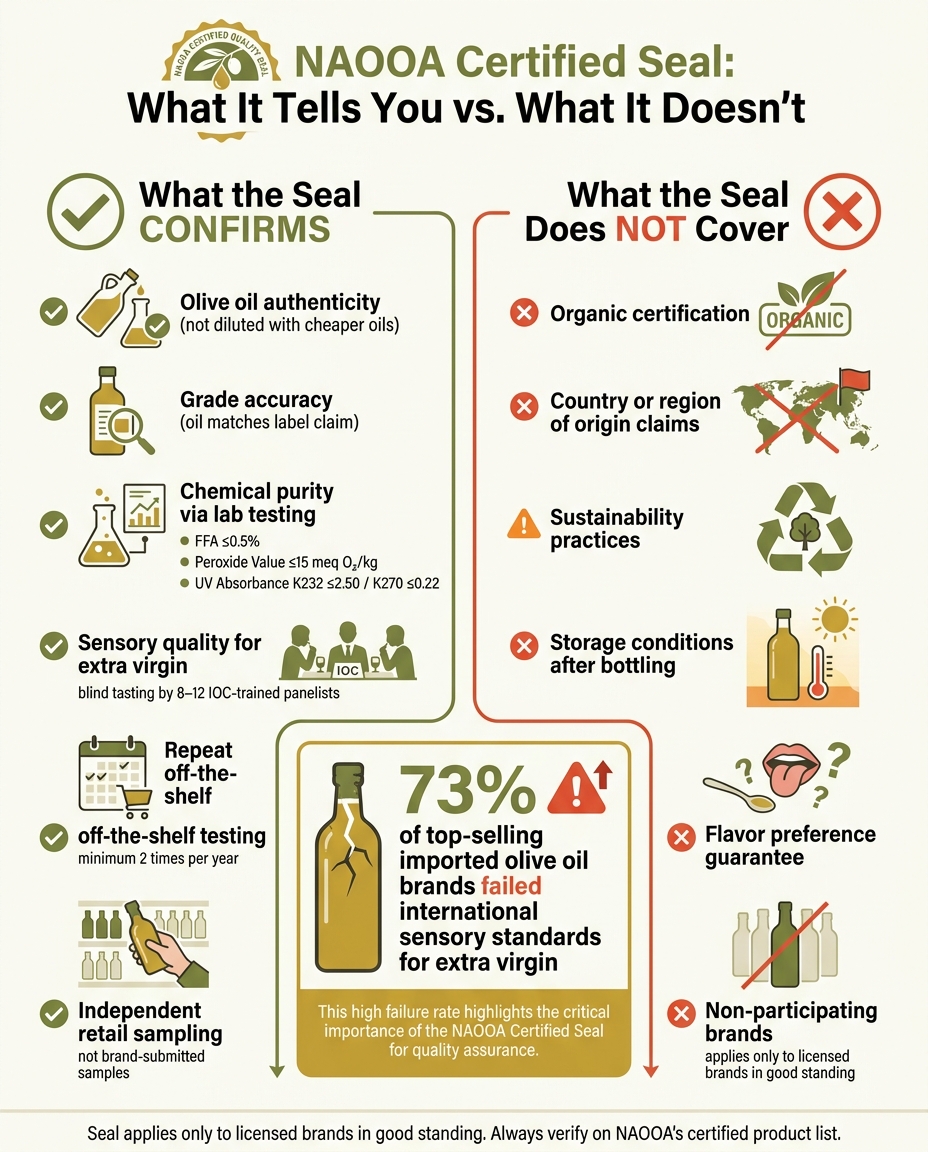
NAOOA Seal Program: What It Covers vs. What It Doesn't
What the Seal Confirms on a Bottle
For shoppers, all that testing shows up as one simple shelf signal: the NAOOA Certified Seal.
If you see that seal on a bottle, the brand has agreed to recurring, independent checks showing that its olive oil is authentic and meets recognized purity and quality standards under International Olive Council (IOC) standards. On extra virgin bottles, the seal also means the oil passed sensory review.
That matters because the seal gives you a fast way to narrow the shelf to bottles that have gone through outside review. ONLY licensed brands in good standing can place the seal on the bottle. And the seal applies to the bottle itself, not to a website or an ad.
Benefits and Limits of the Program
The seal confirms authenticity and grade. It does not certify organic status, origin, or sustainability claims.
It also applies only to brands that take part in the program. And it doesn’t promise that you’ll like the flavor, or that the oil was handled well after bottling.
How to Use the Seal When Shopping
Treat the seal as one strong quality signal, not the whole story. Start by looking for it on the bottle to spot brands that take part in independent, recurring testing.
Then check the freshest bottle date and the best storage conditions you can find. After that, use NAOOA’s current certified product list to confirm the exact bottle and grade. That way, the seal works as a smart first screen before you compare freshness and storage.
Conclusion: Why the NAOOA Seal Program Matters for Quality-Focused Shopping
Put simply, the seal matters because it turns repeated testing into a clear signal you can spot right on the shelf. And that matters because olive oil labels can be messy. Studies have found that 73% of samples from top-selling imported brands failed international sensory standards for extra virgin olive oil. The NAOOA Seal Program gives shoppers a fast way to screen for oils that have been tested for authenticity and quality.
What makes the program stand out is its marketplace model. These oils aren't sent in as hand-picked samples. They're bought from store shelves and tested at least twice a year. On top of that, extra virgin oils also have to pass sensory analysis by an IOC-recognized panel.
Key Takeaways for U.S. Olive Oil Buyers
The seal works best as a first filter, not a promise that covers everything. It shows that a brand agreed to repeated testing on products pulled from the marketplace, which can help shoppers buy authentic extra virgin olive oil. But it shouldn't be the only thing you check.
Pair the seal with a few basic checks:
- harvest date
- dark or protective packaging
- country or region of origin
That last bit still matters. Your own freshness and origin checks help fill in the gaps. Used this way, the seal can help you make faster, smarter choices without treating it like a full guarantee.
FAQs
How do I verify a sealed bottle?
Look for the NAOOA Certified Quality Seal on the label. That seal means the olive oil passed independent chemical and sensory testing for purity and other key quality markers.
If the package has a QR code, scan it. You may be able to see batch-specific lab data, including harvest date, processing timing, free fatty acidity, and peroxide value.
You can also check any listed certification details through the certifying organization’s online verification tools.
Does the seal mean the oil is fresh?
Yes. The NAOOA Quality Seal is meant to signal freshness and quality.
It’s based on:
- regular physico-chemical testing
- sensory checks
- market sampling throughout the year
If an oil passes, it’s expected to meet or go beyond standards that include freshness-related quality thresholds. In plain English, the seal is there to give buyers more confidence that the oil is fresh.
Who can use the NAOOA seal?
The NAOOA seal is available to NAOOA members in North America, including producers, packagers, and importers. To use it, members pay an annual fee and agree to random off-the-shelf retail testing.
Products that pass NAOOA’s purity and quality checks can display the NAOOA Quality Seal. If a product is found to be inauthentic, it faces a mandatory retail recall in North America.