

Natural Additives in Olive Oil Preservation
Yes - some plant extracts can help olive oil last longer, but storage still matters most. From the research I reviewed, olive leaf and rosemary tend to show the best oxidation control, while citrus peels can help more modestly and change flavor less.
If I had to boil the article down, it would be this:
- Extra virgin olive oil already has antioxidants from the olive itself
- Added plant extracts may slow oxidation
- Olive leaf and rosemary usually perform best
- Heat, light, and oxygen still do most of the damage
- More protection often means a stronger taste change
A few numbers stand out:
- Olive leaf extract improved oxidation stability by about 46% in one test
- Rosemary pushed induction time from 34.44 hours to 82.25 hours in one study
- Heated oils with olive leaf phenolics showed peroxide formation cuts of about 17.8% to 38.5%
- Some enriched oils showed phenolic content gains of up to ~40x
Quick Comparison
| Additive | Main effect on stability | Flavor change | General takeaway |
|---|---|---|---|
| Olive leaf extract | Often among the best results | Bitterness and pungency can increase | Strong lab results, but taste shift can be sharp |
| Rosemary extract / leaves | Often strong for peroxide control and induction time | Herbal, resin-like notes | Good option when flavor change is acceptable |
| Citrus peels | Usually lower than olive leaf or rosemary | Bright citrus aroma, softer bitterness | Milder sensory change with some oxidation support |
| Other herbs | Mixed, often below rosemary | Herb-driven flavor shift | Can help, but results are less consistent |
If you want the plain answer: natural additives can help, but they do not fix poor oil or poor storage. I’d treat them as an extra layer, not the main solution.
sbb-itb-4066b8e
Baseline Protection: Natural Antioxidants Already in EVOO
Fresh extra virgin olive oil comes with its own antioxidant shield. That shield is made up of phenolic compounds, tocopherols (vitamin E), and pigments such as carotenoids and chlorophylls. This matters because studies on added extracts don’t start from zero. They measure any extra protection on top of what the oil already has.
Phenolic Compounds and Oxidative Stability
Hydroxytyrosol and other ortho-diphenols - oleuropein aglycone, oleacein, and oleocanthal - are EVOO’s most powerful natural antioxidants.
In a study of 55 EVOOs, hydroxytyrosol accounted for more than 40% of total phenolics, and antioxidant activity moved in step with hydroxytyrosol, tyrosol, and oleuropein levels. Rancimat testing, which checks resistance to oxidation, shows that ortho-diphenolic compounds lead to the biggest increases in induction time compared with other minor components.
Tyrosol is less powerful than hydroxytyrosol and gives only limited protection unless it appears at high levels. EVOOs with more total phenolics - especially oils rich in hydroxytyrosol and secoiridoid derivatives - tend to show slower peroxide value growth and longer induction times during storage over several months.
That helps explain why one EVOO may gain more from added plant extracts than another. If the oil starts with a strong internal defense system, the effect of an additive can look very different.
Tocopherols, Carotenoids, and Pigments as Secondary Defenses
Tocopherols and pigments support phenolics; they don’t take their place. α-Tocopherol interrupts radical chain reactions, carotenoids quench singlet oxygen, and chlorophylls may help in darkness but can speed up photo-oxidation when light is present.
A study of Croatian EVOOs shows how these compounds show up together in actual oils. The Leccino variety had 312.4 mg/kg tocopherols and 246.6 mg/kg total phenols. Its water-soluble fraction had the highest antioxidant capacity at 1.3 mmol TEAC/kg, with a strong correlation between total phenols and DPPH values (r² = 0.9856, p < 0.01). Research also shows that the ratio of polyphenols to tocopherols - not only the raw amounts - plays a major role in oxidative stability among oils with similar fatty acid profiles.
How Freshness and Processing Affect Antioxidant Levels
Harvest timing is one of the biggest drivers here. Early-harvest, less-ripe olives usually produce oils with more polyphenols and better oxidative stability. Later harvests, by contrast, often produce milder oils with fewer phenolics and lower stability.
Processing speed matters just as much. Milling olives soon after harvest - ideally within hours - helps keep phenolic compounds from breaking down through enzyme activity and oxygen exposure. Cold extraction and tight oxygen control during malaxation are linked to better retention of both phenolics and tocopherols.
The flip side is pretty simple: delays between harvest and milling, or warm storage, can cut phenolic levels fast. In long-term storage tests, EVOOs kept at room temperature lost about half to more than 70% of their phenolic content over 36 months, while oils stored at about 39°F (4°C) showed no significant changes.
Put plainly, the starting condition of the oil sets the ceiling for what an additive can do. A fresher, better-processed EVOO already begins with stronger built-in protection, so any added ingredient has less ground to make up.
Natural Additives Studied for Olive Oil Preservation
Researchers have spent the most time on olive-derived extracts, rosemary extracts or essential oils, and citrus peel or other aromatic plant extracts. The idea is pretty simple: olive oil already has its own natural defense system, so studies look at whether plant-based additions can push that protection even further.
Olive Leaf and Olive Fruit Extracts
Olive leaf extract is one of the most studied options, in part because it comes from the same plant as the oil. Olive fruit extracts and other olive-derived extracts get attention for the same reason.
At 0.15%, olive leaf extract increased oxidative stability by about 46% in refined olive oil. In another test, oils with 4% and 6% olive leaf addition reached induction periods of 6.48 hours and 6.99 hours at 120°C (248°F). Researchers have also found that olive leaf extract rich in oleuropein can improve tocopherol, carotenoid, and chlorophyll content while lowering peroxide value.
These extracts have also been tested under heat. At 150 ppm, olive leaf phenolic extracts reduced peroxide formation after 24 hours by about 17.8% to 38.5% in olive oil and 21.5% to 49.0% in sunflower oil. That matters not just for shelf storage, but also for frying conditions in the 338–410°F (170–210°C) range. Results still vary based on things like leaf freshness, the extraction process, and the starting quality of the olive oils.
Rosemary Extracts and Essential Oils
Rosemary extract or essential oil often lowers peroxide value and extends induction time because of its antioxidant polyphenols.
In one heat study, rosemary-treated oil reached an induction time of 4.5 hours at 130°C (266°F) and 53 days at 60°C (140°F), versus 3.75 hours and 22.5 days for the untreated control. Rosemary and thyme treatments also gave lower peroxide, K232, and K270 values than the control during storage.
Still, the form matters a lot. A leaf extract, an essential oil, and a dried herb preparation do not behave the same way, because each brings a different mix of antioxidant and aromatic compounds.
Citrus extracts take a different path, but researchers judge them with the same oxidation markers and sensory checks.
Citrus Peels and Other Plant Extracts
Lemon and orange peels are studied as sources of flavonoids and essential oil compounds that may slow oxidation. In flavored olive oil samples enriched with citrus or other essential oils, acidity values ranged from 0.46% to 0.64% and peroxide index values ranged from 9.59 to 12.16 meq/kg. Both stayed within the reference limits of up to 0.8% acidity and 20 meq/kg peroxide index.
The tradeoff is taste and aroma. Citrus and other aromatic plant extracts can change color, aroma, and flavor intensity, which may not fit a standard EVOO profile. Higher doses may help with oxidative stability, but they can also bring much stronger herbal or citrus notes.
One study makes that pretty clear: adding basil or rosemary herbs slowed oxidation, but it also caused herbal volatile compounds to move into the oil, noticeably changing the volatile profile and sensory identity of the product. In other words, dose and plant form matter just as much as the additive itself.
Comparing Preservation Results Across Additives
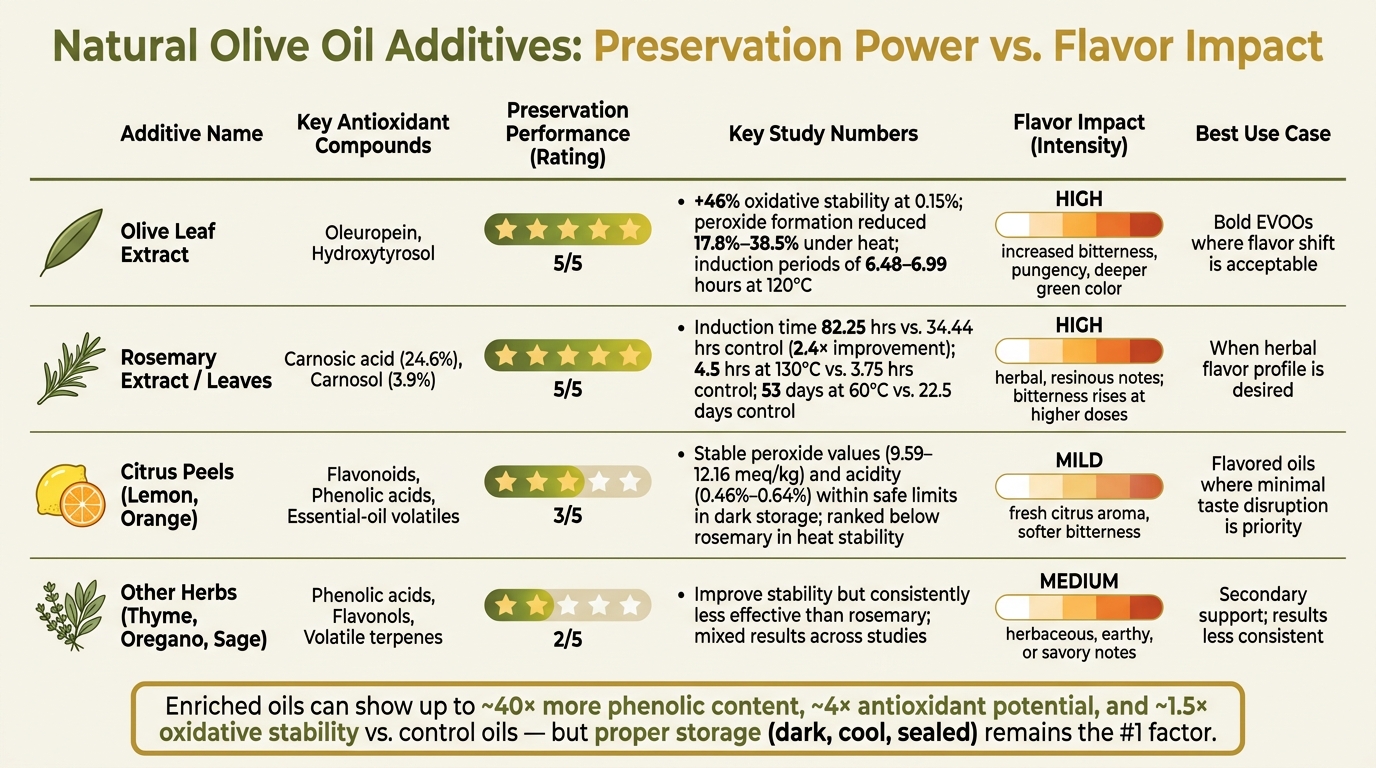
Natural Olive Oil Additives: Preservation Power vs. Flavor Impact
Oxidative Stability, Peroxide Value, and Induction Time Across Additives
Put side by side, the studies show a pretty clear pecking order. Olive leaf and rosemary keep coming out on top for oxidation control, while citrus peels and thyme tend to sit lower in the stack. Olive leaf extract increased oxidative stability by about 46% at only 0.15%. Rosemary extended induction time to 82.25 hours, compared with 34.44 hours for the untreated control. That's a 2.4× improvement. In flavored Tunisian EVOO work, rosemary-flavored oils had the best heat stability, with lemon next and thyme after that.
Storage conditions make those gaps even easier to see. EVOOs enriched with rosemary leaves and lemon peels and kept in the dark at 68°F (20°C) showed no major changes in free acidity, peroxide value, or K232 over time. The same oils, when exposed to light, lost helpful compounds and oxidation resistance more quickly.
That same ranking shows up in flavor. The additives that protect the oil the most also tend to change it the most. Olive leaf additions increase bitterness, pungency, and green color. Some people enjoy that in a bold EVOO; others don't. Rosemary adds herbal, resinous notes that get stronger as the dose goes up. Citrus peels bring bright, fresh aromas and can make bitterness seem softer while still improving antioxidant capacity.
The nutrition side looks strong, too. Enriched oils have shown phenolic content increases of up to ~40×, antioxidant potential up to ~4×, and oxidative stability around 1.5× versus control oils. The hard part is dose. Push additive levels too far, and the oil can drift into off-notes or medicinal flavors, even when the oxidation data looks great.
Sensory Effects and Nutritional Tradeoffs
The tradeoff is simple: better oxidation control usually comes with a bigger flavor shift. Olive leaf and rosemary give the highest level of protection, but they also make the biggest sensory mark. Citrus peels tend to produce milder, cleaner changes. Other herbs sit in the middle. They help stability, but in most cases not as much as rosemary. Herbal volatile compounds move into the oil and reshape its flavor profile, which is why dose and plant form matter just as much as the additive itself.
Comparison Table: Natural Additives Used in Olive Oil Studies
The table below pulls the main results into one place.
| Additive | Major Antioxidant Compounds | Typical Study Dose | Preservation Mechanism | Main Effect | Sensory Impact | Study Setting |
|---|---|---|---|---|---|---|
| Olive leaf extract | Oleuropein, hydroxytyrosol | 0.15%–400 ppm | Radical scavenging, phenolic enrichment | +46% stability at 0.15%; 6.48–6.99 h induction periods at 120°C (248°F). | Increased bitterness, pungency, deeper green color | Rancimat at 120°C (248°F); 6-month storage |
| Rosemary extract / leaves | Carnosic acid (24.6%), carnosol (3.9%) | 100–300 ppm extract; culinary leaf addition | Radical scavenging, suppression of hydroperoxides and aldehydes | Induction time 82.25 h vs. 34.44 h (control); 2.4× stability increase. | Herbal, resinous notes; bitterness rises at higher doses. | Rancimat; 20-day heating at 60°C (140°F); flavored EVOO storage |
| Citrus peels (lemon, orange) | Flavonoids, essential-oil volatiles, phenolic acids | Culinary-level addition | Radical scavenging, phenolic enrichment | Stable PV and K232 in dark storage at 68°F (20°C); ranked below rosemary in heat stability tests. | Fresh citrus aroma; softer bitterness. | Flavored EVOO; storage at 68°F (20°C) in dark vs. light |
| Other herb extracts (thyme, oregano, sage) | Phenolic acids, flavonols, volatile terpenes | Culinary to extract level | Radical scavenging, volatile antioxidant transfer | Other herbs improve stability, but usually less than rosemary. | Herbaceous, earthy, or savory notes depending on plant | Flavored EVOO; accelerated storage tests |
Practical Takeaways, Research Limits, and Conclusion
How Natural Additives Work Alongside Proper EVOO Storage
The study results only matter if storage is handled the right way. Natural additives can help, but they don't fix poor storage. Light, heat, and oxygen still drive most of the damage in EVOO.
That means the basics still come first: store EVOO in dark glass or stainless steel, keep it cool, close the cap tightly, and use opened bottles within 1–3 months.
When those basics are in place, additives like olive leaf phenolics, rosemary extracts, and citrus peels can do their job better. They may slow peroxide buildup and help protect the oil's natural compounds.
Gaps in Current Research and What Future Studies Should Address
Even with these results, there are clear limits in the research. The findings are promising, but they aren't fully consistent. Doses, active-compound levels, and extraction methods vary too much to point to one proven formula.
Another issue is how the studies are run. Most rely on accelerated stability tests at elevated temperatures of about 140°F (60°C) instead of long-term storage at normal room temperature. So while these tests can show patterns, they don't fully match how EVOO sits in a kitchen, warehouse, or store.
Commercial data is thin too. Most of the work is done at lab scale, with limited information on how these additives perform through bottling, shipping, and longer shelf time at retail.
Future studies would be more useful if they focused on:
- Standardized dosing
- More consistent extraction methods
- Room-temperature storage over longer timelines
- Sensory panels
- Commercial-scale trials
That kind of work would turn broad lab findings into guidance people can actually use.
Conclusion: Key Findings on Natural Additives in Olive Oil Preservation
Here's the main point: EVOO already starts with a strong base. Its phenolics, tocopherols, and pigments help protect the oil, and olive leaf and rosemary extracts can extend stability when storage is already handled well.
At the same time, results still vary by additive type, dose, and study design. And preservation depends most on freshness, processing quality, and correct storage. Natural additives can add a bit more protection, but they don't replace the fundamentals.
FAQs
Do natural additives work in all olive oils?
No. Natural additives like lime zest or essential oils can add flavor to olive oil, but they do not work as a one-size-fits-all way to preserve every oil.
There’s another catch too: once you add flavorings, the oil can no longer be labeled Extra Virgin.
For premium oils like those from Big Horn Olive Oil, the best way to protect quality and shelf stability is much simpler. It comes down to cold-pressing, prompt packaging, and storage that shields the oil from light, heat, and air.
Which additive helps most without changing flavor much?
Extra virgin olive oil stays stable mostly because of its natural antioxidants, especially tocopherols, not because of added preservatives.
These vitamin E compounds help guard the oil against oxidation and help keep its quality and flavor in place. Big Horn Olive Oil keeps them intact through mechanical cold-pressing within two hours of harvest, with no heat or chemicals.
How should I store olive oil with added extracts?
Store olive oil with added extracts in a cool, dark spot, like a pantry or cupboard, away from heat and direct sunlight. Aim to keep it between 55°F and 60°F.
Use an airtight, opaque container such as dark glass, stainless steel, or ceramic. After each use, seal it tightly to limit air exposure and help keep its freshness and flavor.