

Olive Oil in Ancient Blessing Rituals
Olive oil has been a symbol of purity, healing, and spiritual connection for millennia. From ancient Mediterranean cultures to modern religious practices, it has played a key role in rituals, medicine, and daily life. Here's a quick summary of its historical and spiritual significance:
- Ancient Mediterranean Use: Olive oil was cultivated over 6,000 years ago and used for anointing, lighting lamps, and healing wounds. Greeks and Romans refined its production and integrated it into their economies and spiritual ceremonies.
- Greek Rituals: Olive oil was sacred, used to anoint statues, athletes, and victors of games. Eternal lamps in temples burned with olive oil as offerings to the gods.
- Jewish and Biblical Traditions: Olive oil symbolized holiness, used to consecrate priests, kings, and sacred objects. It also fueled menorahs, including the miracle of Hanukkah.
- Christian Practices: Early Christians incorporated olive oil into baptisms and sacraments. Today, it remains central in blessings, confirmations, and healing rites.
- Other Ancient Cultures: Egyptians valued olive oil for mummification and skin care, while Romans used it in health remedies and religious offerings.
Even now, olive oil connects us to these ancient traditions. Modern producers, like Big Horn Olive Oil, emphasize purity and quality, reflecting its enduring role in both wellness and spirituality.
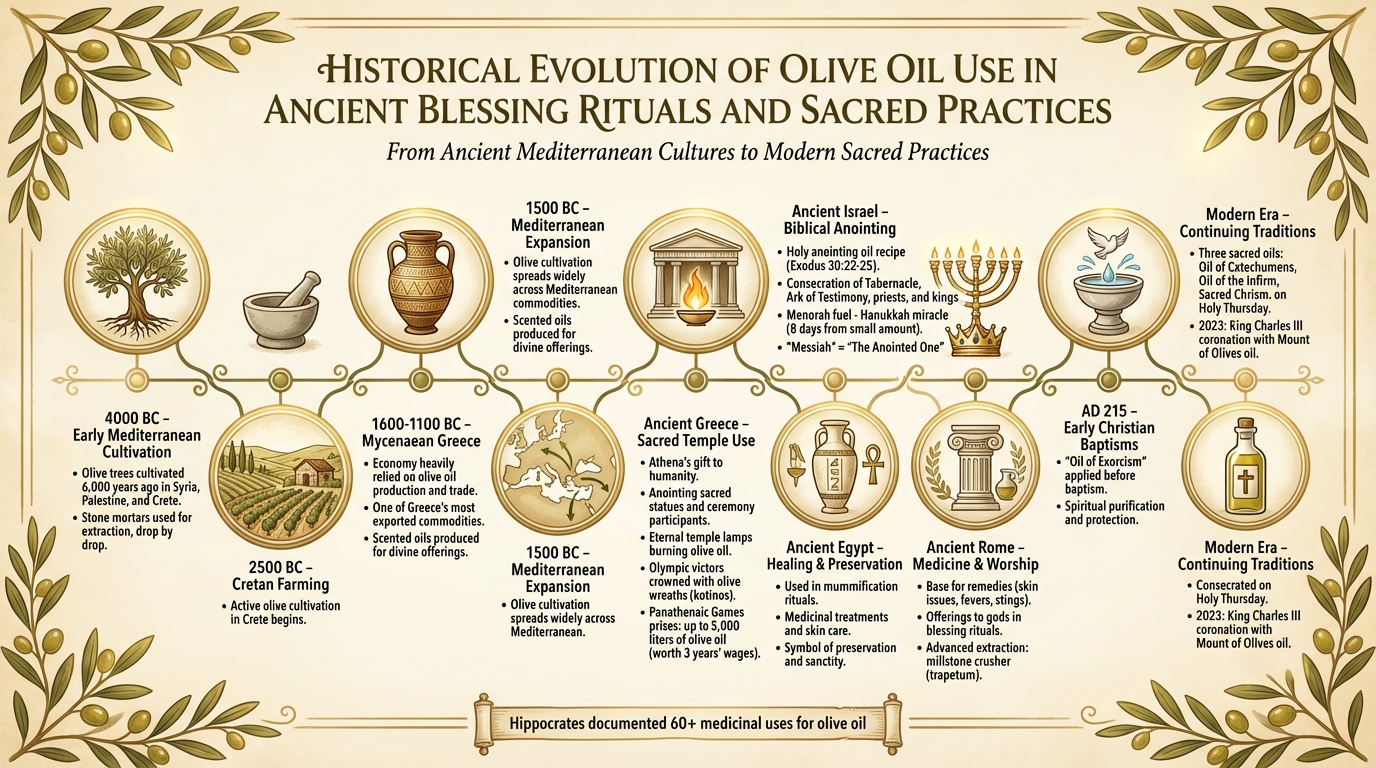
6,000 Years of Olive Oil in Ancient Blessing Rituals and Sacred Traditions
Olive Oil in Ancient Mediterranean Cultures
How Olive Trees Were Cultivated
The cultivation of olive trees in the Mediterranean dates back about 6,000 years, with early efforts taking root in regions like Syria, Palestine, and Crete. By 2500 BC, farmers in Crete were actively growing olives, and by 1500 BC, olive cultivation had spread widely across the area.
In the beginning, extraction techniques were rudimentary. Farmers used stone mortars to press fallen olives, painstakingly collecting oil drop by drop. During the Exodus from Egypt in the 13th century BC, olives were hand-squeezed, and the oil was stored in sacred jars.
The Greeks later revolutionized the process with screw presses, which made oil extraction more efficient. The Romans took it a step further, introducing the millstone crusher (trapetum) and refining separation systems with advanced presses. Despite these innovations, olive farming came with its challenges, as trees typically produced fruit only every other year. However, the Greeks discovered that unripe, green olives - though yielding less oil - produced a higher-quality product.
These advancements not only boosted the economy but also underscored the cultural and spiritual importance of olive oil in ancient Mediterranean societies.
What Olive Oil Represented in Daily and Spiritual Life
Olive oil was a cornerstone of life in the Mediterranean. In Mycenaean Greece, the economy heavily relied on the production, storage, and trade of olive oil. Between 1600 and 1100 BC, it was among Greece’s most exported commodities.
The value of olive oil extended beyond trade. Victors of the Panathenaic Games were awarded significant quantities of it - sometimes as much as 1,000 gallons. To put that into perspective, this prize was worth about three years’ wages for a day laborer. In Athens, the importance of olive trees was so great that cutting down a state-owned tree could result in a trial and even a death sentence.
Pliny the Elder highlighted its significance, writing:
There are two liquids that are especially agreeable to the human body: wine inside and oil outside […] but oil is an absolute necessity.
Hippocrates, often regarded as the father of modern medicine, identified over 60 medicinal uses for olive oil. Similarly, the Greek medical writer Celsus suggested:
If an exhausted person is bordering on a fever, they should immerse themselves […] in warm water to which a little oil has been added and then gently rub the whole body […] with oil.
Olive oil’s role extended far beyond practical uses - it was deeply woven into rituals and spiritual practices. Its purity and healing properties made it a natural choice for blessings and sacred ceremonies, reflecting its dual importance in both daily life and religious traditions.
Ancient Greek Blessing Rituals with Olive Oil
Olive Oil in Greek Temples
In ancient Greece, olive oil was more than a staple - it was sacred. Mythology credits Athena with gifting the olive tree to humanity, symbolizing peace and prosperity. This divine connection made olive oil essential in temple rituals, where it was used to anoint statues, participants in ceremonies, and to sustain eternal flames within the temples.
"Olive oil specifically played a fundamental part in Ancient Greek rituals. It was used to anoint sacred statues, and those taking part in religious ceremonies. Furthermore, olive oil lamps were lit as offerings to their gods, as its purity was seen as vital for connecting with divine beings." - Avlaki
Temples kept eternal lamps burning with olive oil as a continuous tribute to the gods. Records from Mycenaean palace tablets in Pylos even mention the production of specially scented oils crafted for divine offerings. The city of Athens, deeply tied to the olive tree, celebrated this connection in its imagery - Athena often appeared on silver tetradrachm coins alongside olive branches. This sacred use of olive oil in temples naturally extended to public ceremonies, where it played a key role in honoring the gods.
Olive Wreaths and Anointing Practices
Beyond temples, olive oil held a prominent place in public and athletic ceremonies, symbolizing purity, health, and divine favor. Greek athletes were anointed with olive oil before competitions - not just for its physical benefits but as a way to align themselves with the gods. Homer’s Odyssey even describes Odysseus being anointed with olive oil, a gesture that represented purification and dignity.
This sacred substance also played a role in bestowing honor and glory. Victors of the Olympic Games were crowned with olive wreaths (kotinos) made from the branches of Zeus's sacred wild olive tree at Olympia. Winners of the Panathenaic Games received amphoras filled with olive oil - sometimes more than 5,000 liters. These prizes were more than rewards; they were symbols of divine blessing and eternal renown.
Jewish and Biblical Anointing with Olive Oil
Olive Oil in the Tabernacle and Temple
In ancient Jewish traditions, olive oil played a central role in sacred rituals, symbolizing consecration and holiness. The Old Testament makes a clear distinction between suk (the private use of oils) and mashaḥ (its use in religious ceremonies), emphasizing the deep spiritual significance of anointing in religious contexts.
The holy anointing oil, with its recipe detailed in Exodus 30:22–25, was used to sanctify the Tabernacle, the Ark of the Testimony, and other sacred items. Every vessel in the Tabernacle was consecrated with this oil. Initially, it was used to anoint high priests, and later, it became part of the coronation rituals for kings. High priests were marked with this oil in a manner resembling the Greek letter Chi.
Olive oil also fueled the menorahs in the Temple, most famously during Hanukkah, when a small amount miraculously burned for eight days. This act went beyond providing light - it was a powerful reminder of God's enduring presence among His people.
These practices not only established olive oil's ritual importance but also wove it into the fabric of biblical narratives, highlighting its symbolic power.
Biblical References to Olive Oil
Beyond its ritual use, olive oil frequently appears in biblical texts as a symbol of divine favor and sacredness. The term "Messiah" (or "Christ") literally translates to "the Anointed One", directly linking the act of anointing to God's chosen leaders. Biblical accounts tell of kings like Saul, David, and Solomon being anointed with oil, with the phrase "the Lord's anointed" becoming synonymous with kingship.
"We find through all the prophetic writings that olive trees and olive oil are emblems of sacredness and purity." - Joseph Fielding Smith, Jr.
The oil's purity and ability to burn for extended periods made it ideal for both anointing and other sacred purposes. It also played a role in purification rituals, such as those for individuals recovering from leprosy, symbolizing restoration and new life. The strict guidelines for preparing the holy anointing oil further underscored its sacred nature.
Olive Oil in Christian Sacraments and Blessings
Olive Oil in Early Christian Baptisms
In the early days of Christianity, olive oil played a vital role in baptismal ceremonies, drawing inspiration from Jewish anointing customs. It symbolized spiritual purification and dedication, marking a person’s transition into the Christian faith.
St. Hippolytus’s Apostolic Tradition (circa AD 215) provides a fascinating glimpse into these practices. It describes the use of the "Oil of Exorcism", applied to baptismal candidates' chests before the sacrament. This act was seen as a way to invoke divine strength and protection against evil.
Sacred Oils in Modern Christian Practices
Over time, the use of olive oil expanded to encompass various Christian sacraments. Today, many Christian denominations use three distinct holy oils: the Oil of Catechumens, the Oil of the Infirm, and Sacred Chrism. These oils are consecrated by bishops during the Chrism Mass on Holy Thursday, a tradition rooted in the early apostolic era.
Each oil has a unique purpose. The Oil of Catechumens is used to prepare individuals for baptism, the Oil of the Infirm is applied during the sacrament of the sick to provide comfort and healing, and Sacred Chrism is used during confirmations to seal the faithful with the Holy Spirit.
Despite the passage of centuries, the symbolism tied to olive oil remains deeply connected to its ancient origins. Just as it was once used for healing, empowerment, and consecration in biblical times, olive oil continues to serve these roles in contemporary Christian worship. Whether it is a bishop anointing someone during confirmation or a priest administering the sacrament of the sick, these rituals carry forward a tradition that stretches back over two thousand years, embodying purity, divine grace, and spiritual renewal.
sbb-itb-4066b8e
Healing and Purity Across Ancient Cultures
Egyptian Healing Rituals with Olive Oil
In ancient Egypt, olive oil was deeply valued for its purity and preservative qualities. It played a key role in sacred practices, including mummification and other spiritual rituals, symbolizing both preservation and sanctity.
But its use wasn't limited to rituals surrounding death. Egyptians also embraced olive oil for its medicinal benefits and as a cosmetic essential. They used it to treat a variety of ailments and to protect and nourish their skin against the harsh desert environment. This blend of practical health uses and spiritual importance made olive oil a cornerstone of Egyptian life.
The Romans, too, recognized olive oil’s healing and purifying qualities, weaving it into their own traditions.
Roman Blessings and Medicinal Uses
For the Romans, olive oil was an integral part of both religious ceremonies and daily health practices. It served as a base for remedies addressing skin issues, nettle stings, and fevers, while also being a staple in their cleansing routines.
In religious contexts, olive oil was offered to the gods during blessing rituals, highlighting its dual role as a sacred and practical element of Roman culture. These ancient traditions reflect olive oil's lasting reputation as a symbol of health, purity, and devotion across civilizations.
Modern Connections to Ancient Rituals: Big Horn Olive Oil
Big Horn Olive Oil's Commitment to Quality
Big Horn Olive Oil takes inspiration from ancient principles of purity, crafting Ultra Premium Extra Virgin Olive Oils with an unwavering focus on freshness and quality. Their oils are cold-pressed within just 2 hours of harvest, a process that locks in flavor and nutrients. By sourcing only the finest olives and delivering their products within 3 months of harvest, they ensure high levels of antioxidants - something modern science continues to validate. Even Hippocrates, often called the father of medicine, praised olive oil for its wide-ranging medicinal benefits, from treating skin issues to healing wounds. This dedication bridges ancient healing traditions with contemporary wellness practices.
Using Olive Oil in Modern Cooking and Personal Rituals
Olive oil has always been more than just a cooking ingredient. Big Horn Olive Oil invites you to incorporate it into your daily routines, much like its historical use in rituals of healing and blessing.
- Wellness: Kickstart your day with a spoonful of olive oil to support digestion, promote gut health, and help reduce inflammation.
- Beauty and Skincare: Tap into ancient Mediterranean beauty secrets by using olive oil as a natural cleanser or moisturizer. Apply it to your hair for a deep conditioning treatment that adds shine and softness.
- Spiritual Practices: Use olive oil for personal anointing rituals as a symbol of blessing and purity, echoing its ceremonial role in ancient times. You can also use it in decorative oil lamps to create a serene, reflective atmosphere.
- Culinary Use: Drizzle it over fresh vegetables or incorporate it into Mediterranean-inspired dishes to celebrate the timeless relationship between high-quality olive oil and good health.
Big Horn Olive Oil seamlessly connects the ancient and the modern, inviting you to explore its versatility in both practical and meaningful ways.
The Residue of Eden: Myth and Medicine in Early Christian Anointing Practices
Conclusion
For thousands of years, olive oil has been a symbol of purity, healing, and divine blessing. From the ancient Hittites and Egyptians to the Greeks, Romans, and Israelites, this remarkable liquid played a vital role in anointing kings, sanctifying priests, lighting sacred spaces, and healing the sick. Beyond its spiritual significance, olive oil has nourished bodies, treated wounds, and even powered Mediterranean economies.
"Olive oil has a wide range of meaning. It is nourishment, it is medicine, it gives beauty, it prepares us for battle and it gives strength. Kings and priests are anointed with oil, which is thus a sign of dignity and responsibility, and likewise of the strength that comes from God." - Pope Benedict XVI, Homily on April 1, 2010
This timeless legacy continues to resonate in modern times. In 2023, for example, olive oil was used during the coronation of King Charles III. The oil, sourced from groves on the Mount of Olives, was blessed by archbishops in Jerusalem, honoring a tradition that stretches back centuries. Similarly, modern Christian sacraments, such as baptisms and healing rites, still incorporate consecrated olive oil, carrying forward practices rooted in the earliest days of the faith.
Reflecting this enduring reverence, Big Horn Olive Oil honors ancient traditions by cold-pressing their oils within two hours of harvest and delivering them within three months. This method preserves the high levels of antioxidants and healing compounds that Hippocrates once celebrated in his 60 documented medicinal uses for olive oil. Their approach echoes the deep respect ancient cultures held for the purity and power of olive oil.
Whether used in sacred rituals, wellness routines, or simply drizzled over a meal, olive oil remains a powerful connection to the past. It serves as a bridge between ancient wisdom and modern life, seamlessly linking the sacred with the everyday.
FAQs
What was the significance of olive oil in ancient Greek blessing rituals?
In ancient Greek rituals, olive oil held a special place as a symbol of purity, healing, and divine favor. It wasn’t just a practical substance; it was sacred. Priests, kings, and even sacred objects were anointed with olive oil, marking them as holy and establishing a connection to the divine. It also served as a fragrant offering to the gods and was used to cleanse altars, statues, and ceremonial vessels, reinforcing its spiritual importance.
Olive oil also accompanied life's most significant moments. Newborns and mothers were anointed with it for protection, while the deceased were prepared with olive oil before burial - a final act of care and respect. It even fueled lamps in sacred spaces, illuminating rituals and symbolizing its role in both the physical and spiritual realms.
This reverence for olive oil endures today. Products like Big Horn Olive Oil’s Ultra Premium Extra Virgin Olive Oils carry on this tradition, offering pure, fresh oils that can easily become part of modern wellness practices or personal rituals. In doing so, they connect us to the timeless appreciation for this extraordinary substance.
What does olive oil represent in ancient Jewish and Christian rituals?
In ancient Jewish traditions, olive oil held a sacred place, used to anoint priests, kings, and holy objects. It represented holiness, divine favor, and healing, serving as a key element in consecration ceremonies.
In Christian practices, olive oil continues to carry spiritual significance. It is often used in blessings and sacraments, symbolizing the Holy Spirit, spiritual renewal, and physical healing. This practice underscores a profound connection to purity, faith, and the sacred traditions that have been cherished and preserved through generations.
What is the connection between olive oil's ancient use in blessings and its modern applications?
Olive oil has always been more than just a cooking ingredient - it’s steeped in history and symbolism. In ancient times, it represented purity, healing, and sanctity. It played a central role in rituals, where it was used to anoint newborns, priests, and sacred objects, symbolizing divine approval and protection. Kings and prophets were also anointed with olive oil as a mark of spiritual authority and their connection to the divine. Even today, many religious ceremonies incorporate olive oil in blessings, baptisms, and healing practices, continuing its legacy as a sacred element.
Beyond its spiritual significance, olive oil is celebrated in modern times for its health benefits and versatility. It’s a kitchen essential, prized for its rich flavor and nutritional profile. But its value doesn’t stop there - it’s also a key component in wellness routines, such as massages that promote relaxation and renewal. Producers like Big Horn Olive Oil honor this ancient tradition by crafting ultra-premium extra-virgin olive oils, blending historical significance with exceptional quality.