

Olive Oil in Ancient vs. Modern Mediterranean Dishes
Olive oil has been a cornerstone of Mediterranean life for thousands of years, evolving from a sacred substance to a kitchen staple. Ancient civilizations used it for lighting, religious rituals, and preserving food, while modern kitchens rely on it for cooking, flavor, and health benefits. Today’s production techniques, like cold-pressing, ensure higher quality and lower acidity compared to the labor-intensive methods of the past.
Key takeaways:
- Ancient Uses: Lighting, ceremonies, medicine, food preservation, and cooking.
- Modern Uses: Cooking, salads, desserts, and heart health (e.g., reducing cardiovascular risks by 50% with 1.5 tsp daily).
- Production Evolution: From stone crushing and beam presses to modern centrifugation, improving efficiency and quality.
- Cultural Significance: Olive oil connects ancient traditions to contemporary Mediterranean cuisine, from bread dipping to mezze dishes like hummus.
This rich history and transformation highlight olive oil’s enduring role in Mediterranean life and its growing global appeal.
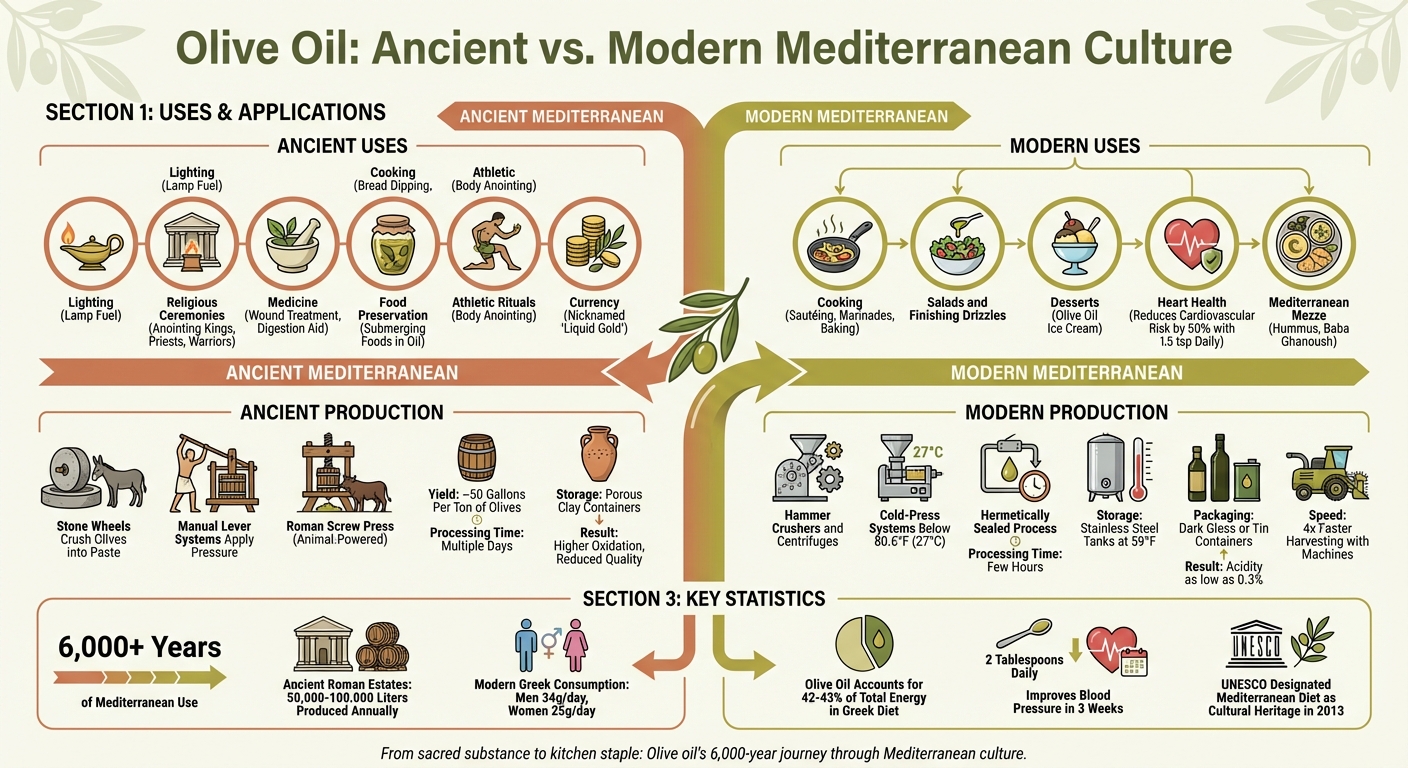
Ancient vs Modern Olive Oil Production and Uses Comparison
Olive Oil in Ancient Mediterranean Cooking
How Ancient Cooks Used Olive Oil
In ancient times, olive oil wasn’t just a cooking staple - it was a cornerstone of daily life. Cooks used it in countless ways: dipping bread, enriching stews, and sautéing vegetables or fish. Its ability to preserve food by submerging items in oil made it invaluable, especially in an era without refrigeration. Foods stored this way could last for months, which was a game-changer for ancient households.
Even Roman soldiers carried olive oil as part of their rations, highlighting its importance in their diet. Everyday cooking relied on common olive oils made from ripe or overripe olives, while a finer, early-harvest oil was reserved for more selective uses. This fresh harvest extra virgin olive oil, pressed from green olives, had a lower acidity, a clearer appearance, and a distinct peppery-sweet flavor. It was often reserved for the wealthy or used in medicinal and cosmetic practices, setting it apart from the darker, stronger oils consumed by the general population.
Economically, olive oil was a powerhouse. Roman writer Cato noted that a single large estate could produce anywhere from 50,000 to 100,000 liters (13,200–26,400 gallons) of oil annually. In ancient Greece, it even served as a form of currency, earning its nickname "liquid gold". Its essential role in cooking was just the beginning - it also became a key player in the sacred and economic life of the Mediterranean.
Religious and Ceremonial Uses
Olive oil’s significance extended far beyond the kitchen. It held a sacred place in religious and ceremonial practices. According to Greek mythology, the goddess Athena gifted the olive tree to Athens, making olive oil more than just a product - it was seen as divine. Temples used it to fuel eternal flames, and it was central in anointing rituals for kings, priests, and warriors.
The word "Messiah" translates to "the anointed one," a concept deeply tied to these ancient practices. Olive oil also played a symbolic and practical role for athletes in Greece and Rome. Before competitions, athletes would rub their bodies with oil, signifying strength, purity, and discipline. Victors in Athens’ Panathenaic Games were awarded amphorae filled with oil from sacred groves, known as moriae.
Medicinally, olive oil was equally prized. Hippocrates, often called the "Father of Medicine", referred to it as "the great healer", acknowledging its use in treating wounds, soothing skin, and aiding digestion.
| Use Category | Ancient Application | Cultural Significance |
|---|---|---|
| Culinary | Bread dipping, stews, food preservation | Symbol of wealth and status |
| Religious | Anointing royalty, sacred offerings | Symbol of divine favor |
| Athletic | Anointing athletes and gladiators | Symbol of strength and purity |
| Medicinal | Treating wounds, aiding digestion | Known as a healing ointment |
| Practical | Lamp fuel, tool lubricant | Essential for daily life |
Olive oil’s versatility and cultural importance made it one of the most prized commodities in the ancient Mediterranean world, influencing everything from daily meals to sacred traditions.
sbb-itb-4066b8e
Olive Oil in Modern Mediterranean Cooking
Daily Cooking Applications
Olive oil has become an essential part of Mediterranean kitchens, finding its way into a wide range of dishes. It's drizzled over crisp salads, whisked into flavorful marinades, and used for sautéing vegetables. Surprisingly, it even plays a role in desserts, like olive oil-based ice cream, which adds a unique twist to sweet treats.
A classic technique called Tsigarisma - sautéing onions and garlic in hot olive oil - not only enhances flavors but also improves the absorption of nutrients like polyphenols and carotenoids from vegetables. Beyond just taste, these methods maximize olive oil's health benefits. Extra virgin olive oil, prized for its rich aroma, is often used as a finishing touch on dishes like hummus, roasted vegetables, or freshly baked bread. This step preserves its delicate flavors and aromatic qualities. Even bakers have embraced olive oil, using it as a butter substitute to create moist cakes and pastries with a healthier edge. This shift reflects how olive oil has transitioned from ancient rituals to a cornerstone of modern culinary innovation.
Health Benefits and Flavor Profiles
While ancient civilizations valued olive oil for its healing properties, modern science has confirmed its role in heart health. Studies show that consuming just 1.5 teaspoons of extra virgin olive oil daily can cut the risk of dying from cardiovascular disease by half. In fact, as little as two tablespoons (25 mL) per day can improve blood pressure and cholesterol levels in just three weeks.
"I call the Mediterranean diet a plant-based olive oil diet... We have no food or medicine that can do what olive oil can do."
– Mary Flynn, Nutrition Researcher and Founder of the Olive Oil Health Initiative at Brown University
In Greece, where olive oil dominates dietary fat intake, it accounts for 42–43% of total energy consumption. Men typically consume about 34 grams (1.2 oz) daily, while women average 25 grams (0.9 oz). Beyond its health benefits, olive oil has also become a culinary star for its diverse flavor profiles. Descriptions like grassy, fruity, peppery, or buttery are now used to match specific oils to dishes, from delicate white fish to hearty grilled steak. This growing appreciation highlights how olive oil continues to evolve as both a healthful and flavorful ingredient.
How Olive Oil Production Has Changed
Ancient Pressing Methods
In ancient Mediterranean societies, producing olive oil was a labor-intensive process. Large stone wheels were used to crush olives into a paste, which was then spread onto fiber disks and stacked. Workers applied pressure using simple lever systems to extract the oil.
The Romans introduced the screw press, a game-changer for the time. Often powered by animals like donkeys or mules, it significantly improved efficiency over earlier manual methods. On average, these presses could yield about 50 gallons (200 liters) of oil from one ton of olives. However, these ancient techniques had their drawbacks. Without temperature control and with storage in porous clay containers sealed only with amurca (a bitter byproduct of pressing), the oil often oxidized, leading to reduced flavor and quality. Today's methods have eliminated these issues, focusing on precision and modern technology.
Modern Cold-Pressing and Storage
The production of olive oil has undergone a complete transformation, thanks to advancements in technology. Modern systems prioritize speed, hygiene, and temperature control. Instead of manual labor, facilities now use hammer crushers and centrifuges to separate oil from water and solids. These hermetically sealed cold-press systems maintain temperatures below 80.6°F (27°C), preserving delicate polyphenols that contribute to the oil's flavor and health benefits. Once extracted, the oil is stored in stainless steel tanks at 59°F (15°C) and packaged in dark glass or tin containers to prevent oxidation.
Harvesting has also become faster, with machines operating at roughly four times the speed of traditional hand-picking. Processing times have drastically improved as well. For example, the 19th-century hydraulic press could produce oil in just a few hours, a striking improvement over the days-long process of ancient screw presses. These advancements mean olives are pressed shortly after harvest, reducing fermentation and keeping acidity levels low. High-quality extra virgin olive oil now boasts acidity levels as low as 0.3%, far below the 0.8% threshold for the extra virgin category. Modern techniques ensure that today's olive oil is not only efficient to produce but also ideal for contemporary Mediterranean dishes.
Ancient Recipes in Modern Kitchens
From Ancient Stews to Today's Mezze
Centuries of culinary tradition have left a lasting mark on how olive oil is used in modern cooking. In the Levant, ancient cooks relied on olive oil to preserve vegetables and cheeses. They also used it in hearty stews like the Roman puls, where olive oil softened grains and legumes while adding much-needed calories.
Fast forward to today, and these ancient techniques are finding new life in contemporary dishes. Mezze staples such as hummus, baba ghanoush, and labneh are often finished with a drizzle of high-quality extra virgin olive oil. This simple addition enhances their flavors and ties them to their historical roots. Even the timeless gesture of serving bread with olive oil as a sign of hospitality remains a cherished tradition.
"Using the highest quality olive oil – and being generous with it – is one way of showing hospitality to guests."
- Amina Al-Saigh, Author of Souk to Table
Modern chefs are also drawing inspiration from ancient methods, such as pouring hot olive oil infused with garlic and herbs over dishes like lentil soup or bulgur pilaf. This technique, reminiscent of ancient slow-cooking practices, not only adds fresh flavor but also enhances the phenolic content of the vegetables it touches.
Regional Differences Over Time
The Mediterranean's diverse regions have each shaped olive oil's role in their culinary traditions, creating distinct flavors and techniques. In the Levant, olive oil is central to dishes like tabbouleh, where it complements citrus, herbs, and yogurt. In North Africa, it serves as the foundation for slow-cooked tagines, blending seamlessly with spices like cumin and coriander. Meanwhile, Greek cuisine celebrates simplicity, using olive oil to drizzle over feta cheese or as the key ingredient in ladolemono, a lemon-honey-oil dressing often paired with warm bean stews.
In April 2025, Chef Eliana of Athens made waves by reviving recipes from 5th-century BC Greece. Using ancient grains like spelt, barley, and einkorn, she combines historical simplicity with modern techniques to bring out bold, vibrant flavors. This "culinary time travel" movement showcases how ancient recipes can be reimagined with modern cold-pressed olive oils, which preserve delicate flavor profiles. This commitment to authentic flavor ensures that traditional methods remain relevant in today's kitchens. Similarly, chefs adapting ancient Roman recipes have swapped garum (a fermented fish sauce) for Vietnamese fish sauce, achieving the same savory depth with a more balanced flavor.
"The beauty of ancient recipes lies in their simplicity, but with modern techniques, we're able to enhance the flavors and make them more vibrant."
- Chef Eliana, Athens-based Restaurateur
This harmonious blend of tradition and innovation reflects the evolution of olive oil's role in Mediterranean cuisine over time.
The World of Olive Oil | Full Episode
Conclusion
For over 6,000 years, olive oil has been central to Mediterranean life. Once hailed as "liquid gold" in ancient Greece - used in religious rituals, athletic ceremonies, and even as lamp fuel - it has transformed into a global kitchen staple while preserving its deep-rooted significance.
Advancements in production have revolutionized how olive oil is made. Traditional stone mills and manual presses have given way to modern cold-pressing systems that operate at temperatures between 77°F and 81°F. These methods help retain antioxidants and ensure free acidity levels stay below 0.8%. Meanwhile, contemporary research validates what ancient healers seemed to understand: the polyphenols and monounsaturated fats in olive oil promote heart health and reduce inflammation.
Despite these innovations, olive oil remains a symbol of Mediterranean heritage.
"Olive oil is more than a cooking fat - it's a central part of daily life and culture." - Mecene Research Team
In Mediterranean communities, olive trees are often passed down through generations, symbolizing a lasting connection to the past. The oil that once anointed ancient athletes now enhances modern dishes like hummus, creating a link between today’s meals and culinary traditions dating back to 4000 B.C. In recognition of its cultural and nutritional importance, UNESCO designated the Mediterranean Diet - anchored by olive oil - as an "intangible cultural heritage" in 2013.
From ancient stews to contemporary mezze, olive oil effortlessly bridges the past and present. Its evolution from a sacred ceremonial substance to an everyday essential highlights its timeless quality. While adapting to new culinary trends, it continues to honor the traditions that have nurtured Mediterranean communities for thousands of years.
At Big Horn Olive Oil (https://bhooc.com), we embrace this legacy by offering ultra premium extra virgin olive oils that embody the Mediterranean spirit - bringing together history, health, and flavor in every drop.
FAQs
What’s the biggest difference between ancient and modern olive oil?
The most striking difference lies in the peppery flavor associated with modern extra virgin olive oil, which became prominent during the Industrial Revolution. In ancient times, olive oil was prized more for its medicinal, ceremonial, and symbolic purposes than for its flavor.
Is extra virgin olive oil best for cooking or finishing?
Extra virgin olive oil (EVOO) is a fantastic choice for adding a finishing touch to dishes. Its rich flavor and aroma can elevate salads, roasted vegetables, or even grilled meats when drizzled on top. While it's commonly used raw, EVOO also works well for cooking methods like sautéing or frying - just be mindful of its smoke point, which ranges between 375°F and 410°F. Keeping the temperature below this threshold helps retain its antioxidants and full flavor. This versatility is one reason why EVOO remains a cornerstone of Mediterranean cuisine.
How can I tell if an olive oil is truly high quality?
To spot top-notch olive oil, check for the term extra virgin on the label. This signifies the oil has undergone minimal processing, preserving its rich flavor and quality. High-quality olive oil should taste fresh and fruity, often with a slight peppery kick - never dull or rancid. While the color and clarity might differ, the real indicators are its taste and aroma. Opt for brands that emphasize freshness and follow proper production practices to guarantee you're getting the real deal.