

Why Aroma Matters in Olive Oil Quality
Your nose can tell you if olive oil is still worth using. In one UC Davis study, 69% of imported bottles sold as extra virgin failed sensory standards, along with 10% of California samples. A lot of those failures came down to smell.
Here’s the short version: when I smell olive oil, I’m checking for clean green fruit notes, any clear defect, and how storage may have changed the oil. If I get stale nuts, damp basement, sour vinegar, or fermented sludge-like notes, that bottle has a problem.
What matters most:
- Extra virgin means no sensory defects
- Good oil smells green, fruity, and clean
- Bad oil often smells rancid, musty, fusty, or winey
- Heat, light, air, and time wear down aroma fast
- A 30-second smell test at home can catch a lot
If I want a simple rule, it’s this: clean smell in, off smell out. That’s the main idea behind olive oil aroma and quality.
Real Extra Virgin Olive Oil: Best Way to Know it's REAL
sbb-itb-4066b8e
The Problem: Missing Quality Clues in Olive Oil Aroma
Many home cooks lean on labels like "extra virgin" or "cold-pressed." But by the time the bottle lands in the kitchen, the smell can tell a very different story.
That’s because labels usually reflect how the oil was graded at the start. They don’t tell you what happened during shipping, warehouse storage, or months on a store shelf. Aroma is the fastest check for whether the oil still lives up to that label.
Why Judging Smell Is Harder Than It Seems
Plenty of mass-market oils come from late-harvest fruit or older lots. As a result, they often have weaker fruitiness and fewer crisp green notes. When those good aromas fade, defects like rancidity or mustiness don’t jump out as clearly. They sort of hide in the background.
There’s another problem: your nose gets used to smells fast. If you sniff several oils in a row, your judgment can get less sharp. That’s one reason professional tasting panels limit how many samples they judge at once and take breaks between them. Most home cooks don’t have that setup.
And then there’s the learning curve. Most people were never taught what fresh olive oil is supposed to smell like in the first place. If you don’t know the target, it’s easy to miss when something is off. The next step is knowing which off-aromas matter most.
Common Off-Aromas People Overlook
The International Olive Council (IOC) recognizes sensory defects that can keep an oil from extra virgin status. Four show up often enough that home cooks miss them all the time:
- Rancid smells like old nuts, stale crackers, or crayon wax. It develops when oil oxidizes from heat, light, or air.
- Musty–humid–earthy smells like a damp basement or moldy bread. It points to mold growth from humid olive storage before milling.
- Fusty–muddy sediment smells fermented, like brine or dirty sediment. It comes from olives piled without airflow before pressing or from tank sediment.
- Winey–vinegary smells sour, like wine vinegar. It comes from aerobic fermentation in damaged olives.
Each of these is a recognized sensory defect. Even a mild but clear version of one can keep an oil from being classified as extra virgin under official standards.
High-Quality vs. Low-Quality Olive Oil Aroma: A Side-by-Side Look
Here’s the fastest way to tell a good smell from a bad one:
| Aroma Descriptor | Underlying Cause | What It Means for Quality |
|---|---|---|
| Fresh-cut grass, green tomato, artichoke | Early-harvest olives, quick processing | Strong indicator of high-quality extra virgin oil |
| Green almond, fresh herbs, ripe stone fruit | Cultivar-specific compounds preserved through proper storage | Positive attribute; reflects fruitiness and freshness |
| Rancid (old nuts, crayon, stale crackers) | Oxidation | Sensory defect; can keep oil from extra virgin classification |
| Musty–humid–earthy (damp basement, moldy bread) | Mold during storage | Sensory defect; indicates poor pre-mill handling |
| Fusty–muddy sediment (fermented, dirty brine) | Anaerobic fermentation | Sensory defect; signals delayed processing or poor storage |
| Winey–vinegary (sour, wine vinegar) | Aerobic fermentation | Sensory defect; indicates microbial activity in the fruit |
The gap can be subtle. In many cases, it comes down to a lively, grassy aroma versus a flat smell with a faint off-note. That’s why the next section turns to what good olive oil should smell like.
What Good Olive Oil Should Smell Like
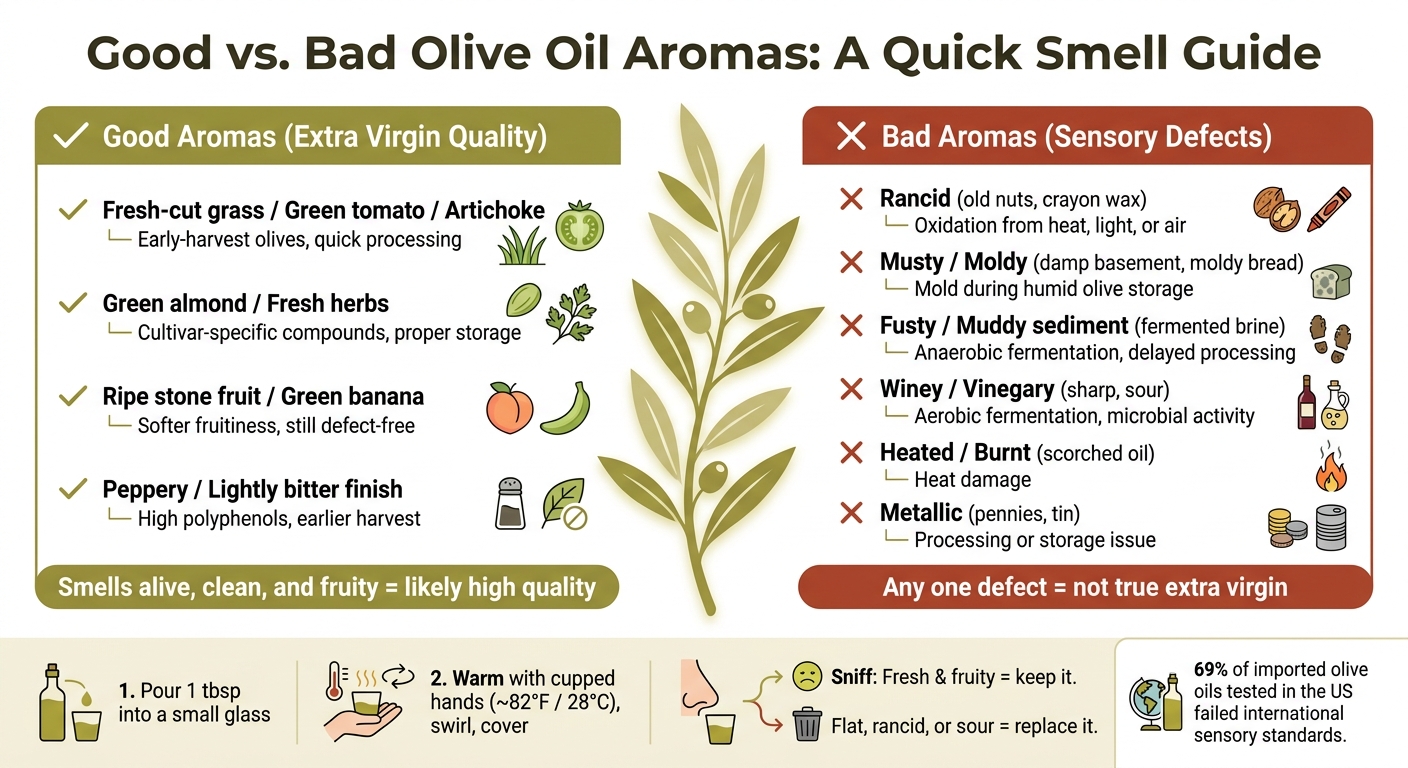
Good vs. Bad Olive Oil Aromas: A Quick Smell Guide
Once you know the defects, the next part gets easier: fresh olive oil should smell fresh.
Positive Aromas That Point to Quality
Good olive oil should smell clean, fresh, and fruity. It should feel alive, not dull or stale. If it smells flat, greasy, or tired, that’s a bad sign.
Common good notes include green grass, herbs, tomato leaf, and artichoke. Some oils lean grassy and herbal. Others come across as softer, with ripe fruit or green banana notes. Cultivar and harvest timing can shift the profile, but the core idea stays the same: good oil smells fresh and clean. Different cultivars can smell quite different, but good ones share a defect-free profile.
How Bitterness and Pungency Fit Into the Aroma Picture
Bitterness and pungency help confirm quality when they show up alongside fresh fruitiness. A peppery finish or light bitterness isn’t a flaw. It’s often a good sign, since both can come from higher polyphenol content and earlier-harvest olives.
Sensory panels score fruitiness, bitterness, and pungency as the three positive attributes of extra virgin olive oil. When those three line up well and the aroma stays clean, you’re probably holding a good bottle. Use those clues, then compare them with the defects below.
Off-Aroma Reference Guide
These are the smells that break the quality profile.
| Defect | What It Smells Like | What It Means |
|---|---|---|
| Rancid | Old nuts, crayon wax | Oxidized oil |
| Musty / Moldy | Damp cardboard, basement, moldy bread | Poor fruit handling |
| Fusty / Muddy sediment | Sweaty, fermenting fruit | Delayed or improper processing |
| Winey / Vinegary | Sharp, sour, wine vinegar, alcoholic | Microbial activity in the fruit |
| Heated / Burnt | Cooked oil, scorched | Heat damage |
| Metallic | Pennies, tin, sharp mineral bite | Processing or storage issue |
| Plastic-like | Synthetic, chemical | Contamination or packaging defect |
Any one of these, even a faint but clear version, is enough to keep an oil from qualifying as extra virgin. The goal is simple: fresh fruit aromas and zero defects.
Next, you’ll see how to test those smells at home.
How to Assess Olive Oil Aroma at Home
Once you know the main aroma clues, you can judge a bottle in under a minute. You don't need special gear. A small glass and your hands will do the job.
A Step-by-Step Smelling Method for Home Use
Pour about 1 tablespoon (15 ml) into a small glass. A stemless wine glass, juice glass, or shot glass all work. If the opening is a bit narrower, that helps hold the aroma in the glass.
Cover the top with one hand and cup the bottom with the other. Warm the oil to about 82°F (28°C), which is the standard sensory-testing temperature.
Swirl the glass slowly while keeping it covered. That spreads the oil around the inside of the glass and helps the aroma open up.
Then uncover it and smell right away. Take two or three short sniffs, wait 20 to 30 seconds, and sniff again if you need to. Try to keep each sample to about 30 seconds.
Do this in a neutral-smelling space, away from cooking fumes, candles, or perfume.
If the smell feels weak, the next thing to think about is freshness or storage.
What to Look for on the First Smell
The first 5–10 seconds tell you a lot. Start with one simple question: does this smell fresh or flat?
Fresh extra virgin olive oil usually smells green and fruity. Those notes should feel lively. If the first impression seems dull or muddy, that's a sign to pay attention to.
Next, check the fruitiness intensity. Does the aroma jump out of the glass, feel moderate, or barely show up? Strong fruitiness is a good sign. After that, scan for any defect you already know to watch for. Even a light but clear version of one is worth noting.
A Simple Aroma Scoring Sheet
Use this quick check to compare a lively oil with one that smells flat or off.
| Attribute | Intensity Rating (0–5) | Interpretation |
|---|---|---|
| Fruitiness | 5 – Very vivid, green/fruity | Excellent for finishing: salads, dipping, drizzling |
| Fruitiness | 3–4 – Moderate to strong, pleasant | Good for finishing and everyday use |
| Fruitiness | 0–2 – Faint or absent | Better for cooked dishes than raw finishing |
| Defects | 0 – None detected | No concerns |
| Defects | 1–2 – Slight flatness or faint off-note | Acceptable for sautéing or roasting |
| Defects | 3–5 – Clear rancid, musty, or winey smell | Replace the bottle. |
Use oils with Fruitiness 3+ and Defects 0 for raw finishing. If a bottle scores Defects 3+, replace it.
If the aroma seems muted or off, freshness and storage are the most likely reasons.
How Freshness and Storage Affect Aroma Quality
What Weakens Aroma Before the Oil Reaches You
Aroma quality is often decided before the bottle ever gets to your kitchen. The biggest problems usually start when milling is delayed or the olives are damaged.
If olives sit too long before crushing, enzymes and microbes start breaking down the fruit. That dulls those fresh fruit notes fast. Bruised or mechanically damaged olives make things worse by speeding oxidation, and the volatile compounds behind fresh, grassy, and floral aromas fade quickly. High milling temperatures can also drive off delicate aromas during extraction.
Production sets the starting point. Storage decides how much of that aroma is still there when you use it.
How to Store Olive Oil to Protect Its Aroma
Once you open the bottle, storage becomes the main thing working against aroma. The big threats are simple:
- Heat
- Light
- Oxygen
- Time
Temperatures above 70°F (21°C) can cut shelf life fast, and some research suggests that every 10°C increase can double rancidity rates. If the bottle lives next to a stove, the oil can go rancid in as little as 2–3 weeks.
A better move is to keep olive oil in a cool, dark pantry or cabinet, ideally around 55–70°F (13–21°C). Keep it away from the oven, stovetop, and windows. Use dark glass or an opaque container, and recap it tightly after every pour so less oxygen gets in.
When stored this way, fresh aroma can last about 3–6 months after opening. Under poor conditions, that window can shrink to just a few weeks.
Fresh, green aroma usually points to sound olives and careful handling. Stale or sour notes usually point the other way.
Conclusion: The Aroma Signals Worth Remembering
The aroma in your bottle is a direct record of how the oil was made and stored. Fresh, fruity, and green notes usually mean healthy olives, fast milling, and careful storage. Rancid, musty, fusty, or winey notes mean something went wrong along the way.
Producers that focus on rapid cold pressing and dark, protective packaging give the oil a better shot at arriving with its positive aromas still in place. After that, your storage habits make the difference. A quick smell check every few weeks is enough to tell you if the bottle in your cabinet is still one you want to use.
Fresh aroma signals quality. Heat, light, oxygen, and time wipe it out.
FAQs
Can good olive oil smell mild?
Yes. Good olive oil can have a mild smell, especially when it’s a delicate oil with soft, low-intensity aromas like faint floral notes or a light nutty scent.
What matters most is that it still smells fresh and pleasant, not musty, waxy, rancid, or crayon-like.
Does cloudy olive oil mean it's bad?
No. Cloudiness in olive oil does not automatically mean it has gone bad.
Olive oil can look different from bottle to bottle. Its color may range from deep green to golden yellow, depending on the olive variety and when the olives were picked.
That’s why appearance on its own isn’t a good way to judge quality. A cloudy oil can still be perfectly fine. What matters more is how it smells and tastes.
If the oil doesn’t have unpleasant odors like musty, waxy, or rancid notes, it’s likely still okay. Smell and taste are the best ways to judge freshness.
Can rancid olive oil make food taste bad?
Yes. Rancid olive oil can make food taste bad because oxidation wipes out the oil’s fresh, fruity smell and flavor.
What’s left behind often tastes stale, waxy, or even a bit like crayons. That can make a dish seem flat, heavy, or greasy. And because rancidity is a major defect, it’s a clear sign the oil is past its prime.