

Study: How Olive Oil Enhances Cheese Flavor
Olive oil and cheese create a dynamic pairing that goes beyond taste. Research shows that when combined, these two ingredients interact chemically and physically to alter flavor, texture, and preservation. Key findings include:
- Phenolic compounds in olive oil bind with cheese proteins, reducing oxidation and enriching flavor.
- Herb-infused olive oils, like rosemary or oregano, can extend cheese shelf life by reducing lipid oxidation by over 75%.
- Olive oil emulsions in cheese production improve moisture retention and enhance aroma through increased fat breakdown.
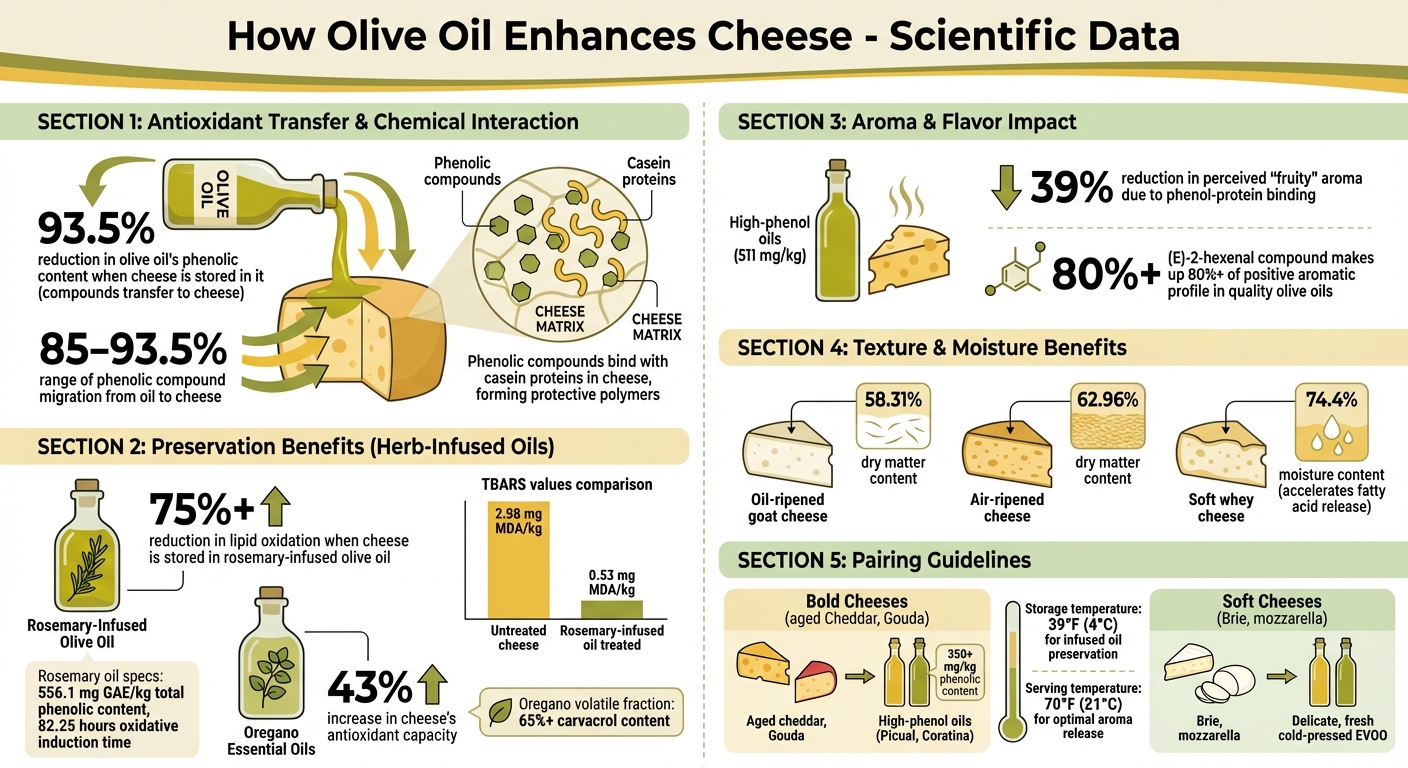
- Cheese stored in olive oil gains antioxidants, while the oil itself loses up to 93.5% of its phenolic content due to binding with cheese proteins.
Pairing tips: Use bold oils like Picual for aged cheeses and delicate oils for soft varieties. Herb-infused oils add extra flavor and preservation benefits. Proper storage at cool temperatures maintains quality.
This combination isn't just delicious - it transforms both ingredients, creating new sensory experiences and practical benefits.
How Olive Oil Transforms Cheese: Key Scientific Findings and Benefits
Research Findings on Olive Oil and Cheese Flavor
Olive Oil-Whey Emulsion in Cheddar Cheese
Research on Cheddar cheese has shown that substituting milk fat with olive oil emulsions can improve water-binding capacity and encourage lipolysis, a process that breaks down fats into free fatty acids, contributing to a richer cheese aroma. These emulsions hold more water than traditional milk fat, increasing moisture levels, which supports this breakdown. However, this substitution also results in lower total solids compared to full-fat Cheddar, which can influence the cheese's overall sensory qualities. These findings open up possibilities for further studies on how olive oil might impact cheese preservation and flavor.
Herb-Infused Olive Oils for Cheese Preservation
In Tunisia, researchers from the Laboratory of Olive Biotechnology examined how herb-infused olive oils could preserve and enhance fresh cheese. They used ultrasound-assisted extraction to infuse extra virgin olive oil with herbs like rosemary, oregano, basil, and thyme. Cheese stored in rosemary-infused oil for 21 days showed a dramatic reduction in TBARS values (a measure of lipid oxidation), dropping to just 0.53 mg MDA/kg compared to 2.98 mg MDA/kg in untreated cheese - a reduction of over 75%. The rosemary-infused oil also boasted a total phenolic content of 556.1 mg GAE/kg and an oxidative induction time of 82.25 hours.
Oregano-infused oils also stood out, with carvacrol making up more than 65% of the volatile fraction in treated cheese. Additionally, incorporating oregano essential oils boosted the cheese's antioxidant capacity by 43%.
"These results highlight the potential of bioactive-enriched olive oils as natural preservatives and functional ingredients, extending cheese shelf life while enhancing its nutritional value." - Hédia Manai-Djebali, Laboratory of Olive Biotechnology
This research emphasizes olive oil's ability to act as both a natural preservative and a flavor enhancer.
Low-Fat Gouda Cheese with Olive Oil Emulsion
A 2015 study explored a Gouda-style cheese made with an olive oil emulsion, finding that it had higher levels of free fatty acids, a sign of increased lipolysis and flavor development. However, when compared to full-fat versions, the latter still scored better in overall sensory evaluations.
The Science Behind Olive Oil and Cheese Pairing
Antioxidant Transfer and Phenolic Compounds
When olive oil meets cheese, phenolic compounds in the oil migrate to the cheese-oil interface. Here, they bind with casein proteins, forming polymers that not only enhance flavor but also create a protective shield against oxidation. This process helps prevent the development of rancid off-flavors during storage. Key players in this interaction are phenolic compounds like oleacein and oleocanthal, which are known for their antioxidant properties.
"Compositional changes in EVOO used as a medium for cheese preservation are under significant influence of the cheese's chemical composition." - Dora Klisović, Institute of Agriculture and Tourism
Interestingly, the strength of this binding depends on the type of cheese. Hard and semi-hard cheeses, which are rich in caseins, exhibit a much stronger affinity for these phenolic compounds compared to soft cheeses, which contain more whey proteins. Beyond preventing oxidation, these interactions also promote lipolysis, a process that enhances the aroma of the cheese.
Lipolysis and Aroma Development
Olive oil doesn’t just preserve cheese - it actively transforms it. Moisture from the cheese triggers hydrolytic degradation in the oil, breaking down triacylglycerols and releasing free fatty acids. These acids contribute to the complex aromas that make each cheese-oil pairing unique.
The moisture content of the cheese plays a big role in this process. For example, soft whey cheese, with a moisture content of about 74.4%, accelerates the release of free fatty acids more than harder cheeses. Over time, these fatty acids and other compounds migrate between the cheese and the olive oil, enriching both with new layers of flavor.
Phenolic compounds also influence how we perceive aroma. They interact with proline-rich proteins in saliva, forming complexes that can trap volatile compounds. Research from the University of Naples Federico II found that olive oils with high biophenol levels (around 511 mg/kg) can reduce the perceived "fruity" aroma by approximately 39%. This occurs due to the in-mouth interaction between phenols, saliva, and aroma compounds.
"The interaction between EVOO phenolics and proline-rich proteins could bind aroma compounds and consequently decrease their level during head-space analysis and during organoleptic assessment of olive oil." - Alessandro Genovese, Department of Agricultural Sciences, University of Naples Federico II
How Emulsions Affect Texture and Taste
When cheese and olive oil meet your palate, saliva creates a water-in-oil emulsion that changes how flavors and textures are experienced. This emulsion is dynamic, influenced by salivary proteins like mucins and albumin, as well as enzymes like lipase. These interactions affect the release of flavors and the overall mouthfeel.
The benefits of using olive oil as a ripening medium go beyond taste. A 2023 study from the University of Zagreb’s Department of Dairy Science found that semi-hard goat cheese ripened in a 50:50 blend of extra-virgin olive oil and refined sunflower oil retained a dry matter content of about 58.31%, compared to 62.96% in air-ripened samples. The oil-ripened cheese scored higher in sensory evaluations for texture and taste, as the oil prevented dehydration, which can make goat cheese less appealing.
"Oil as a ripening medium for cheese prevented water loss from the cheese... having a significantly positive effect on the sensory characteristics, particularly color, texture, and taste." - S. Levak, Department of Dairy Science, University of Zagreb
Ultimately, the viscosity and composition of the saliva-oil-cheese mixture influence how flavor compounds reach your olfactory receptors. This explains why the in-mouth (retronasal) perception of cheese paired with olive oil feels so different from the aroma you detect when simply smelling it. Pairing cheese with high-quality olive oil transforms the sensory experience, making every bite more complex and enjoyable.
sbb-itb-4066b8e
Pairing Cheese with Big Horn Olive Oil
Best Olive Oils for Common Cheeses
When pairing olive oil with cheese, matching their intensities is key. For bold cheeses like aged Cheddar or Gouda, Big Horn Olive Oil's Picual and Coratina varieties - both boasting phenolic content of at least 350 mg/kg - are excellent choices. These high-phenol oils hold their own against the robust flavors of strong cheeses, ensuring a balanced and enjoyable taste experience. Using a mild oil with a strong cheese often results in the oil's flavor being overshadowed, so opting for a bolder oil is crucial.
On the other hand, softer cheeses like Brie shine when paired with a more delicate oil. Big Horn's fresh, cold-pressed extra virgin olive oils (EVOO), known for their natural almond and artichoke notes, beautifully complement the creamy, mild flavors of these cheeses. The trick? Pair mild oils with mild cheeses and bold oils with bold cheeses for the best results.
Looking to take it a step further? Herb-infused oils can elevate these pairings even more.
Using Infused Olive Oils with Cheese
Herb-infused olive oils not only enhance the flavors of cheese but also help preserve it. Big Horn Olive Oil's rosemary-infused variety, for instance, stands out for its remarkable oxidative stability, with an induction time of 82.25 hours in laboratory tests. These infused oils can reduce lipid oxidation by over 75%, making them a practical and flavorful option for cheese storage.
"Cheese is an excellent vehicle for delivering bioactive compounds, as its fat matrix can effectively encapsulate and preserve these compounds during storage."
- Souha Ammar et al., Biotechnology Center of Borj-Cedria
For fresh, high-moisture cheeses like mozzarella or whey cheese, basil and oregano-infused oils are perfect. They add bright, aromatic notes while offering antimicrobial properties. To get the best results, store your cheese in infused oil at 39°F (4°C).
Why Fresh, Cold-Pressed EVOO Matters
Freshness plays a crucial role in olive oil and cheese pairings. Big Horn Olive Oil’s cold-pressed EVOO is pressed within two hours of harvest, preserving the volatile compounds that enhance its flavor. This type of oil is rich in (E)-2-hexenal, a compound responsible for the "green" and "fruity" notes that make up over 80% of the positive aromatic profile of high-quality olive oils.
For the best tasting experience, serve your olive oil at around 70°F (21°C) to fully release its aromatic volatiles. To maintain the quality of your cheese-and-oil pairings, store them in complete darkness at stable temperatures. This helps prevent oxidation and the development of rancid flavors. If you're sampling multiple pairings, cleanse your palate between tastes with slices of tart green apple and water.
Conclusion
Scientific studies reveal that olive oil can significantly alter cheese when the two are combined. When cheese is stored in extra virgin olive oil (EVOO), phenolic compounds from the oil transfer into the cheese, leading to an 85–93.5% reduction in the oil's phenolic content. This process enriches the cheese with antioxidants and creates new flavor profiles through interactions between proteins and phenols.
Fresh EVOO also contributes aromatic compounds - like (E)-2-hexenal - that add "green" and "fruity" notes. These aromas can brighten the richness of heavier cheeses, but only high-quality oils retain their potency. Additionally, rosemary-infused olive oil has been shown to significantly lower TBARS values, offering enhanced oxidative protection compared to untreated oils.
"EVOO could be used as an alternative to a less healthy fat, such as butter, without sacrificing overall flavor or flavor complexity of the dish."
- Jean‑Xavier Guinard, International Journal of Gastronomy and Food Science
These findings provide clear guidance for pairing practices. High-quality olive oils, like Big Horn Olive Oil's cold-pressed varieties with at least 350 mg/kg of phenolic content, are essential for preserving both antioxidants and key flavor compounds. For example, bold Picual pairs beautifully with aged Cheddar, while rosemary-infused oil is ideal for preserving the delicate freshness of mozzarella.
When fresh, high-phenol olive oil meets cheese, the result is a combination that exceeds the sum of its parts - delivering both rich flavors and nutritional benefits.
FAQs
How does olive oil enhance the flavor and freshness of cheese?
Olive oil brings out the best in cheese by enhancing its flavor and keeping it fresh, thanks to its phenolic compounds and monounsaturated fats. When you pair cheese with high-quality extra virgin olive oil (EVOO) or even immerse it, the phenolic compounds in the oil add delicate aromatic and flavor notes, giving the cheese a richer taste. These compounds also act as natural antioxidants, which help slow spoilage and maintain the cheese's freshness.
The monounsaturated fats in olive oil, especially oleic acid, play a key role in preservation by reducing oxidation - a common cause of quality loss. Plus, olive oil creates a protective layer around the cheese, shielding it from air and microbial activity. This combination not only boosts the overall taste experience but also helps cheese last longer. To get the most out of this pairing, opt for a high-quality EVOO that complements your favorite cheeses perfectly.
How do herb-infused olive oils enhance the flavor and quality of cheese?
Herb-infused olive oils bring a whole new dimension to cheese, amplifying both flavor and quality. By adding layers of aromatic depth, these oils enhance the cheese’s natural taste while introducing herbal notes like rosemary, oregano, or basil. The result? A richer, more nuanced flavor experience that’s hard to resist.
But it’s not just about taste. These oils also come with natural antioxidant and antimicrobial properties, which can help preserve the cheese by slowing down spoilage and oxidative damage. This makes herb-infused olive oils a fantastic choice for pairing with cheese, particularly in artisanal or gourmet settings where quality and presentation matter most.
Why is it important to pair olive oil and cheese with matching intensities?
Pairing olive oil and cheese with similar intensity levels is essential for creating a balanced and enjoyable flavor experience. When the boldness of the olive oil aligns with the strength of the cheese, neither one dominates, and their individual flavors can shine together.
Studies suggest that foods with complementary flavor profiles - like olive oil and cheese - create a more harmonious pairing. This balance not only elevates the tasting experience but also brings out the natural qualities of both ingredients.