

How Olive Oil Fights Inflammation at the Molecular Level
Extra virgin olive oil (EVOO) is more than a kitchen staple - it actively reduces inflammation at the cellular level. Packed with compounds like oleocanthal, oleuropein, and hydroxytyrosol, EVOO targets key inflammatory pathways and mimics the effects of medications like ibuprofen. Consuming just ½ tablespoon daily has been linked to lower risks of early death, neurodegenerative diseases, and cancer.
Key takeaways:
- Oleocanthal: Inhibits COX enzymes, reducing inflammation similar to ibuprofen.
- Oleuropein: Blocks NF-κB pathways, preventing tissue damage and inflammation.
- Hydroxytyrosol: Lowers pro-inflammatory cytokines and supports heart health.
- Oleic Acid: Regulates genes to suppress inflammation and improve cell function.
For maximum benefits, choose high-quality EVOO, consume 2–3 tablespoons daily, and store it properly to preserve its active compounds.
Wow! Olive Oil Beat An Anti Inflammatory Drug! Remarkable Study
Anti-Inflammatory Compounds in Olive Oil
Extra virgin olive oil (EVOO) is packed with bioactive compounds that work at the molecular level to reduce inflammation. Let's break down how three key components - oleocanthal, oleuropein, and hydroxytyrosol - target specific inflammatory pathways.
Oleocanthal: A Natural COX Enzyme Inhibitor
Oleocanthal targets COX-1 and COX-2 enzymes, which are responsible for converting arachidonic acid into pro-inflammatory substances like prostaglandins and thromboxanes. Research shows that at a concentration of 25 µM, oleocanthal inhibits 41%–57% of COX activity, outperforming ibuprofen, which inhibits 13%–18% at the same concentration. Lisa Parkinson from Deakin University's School of Exercise and Nutrition Sciences notes, "Oleocanthal not only mimics the mode of ibuprofen inflammatory activity, but inhibits COX 1 and COX 2 enzymes significantly more at equimolar concentrations".
Consuming 50 mL (around 3.4 tablespoons) of EVOO daily provides roughly 10% of a standard adult ibuprofen dose. However, the amount of oleocanthal varies greatly depending on the olive variety and processing methods, ranging from 0.2 mg/kg to as much as 711 mg/kg [4, 9]. The "peppery" sensation you might feel when tasting EVOO is linked to oleocanthal activating TRPA1 receptors.
Oleuropein: Targeting NF-κB Pathways
Oleuropein tackles inflammation by blocking the NF-κB complex, a central player in regulating inflammatory responses. It also inhibits matrix metalloproteinase 9 (MMP-9), an enzyme associated with tissue breakdown and tumor cell invasion. These actions help reduce chronic inflammation and suppress genes tied to fat cell formation.
Hydroxytyrosol: Calming Pro-Inflammatory Cytokines
Hydroxytyrosol, the primary phenolic compound in EVOO, plays a crucial role in managing inflammation. It reduces pro-inflammatory cytokines by inhibiting the NF‑κB pathway and enzymes like iNOS and COX‑2. This results in lower levels of cytokines such as TNF‑α, IL‑1β, IL‑6, and IL‑8 [7, 13, 14]. The European Food Safety Authority recommends a daily intake of 5 mg of hydroxytyrosol for cardiovascular benefits, which can typically be found in 20 g (about 1.4 tablespoons) of high-quality EVOO.
In studies involving human monocytes, hydroxytyrosol reduced superoxide anion production by 40%. Additionally, its metabolites - like hydroxytyrosol sulfate and glucuronides - promote vascular health by lowering adhesion molecules such as VCAM‑1 and ICAM‑1, which are linked to inflammation and vascular issues.
Epigenetic and Antioxidant Mechanisms
Olive oil doesn't just block enzymes - it goes deeper, influencing gene activity and neutralizing harmful, inflammation-causing molecules. These epigenetic and antioxidant effects work alongside enzyme inhibition to tackle inflammation at its core. Let’s dive into how specific compounds like oleic acid derivatives and polyphenols achieve these effects.
OEA and Oleic Acid: Shaping Gene Activity
Oleic acid, which makes up 70% to 80% of olive oil's fatty acid content, plays a key role in regulating inflammation. It activates Sirtuin 1 (SIRT1), a protein that modifies the NFκB p65 subunit, preventing it from binding to DNA and triggering inflammatory genes. As one study highlighted, "SIRT1 deacetylates the NFκB p65 subunit at lysine 310, inhibiting NFκB activity and affecting the nuclear translocation of NFκB and its DNA binding ability".
This gene-regulating ability doesn’t stop there. Oleoylethanolamide (OEA), a compound derived from oleic acid, activates PPARα, which helps manage energy metabolism while reducing inflammation. Human studies show that consuming polyphenol-rich extra virgin olive oil can even suppress cancer-related microRNAs (miR-19a-3p and miR-181b-5p) within just 4 hours.
Oleacein, another compound in olive oil, directly impacts histone proteins - key players in gene regulation. It reduces H3K18 acetylation while increasing H3K9 and H3K27 methylation, effectively silencing genes that promote inflammation, such as IL-1β and IL-6. According to Muñoz-García et al., "Our data present OLA as an interesting anti-inflammatory and antioxidant natural compound that is able to regulate histone epigenetic markers".
Antioxidant Power: Battling Reactive Oxygen Species
Olive oil's polyphenols, particularly hydroxytyrosol and oleuropein, are powerful antioxidants that neutralize reactive oxygen species (ROS), which can damage cells. These compounds not only tackle harmful molecules like the peroxynitrite anion (ONOO−) but also prevent their formation by binding metals.
Additionally, olive oil polyphenols activate the Nrf-2 pathway, which governs the body's antioxidant defense system. This activation boosts the production of protective enzymes like superoxide dismutase (SOD), glutathione peroxidase (GPx), catalase (CAT), and heme oxygenase-1 (HO-1). Oleacein stands out with its strong antioxidant activity, showing an IC50 value of 23.92 ± 3.96 µM for ABTS radicals - on par with the well-known antioxidant TROLOX, which has a value of 20.8 ± 3.81 µM.
sbb-itb-4066b8e
Molecular Targets of Olive Oil Compounds
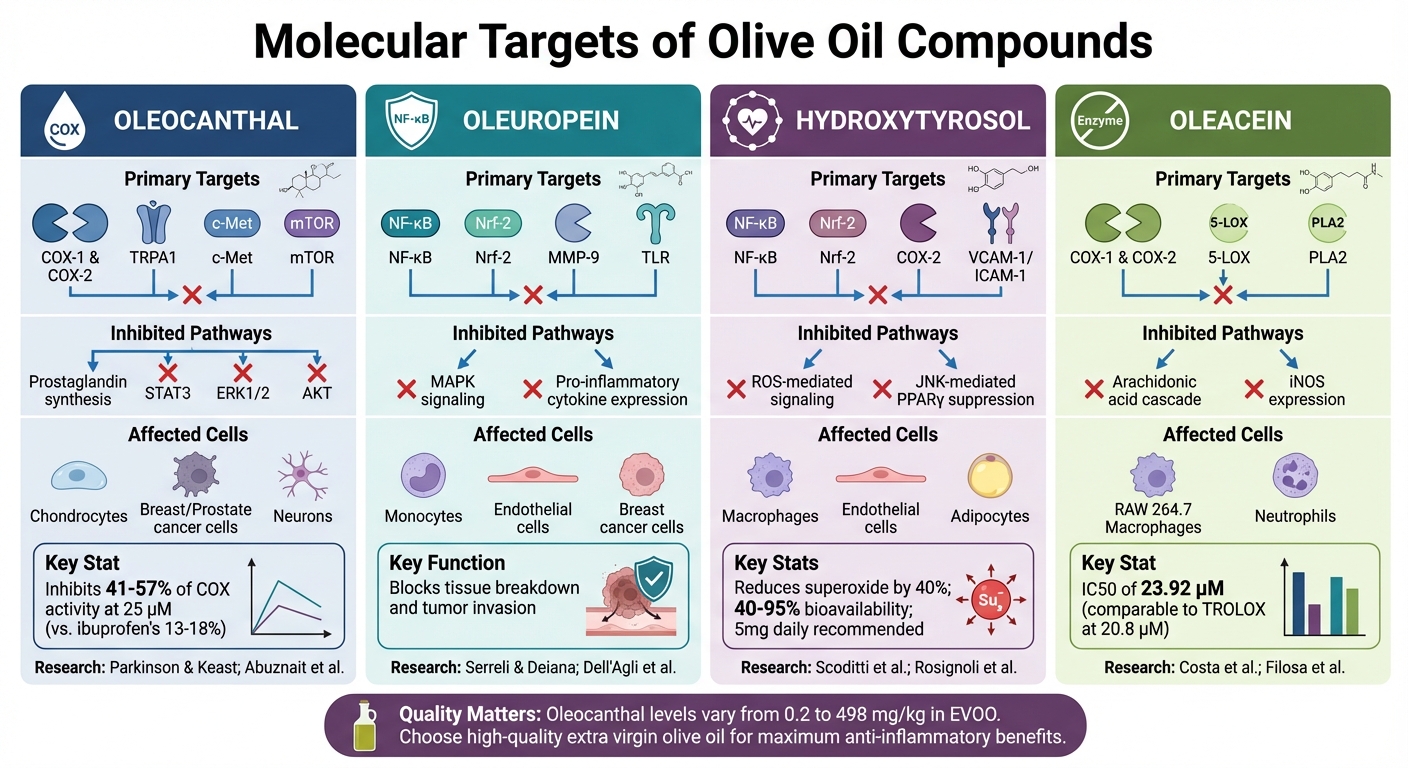
How Olive Oil Compounds Fight Inflammation: Molecular Targets and Mechanisms
The phenolic compounds in olive oil engage with specific enzymes, receptors, and signaling molecules to combat inflammation. Each compound operates through unique mechanisms, offering insights into olive oil's therapeutic potential.
Table: Phenolic Compounds and Their Effects
| Phenolic Compound | Primary Molecular Target | Inhibited Pathways | Affected Cell Types | Supporting Research |
|---|---|---|---|---|
| Oleocanthal | COX-1 & COX-2; TRPA1; c-Met; mTOR | Prostaglandin synthesis; STAT3; ERK1/2; AKT | Chondrocytes; Breast/Prostate cancer cells; Neurons | Parkinson & Keast; Abuznait et al. |
| Oleuropein | NF-κB; Nrf-2; MMP-9; TLR | MAPK signaling; Pro-inflammatory cytokine expression | Monocytes; Endothelial cells; Breast cancer cells | Serreli & Deiana; Dell'Agli et al. |
| Hydroxytyrosol | NF-κB; Nrf-2; COX-2; VCAM-1/ICAM-1 | ROS-mediated signaling; JNK-mediated PPARγ suppression | Macrophages; Endothelial cells; Adipocytes | Scoditti et al.; Rosignoli et al. |
| Oleacein | COX-1 & COX-2; 5-LOX; PLA2 | Arachidonic acid cascade; iNOS expression | RAW 264.7 Macrophages; Neutrophils | Costa et al.; Filosa et al. |
This table highlights how these compounds function together rather than independently. For instance, oleocanthal exhibits a COX inhibition potency that surpasses ibuprofen at comparable concentrations. Additionally, oleuropein reduces tumor cell invasiveness by targeting matrix metalloproteinase 9 (MMP-9) and influences the G-protein-coupled estrogen receptor (GPER) pathway.
Hydroxytyrosol, another standout compound, mitigates inflammation through various mechanisms. It reduces NF-κB activation, blocks adhesion molecules like VCAM-1 and ICAM-1 that facilitate inflammatory cell recruitment, and activates the NRF-2/ARE and AMPK pathways, essential for antioxidant defense and endothelial health. Its broad functionality makes it one of the most impactful phenolic compounds in extra virgin olive oil.
Beyond their individual effects, the bioavailability of these compounds underscores the importance of choosing high-quality extra virgin olive oil (EVOO). For example, humans absorb 40% to 95% of hydroxytyrosol and tyrosol depending on the dose. However, the concentration of these compounds in EVOO can vary significantly. Oleocanthal levels, for instance, range from 0.2 mg/kg to 498 mg/kg, emphasizing the need for premium EVOO to maximize anti-inflammatory benefits.
Conclusion
The molecular science behind olive oil's anti-inflammatory effects highlights why this ancient staple continues to be a pillar of healthy diets. Compounds like oleocanthal, which inhibits COX enzymes more effectively than ibuprofen, and hydroxytyrosol, which reduces pro-inflammatory cytokines, play key roles. Along with oleacein and other bioactive molecules, these compounds work together to target various pathways, creating a broad anti-inflammatory response. This underscores the importance of choosing high-quality olive oil to reap its full benefits.
"It is plausible that low, chronic doses of a naturally occurring NSAID such as oleocanthal may attenuate inflammation over time, and may then contribute to significant reductions in the development of chronic inflammatory disease." – Lisa Parkinson, Deakin University
Studies show that replacing saturated fats with olive oil is linked to lower mortality rates from cardiovascular disease, neurodegenerative disorders, and cancer.
To maximize these benefits, it’s crucial to select olive oil processed in ways that preserve its active compounds. Processing methods matter - a lot. For instance, Big Horn Olive Oil sets a standard by cold-pressing olives within two hours of harvest and storing the oil properly to maintain its phenolic content and protective properties.
For best results, aim to consume 2–3 tablespoons (30–50 g) of high-quality extra virgin olive oil daily. Use it as a finishing oil for salads or cooked dishes to protect its active compounds. Store it away from light and heat to prevent oxidation.
The evidence is clear: incorporating premium extra virgin olive oil into your daily routine provides a steady, low-level reduction in inflammation, potentially lowering the risk of chronic diseases over time.
FAQs
How does oleocanthal in olive oil work to reduce inflammation, and how does it compare to ibuprofen?
Extra virgin olive oil contains a natural compound called oleocanthal, which can help reduce inflammation in the body. It works by blocking cyclooxygenase (COX) enzymes, much like ibuprofen does. This means olive oil can offer similar anti-inflammatory benefits, making it a natural and nutritious way to support your body’s response to inflammation.
Adding high-quality olive oil, such as Ultra Premium Extra Virgin Olive Oil, to your meals not only enhances their flavor but also ensures you’re reaping the full health benefits of its active compounds like oleocanthal. Opting for fresh, top-tier olive oil is key to maximizing these advantages.
How should I store extra virgin olive oil to preserve its anti-inflammatory benefits?
To keep extra virgin olive oil (EVOO) fresh and preserve its beneficial compounds like oleocanthal and oleacein, proper storage is crucial. The main culprits that can degrade EVOO are heat, light, and oxygen. To protect your oil, store it in a cool, dark spot - like a pantry or cupboard - away from heat sources such as stoves or ovens. Ideally, keep the temperature steady between 60–70°F.
Choose containers made from dark-tinted glass, stainless steel, or other opaque materials to shield the oil from light. Make sure the bottle is tightly sealed to minimize air exposure. For everyday use, transfer a small amount into a smaller container that you can finish within a few weeks, and reseal the main bottle promptly after each use. If you plan to store the oil for several months, refrigeration is an option. Just remember to let it return to room temperature before opening to prevent condensation.
By taking these steps, you’ll help maintain the health-boosting polyphenols in Big Horn Olive Oil, ensuring it retains its anti-inflammatory properties with every use.
How much extra virgin olive oil should I use daily for the best health benefits?
For the best health perks, aim to include 1 to 2 tablespoons of extra virgin olive oil in your daily diet. It’s simple to work this into your meals - drizzle it over a fresh salad, whisk it into a dressing, or add a touch to finish off a cooked dish for extra flavor.
Packed with healthy fats and antioxidants, extra virgin olive oil is known for its anti-inflammatory properties and overall wellness benefits. To get the most out of it, opt for a high-quality, fresh olive oil to ensure both maximum nutrition and taste.