

Olive Oil Storage Studies: What Data Shows
My rule for storing olive oil: keep it cool, dark, and tightly sealed. A cabinet away from the stove is a good default. Cold storage can slow quality loss, but a lab test at 104°F cannot tell you exactly how long your bottle will last at home.
Here’s what I take from the research:
- Heat, light, and air work together. Glass, metal, plastic, and bag-in-box offer different protection; the seal, light barrier, and air inside matter, too.
- Flavor and test results don’t always match. Oil can meet chemical limits while losing aroma and antioxidants.
- Refrigerating or freezing can help preserve quality. Cloudiness or solidification alone doesn’t mean the oil has spoiled.
- Quality loss isn’t the same as a safety risk. Homemade garlic-in-oil needs refrigeration at 40°F or below and use within 4 days.
My takeaway: buy an amount you’ll use, reseal it after pouring, and consider the label date, storage history, smell, and taste - not a fixed shelf-life promise. <u>Storage slows damage; it doesn’t undo it.</u>
Storing Olive Oil
sbb-itb-4066b8e
How Light and Oxygen Cause Oxidation
Light speeds up oxidation, while oxygen keeps the process going - even in the dark. Together, they make stored olive oil lose quality faster.
That’s why studies on light exposure often measure both oxidation markers and antioxidant loss.
Light's Effects on Antioxidants and Aroma
A 2021 experiment followed Arbequina EVOO under five storage conditions for up to 12 months. Peroxide values rose most during the first 3–4 months; condition C2 reached 8.2 meq O₂/kg after one year. The room-temperature light condition showed the greatest α-tocopherol degradation. These findings point to combined light-and-oxygen damage rather than a light-only effect.
Light exposure can also reduce chlorophyll, carotenoids, and phenolics.
A five-week sunlight experiment found higher peroxide value and K270, lower pigment and phenolic levels, and more acrolein in clear-glass oils than in covered or amber glass.
This study tested sunlight and packaging, not oxygen alone. It measured chemical changes, not how people perceived the oil’s taste or aroma.
Opening, Pouring, and Air Above the Oil
Opening and pouring admit air and leave more headspace - the air space above the oil - increasing oxygen exposure. Most research tests storage atmosphere and packaging, rather than how often someone pours oil. A tight closure limits new air entry, but it can’t remove oxygen already inside.
For home storage, that means limit light, limit air, and keep the bottle sealed.
| Condition | Measured research signal | Antioxidant and sensory implications | Household application |
|---|---|---|---|
| Light exposure in air | More hydroperoxide formation and faster quality loss during storage in light. | Faster α-tocopherol loss; chemical changes alone don’t prove a rancid taste. | Keep oil away from windows and strong lighting. |
| More air exposure | Headspace and package permeability affect oxidation; reviews report worsening oxidation indices and sensory quality. | Antioxidants are consumed as oxidation progresses. | Reseal promptly instead of leaving the bottle open while cooking. |
| Reduced headspace | Limiting oxygen in closed systems can reduce primary oxidation products. | Results depend on temperature, package type, and storage time. | Choose a bottle size that fits how fast you use the oil; avoid transferring it into an oversized bottle. |
Temperature and container choice also affect how long that protection lasts.
How Temperature and Containers Affect Quality
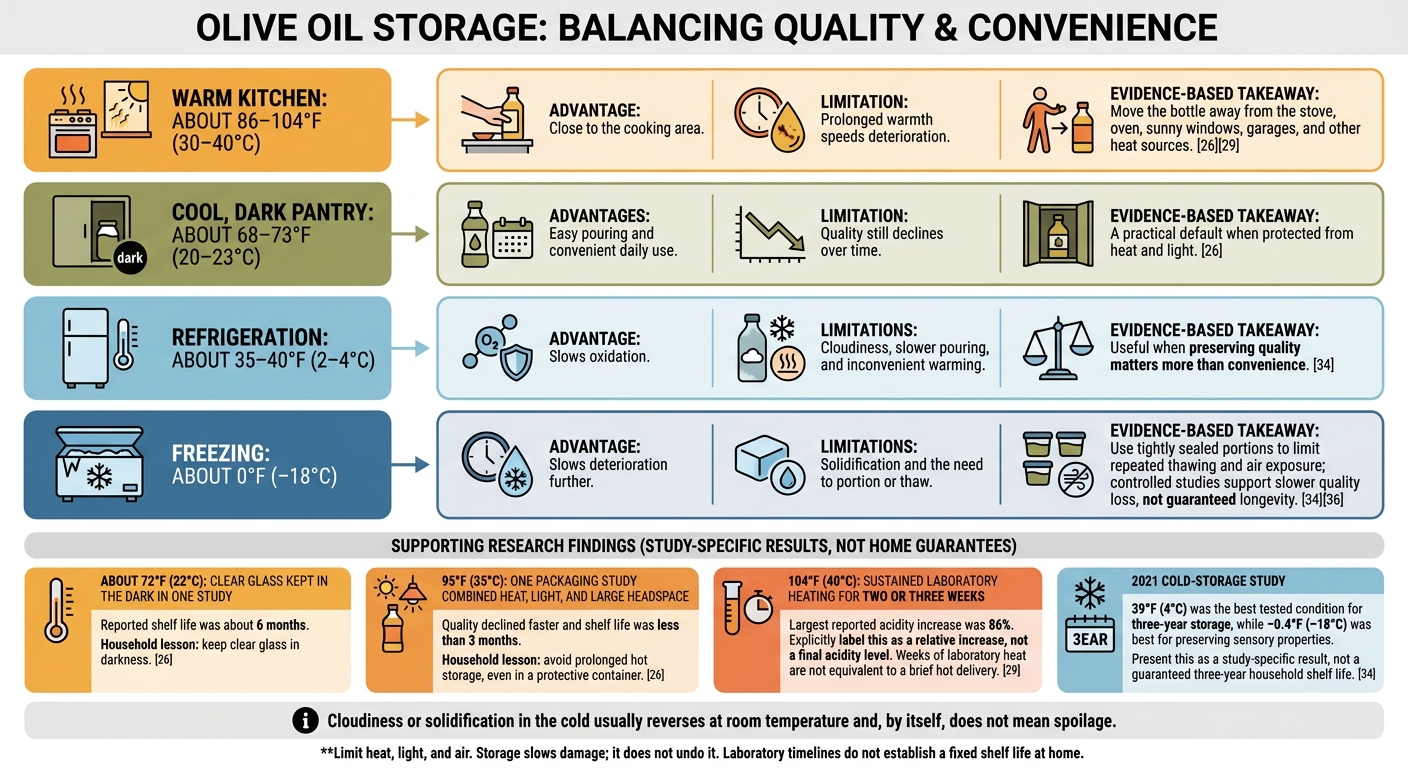
Olive Oil Storage Temperatures Compared
Once you limit light and oxygen, temperature and packaging determine how quickly the oil’s quality declines.
Cool Storage Versus Prolonged Heat
Prolonged heat matters more than a brief warm spell. Controlled studies expose oil to sustained heat, sometimes alongside light or a large air space inside the container. Their timelines don’t translate directly to home storage. Keep oil in a cabinet away from the oven, stovetop, sunny windows, garages, and other heat sources.
| Temperature | Test setup | Main result | Home-storage lesson |
|---|---|---|---|
| About 72°F (22°C) | Clear glass kept in the dark in one study | Reported shelf life was about 6 months. | Keep clear glass in darkness. |
| 95°F (35°C) | One packaging study combined heat, light, and large headspace | Quality declined faster; shelf life was less than 3 months. | Avoid prolonged hot storage, even in a protective container. |
| 104°F (40°C) | Sustained laboratory heating for two or three weeks | Largest reported acidity increase: 86%. | Weeks of heat aren’t the same as a brief hot delivery. |
The 86% figure is a relative increase, not a final acidity level.
If heat exposure is hard to avoid, low-temperature storage slows quality loss.
Refrigerating and Freezing Olive Oil
Cold storage slows deterioration. In a 2021 study, 39°F (4°C) was the best tested condition for three-year storage, while −0.4°F (−18°C) was best for preserving sensory properties.
Oil may turn cloudy or solidify in the cold. These changes usually reverse at room temperature and, on their own, don’t mean the oil has spoiled. If you freeze oil, divide it into tightly sealed containers to limit repeated thawing and air exposure.
| Storage method | Advantages | Limitations | Evidence and suitable use |
|---|---|---|---|
| Cool, dark pantry: about 68–73°F (20–23°C) | Easy pouring; convenient for daily use | Quality still declines over time | A practical default when protected from heat and light. |
| Warm kitchen: about 86–104°F (30–40°C) | Close to the cooking area | Prolonged warmth speeds deterioration | Heat studies support moving the bottle elsewhere. |
| Refrigeration: about 35–40°F (2–4°C) | Slows oxidation | Cloudiness, slower pouring, and inconvenient warming | Useful when preserving quality matters more than convenience. |
| Freezing: about 0°F (−18°C) | Slows deterioration further | Solidification and the need to portion or thaw | Controlled studies support slower quality loss, not guaranteed longevity. |
Packaging also affects how much light and air reach the oil.
Glass, Metal, Plastic, and Bag-in-Box Containers
A suitable bag-in-box limits new air contact because its bag collapses as you use the oil, reducing headspace. But the film, seal, and tap still matter.
In a 12-month dark-storage study, higher-barrier PET performed better than standard PET on peroxide and K232 measures. That doesn’t mean all plastic bottles perform alike.
| Container | Light protection | Oxygen barrier and seals | Findings and home-storage lessons |
|---|---|---|---|
| Dark or opaque glass | High when it blocks enough light | Strong material barrier; cap quality still matters | Dark glass and tin maintained acceptable properties for at least 180 days at 68°F (20°C) under light exposure. |
| Clear glass | Little protection unless stored in darkness | Strong material barrier; closure still matters | Reported shelf life was about 6 months in darkness at 72°F (22°C); keep it away from light. |
| Tin-plated metal | Opaque | Closure matters; rigid containers can leave more headspace as oil is used | Protected against light, but deteriorated faster than bag-in-box during hot storage and repeated sampling. |
| PET or other studied plastics | Varies by formulation and design | Oxygen barrier depends on the bottle design and seal | Higher-barrier PET performed better than standard PET on peroxide and K232 over 12 months in darkness. |
| Bag-in-box | Good when the outer box blocks light | Barrier film and fitments must seal well | Kept extra-virgin classification through the 120-day test at 71.6°F (22°C), and for about 100 days at 98.6°F (37°C). |
These differences guide the storage choices below.
Research-Based Home Storage Practices
Store Oil in a Cool, Dark Place and Seal It
The research points to a simple rule: limit heat, light, and air. Keep oil in a cool, dark cabinet away from heat sources. Close the bottle tightly, and keep the pour spout clean and capped. Buy a bottle size that fits how much you use. Pour only what you need, then reseal it.
These steps help protect quality. Some oil-based mixtures, though, need separate food-safety precautions.
Quality Warning Signs and Food-Safety Risks
Stale, waxy, crayon-like, or cardboard-like smells and fading flavor are signs of poor quality. Bitterness and a peppery feeling in your throat, on the other hand, can be normal EVOO traits. Discard clearly rancid oil, but know the distinction: a rancid smell or taste signals quality loss - not, by itself, a safety risk.
Oils infused with fresh garlic or herbs need extra care. Covering these ingredients with oil creates low-oxygen conditions that can allow botulinum toxin to form. The National Center for Home Food Preservation recommends refrigerating homemade garlic-in-oil at 40°F or below and using it within 4 days. Oregon State University Extension recommends refrigerating homemade flavored oils, including pesto, for up to 4 days or freezing them for longer storage.
Don't rely on vinegar or lemon juice unless you're following a validated recipe. Acidification requires a procedure specific to the food. If a mixture hasn't been validated and its storage history is uncertain, discard it without tasting it. Refrigerating it later won't undo unsafe storage. For commercially prepared infused oils, follow the manufacturer's handling instructions.
Protect Olive Oil After Purchase
Once you open the bottle, handling matters as much as storage. After purchase, note the opening date, follow the package instructions, and protect the oil from light, heat, and oxygen. Good handling preserves the quality that's still there; it can't bring back lost aroma or reverse rancidity.
Conclusion: Storage Preserves Quality, Not Restores It
Shared Findings and Condition-Dependent Results
The studies point to the same finding: controlling exposure matters more than container type. How well a container protects oil depends on light exposure, oxygen transfer, fill level, and seal quality.
Proper storage slows further damage. It cannot replace lost antioxidants or reverse oxidation.
Why Shelf-Life Estimates Vary
An oil’s stability depends on its cultivar, harvest age, and starting phenol and antioxidant levels. Headspace and how often you open the bottle matter, too. A nearly empty bottle oxidizes faster than a sealed one.
These differences help explain the range of shelf-life estimates. A 2025 review found storage studies lasting 2 months to 2 years at 68–122°F (20–50°C). Predictive models still need testing in households before they can guide consumers. Lab results alone cannot establish a fixed shelf life at home.
Chemical and sensory changes don’t always happen at the same pace. An oil may meet chemical limits yet lose aroma and flavor. At home, use the date on the bottle as a baseline, then weigh the opening date, storage history, and changes in aroma and flavor when judging its remaining quality.
FAQs
Should I refrigerate olive oil between daily uses?
Olive oil doesn’t need refrigeration for daily use. It may temporarily solidify or turn cloudy in the refrigerator, but that’s normal and doesn’t affect its quality.
For most households, a cool, dark pantry or cupboard is the best place to store olive oil, ideally between 55°F and 75°F. Keep the container tightly sealed to limit oxygen exposure.
Should I move leftover oil to a smaller bottle?
Yes. Moving leftover oil to a smaller bottle helps maintain its quality. Each time you open the bottle, oxygen enters, speeding up oxidation and leading to rancidity.
Choose a smaller dark glass or stainless steel container to reduce headspace - the air above the oil - and limit oxygen exposure. Seal it tightly and store it somewhere cool and dark to preserve your Big Horn Olive Oil’s quality and health benefits.
How can I assess olive oil after a hot delivery?
Pour a little oil into a glass, warm it with your hands, and give it a sniff. Expect a grassy aroma. Rancid, sour, musty, or moldy odors are signs of possible spoilage.
Next, taste it. Look for a clean, fruity flavor, pleasant bitterness, and a peppery finish in your throat. If the oil feels greasy or lacks these qualities, heat exposure during transit may have damaged its quality.