

5 Olive Oil Symbols in Mediterranean Folklore
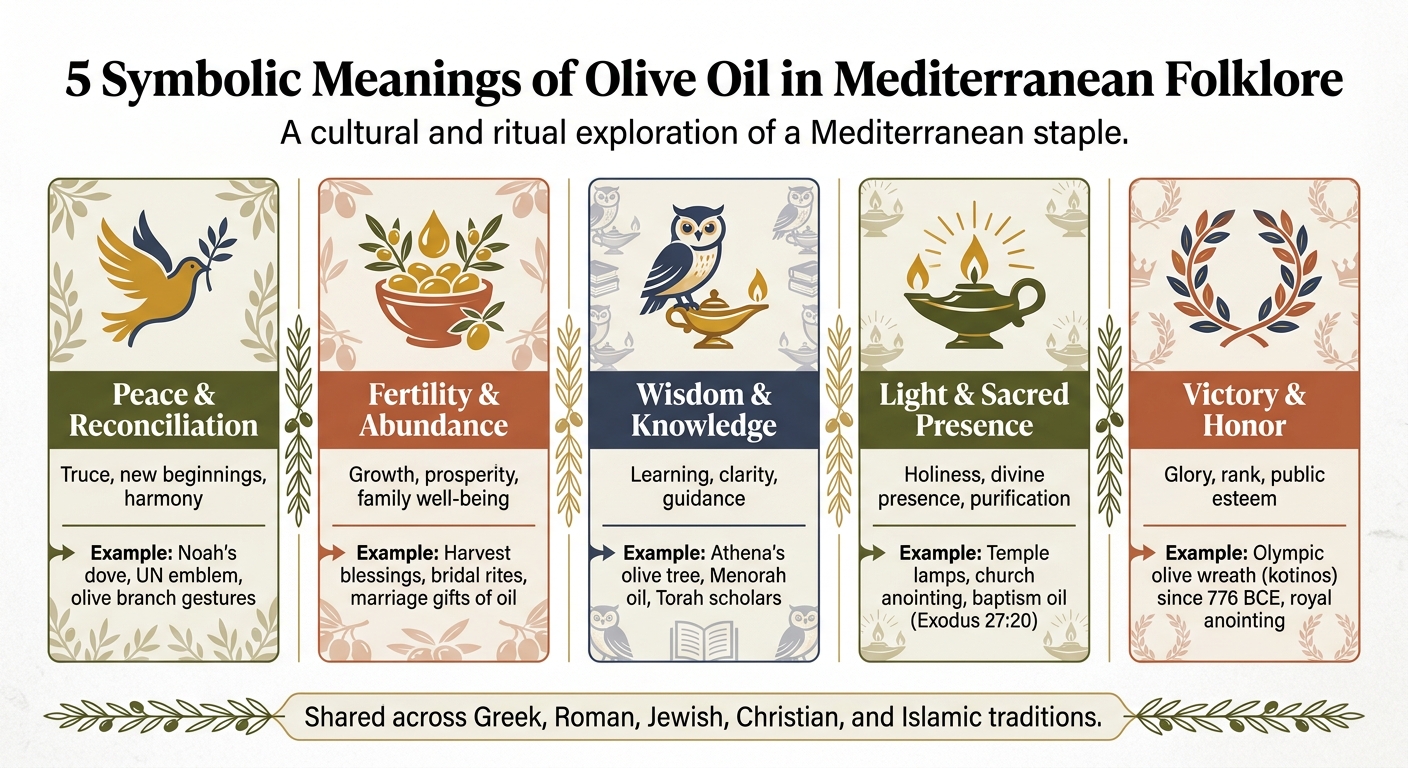
Olive oil meant far more than food across the Mediterranean. In this piece, I’d sum it up this way: one everyday item came to stand for 5 main ideas - peace, fertility, wisdom, sacred light, and honor.
If you want the short answer, here it is:
- Peace and reconciliation: tied to the olive branch, Noah’s dove, and acts of blessing
- Fertility and abundance: linked to harvest, family security, marriage wishes, and prosperity
- Wisdom and knowledge: connected with Athena, study, lamps, and learning
- Light and sacred presence: used in temple lamps, church rites, and anointing
- Victory and honor: seen in Olympic olive wreaths, kingship, priesthood, and public esteem
One fact helps explain all of this: before modern lighting, olive oil was a main lamp fuel in many Mediterranean homes and worship spaces. And olive trees can live for hundreds of years, which helps explain why people tied them to endurance, continuity, and blessing.
5 Symbolic Meanings of Olive Oil in Mediterranean Folklore
Why the Ancient Greeks Considered Olives Sacred
sbb-itb-4066b8e
Quick Comparison
| Symbol | What it meant | Common use in story or ritual |
|---|---|---|
| Peace | Reconciliation, truce, new beginnings | Olive branch, dove, anointing |
| Fertility | Growth, prosperity, family well-being | Harvest customs, marriage gifts, blessings |
| Wisdom | Learning, clarity, guidance | Athena, lamp light, study |
| Light | Purity, holiness, divine presence | Temple lamps, church oil, sacred rites |
| Honor | Victory, rank, public respect | Olympic wreaths, royal and priestly anointing |
So when I look at Mediterranean folklore, I don’t see olive oil as just a kitchen staple. I see a substance that moved through the home, worship, and public life - and picked up meaning everywhere it went.
Why Olive Oil Carries Symbolic Meaning Across the Mediterranean
Olive oil became symbolic for a simple reason: people depended on it every day. It wasn't just something used in cooking. It showed up in homes, temples, and ceremonies too. When one substance keeps turning up in so many parts of life, it starts to carry meaning far beyond its practical use.
Olive Trees as Long-Lived Markers of Stability
Olive trees live a long time and can survive dry, harsh conditions. That made them a natural sign of endurance, persistence, and stability. Over time, those same ideas became tied to olive oil itself.
Daily Uses in Food, Lamps, and Ritual
Olive oil mattered because it did so much. It cooked food, cared for the body, and lit homes and sacred spaces. It was also used to anoint kings and priests, poured out as offerings, and applied in healing.
That range matters. If one substance is linked to nourishment, light, medicine, and the sacred, people don't see it as ordinary for long. They start to treat it as something set apart.
A Symbol Shared Across Mediterranean Cultures
Greek, Roman, Jewish, Christian, and Islamic traditions all connected olive oil with blessing, peace, wisdom, prosperity, and victory. The details changed from place to place, but the main ideas stayed much the same.
That's why olive oil carries shared meaning across the Mediterranean, even when each group tells the story a little differently.
1. Peace and Reconciliation
Of all these shared symbols, peace stands out most clearly. And it starts with the olive tree itself, even before olive oil entered the picture.
In Greek mythology, Athena gave the olive tree to the city that later became Athens. Her gift settled her rivalry with Poseidon through peace instead of force. Eirene, the Greek goddess of peace, was shown carrying an olive branch, and the Romans later linked that same branch with Pax.
The Biblical tradition added a second layer that stuck for centuries. A dove returned to Noah with an olive leaf, showing that the flood had ended and that a new beginning had begun. That image became one of the best-known peace symbols in Western culture. It also gave us the phrase "extend an olive branch."
Olive oil makes the symbol feel more close to daily life. People could pour it, share it, and use it in ritual. In folk and religious practice, anointing with oil marked blessing and helped mend relationships - peace made visible.
The olive branch still appears in the United Nations emblem, which shows how strongly the symbol remains tied to peace.
Its life-giving role also connects naturally to fertility and abundance.
2. Fertility and Abundance
Olive trees can grow and bear fruit in rough, dry places. Because of that, people across the Mediterranean came to see them as signs of fertility and abundance. And that wasn’t just an abstract idea. It shaped daily life, family customs, ritual, and blessing.
In Greek myth, Athena’s gift of the olive tree to Athens had plain, practical value: food, oil, wood, and income from trade. That’s abundance in a form a city could use and depend on. In Jewish tradition, the Hebrew word for oil, shemen, also came to carry the sense of fertility and prosperity, tied to growth, wealth, joy, and continuity.
In rural Greece and southern Italy, an olive grove meant security for a family. Olives and oil could help feed a household, light the home, and serve as goods for trade. One Italian folkloric account describes the olive tree as a sign of peace, wisdom, prosperity, fertility, and victory. Olive oil also had a place in life-cycle rituals. In some Greek and Cypriot customs, families gave newlyweds oil from their own trees as a wish for a fruitful marriage. In Catholic and Orthodox communities, chrism oil used in baptism and confirmation stood for the fruitfulness of faith within the person and the family.
Religious texts repeat the same pattern. Canaan is described as a land of olive oil and honey, and the olive tree appears again and again as an image of fertility, wealth, and blessing. Its power to send up new shoots even after the stump is cut down helped make it a lasting sign of renewed fruitfulness. That staying power kept the meaning alive from one generation to the next.
3. Wisdom and Knowledge
Beyond abundance, olive oil also came to stand for wisdom.
This is one of its oldest meanings. Greek myth gives a clear example: Athena's olive tree represented practical wisdom because it provided lasting food, light, and a way to make a living.
That same sense of practical use shaped Jewish symbolism too. In Jewish tradition, the link between olive oil and wisdom runs deep. Rabbinic sources connect communities familiar with olive oil to wisdom and learning, and a Talmudic note about Tekoa says wisdom was found there. The Menorah's olive oil flame became a symbol of Torah, study, and understanding. Rabbinic writings also read olive trees and oil in prophetic visions as references to Torah scholars, while the Menorah stands for the seven branches of Torah and the broader wisdom woven into it.
Before electricity, olive oil lamps made study at night possible. That's a simple point, but it matters. The same oil that kept a lamp lit also helped people read, learn, and teach. Over time, the fuel and the knowledge it revealed became closely tied together.
That old link still lingers. Even now, the long-standing tie between olive oil and clarity still shapes the way people speak about health.
Its meaning went even further, touching not just wisdom, but also light and sacred presence.
4. Light, Purity, and Sacred Presence
Long before candles and electric bulbs, olive oil kept lamps burning. In homes and worship spaces across the ancient Mediterranean, it served as the main lamp fuel and was prized for its low-smoke flame. That everyday use gave oil a clear place in religious life. Light wasn’t just useful; it came to stand for sacred presence.
The Hebrew Bible states that link directly. Exodus 27:20 connects "pure oil of pressed olives" with continual worship, tying purity to holiness and divine presence. What began in the Temple later carried into worship beyond it.
Churches used multi-lamp fixtures filled with olive oil, as well as lamps shaped like doves, crowns, or boats. Those forms helped underline the point: divine light set the space apart. Christian tradition also saw olive oil as a sign of nourishment, enlightenment, and comfort through the Holy Spirit. That same thread carried into anointing rites.
Today, olive oil still holds a central place in Catholic, Orthodox, and Anglican baptism, confirmation, and anointing of the sick. In these rites, the oil points to purification, healing, and the sacred. The long-standing use of pure, unrefined oil kept the idea of purity at the heart of the symbol. Across generations, pure oil remained closely linked with sacred presence.
5. Victory, Strength, and Honor
Olive oil didn't stop at sacred use. It also became a public sign of victory and honor.
In ancient Greece, the olive wreath (kotinos) was awarded to Olympic victors, and the games are usually dated to 776 BCE. The wreath was made from branches of the sacred wild olive at Olympia, said to have been planted by Heracles. It had no cash value. That was the point. It showed that the winner had earned glory, not bought it.
Herodotus says that when Xerxes heard Greek athletes competed for nothing more than an olive wreath, he was stunned that they fought "not for money, but for honor." That detail says a lot. The olive came to stand for discipline, restraint, and honor, not just raw physical power.
Olive oil also marked honor beyond the stadium. It was used to anoint kings, priests, and sacred objects, showing divine favor and dignity. So olive oil wasn't tied only to ritual. It was linked to rank, authority, and public esteem as well.
The tree itself strengthened that meaning. Olive trees keep going through drought, rocky ground, and repeated harvests. That toughness made the olive an easy symbol for endurance and honor that had to be earned, not handed out.
You can still see that idea now. Modern Olympic ceremonies still use olive wreath motifs, and olive branches still point to excellence and prestige.
These meanings show up in both ritual practice and public symbolism.
Symbolic Meanings and Their Folkloric Uses at a Glance
Use the table below for a quick summary.
| Symbolic Meaning | Common Folkloric or Ritual Expression |
|---|---|
| Peace & Reconciliation | Olive branches as truce gestures, peace offerings in community disputes, and reconciliation stories |
| Fertility & Abundance | Harvest blessings, bridal rites, and prosperity rituals tied to the olive crop's role in Mediterranean livelihood |
| Wisdom & Knowledge | Athena, guidance, and learning |
| Light, Purity & Sacred Presence | Lamps, anointing, and blessing |
| Victory, Strength & Honor | Olive crowns, games, and public honor |
Lighting a lamp and crowning an athlete may seem far apart. But both come from the same root.
The olive was part of the full sweep of Mediterranean life, from quiet moments at home to public ceremony. It showed up in family rites, worship, harvest customs, and civic honor.
These symbols changed from one place to another, but the main ideas kept showing up across the Mediterranean. That repetition points to a broader pattern in Mediterranean life.
A Shared Thread Across Mediterranean Life
How One Ingredient Connects Home, Ritual, and Public Life
Olive oil ran through every layer of Mediterranean life and kept its symbolic force the whole time. It showed up in the kitchen, in ritual, and in public life. That broad reach helps explain why olive oil became a shared symbol, not just a handy ingredient.
Across these settings, olive oil stood for daily need, sacred use, and public authority. Those meanings still shape how people understand olive oil today.
Why These Symbols Still Matter Today
Olive oil still carries memory across generations. That weight still gives olive oil a special place in Mediterranean identity.
Conclusion
Put together, these five symbols make one thing clear: olive oil was never just an everyday ingredient. In Mediterranean folklore, it came to stand for peace, fertility, wisdom, light, and honor. Those meanings show how a single ingredient could shape both ordinary life and deeply held belief.
What kept those ideas alive was daily use. In the home, in ritual, and in public life, people turned those symbols into lived acts through gestures, rituals, and ceremonies. That gave them staying power across generations and across Greek, Roman, Jewish, Christian, and Islamic traditions alike.
Today, olive oil is often seen first as a kitchen staple, but its meaning goes much deeper. The same ingredient that finishes a dish has also been used to mark sacred moments, seal agreements, and celebrate victories. That history still gives olive oil a strong place in Mediterranean life.
Whether it appears in ritual, celebration, or food, olive oil still carries the stories of the Mediterranean.
FAQs
Why did olive oil become so symbolic?
Olive oil became a symbol because it tied daily Mediterranean life to the sacred. People used it for food and light, but its clean quality and long-burning flame also gave it a place in rituals, the anointing of leaders, and offerings to the gods.
Stories like Athena’s gift to Athens pushed that meaning even further. They linked the olive tree to wisdom, peace, and prosperity, while its status as “liquid gold” strengthened its place in trade, health, and social stability.
How did different Mediterranean cultures use olive oil?
Mediterranean cultures used olive oil in almost every part of life: spiritual rituals, medicine, and day-to-day tasks.
Greeks, Egyptians, and Phoenicians anointed leaders, athletes, and the dead with it. They also offered it to their deities, which shows how much weight it carried beyond simple daily use.
Olive oil also fueled lamps, helped with grooming and skincare, and worked as a base for perfume. At home and in the marketplace, it mattered just as much. People used it for trade, food preservation, and cooking.
Why is olive oil linked to religion and daily life?
Olive oil was tied to both daily life and worship because it did two jobs at once: it was useful, and it meant something deeper.
Across the Mediterranean, people used it for cooking, preserving food, medicine, skincare, and lamp fuel. But olive oil wasn't just a household staple. Its purity and golden glow also gave it a sacred role in rituals. It was used for anointing and temple lamps, where it stood for divine presence, favor, and healing.