

How Olive Oil Traceability Ensures Fair Practices
Traceability in olive oil production is transforming how consumers and producers approach quality, ethics, and transparency. By tracking every step - from the olive grove to the bottle - it ensures:
- Quality Control: Detailed records of harvest dates, locations, and processing methods help maintain high standards. For example, high-quality extra virgin olive oil requires an acidity level below 0.8%.
- Fraud Prevention: Traceability combats adulteration, ensuring oils marketed as "extra virgin" or region-specific are genuine. Fraud impacts up to 70% of olive oils sold in the U.S.
- Ethical Practices: Transparent supply chains protect fair labor standards and environmentally responsible farming, verified through tools like GPS and blockchain.
- Support for Small Producers: Traceable systems boost incomes for family farms by 20–30%, connecting them directly with consumers and reducing reliance on intermediaries.
- Consumer Confidence: Certifications like PDO, PGI, and COOC, along with harvest dates and quality metrics, make it easier to choose authentic, high-quality products.
Traceability not only protects consumers but also supports producers and local communities. Keep an eye out for clear labels, certifications, and supplier details when buying olive oil to ensure you're getting a high-quality product while supporting ethical practices.
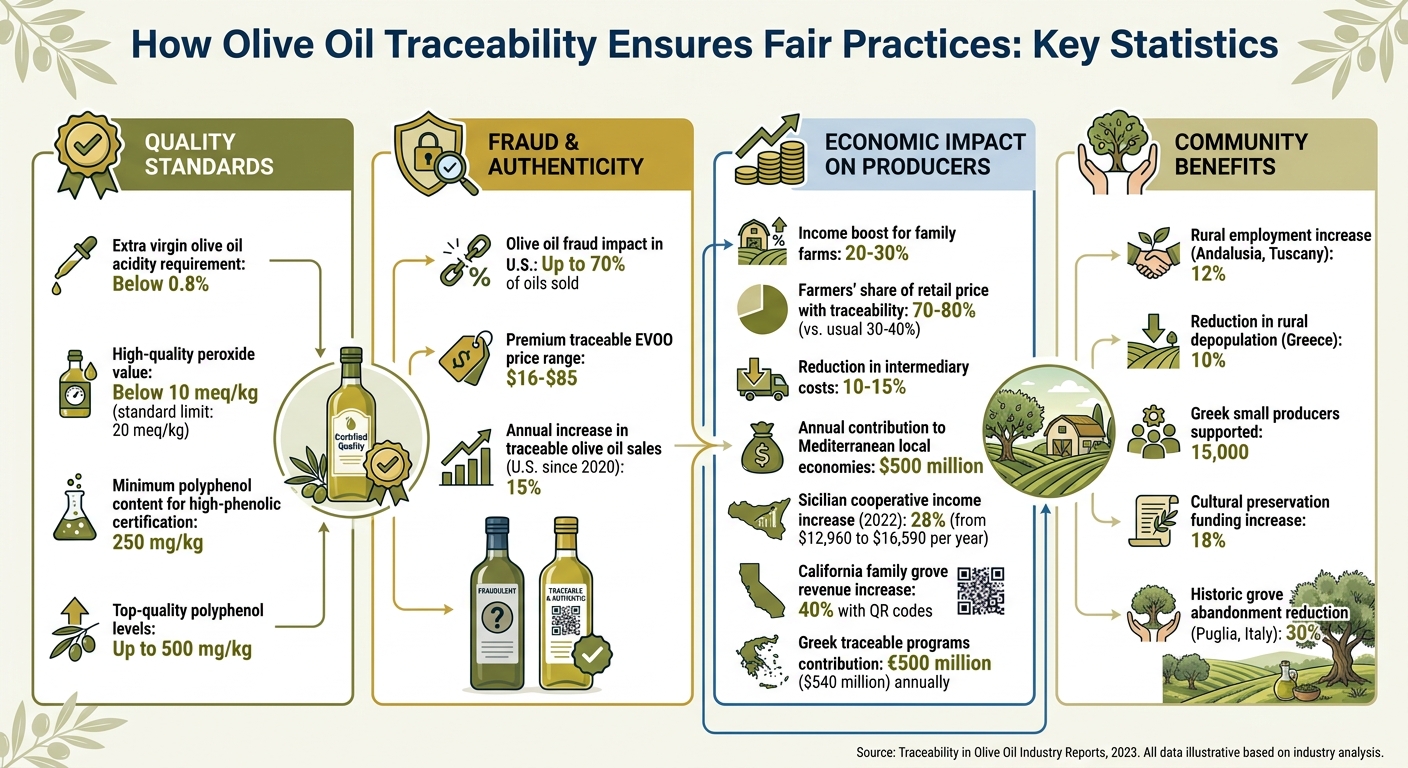
Olive Oil Traceability: Key Statistics on Quality, Fraud Prevention, and Economic Impact
How to Spot Real Extra Virgin Olive Oil (Before You Get Tricked Again)
sbb-itb-4066b8e
How Traceability Maintains Quality Standards
When it comes to olive oil production, maintaining quality is all about keeping meticulous records every step of the way - from the grove to the bottle. The International Olive Council (IOC) plays a key role here, setting trade standards that outline the chemical and sensory benchmarks for different olive oil grades. The latest update, Revision 21 in 2025, provides a clear framework that producers can follow to ensure their oils meet consistent, high standards. These records aren't just for show - they allow producers to monitor every stage of production with precision.
Monitoring Olive Growth and Harvest
Everything starts in the olive grove. The condition of the olives at harvest is crucial to the quality of the oil they produce. To meet IOC standards, producers evaluate olive maturity and keep detailed records of harvest dates and locations. This ensures the fruit is picked at its peak, which is critical for producing high-grade oil. If markers like free fatty acids or peroxide values are elevated, it can point to delays or mishandling that might jeopardize the oil's extra virgin status. By documenting these early stages, producers can ensure the rest of the process reflects the fruit's original quality.
Cold-Pressing and Freshness Verification
Once the olives reach the mill, the traceability system tracks every detail of their processing. Olives are cold-pressed under carefully controlled conditions to preserve their freshness and integrity. This step directly ties the quality of the raw olives to the final product. After pressing, trained sensory panels step in to evaluate the oil's flavor and aroma. These experts are skilled at identifying defects like rancidity or mustiness, which can indicate problems during handling or processing. Together, the production records and sensory assessments create a comprehensive profile of the oil's quality, ensuring it meets the highest standards.
Preventing Fraud and Verifying Purity
Olive oil fraud undermines the trust and quality associated with premium products. To combat this, robust traceability systems track every step of the process - from grove to bottle - helping identify discrepancies between records and the actual product. Detailed documentation connects harvest volumes to the final output, making it easier to spot tampering and confirm the oil's authenticity. Here's how traceability plays a key role in both exposing adulteration and verifying origin.
Identifying Adulteration in Olive Oil
Adulteration often involves mixing extra virgin olive oil with cheaper oils to boost profits. By recording the volume at every production stage, traceability systems can flag any excess output beyond the documented harvest as a potential sign of tampering. Additionally, chemical analysis, such as examining fatty acid profiles, provides further confirmation of adulteration.
This process is crucial because the health benefits of extra virgin olive oil - like supporting heart health, reducing inflammation, and improving cholesterol levels - are tied to its purity and quality. When adulteration occurs, these benefits may be compromised. By preventing fraud, traceability not only protects consumers but also upholds ethical sourcing practices and preserves trust in the market. Beyond spotting volume issues, it also ensures the oil’s true origin, as explained below.
Confirming Geographic Origin and Production Methods
Traceability also verifies where olive oil comes from, which is important for both consumers and producers. Detailed records, including GPS coordinates of olive groves, mill locations, and processing dates, help confirm that an oil marketed as being from a specific region - like Italy or Greece - actually originates there.
This level of authentication is especially critical in the premium market, where traceable extra virgin olive oils can range from $16 to $85, depending on their source and production methods. Producers who focus on small-batch, authentic production rely on traceability to justify their higher prices and highlight the integrity of their products. For consumers, knowing the oil’s geographic origin ensures that the premium price reflects its unique quality and genuine production methods.
Promoting Ethical and Environmental Practices
Traceability does more than just reduce fraud - it ensures transparency throughout production. By thoroughly documenting every step of the process, these systems verify that producers adhere to ethical and sustainable practices. This section focuses on how traceability supports environmentally responsible farming and fair labor practices, demonstrating its role in promoting accountability and quality.
Supporting Environmentally Responsible Farming
Traceability systems play a key role in verifying practices like organic farming, sustainable water use, and biodiversity preservation. Tools like Digital Product Passports (DPPs) utilize GPS data to confirm that farming locations avoid deforestation and other environmental damage. These systems also monitor environmental metrics such as carbon emissions and water usage, ensuring compliance with standards like the EU's Ecodesign for Sustainable Products Regulation (ESPR).
For instance, in November 2024, Turkish olive oil producer Murat Kalavaoglu Oil adopted Digital Product Passports to expand into the German market. By providing precise GPS coordinates of harvest sites and detailed data on carbon emissions and packaging recyclability, the company met the requirements of the EU Deforestation Regulation (EUDR) and the ESPR. This level of transparency helped the producer secure partnerships with European retailers that demand strict environmental and ethical compliance.
"Traceability gives you the opportunity to opt for olive oils from groves that prioritize environmental conservation, use organic farming methods, or promote fair labor practices." - OLIVO AMIGO
While environmental accountability is essential, ensuring ethical labor practices is just as critical.
Verifying Fair Labor Practices
Traceability systems are equally effective in confirming adherence to fair labor standards. They ensure that production processes do not involve violations like child labor. Detailed documentation supports compliance with regulations such as the Corporate Sustainability Due Diligence Directive (CSDDD) and the German Supply Chain Due Diligence Act (LkSG). By safeguarding workers' rights, these systems not only protect laborers but also give consumers confidence that their purchases contribute to ethical practices throughout the supply chain.
Benefits for Local Communities
Traceability in olive oil production isn’t just about ensuring ethical practices - it plays a big role in improving the lives of local communities. By connecting small-scale producers with buyers who value verified origins, traceability creates direct economic opportunities. Tools like QR codes and blockchain tracking help buyers choose family-owned groves over mass-produced options. Research shows that traceable olive oils can sell for 20–30% more, with farmers pocketing 70–80% of the retail price instead of the usual 30–40%. Meanwhile, intermediary costs drop by 10–15%. In areas like Andalusia, Spain, and Tuscany, Italy, these systems have led to a 12% rise in rural employment and steadier incomes, helping curb urban migration. According to the International Olive Council, certified traceable oils contribute $500 million annually to Mediterranean local economies. This transparency not only ensures fair practices but also brings clear financial and cultural benefits to the regions where olive oil production is deeply rooted.
Supporting Small-Scale Producers
Traceability offers small producers a chance to stand out by letting them share their unique stories directly with consumers. A great example is the Sicilian cooperative "Oleificio sociale Cooperativo", which introduced blockchain traceability for 500 small producers in 2022. This tracked olives from 1,200 hectares to bottles, boosting average farm incomes by 28% - from roughly $12,960 to $16,590 per year - and increasing sales by 40% to $3.2 million. Similarly, in California's Central Valley, small family groves have seen sales grow 15–25% by using traceability apps at farmers' markets and online. One 50-acre farm in the Sierra Nevada foothills increased its revenue by 40% after adding harvest-date QR codes, allowing it to bypass large distributors. In Greece, traceable programs have supported 15,000 small producers, contributing €500 million (about $540 million) annually to rural economies and reducing rural depopulation by 10%. These successes highlight how traceability builds trust and adds value to products, giving smaller producers a competitive edge.
Protecting Cultural Heritage
Traceability also plays a key role in preserving traditional methods that might otherwise disappear under modern industrial pressures. By documenting practices like hand-harvesting and stone-milling, it helps maintain Protected Designation of Origin (PDO) status and keeps cultural traditions alive. For instance, in Greece's Kalamata region, traceability has revived ancient Koroneiki olive varieties and supported traditional festivals tied to olive oil production. A 2023 EU Olive Oil Report revealed that traceable PDO oils led to an 18% increase in cultural preservation funding, with 70% of small communities maintaining traditional milling operations. In Puglia, Italy, traceability programs have reduced the abandonment of historic groves by 30%, preserving both biodiversity and cultural practices. One standout example is the "Frantoio Oleario Muggeo", which introduced GPS-mapped traceability for 200 family farms in 2023. This initiative not only sustained 1,500 jobs but also boosted fair trade premiums by 35% and increased export revenue by 25%, reaching €1.8 million (around $1.94 million). These efforts ensure that the cultural and historical significance of olive oil production endures for future generations.
Certifications and Standards for Traceable Olive Oil
Certifications play a key role in reinforcing consumer trust when it comes to traceable olive oil. Blockchain technology is at the heart of this process, offering a secure and unchangeable record of every step in the supply chain - harvesting, milling, bottling, and distribution. Through a QR code, consumers can access this digital record, which ties directly to the product's certification.
This approach ensures transparency by verifying essential details like the geographical origin of the olives, the specific methods used in processing, and any certifications the product has earned. These measures not only help protect against fraud and counterfeiting but also uphold the reputation and quality of premium olive oil.
Big Horn Olive Oil's Traceability Practices
Big Horn Olive Oil prioritizes transparency and high quality in every product. Their focus on Ultra Premium Extra Virgin Olive Oils and balsamic vinegars highlights freshness and clear product origins. These principles drive their meticulous traceability practices.
Fresh Harvest and Source Transparency
Big Horn Olive Oil ensures freshness through a rigorous process. Olives are cold-pressed within just 2 hours of harvest, and products are delivered within 3 months. Each label provides detailed information about the product's origin and processing methods. For instance, their Picual and Coratina Extra Virgin Olive Oils exemplify these standards, as do their balsamic vinegars, including the 18-Year Aged Dark Balsamic and 25-Year Aged Dark Balsamic, sourced from Modena, Italy.
This commitment to quality extends to pricing. The Estate Reserve Ultra Premium EVOO, priced at $8.99, reflects their dedication to traceability and craftsmanship. These practices underscore their focus on ethical sourcing and maintaining product integrity.
How to Choose Traceable Olive Oil
Understanding how to pick a traceable olive oil is key to enjoying both quality and ethical benefits. By knowing what to check on labels and packaging, you can ensure the oil you choose is genuine, high-quality, and produced responsibly. This knowledge helps you avoid adulterated products and supports better production practices.
Understanding Labels and Certifications
Certifications are your best guide to traceability. Look for seals like PDO (Protected Designation of Origin), marked by a red and yellow label, which guarantees that every step of production - from growing and pressing to bottling - took place in a specific region using traditional methods. Another seal to watch for is PGI (Protected Geographical Indication), identified by a blue and yellow label, which ensures that at least one stage of production occurred in a designated area.
In the U.S., certifications such as the COOC (California Olive Oil Council) and NAOOA (North American Olive Oil Association) Quality Seals add further assurance of traceable and high-quality production. Additionally, organic certifications like USDA Organic or EU Organic confirm that the oil was produced without synthetic pesticides or fertilizers. For health-conscious buyers, high-phenolic certifications ensure the oil contains at least 250 mg/kg of polyphenols, with top-quality oils reaching closer to 500 mg/kg. These levels are verified through advanced testing methods like Nuclear Magnetic Resonance (NMR). These certifications not only guarantee quality but also reflect sustainable practices and support for local producers.
Reviewing Harvest Dates and Supplier Information
Beyond certifications, checking harvest dates and supplier details is another way to confirm authenticity. Instead of relying on a generic "Best By" date, look for the specific harvest year. This is crucial because certifications are tied to a particular harvest, and even certified extra virgin olive oil can lose quality if improperly stored or shipped.
Be cautious of vague labels like "Product of Italy" or "Imported from Italy", which may hide blended origins. Transparent brands often provide a Certificate of Analysis (COA), detailing key quality metrics such as free fatty acidity, peroxide value, and polyphenol content. For example, high-quality olive oil should have a peroxide value below 10 meq/kg, well under the standard limit of 20 meq/kg, and an acidity level far below the 0.8% required for extra virgin olive oil. To preserve the oil's quality, opt for bottles made from dark glass, which protect it from light exposure.
Conclusion
Traceability in olive oil production is reshaping how we approach quality, ethics, and responsible practices. By tracking olives from the grove to the bottle, traceability ensures that extra virgin olive oil consistently meets strict standards, such as an acidity level below 0.8% and polyphenol content above 250 mg/kg. It also plays a crucial role in combating fraud, which impacts up to 70% of olive oil sold in the U.S.. Beyond quality, traceability promotes environmentally responsible farming and fair labor practices, which directly benefit local producers. For instance, in Italy, traceable supply chains have enabled small producers to increase their incomes by 20-30% through premium pricing.
"Traceability is the cornerstone of trust in olive oil - without it, you're gambling with quality and ethics." – Dan Flynn, UC Davis Olive Center Director
Choosing traceable olive oil not only guarantees quality but also supports ethical practices and sustainable supply chains. Brands like Big Horn Olive Oil set an example by offering full transparency, including harvest dates, single-origin sourcing, and detailed supplier information for their Ultra Premium EVOO.
As consumer demand for ethically sourced and transparent food grows - evidenced by a 15% annual increase in traceable olive oil sales in the U.S. since 2020 - taking steps like checking for recent harvest dates, verifying certifications such as COOC or PDO/PGI seals, and selecting brands that disclose their supply chain details ensures you’re making informed choices that support fair practices and exceptional quality.
FAQs
How can I verify an olive oil’s traceability at the store?
To confirm the traceability of olive oil, look for features like QR codes, batch numbers, or blockchain tracking on the packaging. These tools reveal essential details, including the oil's origin, harvest date, and production process. Certifications like PDO (Protected Designation of Origin) or PGI (Protected Geographical Indication), along with third-party testing, also help verify its authenticity. By scanning a QR code or entering a batch number online, you can access clear and verified information about the product.
What does a QR code or blockchain record show about an olive oil?
A QR code or a blockchain record offers a detailed account of the olive oil's journey. It includes key information such as when and where the olives were harvested, milled, analyzed, and bottled. This level of transparency ensures both quality and traceability at every step of the production process.
Which label details matter most for freshness and quality?
The two key details to look for on the label to ensure olive oil's freshness and quality are the harvest date and the bottling date. These dates give you a clear idea of how recently the oil was made, which is essential for maintaining its flavor and freshness.