

Organic Fertilizers and Microbial Benefits
If your soil is low in organic matter, your crops pay for it. When soil sits at just 1% to 3% organic matter, microbial life drops, nutrient cycling slows, water moves poorly, and plants handle heat and drought less well.
Here’s the short version: organic fertilizers feed soil microbes, and those microbes help rebuild soil function. Compost, composted manure, woody compost, olive pomace compost, and vermicompost add carbon and organic matter that help microbes process nutrients, improve soil structure, and support better water holding over time.
If I had to boil the article down, I’d say this:
- Low organic matter hurts soil by weakening aggregation, drainage, and nutrient supply.
- Microbial diversity matters for disease pressure, drought response, and root performance.
- Organic inputs help fix the problem by feeding bacteria, fungi, actinomycetes, and protozoa.
- Results come in stages: some water-flow gains can show up in the first season, while soil organic matter and CEC often take 3 to 10 years to shift.
- For olives and grapes, woody composts and olive pomace compost fit well because they support long-term soil building in perennial systems.
- Mature compost only should go into orchards and vineyards, with a common rate around 10 tonnes per hectare or about 4 tons per acre.
A few numbers stand out:
- A practical soil target is 5% organic matter
- A useful pH range is 6.0 to 7.0
- Compost can lift phosphatase activity by 30% to 60%
- Better soil structure may cut runoff by up to 50%
- Drought stress may drop by 15% to 30%
- Soil organic matter may increase by 0.1 to 0.5 percentage points per year
This article explains why that happens, which amendments do what, and how to use compost in orchards and vineyards without hurting roots or tying up nitrogen.
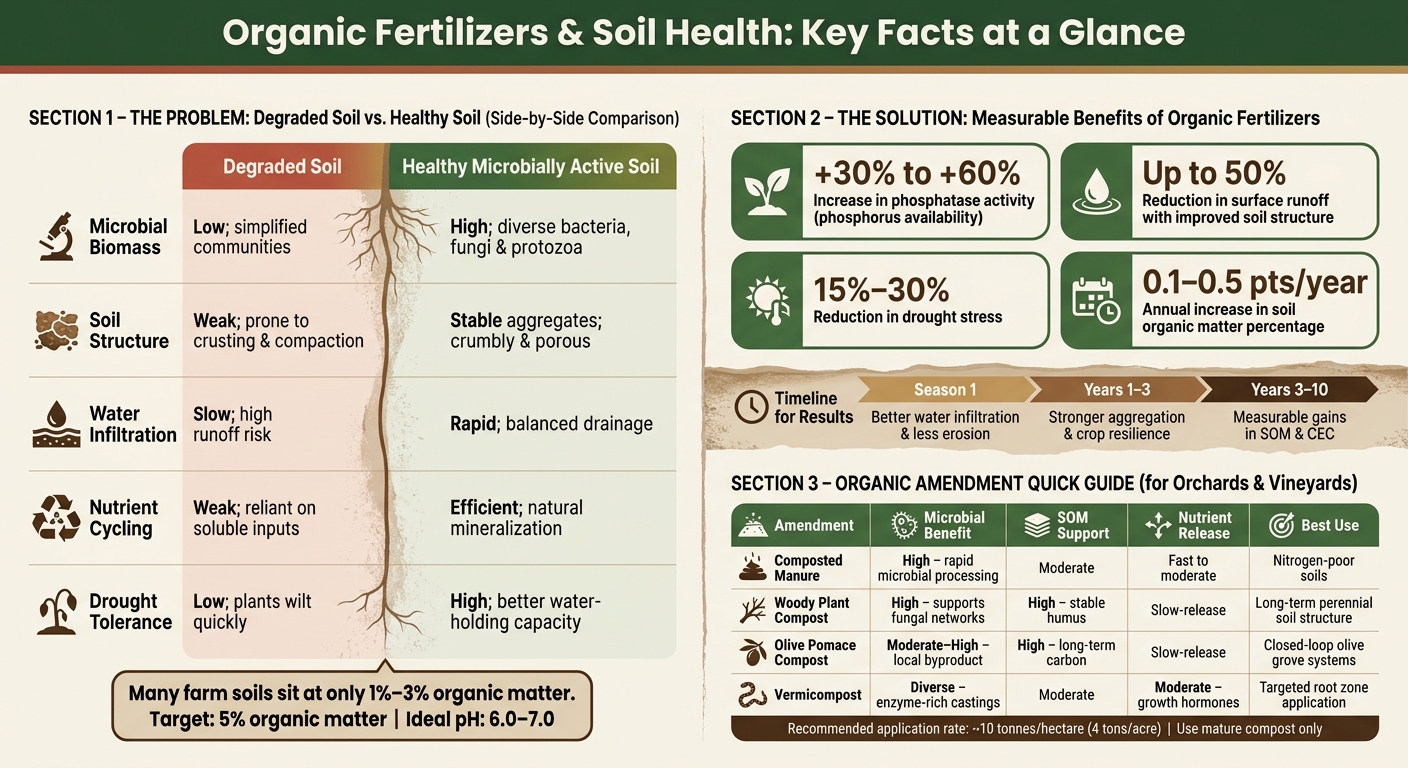
Degraded Soil vs. Healthy Soil: Key Indicators & Organic Fertilizer Benefits
How are organic fertilizers effecting soil microbes and what does that mean for your soil health?
sbb-itb-4066b8e
The Problem: What Happens When Soil Microbial Activity Declines
When soil loses organic matter, the microbial community gets thinner. And when that happens, nutrient cycling slows, soil structure weakens, water retention drops, and crops become less resilient. That’s not a small issue, especially when many farm fields already test at only 1% to 3% organic matter.
Low Organic Matter, Weaker Nutrient Cycling, and Poor Soil Structure
Helpful fungi make glomalin, and bacteria release polysaccharides. Think of them as the soil’s natural glue. They help bind particles into stable aggregates.
When microbial activity falls, that glue supply drops. Soil structure starts to break apart, aggregates collapse, and compaction becomes more common.
You can see the effects in the field pretty fast. Compacted soil crusts after rain, which makes it harder for roots to push through. Sandy soils let water move out too fast, while clay soils can leave water sitting on the surface. With fewer active microbes, nutrients stay less available to plants, so crops lean more on soluble fertilizers that can leach away easily.
How Simplified Microbial Communities Affect Crop Resilience
It’s not just about how many microbes are in the soil. Diversity matters too.
Soils that go without steady organic inputs often shift into simplified microbial communities, where only a small number of species dominate. That loss of diversity weakens natural disease suppression and lowers plant tolerance to drought, heat, and salinity.
In olive groves and vineyards, degraded soils hold less water. The result is pretty direct: crops wilt faster and recover more slowly during heat and drought.
Degraded Soil vs. Healthy Microbially Active Soil: A Side-by-Side Comparison
| Indicator | Degraded Soil | Healthy Microbially Active Soil |
|---|---|---|
| Microbial Biomass | Low; simplified communities | High; diverse community of bacteria, fungi, and protozoa |
| Soil Structure | Weak; prone to crusting and compaction | Stable aggregates; crumbly, porous structure |
| Water Infiltration | Slow; high runoff risk | Rapid; balanced drainage |
| Nutrient Cycling | Weak; reliant on soluble inputs | Efficient; natural mineralization keeps nutrients available |
| Drought Tolerance | Low; plants wilt quickly under heat | High; better water-holding capacity |
Getting organic matter back from 1%–2% up to 3%–5% usually takes 3–5 years of steady inputs, which is why the next section moves into organic fertilizers.
The Solution: How Organic Fertilizers Feed Beneficial Microbes
Organic amendments help bring life back to the soil by giving microbes both food and a place to live. Put simply, organic fertilizers help rebuild microbial activity because they add organic carbon and organic matter below ground.
What Organic Fertilizers Give Microbes
Inputs like composted manure, plant-based compost, and olive pomace give soil microbes a steady food source. That matters because, unlike synthetic inputs that can create short nutrient spikes, these materials keep microbial activity going over time.
Microbes then break down that organic matter and turn it into nutrients plants can use. Once they have enough fuel, they start nutrient cycling again and help bind soil particles into aggregates.
Organic matter also increases cation exchange capacity (CEC), which helps soil hold onto nutrients like potassium, calcium, and magnesium. Olive pomace breaks down slowly, which tends to favor fungi and long-term carbon storage. That’s a direct plus in olive grove soils, where fungal networks support crop health over many seasons.
Soil Gains From Higher Microbial Activity
When microbial activity rises, soil function tends to improve in a few different ways.
Compost can increase phosphatase activity by 30–60%, which improves phosphorus availability. As microbial communities become more active, soil structure can improve enough to cut surface runoff by up to 50% and reduce drought stress by 15–30%.
The timing, though, is not instant.
- Better water infiltration and less surface erosion often show up in the first season.
- Stronger aggregation and better crop resilience usually become more visible over 1–3 years.
- Measurable increases in soil organic matter and CEC often take 3–10 years of steady applications.
Organic Fertilizer Types and Their Effects on Soil Microbes: A Comparison
Not all amendments do the same job. Some feed microbes fast. Others work more slowly and help build soil over time. In perennial systems like olive groves and vineyards, that difference matters because the goal isn’t a quick fix. It’s year-by-year improvement.
| Amendment Type | Microbial Activity Focus | Soil Organic Matter (SOM) Support | Nutrient Release Pattern | Best Fit for Orchards and Vineyards |
|---|---|---|---|---|
| Composted Manure | High; labile carbon for rapid microbial processing | Moderate; can be high in soluble salts | Fast to moderate; quick nutrient pulses | Good for nitrogen-poor soils; monitor phosphorus buildup |
| Woody Plant Compost | High; supports fungal networks and diverse microbes | High; builds stable humus and aggregates | Slow-release; syncs with plant demand | Excellent for long-term soil structure in perennial systems |
| Olive Pomace Compost | Moderate to high; feeds microbes using local byproducts | High; stable organic particles, long-term carbon storage | Slow-release; retains moisture in dry climates | Ideal for closed-loop systems in olive groves |
| Vermicompost | Diverse; enzyme-rich worm castings | Moderate; improves soil tilth | Moderate; rich in plant-growth-promoting hormones and enzymes | Excellent for targeted application near active root zones |
For orchards and vineyards, choosing the right input can make a big difference. In olive groves and vineyards, plant-based composts and olive pomace composts tend to be the best long-term match because they build stable humus and support fungal networks. That kind of stability is especially useful in perennial systems, where soil structure needs to improve season after season.
Compost and Orchard Management: Turning Organic Inputs Into Better Soil
How Composting Produces a Stable, Microbe-Friendly Amendment
After organic inputs start feeding microbes, the next job is to make those materials stable enough to help soil instead of stressing it. Composting does that. It's a microbially driven process where bacteria break down simple compounds first. As they work, the pile heats up to 131–160°F, which helps cut down weed seeds and pathogens. After that, fungi and actinomycetes move in to break down tougher fibers and turn the material into stable humus.
That living activity only helps when the compost is fully stabilized. Use mature compost only. If the material is still immature, it can tie up nitrogen, acidify soil, and release ammonia that can damage roots. A simple way to check maturity is with a seed test: germinate radish or lettuce seeds in a compost mix. If they grow with vigor, the compost is stable.
For day-to-day compost management, keep the pile:
- Near a 20:1 to 30:1 carbon-to-nitrogen ratio
- Moist like a wrung-out sponge
- Aerated with regular turning
Applying Compost in Olive Groves and Grape-Growing Systems
Once compost is mature, placement starts to matter just as much as the material itself. In olive groves and vineyards, woodier composts tend to work well with perennial root systems because they help support long-term soil structure. Spread compost near the dripline so nutrients reach active root zones. Putting compost under mulch helps protect the microbial community from UV light and big temperature swings. In no-till systems, surface application adds organic matter without breaking up fungal networks.
A practical yearly rate for orchards and vineyards is about 10 tonnes per hectare - roughly 4 tons per acre. That rate has been used in Chilean vineyards and has shown measured gains in soil structure and water retention under dry-climate conditions.
For olive groves, composted olive mill pomace is a useful local byproduct choice. It puts orchard waste back into the soil instead of letting it go to waste. With repeated applications, it can improve aggregate stability, water infiltration, and drought tolerance within 1–2 years.
Those choices help turn organic inputs into steady gains in soil structure and microbial activity.
Conclusion: Key Takeaways for Building Healthier Soil Naturally
The Core Problem and Solution, Restated
In practice, organic fertilizers do their best work when they keep feeding the soil food web year after year. Many worn-out soils sit at just 1% to 3% organic matter and have weak microbial activity. That slows nutrient cycling and makes the soil less able to handle stress.
Organic fertilizers and compost help turn that around. They supply the carbon and nitrogen microbes need to do their job. Put simply: organic fertilizers feed microbes, and microbes help rebuild soil function. As microbial activity comes back, soil aggregates get stronger, which improves both drainage and water retention. And with steady organic inputs, soil organic matter can increase by 0.1 to 0.5 percentage points per year.
What Healthy Soil Means for Premium Crop Quality
This biological recovery matters even more in perennial crops, where soil health affects fruit quality across many seasons. For olives and grapes used in premium olive oil and balsamic vinegar, biologically active soil helps provide the steady nutrient supply needed for premium olives and grapes.
A working soil food web releases nutrients slowly and in step with what plants need, which can reduce root stress and support even fruit development. Mycorrhizal fungi stretch the plant’s root reach and help with phosphorus and micronutrient uptake. Diverse microbial communities can also suppress soil-borne pathogens on their own, helping plants keep growing at a steady pace.
Healthy soil connects organic fertilizers to premium crop quality.
FAQs
How do I know if my soil microbes are lacking?
Start with a professional soil test to check organic matter, pH, and nutrient levels.
Low microbial activity often shows up in the soil before it shows up in the crop. Common signs include compacted soil, poor drainage, slow water infiltration, surface runoff, crusting, shallow roots, low earthworm activity, and plants that don’t handle drought or disease well.
Adding organic matter on a regular basis, such as compost, helps feed soil microbes and improve soil structure over time.
Which organic fertilizer is best for olives or grapes?
Composted olive pomace works well as an organic fertilizer for both olive trees and grapes. Once it’s processed the right way to neutralize polyphenols, it supplies slow-release nitrogen, phosphorus, and potassium. It also helps improve soil structure, water retention, and microbial activity.
For better results, mix it with nitrogen-rich manure and bulking materials like grape stalks or pruning residues. That mix helps balance the carbon-to-nitrogen ratio, which is a big part of getting compost to work the way it should.
How long does compost take to improve soil?
It depends on the result you want.
Soil moisture behavior can start to improve in 4 to 8 weeks. Soil structure often begins to get better within one growing season.
The bigger changes usually take more time. More noticeable shifts in soil structure, microbial activity, and plant response tend to show up within 1 to 3 years of steady use.
Long-term fertility and higher organic matter usually take 3 to 10 years of consistent annual applications.