

Producer Accountability in Olive Oil Supply Chains
Olive oil fraud is a $10–15 billion global issue, with up to 10% of food products affected. Mislabeling, adulteration with cheaper oils, and unethical labor practices are rampant. These challenges degrade quality, harm workers, and mislead consumers.
Accountability in olive oil production ensures quality, fair labor, and transparency. Key solutions include:
- Certifications like PDO and Fairtrade for quality and ethical standards.
- Blockchain technology for tamper-proof supply chain tracking.
- Life Cycle Assessments (LCAs) to measure production impacts.
- Fair labor practices to improve worker conditions and product quality.
Consumers can support this by choosing certified products and using tools like QR codes for traceability. Producers benefit from transparency through higher consumer trust and premium pricing. Together, these efforts strengthen the olive oil supply chain.
Challenges in Olive Oil Supply Chains
Fraud and Adulteration Risks
The olive oil industry has long struggled with fraud that undermines both product quality and consumer confidence. A common scheme involves blending high-quality Extra Virgin Olive Oil (EVOO) with lower-grade oils, such as refined olive oil, olive pomace oil, or lampante oil. Some producers go even further, diluting EVOO with cheaper vegetable oils like soybean, sunflower, corn, canola, hazelnut, peanut, or palm oil.
Geographical mislabeling is another widespread issue. For instance, in December 2015, Italian authorities discovered nearly 7,000 tons of olive oil imported from North Africa that had been mixed with domestic Italian oil and falsely labeled as "100% Italian." This fraudulent batch was valued at tens of millions of dollars.
These practices don't just deceive consumers - they degrade the quality of the product. Adulterated oils often have lower nutritional benefits, are more prone to oxidation, and may contain chemical residues from industrial processing. Jeffrey C. Moore, Lead Scientist at the US Pharmacopeial Convention, highlights the risks clearly:
"Only the criminal knows how the food ingredient has been manipulated and is, thus, the only one with the information, but not necessarily the expertise, to assess whether such a manipulation poses any toxicological or hygienic risks."
Penalties for such fraud are often minimal. In Italy, for example, falsely labeling olive oil as "100% Italian" typically results in fines ranging from $2,200 to $13,200. Many experts argue that these amounts fail to deter large-scale fraud. Beyond product quality, addressing ethical concerns like labor practices is equally critical.
Labor Exploitation and Fair Wages
Labor exploitation remains a pressing issue in some olive oil-producing regions. Workers often face poor conditions, low wages, and job insecurity, which not only harm individuals but also threaten the stability of the supply chain over time.
Fair labor practices can directly influence product quality. Producers who treat their workers fairly are more likely to invest in practices like hand-picking olives at their peak ripeness. This method helps maintain the fruit's integrity, resulting in better flavor and higher antioxidant levels.
Some producers are already taking steps to improve transparency. In November 2024, Turkish producer Murat Kalavaoglu Oil introduced Digital Product Passports (DPPs) to document ethical farming practices. By doing so, the company complied with Germany's Supply Chain Due Diligence Act, resolved customs delays, and secured partnerships with European retailers seeking proof of ethical standards.
New regulations, such as the EU's Corporate Sustainability Due Diligence Directive (CSDDD) and Germany's Supply Chain Due Diligence Act (LkSG), are pushing producers to address human rights risks like child labor and unfair wages. Noncompliance could lead to customs holds, steep fines, or exclusion from premium markets.
sbb-itb-4066b8e
Certifications and Standards for Responsible Production
Key Certifications for Responsible Olive Oil Production
Certifications play a crucial role in ensuring accountability and promoting responsible practices in olive oil production. They set strict guidelines for producers to follow, covering both environmental sustainability and social responsibility. For example, organic certification in the EU, governed by Regulation (EC) No 834/2007, limits the use of synthetic fertilizers and pesticides. Producers must undergo a conversion period of 24 to 36 months to meet these standards.
Fairtrade (Max Havelaar) emphasizes fair wages, ethical labor practices, and environmental stewardship. Similarly, GlobalG.A.P., established in 1997, offers a worldwide standard for safe and sustainable agricultural practices that address both environmental and social aspects. On the geographical front, Italy boasts an impressive 42 Protected Designation of Origin (PDO) and 6 Protected Geographical Indication (PGI) certifications, which tie olive oil quality to specific regions and traditional methods.
The Product Environmental Footprint Category Rules (PEFCR), developed by the European Commission, provide a clear framework for conducting Life Cycle Assessments (LCA) in line with ISO 14040 and 14044 standards, specifically tailored for olive oil. In the United States, certifications like the California Olive Oil Council (COOC) Seal ensure full traceability, linking products to their geographic origins and harvest years.
A noteworthy example of environmental certification is Italian producer Apolio, which received an Environmental Product Declaration (EPD) in 2021 for its "Denocciolato" extra virgin olive oil. This certification followed International EPD System standards (ISO 14025) and involved a life cycle assessment covering three key phases: agriculture (upstream), processing (core), and end-of-life (downstream).
Many of these certifications incorporate LCAs to provide a comprehensive understanding of environmental impacts across the supply chain.
How Life Cycle Assessments (LCA) Work
Life Cycle Assessments (LCA) are essential tools for evaluating the environmental impact of olive oil production, covering every stage from farming to waste management - often referred to as "cradle to grave". By identifying environmental hotspots, LCAs help producers target areas for improvement, such as farming, extraction, packaging, and waste treatment.
LCAs measure various environmental factors, including Global Warming Potential (GWP), water usage, acidification, and eutrophication. Studies show that farming is the primary contributor, accounting for 70% to 90% of the total environmental impact. For instance, research on Spanish olive oil revealed that farming contributed 76.3% of the overall impact, with fertilizers alone responsible for 81% to 87% of the climate change and acidification impacts.
"The farming phase accounted for 76.3% of the EIs [Environmental Impacts]. Therefore, to reduce the impact of the virgin olive oils production, most of the efforts should be made especially in the farming phase."
– R. García-Ruiz, Researcher, Journal of Environmental Management
The choice of farming methods can significantly influence environmental outcomes. A study conducted between 2015 and 2020 on 11 olive farms in Southern Spain found that traditional rainfed groves had a negative carbon footprint of -5.5 kg CO₂ eq per kg of oil produced. This was due to the CO₂ absorbed by the trees exceeding the emissions from production. Olive trees, when managed effectively, can sequester approximately 28.9 kg of CO₂ per plant annually, making them valuable carbon sinks.
Processing methods also play a role in sustainability. For instance, research comparing two-phase and three-phase extraction systems for processing 1,000 kg of olives found that the two-phase system produced about 212 kg CO₂ eq, while the three-phase system nearly doubled that at 396 kg CO₂ eq. Packaging decisions further impact sustainability, with glass bottle production accounting for 80% to 90% of the energy use and environmental impact during the transformation stages.
Technology for Supply Chain Traceability
Blockchain for Supply Chain Transparency
Building on established sustainability certifications, technology now offers a way to achieve deeper visibility into supply chains. Blockchain creates a permanent record of every step in the production process - from harvesting to bottling - using IoT sensors to track details like temperature, acidity, and GPS location. Unlike traditional databases controlled by a single entity, blockchain stores records across multiple servers, making them resistant to tampering. Each transaction is added as a block, creating an unalterable chain of custody.
Smart contracts add another layer of efficiency by verifying sensor data in real time and automatically flagging quality issues. This system allows consumers to instantly confirm the authenticity of products.
For example, in October 2023, an olive mill in Jordan adopted the Decapolis Food Guard blockchain platform to monitor olives from their arrival at the mill through the bottling process. This initiative led to a 15–25% rise in sales, as customers gained confidence in the oil's authenticity. Meanwhile, a survey of Italian consumers revealed they were willing to pay an average premium of 17.8% for olive oil with blockchain-verified traceability. Some producers have even added gamification elements, like scratch-and-win features that protect QR codes and reward consumers with digital tokens - worth about $0.05 - for verifying their purchase. These features not only build trust but also enhance customer engagement.
This approach is already making its mark, as seen in practical applications like the one below.
Case Study: Olive Oil Traceability in Montorio Romano
This case study highlights how even small-scale farms can adopt advanced traceability systems. In November 2020, the Ponzani Antonio farm in Montorio Romano, Italy, implemented a comprehensive tracking system for its 33 olive trees, which included three cultivars: Carboncella, Frantoio, and Leccino. Waterproof RFID tags were attached to each tree to record its cultivar and GPS location. During harvest, workers scanned these tags and placed the olives into crates equipped with their own RFID tags to log weight and maturity details. A portable reader, paired with a dedicated app, synchronized all this data. Finally, the farm labeled 100 bottles with QR codes, enabling consumers to view the entire estate production history.
Financially, the system increased production costs by 3%–15.5%, depending on the yield. Higher-yield trees (producing up to 60 kg, or about 132 lbs, per tree) kept costs lower, while trees yielding around 5 kg (about 11 lbs) saw higher cost increases. This example shows that smaller operations can successfully incorporate advanced traceability systems by using open-source hardware and Bluetooth-enabled apps, keeping upfront costs manageable.
Benefits of Producer Accountability
Fair Pricing and Ethical Labor
When producers are held accountable, it creates a direct link between production practices and worker well-being. Transparent systems for tracking labor help prevent exploitation, ensure fair wages, and promote worker safety through enforceable contracts and investments in local communities. These practices don’t just benefit the workers - they also contribute to the overall quality of the final product.
Better Product Quality and Consumer Trust
Producer accountability doesn’t just stop at ethical labor - it also plays a key role in delivering higher-quality products. For example, a September 2025 study by the North American Olive Oil Association examined 190 olive oil samples. It found that the top 15 brands, which dominate 85% of the market, showed zero adulteration. On the other hand, two smaller brands with less than 1% combined market share contained non-olive oils. This study also highlighted a connection between price and quality: oils priced below $6.50 per liter often had sensory defects, while those in the $14–$23 range consistently met extra virgin standards.
Additionally, digital verification tools are transforming how consumers engage with products. Take Terra Delyssa as an example: their QR codes let buyers access supply chain photos and lab results confirming zero pesticide residue for specific batches. This kind of transparency replaces vague marketing claims with hard evidence, giving consumers confidence in what they’re purchasing. Considering that 70% of consumers are unaware of the legal maximum acidity level for extra virgin olive oil classification, tools like these are essential for bridging the knowledge gap.
From Grove to Global Table: Today's Olive Oil Supply Chain
Comparing Accountability Methods
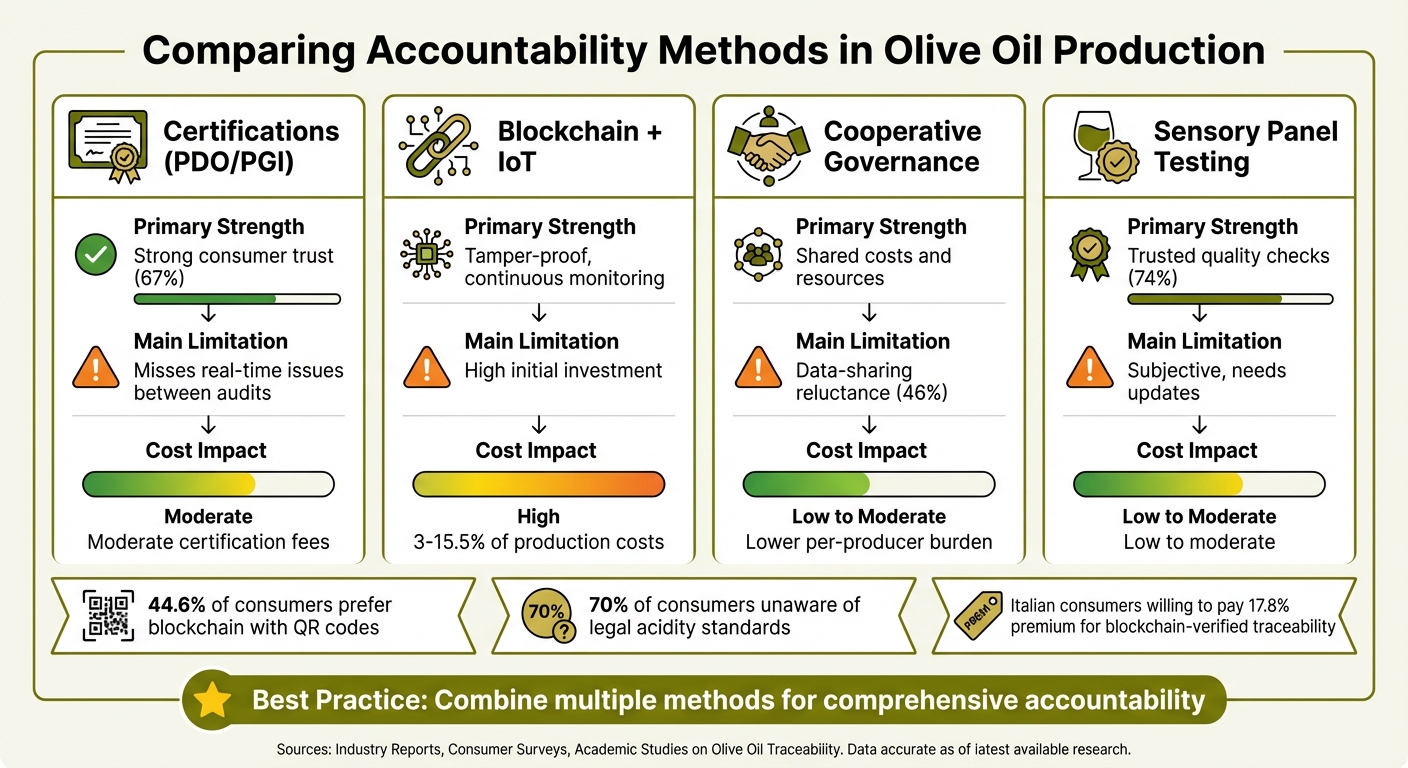
Olive Oil Supply Chain Accountability Methods Comparison
Pros and Cons of Different Accountability Methods
When it comes to accountability in olive oil production, various methods bring their own strengths and challenges. These approaches aim to improve traceability and uphold ethical sourcing, but no single method checks all the boxes.
Traditional certifications like PDO (Protected Designation of Origin) and PGI (Protected Geographical Indication) are well-recognized by consumers. In fact, 67% of European consumers trust these systems to safeguard traditional production methods. But there’s a catch - they rely on periodic audits instead of continuous monitoring. This creates gaps where mislabeling can occur between inspections. Plus, the administrative costs can be a heavy burden for smaller producers.
Blockchain and IoT systems, on the other hand, offer a modern, tech-driven solution. These tools create a tamper-proof record of every step in the supply chain, ensuring transparency from the olive tree to the bottle. A 2019 consumer study in Grottaferrata, Italy, tested three traceability technologies, and blockchain paired with QR codes emerged as the favorite, chosen by 44.6% of participants over NFC tags (20.8%) and RFID devices (20.9%). However, the downside is cost. Depending on farm size and yield, implementation can eat up 3% to 15.5% of production costs.
Cooperative governance models provide a way to spread these costs across multiple producers. For example, researchers in Montorio Romano, Italy, showed in 2020 that a technological traceability system tracking 33 olive trees became economically viable when scaled up to a consortium level. Still, convincing producers to share data is a hurdle - 46% of industry players worry about intellectual property concerns.
Here’s a quick breakdown of these methods:
| Method | Primary Strength | Main Limitation | Cost Impact |
|---|---|---|---|
| Certifications (PDO/PGI) | Strong consumer trust (67%) | Misses real-time issues | Moderate certification fees |
| Blockchain + IoT | Tamper-proof, continuous monitoring | High initial investment | 3-15.5% of production costs |
| Cooperative Governance | Shared costs and resources | Data-sharing reluctance (46%) | Lower per-producer burden |
| Sensory Panel Testing | Trusted quality checks (74%) | Subjective, needs updates | Low to moderate |
Ultimately, no single method can stand alone. Combining approaches - like leveraging certifications for consumer trust, integrating technology for real-time monitoring, and adopting cooperative models to share costs - creates a more balanced and effective accountability system. This integrated strategy could be the key to sustainable and transparent olive oil supply chains.
Conclusion: The Path Forward for Olive Oil Supply Chains
Key Takeaways for Producers and Consumers
The olive oil industry faces ongoing challenges with fraud and adulteration, which threaten both product quality and consumer trust. To address these issues, accountability across the supply chain is more important than ever.
For producers, embracing transparency isn't just about compliance - it's a strategic move. Tools like Digital Product Passports and traceability systems may slightly increase production costs, but they align with consumer priorities. In fact, 74% of consumers are willing to pay a premium for oils with verified traceability. As Slovenian olive grower Sandi Babič aptly states:
"Excellence is not created by laws. It comes from conscience, ethics and personal responsibility."
Consumers also play a crucial role in shaping the future of the industry. Supporting oils with PDO or PGI certifications, which safeguard traditional methods, sends a strong message to producers. Smartphone apps that scan QR codes make it easier than ever for buyers to verify a product's authenticity, turning passive purchases into active endorsements of supply chain integrity.
The path forward requires a united effort. Producers should focus on obtaining third-party certifications, adopt early harvesting techniques to boost polyphenol content, and participate in data-sharing initiatives. Meanwhile, consumers can back brands that prioritize ethical labor practices and responsible production methods. Together, these actions can create a supply chain rooted in quality, ethics, and sustainability - ensuring every bottle reflects these values.
At Big Horn Olive Oil, we are dedicated to transparency, quality, and ethical practices in every step of our process.
FAQs
How can I ensure the olive oil I buy is authentic and ethically produced?
To make sure you're getting genuine, high-quality olive oil, check for certifications like the USDA’s Quality Monitoring Program (QMP) seal. This seal means the oil has undergone strict chemical and sensory tests to confirm its purity and quality. Be cautious of oils with unclear or misleading labels - some products claiming to be "extra virgin" might actually include lower-grade oils.
For added peace of mind, go for brands that are upfront about their sourcing and production methods. By supporting producers who focus on ethical and sustainable practices, you’re not only ensuring top-notch olive oil but also contributing to a more responsible supply chain.
How does blockchain technology improve transparency in the olive oil supply chain?
Blockchain technology brings a new level of transparency to the olive oil supply chain by creating a secure and unalterable record of every stage - from harvesting olives to delivering the finished product. This system ensures precise tracking of the oil's origin and quality, helping to minimize issues like fraud, mislabeling, or tampering.
When combined with smart devices, such as sensors and electronic labels, blockchain also allows for real-time monitoring of product conditions. This ensures that extra virgin olive oil (EVOO) maintains the highest quality standards. For consumers, this means greater confidence in the product's authenticity, while the supply chain as a whole benefits from stronger support for ethical and environmentally conscious practices.
Why do fair labor practices matter in olive oil production?
Fair labor practices are essential for ensuring the quality and integrity of olive oil. When workers are treated with respect and provided safe working environments, they’re more likely to approach their work with care and attention to detail. This dedication directly impacts the quality of the final product.
On the flip side, unethical labor practices can lead to cutting corners, lower production standards, and even instances of fraud. These practices not only harm workers but also erode consumer trust and tarnish the product's reputation. By supporting ethical labor practices, we promote transparency, long-term sustainability, and a better olive oil experience for everyone involved.