

5 Regenerative Practices for Olive Grove Soil
Healthy soil is the backbone of producing high-quality olive oil. By focusing on soil health, olive growers can improve tree resilience, reduce pests, and boost oil quality. Here are five practices that can transform olive groves:
- No-Till Farming: Protects soil structure, reduces erosion, and supports microbes.
- Cover Cropping: Prevents erosion, recycles nutrients, and improves soil health.
- Compost and Organic Amendments: Enriches soil with organic carbon and nutrients.
- Mulching with Pruning Residues: Reduces water loss, prevents erosion, and builds soil fertility.
- Directed Grazing: Naturally manages weeds and enriches soil with livestock manure.
These methods not only improve the soil but also lead to better olive oil flavors and higher tree productivity. Below, we explain how each practice works and why it matters.
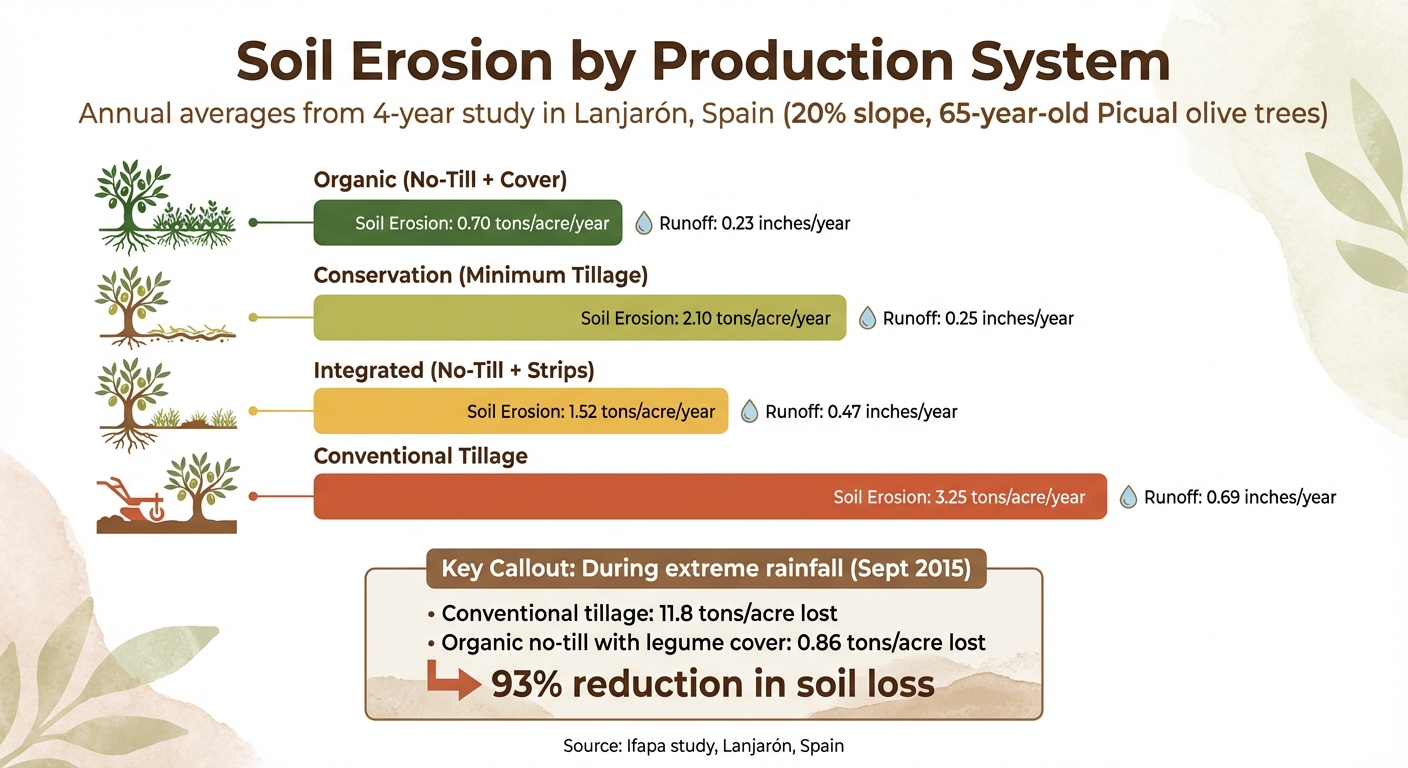
Soil Erosion Comparison: Regenerative vs Conventional Olive Farming Methods
How Regenerative Agriculture Helped Create the World’s Most Powerful Olive Oil
sbb-itb-4066b8e
1. No-Till Farming
No-till farming means leaving the soil undisturbed - no plowing, discing, or mechanical turning. In olive groves, this approach protects the soil’s natural structure and preserves the microbial community. The result? Trees can more effectively access and use nutrients.
Improves Soil Health
One major benefit of no-till is reduced soil compaction. Toni Longley, Agricultural Project Manager at California Olive Ranch, shared insights from their 650-acre organic block. By incorporating no-till practices alongside multi-species cover crops, they observed a decrease in bulk density, which made the soil less compact and more porous.
"We did see benefits of the cover crop on some parameters of soil health. It decreased the bulk density so that was a positive. It shows that our soil is becoming less compact which will also increase our water infiltration." - Toni Longley, California Olive Ranch
This reduced compaction encourages deeper root growth and better aeration, creating the perfect conditions for beneficial microbes to thrive.
Enhances Nutrient Availability
Frequent tillage disrupts the delicate balance of the soil microbiome - the network of bacteria and fungi that help olive trees absorb nutrients. In Andalusia, where nearly 30% of olive groves are on steep slopes, tillage has stripped the soil of critical nutrients. No-till farming preserves this microbial balance, allowing trees to more efficiently transform simple nitrates into essential amino acids and proteins. Healthy soil equals healthier trees, which ultimately leads to higher-quality extra virgin olive oil.
Supports Biodiversity
When combined with ground cover, no-till farming creates habitats for beneficial insects and predators of olive pests. Between 2015 and 2018, researchers from Ifapa and the University of Granada studied 20 plots in Jaén, Granada, Málaga, and Córdoba. Their findings showed that no-till systems with protective vegetation supported higher biodiversity, including moths, butterflies, and predatory insects, compared to conventionally tilled plots.
"It is a more natural and profitable cultivation system that helps stop erosive processes and the scarcity of biodiversity." - Francisco Bruno Navarro, Lead Researcher, Ifapa
Reduces Erosion and Water Loss
No-till farming also helps prevent erosion and conserves water. In a study by Ifapa conducted in Lanjarón, Spain, researchers tracked soil erosion on a 20% mountain slope planted with 65-year-old Picual olive trees. Over four years, organic no-till systems lost only 0.70 tons of soil per acre annually, while conventional tillage plots lost 3.25 tons. During an extreme rainfall event in September 2015, tilled plots lost 11.8 tons of soil per acre, while no-till plots with legume cover lost just 0.86 tons.
| Production System | Avg. Soil Erosion (t/acre/year) | Avg. Runoff (inches/year) |
|---|---|---|
| Organic (No-Till + Cover) | 0.70 | 0.23 |
| Conservation (Min. Tillage) | 2.10 | 0.25 |
| Integrated (No-Till + Strips) | 1.52 | 0.47 |
| Conventional Tillage | 3.25 | 0.69 |
No-till also improves water infiltration and retention, making olive groves more resilient during droughts. By strengthening soil structure, this practice sets the stage for other regenerative methods that further enhance soil health.
2. Cover Cropping
Cover cropping involves planting or allowing spontaneous vegetation to grow between olive tree rows, working hand-in-hand with no-till practices. This approach helps preserve soil structure, maintain nutrient cycles, and shield the land from erosion. In Mediterranean climates, where heavy rains can strip away topsoil, cover crops act as a natural defense system.
Reduces Erosion and Water Loss
Cover crops serve as a barrier against the damaging effects of rainfall and water runoff. Research from Andalusian olive groves highlights their impact: systems with cover crops reduced soil loss by an impressive 85-89% and runoff by 37-43%, compared to conventional tillage. To put this into perspective, annual soil loss under cover crops ranged from 0.1 to 14.5 tons per acre, while tilled plots saw losses between 2.0 and 65.8 tons per acre. Additionally, ground cover protected the soil 65.7% of the time, compared to just 22.4% under conventional tillage.
"We concluded that ground cover not only reduces erosion and runoff, but also losses of organic carbon in soil, by three quarters compared to tillage."
– Francisco Márquez, University of Córdoba
Enhances Nutrient Availability
Cover crops do more than prevent erosion - they actively recycle nutrients. Spontaneous vegetation can accumulate approximately 43 lbs of nitrogen, 5.5 lbs of phosphorus, and 53.6 lbs of potassium per acre each year. Legumes like vetch and clover are particularly beneficial since they naturally fix nitrogen from the atmosphere, enriching the soil. When these crops are mowed or terminated in early spring, their decomposing biomass releases these nutrients back into the soil, feeding olive trees during their growing season. This nutrient boost not only strengthens the trees but also enhances the quality of the olives, leading to superior extra virgin olive oil.
Improves Soil Health
The roots and organic matter from cover crops play a key role in improving soil structure and promoting microbial activity. In fact, a two-year study using multi-species cover crops restored soil bacterial functionality to natural levels. Cover crops also significantly increase carbon storage - olive groves with full ground cover can sequester about 1,414 lbs of carbon per acre each year, more than double the amount stored in groves managed by clearing the canopy. To achieve the best results, it’s recommended to plant cover crops in the fall and either mow or chemically manage them by mid-spring (March to April) to avoid competing with olive trees for water during the dry summer months.
3. Compost and Organic Amendments
Building on practices like no-till farming and cover cropping, adding compost and organic materials plays a key role in rebuilding soil structure and fertility. Using materials such as olive mill pomace, pruning residues, and composted organic matter doesn't just nourish the trees - it revitalizes the entire soil ecosystem.
Improves Soil Health
Organic amendments are a game-changer for carbon storage in olive grove soils. Between 2009 and 2014, Francesco Montemurro and his team conducted a five-year study in an organic Mediterranean olive grove in Italy. They tested olive pomace compost (OPC) and olive mill wastewater (OWW) against green manure (GM) and organic-mineral fertilizers. The results were striking: OPC increased total organic carbon by 47.5% compared to organic-mineral treatments, and humified organic carbon levels were notably higher in soils treated with OWW and OPC than in those treated with green manure. Even after a year of decomposition, 40% to 49% of the carbon from these amendments remained in the soil, promoting long-term carbon storage. In groves where organic amendments had been used for over a decade, soil organic matter was twice as high, and total nitrogen was 1.6 times higher than in conventionally managed soils.
Enhances Nutrient Availability
These amendments offer a steady release of nutrients, making them ideal for managing soil fertility over time. While cover crops provide an immediate nitrogen boost, materials like pruning residues and pomace release nutrients more gradually. For example, cover crop residues can release up to 31% of their nitrogen within 130 days, while pruning residues and pomace, with their higher carbon-to-nitrogen ratios, ensure a slower, more sustained nutrient release. This not only supports long-term soil health but also prevents nitrogen loss during heavy rains. The consistent nutrient availability also nurtures a dynamic and thriving microbial community.
Supports Biodiversity
Organic materials create a rich environment where microorganisms can flourish. A long-term study (1997–2014) conducted on olive farms in Andújar, Jaén Province, Spain, examined the effects of olive-mill pomace co-compost. Researchers, including G. Masciandaro and C. Macci, found that after 17 years of application, the resilient organic matter pool increased six-fold in carbonated soils and eight-fold in silicic soils. Additionally, enzymatic activity saw a dramatic boost, with β-glucosidase activity increasing 25-fold in amended silicic soils. Soils managed with organic amendments over the long term also had enzyme activities 2.1 times higher than those in depleted soils. These enzymes are vital for breaking down organic matter and cycling nutrients, fostering healthier trees and better-quality fruit.
4. Mulching with Pruning Residues and Biochar
Using shredded pruning residues and biochar as mulch not only helps maintain soil fertility but also provides a protective layer against erosion.
Improves Soil Health
Shredded pruning residues contribute about 819 kg of carbon per hectare (≈730 lbs/acre) each year, while biochar acts as a long-term carbon sink, lasting over 13 years. To see a noticeable boost in topsoil carbon (0–20 cm depth), aim to apply at least 15 tons per hectare (≈6.1 tons/acre). In super-intensive groves, pruning biomass can range from 10.5 to 17.6 tons per hectare (≈4.3 to 7.1 tons/acre). Concentrating these residues in specific areas, rather than spreading them evenly, can maximize their carbon-storing potential. This stable carbon buildup also strengthens the soil’s ability to resist erosion.
Reduces Erosion and Water Loss
Mulching creates a physical shield that protects the soil from the impact of raindrops, preventing surface sealing and helping water soak into the ground more effectively. During heavy rainfall, mulching has been shown to cut soil loss by over 95% and reduce runoff by 42% to 95%. For the best results in retaining moisture, apply mulch at rates exceeding 7.5 tons per hectare (≈3.0 tons/acre), preferably in the spring when residues retain moisture.
Enhances Nutrient Availability
Initially, shredded mulch can temporarily tie up nitrogen as microbes break down the carbon-rich material. However, this is a short-term effect. Over time, as decomposition continues, it produces humic and fulvic acids - key compounds for plant nutrition. These acids improve soil carbon, nitrogen, and phosphorus levels. ESAO explains:
"The shredded mulch, in the short run, sequesters nitrogen, but in the medium and long run, it brings valuable humic substances and nutrients that can be assimilated".
To speed up nutrient availability, consider adding manure or slurry over the mulch. Once nutrient levels stabilize, the enriched soil environment fosters a variety of beneficial organisms.
Supports Biodiversity
A mulch layer provides a welcoming habitat for soil organisms and arthropods that are essential for natural pest control. By regulating soil temperature and conserving moisture, mulching promotes the growth of microbes, earthworms, and beneficial insects. Additionally, the mulch acts as a physical barrier and creates a nitrogen-poor surface, which helps suppress weeds - reducing the need for chemical herbicides. These benefits enhance tree health and contribute to producing higher-quality olive oil.
5. Directed Grazing
Bringing livestock into olive groves offers a natural way to manage vegetation while boosting soil health. By letting animals graze among the trees, you not only control weeds but also enrich the soil with their manure and urine, which supply key nutrients like nitrogen, phosphorus, and potassium. This approach maintains continuous ground cover, protecting against erosion and reducing water loss. Similar to no-till farming and cover cropping, directed grazing helps sustain soil fertility and structure without the need for heavy machinery.
Improves Soil Health
Directed grazing plays a big role in improving soil organic carbon (SOC) levels and water dynamics. Unlike mechanical tillage, which can damage soil structure by breaking down aggregates, livestock help maintain soil integrity by converting cover crops into nutrient-rich manure. Studies show that integrated crop-livestock systems maintain higher SOC levels compared to traditional monoculture farming practices. Even a small 1% boost in organic matter can increase the soil’s water-holding capacity by roughly 2,100 liters per hectare (about 560 gallons per acre).
Enhances Nutrient Availability
Livestock waste doesn’t just fertilize the soil - it also boosts the activity of soil microbes, encouraging bacteria and fungi that break down organic matter into nutrients olive trees can absorb. Some farmers take this a step further, pairing grazing with permanent vegetative covers, sheep manure, and Effective Microorganisms (made from fermented wheat bran and molasses) to cut out synthetic fertilizers while improving fruit quality. In certain regenerative setups, applying animal waste has even raised phosphorus levels by about 0.03 tons per hectare annually. This method works alongside other regenerative practices to create a nutrient-rich environment for olive trees.
Supports Biodiversity
Directed grazing also enhances biodiversity, creating a "dehesa"-like landscape where olive trees thrive alongside a mix of plants and grazing animals. By consuming cover crops at just the right height, livestock provide natural weed control, reducing competition for water while keeping the ground covered. Meanwhile, their manure introduces beneficial microorganisms into the soil, which helps suppress harmful pathogens. This balanced ecosystem not only supports healthier olive trees but also contributes to the production of premium olive oil.
How Soil Health Affects Olive Oil Quality
The relationship between soil health and olive oil quality is at the heart of what makes premium oils stand out. Soil forms the basis of "terroir" - the unique environmental factors that shape the flavor of olive oil. By prioritizing regenerative farming practices, growers aren't just improving the soil; they're cultivating conditions that lead to oils with richer flavors, more complex aromas, and higher nutritional benefits.
Healthy soil ecosystems play a direct role in shaping the sensory qualities of olive oil. Mycorrhizal fungi and beneficial microorganisms transform nutrients like phosphorus and nitrogen into forms olive trees can absorb. This nutrient cycling supports the development of aromatic compounds that give extra virgin olive oil its distinct character [6,27]. These processes result in what producers describe as "enhanced flavor" - those nuanced notes that elevate exceptional oils above the rest. As Juan Antonio Polo, Head of the Olive Oil Technology and Environment Department at the International Olive Council, explains:
"Soil health is the cornerstone of olive grove sustainability... synergies between soil health and product quality could pave the way for innovative solutions in olive oil production".
Regenerative practices such as cover cropping also play a pivotal role in preserving the integrity of olive oil. By enabling faster processing, these methods help retain aromatic compounds and antioxidants. Quick milling ensures olives maintain their high levels of oleocanthal - the compound responsible for the peppery sensation in premium oils, which also signals strong antioxidant properties. For instance, at Big Horn Olive Oil, olives are pressed within two hours of harvesting and bottled within three months, showcasing the full depth of flavors that healthy soil nurtures.
Beyond flavor, soil vitality directly impacts tree health and the nutritional value of the oil. Conventional farming methods often diminish the natural quality of the fruit, while regenerative approaches restore it by replacing synthetic inputs with natural amendments [6,27]. Maintaining living roots in the soil year-round is another key strategy, as these roots release sugars and amino acids that sustain microbial communities essential for nutrient-dense fruit.
Healthy soil also helps trees thrive under less stress. Ground cover stabilizes soil moisture and temperature, allowing trees to focus on producing high-quality fruit instead of merely surviving. This is particularly crucial in areas like Andalusia, where about 29.6% of olive groves - spanning 1.22 million acres (495,400 hectares) on steep slopes - are adopting regenerative practices to combat soil degradation and improve fruit quality. These efforts underscore how essential soil health is for crafting olive oil that excels in both flavor and nutrition.
Conclusion
The five practices highlighted in this article - no-till farming, cover cropping, organic amendments, mulching with pruning residues, and directed grazing - form a powerful combination for creating a thriving olive grove. Together, they protect the soil from erosion, improve water retention, enhance microbial activity, and naturally manage pests. As Francisco Bruno Navarro from Ifapa explains, "It is a more natural and profitable cultivation system that helps stop erosive processes and the scarcity of biodiversity".
Healthier soil leads to stronger trees, which produce olives with richer flavors and higher antioxidant content. California Olive Ranch puts it perfectly: "Healthy Soils = Healthy Trees = Healthy Fruit = The Best EVOO". By focusing on improving the soil microbiome - similar to cultivating a healthy gut - you create the foundation for olive oil that excels in both taste and nutritional value. These improvements also bring economic advantages to growers.
For instance, no-till farming uses 56% less energy and lowers carbon emissions by 39% compared to conventional methods. Recycling 100% of harvest waste and pruning residues reduces dependence on expensive synthetic fertilizers and opens opportunities for public financial aid programs. If just 20% more farmers across the EU adopted these climate-smart techniques, it could increase farmer incomes by an estimated $2–9 billion annually while cutting greenhouse gas emissions by 6%.
At Big Horn Olive Oil, sustainability is at the heart of everything we do. By adopting these regenerative methods, we not only elevate the quality and nutritional profile of our extra virgin olive oil but also contribute to a healthier planet for generations to come.
For growers ready to take the next step, the path is clear. Start with no-till farming to protect bare soil and establish a diverse cover crop. Add organic amendments and consider directed grazing to create a closed nutrient cycle. These steps are more than just environmentally friendly - they’re long-term investments that lead to better oil quality, reduced input costs, and groves that can withstand drought and extreme weather.
Regenerative agriculture offers a new way forward for olive cultivation. Instead of depleting the land, these methods work in harmony with natural systems to restore soil health over time. With 29.6% of Andalusia’s olive groves on erosion-prone slopes and alarming predictions of only 60 harvests remaining if soil degradation continues, the urgency is undeniable. The future of exceptional olive oil lies in embracing practices that nurture the soil - the very foundation of its quality.
FAQs
Which regenerative practice should I start with first in my olive grove?
The best way to begin regenerative farming in olive groves is by implementing no-till methods and ensuring a vegetal cover between the rows of olive trees. These practices help combat soil erosion, improve water retention, and promote healthier soil overall. They’re especially useful for groves located on steep slopes or in areas with poor-quality soil. Plus, they support more sustainable farming while increasing profitability over time.
How can I prevent cover crops from competing with olive trees for water?
To ensure cover crops don’t compete with olive trees for water, opt for species that require minimal water and are well-suited to the local climate. You can manage their growth by adjusting planting density, timing their planting carefully, or applying mulches. With thoughtful planning, cover crops can improve soil health without compromising the water supply for olive trees.
Can directed grazing damage olive trees or compact the soil?
When grazing is carefully managed, it generally poses no threat to olive trees or soil structure. In fact, it can improve soil health by encouraging nutrient cycling and increasing organic matter. However, overgrazing or mismanagement can lead to soil compaction around tree roots, which may hinder water absorption and restrict root development. To avoid these issues, adopting controlled rotational grazing systems is advised. This approach helps reduce risks and promotes a balanced, sustainable olive farming practice.