

Rif Mountain Olive Oil: History and Origins
Rif Mountain olive oil has a history that spans thousands of years, deeply tied to northern Morocco’s fertile Rif Mountains. These mountains, with their Mediterranean climate and abundant rainfall, have supported olive cultivation since ancient times. The region’s olive-growing traditions date back to pre-Phoenician times and have evolved through Roman-era innovations and modern practices.
Key points about Rif Mountain olive oil include:
- Origins: Olives were domesticated around 4,500 BCE in the southern Levant. In Morocco, wild olive use dates back over 100,000 years, with cultivation predating Phoenician influence.
- Roman Influence: During Roman rule, Morocco became a major olive oil producer, with cities like Volubilis hosting large-scale oil mills.
- Local Practices: Farmers in the Rif use ancient grafting techniques, blending wild olive trees with domesticated varieties for resilience and productivity.
- Modern Growth: Initiatives like the Green Morocco Plan have boosted production, with Morocco now ranked as the 5th largest olive oil producer globally.
- Cultural Significance: Olive oil holds spiritual and culinary importance in the Rif, symbolizing blessings and enriching local dishes.
The combination of ancient methods and modern advancements has positioned Rif Mountain olive oil as a premium product on the global stage.
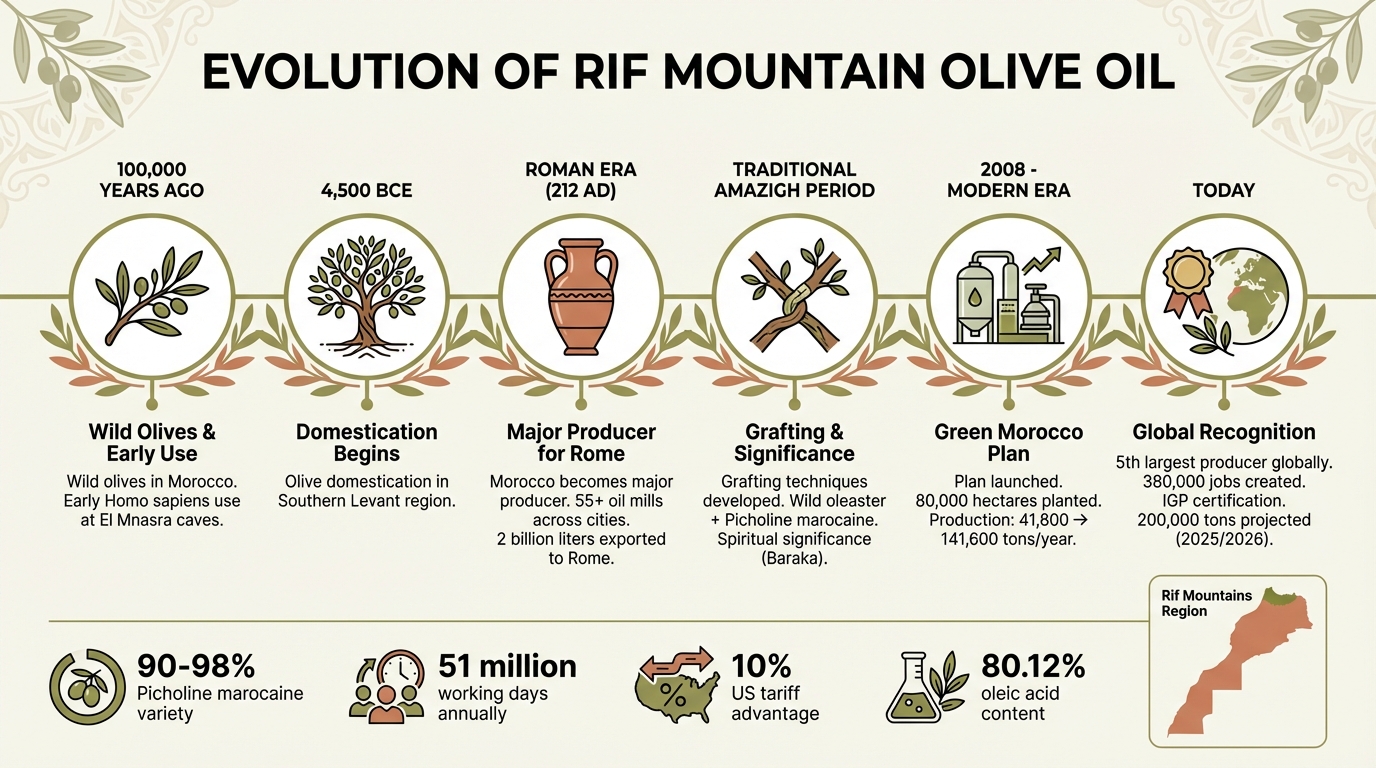
Timeline of Rif Mountain Olive Oil History: From 100,000 BCE to Modern Day
The Ancient Origins of Olive Cultivation
Domestication of Olives
The story of olive cultivation dates back roughly 6,500 years to the southern Levant, an area that includes modern-day Israel, Palestine, Jordan, Lebanon, and Syria. Farmers in this region began selecting the best wild olive specimens (Olea europaea subsp. europaea var. sylvestris) and cultivating them extensively around 4,500 BCE.
Interestingly, this agricultural milestone occurred about 3,000 years before similar efforts took root in the northern Levant, the Aegean, or the Iberian Peninsula. Archaeological evidence from Kfar Samir reveals olive oil production as far back as 7,600–7,000 years ago, with primary olive farming firmly established by approximately 4,500 BCE.
From its origins in the southern Levant, olive cultivation gradually spread throughout the Mediterranean. By the early-to-mid 4th millennium BCE, olives had made their way to Crete, reached mainland Italy by around 1,400 BCE, and arrived in Anatolia by 1,200 BCE. This expansion transformed olives from a simple rural resource into a vital economic asset, even before the rise of Bronze Age cities. These early developments laid the foundation for the enduring importance of olives, which also had much earlier interactions with wild varieties in North Africa.
Early Evidence in North Africa
While cultivated olives boast an ancient history, wild olives in North Africa trace back even further. Archaeologists working at the El Mnasra and El Harhoura 2 caves along Morocco's Atlantic coast uncovered charred olive stones and wood fragments dating to roughly 100,000 years ago. These discoveries suggest that early Homo sapiens relied on wild olives for fuel and possibly as a food source long before formal cultivation emerged.
The Rif Mountains in Morocco are home to wild olive trees (Olea europaea subsp. oleaster), which thrive in the region's coastal Mediterranean zones. Pollen records from the Kaf Taht el Ghar site in Northern Morocco link the presence of olives to the Early Neolithic period. The Berber word for olive, Azemmour, hints at a deep-rooted connection to the region’s indigenous traditions. Some researchers, including Terral, have even proposed that the origins of olive domestication extend beyond the Jordan Valley.
These findings highlight the rich and ancient relationship between olives and the people of North Africa, particularly in the traditions of the Rif Mountains.
Historical Role of Olive Oil in Morocco
Roman Influence on Olive Oil Production
During the Roman occupation of Mauretania Tingitana, Morocco emerged as an important center for olive oil production. Cities like Volubilis and Banasa became bustling trading hubs, with Rome actively encouraging the expansion of olive cultivation. Farmers were provided with financial incentives and guarantees to protect their investments until their olive trees began producing fruit.
Archaeological discoveries highlight the vast scale of this enterprise. Researchers have identified at least 55 Roman-era oil mills scattered across Moroccan cities - 15 in the Tangier region, 16 in Lixus, and six in the Sala (modern-day Rabat) area. Volubilis alone housed numerous ancient olive presses and storage facilities, showcasing the widespread nature of production. By 212 AD, Roman olive oil reserves from North Africa and Baetica were so abundant that they could sustain Rome for up to five years. Evidence of this trade can even be found at Monte Testaccio near Rome, where fragments from ancient oil containers represent an estimated 2 billion liters of olive oil imported from Roman provinces, including North Africa.
The Romans also found innovative ways to utilize by-products of olive oil production. For instance, they repurposed "amurca", the bitter residue left after pressing olives, as a fertilizer, pesticide, lubricant, and even a medicinal remedy. These practices not only enhanced efficiency but also set the stage for olive oil's lasting importance in Moroccan culture.
Olive Oil in Moroccan Traditions
Over time, olive oil became deeply woven into Moroccan traditions, building on the foundations laid during Roman times. During the Roman era, olive oil was even distributed as a means to foster social harmony, reflecting its value beyond the kitchen.
In the Rif Mountains, olive trees carry spiritual significance, embodying the concept of Baraka - a divine blessing believed to offer protection. Local communities regard these trees as sacred, often associating them with jnûn (nature spirits) that connect the natural world with domestic life.
Traditional olive oil-making methods, such as zit d'lma (oil extracted through water decantation) and zit chamiya (oil made using grinding stones and pressing mats), remain cherished for their rich flavor and connection to heritage. The Rif Mountains also produce zit d'l berri, a highly valued medicinal oil derived from wild oleasters. In Moroccan cuisine, olive oil holds a central place, enriching iconic dishes like tagines and bissara. It also serves as a symbol of hospitality, often offered with freshly baked bread as a welcoming gesture.
Methods and Practices in the Rif Mountains
Pre-Rif Amazigh Traditions
For centuries, the Amazigh people of the Rif have preserved unique techniques for olive oil production, with traditional grafting practices being a hallmark of their expertise. Instead of planting fully domesticated olive trees, Rif farmers graft the Picholine marocaine variety onto native wild oleaster (Olea europaea var. sylvestris) rootstocks. This ancient method results in trees that are both hardy and productive.
Ethnoecologist Yildiz Aumeeruddy-Thomas highlighted this preference among Rif farmers, stating:
grafted oleaster trees yield higher production, resist harsh conditions, and produce superior oil
. Beyond its practical benefits, this practice carries a deeper cultural meaning. It transforms wild forest areas into fertile agricultural land while maintaining a spiritual connection to Baraka, a divine blessing believed to be linked to wild olive trees.
Rif farmers rely on two types of wild olives - berri meslal (large olives) and berri rkek (thin olives) - and continue to use hand-harvesting methods due to the rugged terrain of the region.
Single-Origin Groves and Local Varieties
Building on these traditional Amazigh practices, the Rif's olive cultivation now focuses on specific local varieties. The Picholine marocaine dominates the landscape, accounting for 90–98% of Morocco's olive plantations. This variety thrives in the Mediterranean climate of the Rif, producing oil with oleic acid levels as high as 80.12%. Its ability to adapt to the region's varied microclimates and its high oil yield have made it the backbone of local olive production.
In areas like Chefchaouen and across the northern Rif, farmers also grow traditional varieties such as Bouchouk, Meslala, Hamrani, and Fakhfoukha. These single-origin groves produce oils with distinct flavor profiles. Researchers have identified 40 unique volatile compounds in northern Moroccan olive oils, which serve as geographical markers. Traditional extraction methods used in the region further enhance the distinctive flavors of Rif oils.
Modern Development and Global Recognition
Post-1958 Developments
In recent years, initiatives like the Green Morocco Plan and the US AID-funded Millennium Challenge Account (MCA) have revolutionized the Rif's olive oil industry. Since 2008, the MCA has supported the planting of 80,000 hectares of olive trees and the construction of 20 crushing units, each capable of processing 60–80 tons daily.
These initiatives replaced scattered, low-yield groves with high-density plantations featuring 50–100 trees per hectare. Traditional practices, such as grafting wild oleaster trees, gave way to nursery-raised micro-cuttings of productive varieties like Haouzia and Menara. While state policies emphasized industrial extraction systems (zit makina) to increase speed and export capacity, many local farmers still favor traditional methods like zit d'lma (water decantation) and zit chamiya (pressing mats), which are known for producing superior-tasting oil.
Infrastructure improvements also played a pivotal role in connecting local producers to global markets. The Tanger Med port, recognized as Africa’s leading port for connectivity, and an expanded motorway network have drastically reduced shipping times - Moroccan olive oil now reaches the Port of New York in just seven days. Production has soared, growing from an annual average of 41,800 tons in the early 1990s to 141,600 tons in recent years. Experts predict a record 200,000 tons for the 2025/2026 harvest season.
These advancements have solidified Morocco’s position in the global olive oil market while driving economic growth.
Economic Impact and International Markets
Morocco now ranks as the 5th largest olive oil producer in the world, with production increasing by over 70% in the last 25 years. The olive oil sector contributes significantly to the economy, creating more than 51 million working days annually - the equivalent of 380,000 permanent jobs. Women hold 20% of these positions, highlighting the industry's role in fostering gender inclusion.
The introduction of Protected Geographical Indication (IGP) status has elevated Rif olive oil into a premium category. IGP-certified oil commands a price of 43 dirhams ($4.50) per liter, compared to the standard market price of 30 dirhams ($3.20). Women-led cooperatives, such as the "Femmes du Rif" Economic Interest Group, have been instrumental in this transformation. This group, which includes 10 cooperatives and 328 members, has professionalized production and expanded international market access. Hanane Lachehab, President of Femmes du Rif, shared:
Thanks to the cooperatives, women are more and more exposed to public life. They exist also outside of their villages and families
.
Shifting from bulk sales to bottled, labeled products with geographical designations has further boosted Morocco’s competitiveness in global markets. Moroccan olive oil enjoys a 10% tariff in the U.S., compared to 15% for European oils and 20–28% for Tunisian products. Producers like Morocco Gold and Noor Fès have gained international recognition, underscoring the country’s growing prominence. Ghizlane Tazi, General Manager of Noor Fès, expressed optimism about the industry's future:
Morocco is poised to swiftly reclaim, and even exceed, its record olive oil production levels
.
sbb-itb-4066b8e
AMAZING Discovery! We Stopped at a Moroccan OLIVE OIL Press!
Big Horn Olive Oil: A Modern Perspective
In today’s global market, premium olive oil crafted with deep-rooted traditions is highly valued. Big Horn Olive Oil embraces this ethos by producing Ultra Premium Extra Virgin Olive Oils, cold-pressed within just two hours of harvest. This meticulous process not only elevates the oil’s quality but also pays homage to the traditional methods of the Rif Mountains.
Staying true to those time-tested practices, Big Horn Olive Oil adheres to stringent quality standards. Their oils consistently meet an acidity level of 0.2% or lower, a benchmark of excellence.
The Rif region has long revered medicinal oils, and Big Horn carries that legacy forward by ensuring their oils are rich in polyphenols. High-polyphenol olive oils have been associated with a 19% reduced risk of cardiovascular disease and a 29% lower risk of neurodegenerative mortality. These bioactive compounds, which range from 50 to 1,000 mg/kg in high-quality extra virgin olive oil, also contribute to the bold, slightly bitter flavor that defines authentic premium oils.
Big Horn’s dedication to sourcing single-origin varieties, such as Picual and Coratina, mirrors the Rif tradition of celebrating local varietals. This focus on purity and careful handling results in oils that are not only more flavorful but also more durable.
To ensure the best taste and health benefits, Big Horn delivers its oils within three months of pressing. At just $8.99 per bottle, they make exceptional quality accessible, aligning with the growing demand for transparency and traceability. In doing so, Big Horn Olive Oil demonstrates how olive oil has evolved from a simple pantry staple into a prized artisanal product.
Conclusion
The story of Rif Mountain olive oil stretches back thousands of years, deeply intertwined with Morocco's identity. Ancient indigenous practices and Roman advancements laid the foundation for olive oil production, creating a legacy that remains vital to the region's economy and way of life.
Today, this rich history blends with modern advancements. Traditional grafting techniques are paired with cutting-edge extraction methods, producing oils that respect both heritage and progress. Local cooperatives play a key role in this evolution, achieving premium prices for their IGP-certified oils while uplifting communities through economic empowerment.
"The olive tree has become imbued with the culture, cuisine, habits, rhythms, and seasons of the country and a passion for the production of olive oil has been passed on from generation to generation." - Moroccan Olive Oil History
This enduring legacy not only preserves the past but also positions Moroccan olive oil as a global standout. In Moroccan kitchens, olive oil is a cornerstone ingredient, essential for iconic dishes like tajine and bessara, which embody the nation's culinary spirit. The Rif's distinct climate and traditional agroforestry methods produce oils rich in polyphenols and layered flavors, making them a favorite on the world stage.
As the 5th largest olive oil producer globally, Morocco demonstrates how ancient practices and modern standards can coexist. The Rif Mountains' dedication to quality and tradition ensures that their olive oil continues to enrich local culture while making its mark on global markets.
FAQs
What makes olive oil production in the Rif Mountains unique?
Olive oil production in Morocco's Rif Mountains is steeped in tradition, with methods that have been handed down through generations. Families carefully hand-pick the olives, ensuring that only the ripest and undamaged fruits make the cut. Once harvested, the olives are stone-ground into a paste, which is then allowed to rest briefly to bring out their rich flavors. This paste is cold-pressed to produce pure, extra-virgin olive oil.
Farmers in the Rif also rely on age-old agricultural techniques, such as grafting cultivated olive varieties onto resilient wild rootstocks. These methods, combined with the region's diverse ecosystem, result in olive oils that are not only rich in flavor but also deeply tied to the area's heritage. At Big Horn Olive Oil, we embrace these traditions, using only the finest hand-selected olives to craft ultra-premium extra-virgin olive oils that honor this remarkable legacy.
What impact has the Green Morocco Plan had on olive oil production in the Rif Mountains?
The Green Morocco Plan, initiated in 2008, has transformed olive oil production in Morocco's Rif Mountains. By focusing on small-scale farms, the initiative led to the planting of around 200,000 acres of olive trees and the construction of modern processing facilities capable of handling up to 80 tons of olives each day. These developments have provided direct benefits to thousands of farmers and cooperatives, boosting production and increasing rural incomes.
In addition to infrastructure improvements, the plan introduced advanced farming methods and tree grafting techniques tailored to the Rif’s tough terrain and climate. These innovations have not only increased olive yields but also enhanced the quality of the fruit. As a result, the region’s olive oil industry has evolved into a competitive, market-oriented sector. Today, the Rif Mountains are celebrated for producing premium extra virgin olive oil, contributing to local economic development and poverty reduction.
Why is olive oil culturally important in the Rif Mountains of Morocco?
Olive oil is deeply woven into the traditions of the Rif Mountains in Morocco, rooted in the rich heritage of Berber culture. It stands as a symbol of hospitality, community connection, and social harmony, playing an important role in both everyday life and age-old rituals.
For generations, olive oil has been far more than a cooking ingredient in this region. It represents a link to the area's agricultural legacy and the profound bond the people share with their land. The time-honored production techniques, handed down through families, reflect a deep appreciation for nature and tradition, solidifying olive oil as a key part of life in the Rif Mountains.