

Guide to Safe Storage and Labeling of Infused Oils
Infused oils can add incredible flavor to your meals, but improper storage can pose serious safety risks, including botulism. Here’s what you need to know:
- Key Risk: Fresh ingredients like garlic and herbs in oil create an oxygen-free environment, ideal for Clostridium botulinum bacteria, which can produce deadly toxins.
-
Storage Rules:
- Non-acidified oils (with fresh ingredients): Refrigerate immediately and use within 2–4 days. Discard if left at room temperature for over 2 hours.
- Acidified oils: Safer for longer storage but refrigerate for better quality.
- Dried ingredient infusions: Store in a cool, dark place for up to 3–4 weeks or refrigerate for up to 3 months.
-
Best Practices:
- Sterilize containers (dark glass or stainless steel preferred) to prevent contamination.
- Label with preparation and use-by dates, ingredients, and storage instructions.
- Freeze oils in small portions to extend shelf life safely.
Proper handling and labeling ensure both safety and quality, letting you enjoy infused oils worry-free.
How to Safely Store Garlic-Infused Oil #shorts
Why Proper Storage Matters for Infused Oils
Storing infused oils the wrong way can create a perfect breeding ground for harmful bacteria. When fresh garlic or herbs - both naturally low in acid and high in moisture - are submerged in oil, the mixture creates an oxygen-free (anaerobic) environment. This setup allows Clostridium botulinum spores to activate and release toxins.
"Oils provide an anaerobic environment, and when combined with low-acid food matrices such as garlic and herbs, this provides the perfect conditions for specific bacteria to thrive." – UGA Extension
Each year, about 145 cases of botulism are reported in the U.S., with 15% being foodborne. While medical advancements have reduced fatality rates, outbreaks still happen. A notable example occurred in 2015 at a church potluck in Ohio, where improperly stored home-canned potatoes used in a potato salad caused a botulism outbreak. This incident affected 28 people and tragically resulted in one death.
Clostridium botulinum becomes active in temperatures between 38°F and 118°F. Because of this, infused oils that haven’t been acidified and are left at room temperature for more than two hours should be thrown away. It’s important to note that boiling (212°F) doesn’t destroy these spores - only pressure canning at temperatures between 241°F and 250°F can do that [9, 10]. These temperature guidelines highlight just how critical proper storage methods are.
Improper storage also leads to another issue: rancidity. When oils are exposed to light and heat, they oxidize and break down. While rancid oils might not always have a noticeable change in taste or smell, they’ve been linked to potential long-term health risks.
To keep infused oils safe, refrigerate fresh mixtures right away and use them within 2–4 days. For longer storage, consider acidifying the ingredients or using dried herbs instead.
Understanding Botulism Risk in Infused Olive Oils
Fresh garlic, herbs, and vegetables can carry C. botulinum spores from the soil. When these low-acid ingredients (with a pH above 4.6) are submerged in oil, it creates an oxygen-free environment that encourages spore germination and toxin production. The scary part? Contaminated oil doesn’t give itself away - it looks, smells, and tastes completely normal.
"Spores of C. botulinum may already be present in garlic and herbs, and when introduced to an ideal environment - no oxygen, low acid content, and ambient temperatures - they can germinate, multiply, and produce a deadly neurotoxin." – Carla Luisa Schwan, Assistant Professor, University of Georgia
To address this, the FDA has required commercial garlic-in-oil products to include an acidifying agent since 1991. For homemade infusions, you can acidify fresh ingredients by soaking them in a 3% citric acid solution (mix 1 tablespoon of citric acid with 2 cups of water) for 24 hours, ensuring the pH drops to 4.2 or lower. Alternatively, if skipping acidification, refrigerate your infusion and use it up within 4 days.
Sterilization is another key step to reduce contamination risks. Boil glass containers for 10 minutes, thoroughly wash and dry fresh ingredients, and stick to clean utensils throughout the process.
Shelf Life Guidelines for Different Infusion Types
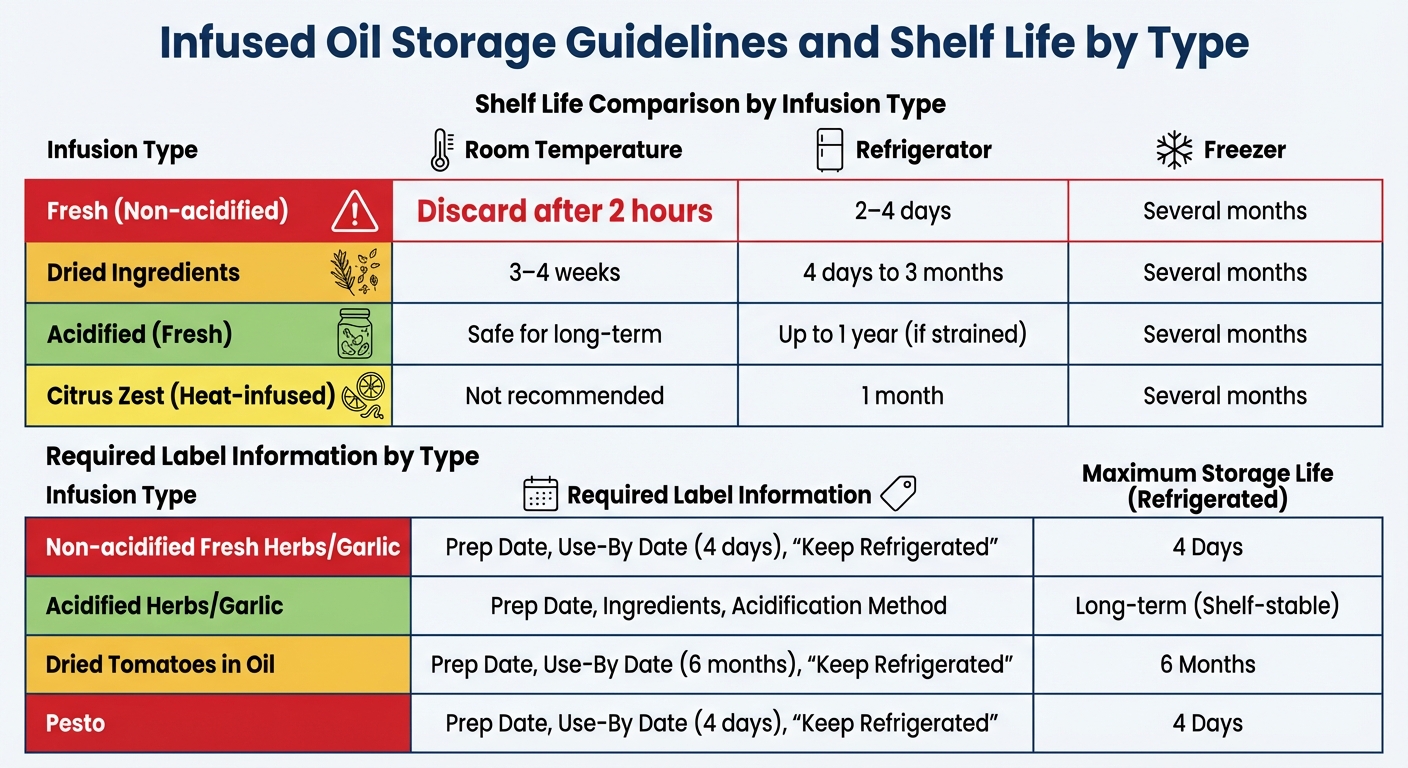
Infused Oil Storage Guidelines and Shelf Life by Type
The shelf life of infused oils varies significantly based on the ingredients used. Non-acidified infusions, like those made with fresh garlic, basil, rosemary, or similar herbs, pose a higher risk of spoilage. These must be refrigerated and consumed within 2 to 4 days. If left at room temperature, non-acidified oils should be discarded after just 2 hours.
Acidified infusions, which involve treating fresh ingredients with citric acid to lower the pH to 4.2 or below, are safer to store at room temperature. That said, refrigerating acidified oils helps maintain their flavor and quality for longer periods.
Infusions made with dried ingredients, such as dried herbs and spices, are less prone to spoilage due to their lower moisture content. For the best results, refrigerate these infusions and use them within 4 days to 3 months. If kept in a cool, dark pantry, aim to consume them within 3 to 4 weeks for optimal freshness.
Here’s a quick reference table summarizing the shelf life of various infusion types:
Shelf Life Comparison Table by Infusion Type
| Infusion Type | Room Temperature | Refrigerator | Freezer |
|---|---|---|---|
| Fresh (Non-acidified) | Discard after 2 hours | 2–4 days | Several months |
| Dried Ingredients | 3–4 weeks | 4 days to 3 months | Several months |
| Acidified (Fresh) | Safe for long-term | Up to 1 year (if strained) | Several months |
| Citrus Zest (Heat-infused) | Not recommended | 1 month | Several months |
For acidified infusions, straining the oil once the desired flavor is achieved (usually within 1 to 10 days) can further extend its refrigerated shelf life to up to one year. Always remove solids to ensure safety and quality.
sbb-itb-4066b8e
Best Storage Containers and Conditions
When it comes to preserving the quality of infused oils, the type of container you use is just as important as following proper shelf life guidelines. The right container can shield your oils from light, oxygen, and heat - three major culprits behind oil degradation. Dark glass bottles and stainless steel containers are excellent choices for this purpose, as they provide strong protection against these factors.
On the other hand, avoid using clear glass or plastic containers. Clear glass allows light to penetrate, which speeds up oxidation and can cause the oil to go rancid. Plastic containers, particularly those made of PET, are porous and can let humidity and gases seep through over time, compromising the oil’s integrity. If glass is your only option, make sure it’s food-grade and dark-colored, such as amber, green, or cobalt blue varieties.
"Dark or opaque packaging minimizes the light exposure that hastens oxidation." - UC Food Quality
Before storing your oils, always sterilize the containers. For glass bottles, wash them thoroughly and boil them for 10 minutes to kill any bacteria, yeasts, or molds. Let them air-dry completely to ensure no residual moisture remains, as this could encourage bacterial growth.
Why Dark Glass or Stainless Steel Containers Are Ideal
Dark glass and stainless steel containers both offer excellent protection, but they work slightly differently. Dark glass filters out harmful UV rays, while stainless steel completely blocks light. Both materials act as nonpermeable barriers, preventing oxygen and moisture from degrading the oil. Stainless steel or tin containers are particularly effective, as they eliminate all light exposure, whereas dark glass allows you to monitor the oil level while still filtering most UV rays.
When filling your container, leave a small gap - known as headspace - between the oil and the lid. This allows for any expansion due to temperature changes. Always use a tightly sealed lid or cap to keep air out and maintain the oil’s freshness.
How Temperature and Light Impact Oil Quality
Proper storage conditions are just as critical as the container itself. Exposure to UV light and high temperatures can rapidly accelerate oxidation, leading to rancidity. For olive-based infused oils, the ideal storage temperature is between 65°F and 75°F.
"The optimal storage temperature for olive oil is 65 to 75 degrees Fahrenheit." - California Olive Ranch
To protect your oils, avoid placing them near heat sources like stoves or ovens, or on sunny countertops. Instead, store them in a cool, dark cabinet, away from direct light and heat. For infusions made with fresh ingredients, refrigeration is a great option to extend shelf life. While refrigeration may cause the oil to become cloudy or even solidify, this is only temporary - it will return to its normal state at room temperature without affecting its quality.
How to Label Infused Oils Correctly
Labeling isn't just about organization - it’s essential for tracking freshness and ensuring safe usage.
What to Include on Labels
Start by noting the preparation date to keep track of how long the oil has been stored. Add a use-by date, especially for non-acidified infusions, which should be consumed or frozen within four days.
"Label containers with the date that the oil mixture was prepared as well as the date (four days later) by which the mixture must be used or else frozen for longer storage." - OSU Extension
Clearly list all ingredients, such as the type of oil (e.g., extra virgin olive oil) and the infusion components like garlic or basil. Storage instructions are equally important - indicate whether the oil needs to be refrigerated or if it has been acidified for shelf stability.
| Infusion Type | Required Label Information | Maximum Storage Life (Refrigerated) |
|---|---|---|
| Non-acidified Fresh Herbs/Garlic | Prep Date, Use-By Date (4 days), "Keep Refrigerated" | 4 Days |
| Acidified Herbs/Garlic | Prep Date, Ingredients, Acidification Method | Long-term (Shelf-stable) |
| Dried Tomatoes in Oil | Prep Date, Use-By Date (6 months), "Keep Refrigerated" | 6 Months |
| Pesto | Prep Date, Use-By Date (4 days), "Keep Refrigerated" | 4 Days |
Making Labels That Last
To ensure your labels stay intact, choose materials that can withstand refrigerated conditions. Waterproof labels or permanent markers work well, as they resist smudging and peeling caused by condensation or oil residue.
Before applying a label, make sure the container is completely dry after sterilization. Any leftover moisture or oil film can weaken the adhesive. If you're using adhesive labels, press them firmly onto the glass, smoothing out any air bubbles. Alternatively, you can write directly on the container with a permanent marker. The goal is to keep the label legible for the entire shelf life of the oil.
Freezing Infused Oils to Extend Shelf Life
When working with infused oils that contain perishable ingredients, freezing is the best option for long-term storage. Keep in mind that non-acidified oils are only safe for up to 4 days when refrigerated. Freezing halts the growth of Clostridium botulinum, a bacterium that thrives in the oxygen-free, low-acid environment of oil at temperatures between 38°F and 118°F. To freeze your infused oils properly, follow these steps.
Freezing not only preserves fresh flavors but also prevents the growth of Clostridium botulinum, extending the shelf life of your infused oils well beyond refrigeration. Barbara Brown, a Food Specialist at Oklahoma State University Extension, explains that while acidified infusions can be stored at room temperature, "the quality will be better longer if you keep it in the refrigerator or freezer".
How to Freeze Infused Oils Correctly
One of the easiest ways to freeze infused oils is by using ice cube trays. Simply pour the oil into the tray compartments and freeze until solid. This method creates convenient, pre-portioned cubes that you can add directly to soups, stews, or sauces without needing to thaw the entire batch.
Once the cubes are frozen, transfer them to airtight glass or plastic containers, or wrap the individual cubes before placing them in a larger freezer-safe container. This extra step ensures that strong garlic or herb aromas won’t seep into other foods in your freezer.
"Package flavored oils to be frozen in airtight containers such as small glass or plastic jars to prevent vibrant aroma of the herbs and vegetables from penetrating other foods in freezer." - Carolyn Raab, PhD, R.D., and Margy Woodburn, Ph.D., Oregon State University Extension
Before freezing, make sure all containers are thoroughly washed, sanitized, and completely dry. Don’t forget to label each container with the preparation date. These precautions will help maintain the safety and quality of your infused oils during storage.
Pros and Cons of Freezing Infused Oils
| Aspect | Benefits | Drawbacks |
|---|---|---|
| Safety | Prevents botulism growth and extends shelf life beyond 4 days | – |
| Flavor | Retains the vibrant aroma and taste of fresh ingredients | Strong aromas can transfer to other foods if not sealed properly |
| Convenience | Ice cube portions allow for easy, precise use | Oil may appear cloudy or solid until thawed |
| Quality | Slows down rancidity and oxidation | – |
The biggest advantage of freezing is safety - it’s the only reliable method for long-term storage of non-acidified infused oils at home. While frozen oil may look cloudy or solid, it will return to its normal state once brought to room temperature.
Conclusion
Proper storage and labeling are key to keeping infused oils both safe and flavorful. The main health risk comes from Clostridium botulinum, a bacteria that thrives in low-acid, oxygen-free environments at unsafe temperatures. Using dried ingredients can help limit bacterial growth.
If you're working with fresh ingredients, make sure to acidify them correctly or refrigerate the infusion immediately, and use it within the recommended time. Any oil left at room temperature for over two hours should be thrown out.
Store your infused oils in sanitized, dark-colored glass or stainless steel containers to avoid oxidation. Keep them in a cool, dark place or refrigerate as needed. Freezing is another great option - it halts bacterial growth and locks in fresh flavors. Even with dried herbs, don't keep infusions for longer than three months to ensure quality.
Label each batch clearly with the preparation date and storage instructions so you always know when to use or discard it. By sticking to these practices, you can safely enjoy the rich flavors of your infused oils without worry.
FAQs
What’s the best way to store non-acidified infused oils safely at home?
To keep non-acidified infused oils safe and fresh, store them in dark, airtight glass bottles. Place these bottles either in the refrigerator or a cool, dark pantry where the temperature remains between 57°F and 70°F. Aim to use the oils within 1 to 2 months, and if you detect any unusual odors, see mold, or notice a change in texture, discard them right away. Storing them correctly helps maintain their quality and minimizes the chance of spoilage.
How can I safely store and prevent botulism in homemade infused oils?
To keep botulism at bay and ensure your infused oils are safe, stick to dried herbs or acidify fresh garlic and herbs by soaking them in a 3% citric acid solution before use. Make sure to sterilize your jars completely, store the infused oil in the refrigerator, and follow these timelines: consume within 1–2 months if acidified properly, or within 2–4 days if not. If you notice off flavors, mold, or any signs of spoilage, discard the oil immediately to avoid any health risks.
Why should infused oils be stored in dark glass or stainless steel containers?
When it comes to storing infused oils, using dark glass or stainless steel containers is a must. These materials are excellent at blocking harmful UV light and reducing exposure to oxygen - two major culprits behind oxidation. Oxidation can lead to spoilage or a loss of flavor, so proper storage is key. By keeping your oil in the right container, you’re not just preserving its taste and quality but also ensuring it stays safe to use for a longer period.