

Science Behind Olive Oil and Weight Loss
Olive oil can help you manage weight effectively when used as a substitute for less healthy fats like butter or margarine. Its unique composition, rich in monounsaturated fats (MUFAs) and polyphenols, supports fat burning, appetite regulation, and reduced inflammation. Studies show that even small daily amounts, like half a tablespoon, can prevent weight gain over time.
Key takeaways:
- MUFAs (like oleic acid) in olive oil improve fat metabolism and control hunger.
- Polyphenols reduce belly fat, inflammation, and improve glucose regulation.
- Replacing saturated fats with olive oil leads to healthier weight and waist size.
- Long-term studies confirm olive oil’s role in reducing fat storage and increasing fat burning.
For best results, choose high-quality extra virgin olive oil (EVOO) and use it consistently in place of less nutritious fats.
Use Olive Oil Daily to Lose Weight and Prevent Obesity
sbb-itb-4066b8e
Nutritional Components of Olive Oil That Support Weight Loss
Extra virgin olive oil (EVOO) stands out from other fats due to its rich concentration of monounsaturated fatty acids (MUFAs) and polyphenols. These components play a role in weight management by influencing how the body stores fat and processes energy.
Monounsaturated Fatty Acids (MUFAs) and Metabolism
EVOO is packed with oleic acid, which accounts for 49%-83% of its fatty acid content. Unlike saturated fats, oleic acid serves more than just an energy source - it acts as a molecular signal in the gut, triggering the release of oleoylethanolamide (OEA). This lipid messenger helps regulate appetite by promoting a feeling of fullness. MUFAs also contribute to better metabolic health by enhancing insulin sensitivity and maintaining glucose balance, thanks to their positive effects on pancreatic function and insulin response. Combined with EVOO's polyphenols, these benefits make it a powerful addition to a weight-conscious diet.
Polyphenols and Antioxidants in EVOO
EVOO's polyphenols add another layer of support for weight management. These compounds, including hydroxytyrosol, oleocanthal, and oleacein, are known for their metabolic benefits. High‑phenolic EVOO contains over 1,500 mg/kg of total polyphenolic compounds, compared to standard EVOO, which may have 700 mg/kg or less. According to the European Food Safety Authority, olive oil is classified as high‑phenolic if it contains at least 5 mg of hydroxytyrosol and its derivatives per 20 grams of oil (equivalent to a minimum of 250 mg/kg). These polyphenols aid fat metabolism by activating the AMPK pathway and boosting PPAR‑α and fibroblast growth factor 21 activity.
Research highlights the effectiveness of these bioactive compounds. In one 12‑week study, 60 adults with overweight/obesity and Type 2 Diabetes consumed whole wheat bread enriched with hydroxytyrosol. The group experienced notable reductions in fat mass, fasting glucose, insulin levels, and TNF‑α compared to the control group. Another study involving 29 women over six months showed that consuming 5 to 15 mg of hydroxytyrosol daily led to weight loss and a decrease in visceral fat within the first four weeks. Additionally, polyphenols help reduce chronic low‑grade inflammation by shifting macrophages toward an anti-inflammatory M2 state and lowering pro-inflammatory markers like TNF‑α and IL‑6.
Major Scientific Studies on Olive Oil and Weight Loss
Recent research highlights olive oil's potential role in weight management, building on its well-documented nutritional advantages. Several large-scale studies have examined its effects on body weight over extended periods.
Insights from the Nurses' Health Study

An analysis of 121,119 participants from the Nurses' Health Study (NHS), NHSII, and the Health Professionals Follow-up Study explored the relationship between olive oil consumption and weight changes over four-year intervals. The findings revealed that increasing daily olive oil intake by 7 grams (about 0.25 oz) correlated with a modest weight reduction of –0.09 kg (–0.20 lb) over four years.
The results were even more striking when olive oil replaced other fats. For instance, substituting just half a tablespoon of butter daily with olive oil helped prevent approximately 0.52 kg (1.15 lb) of weight gain. This substitution effect highlights olive oil's potential to curb weight gain when used in place of less nutritious fats.
"A long-term increase in olive oil intake was inversely associated with body weight in middle-aged adults in the United States. Conversely, increased consumption of other added fats, such as butter and margarine, was positively associated with body weight."
– Marta Guasch-Ferré et al.
Findings from the PREDIMED Trial
The PREDIMED trial, conducted in Spain, followed 7,447 older adults (men aged 55–80 and women aged 60–80) with high cardiovascular risk over a median of 4.8 years. Participants in the Mediterranean diet group were provided with 1 liter (34 fl oz) of extra-virgin olive oil per week for household use, without imposing calorie restrictions or mandatory exercise routines.
Despite following a high-fat diet, the group consuming olive oil experienced a 5-year weight change difference of –0.410 kg (–0.91 lb) compared to a low-fat control group. They also showed a reduction in waist circumference of –0.466 cm (–0.18 in) over the same period. These findings challenge the traditional belief that high-fat diets inevitably lead to weight gain.
"A long-term intervention with an unrestricted-calorie, high-vegetable-fat Mediterranean diet was associated with no significant difference in bodyweight and some evidence of less gain in central adiposity compared to a control diet."
– PREDIMED Study Investigators
Controlled Trials on EVOO and Fat Loss
While observational studies suggest long-term benefits, controlled trials offer more concrete evidence. Randomized controlled trials have shown that extra-virgin olive oil (EVOO) can aid fat loss when included in calorie-restricted diets. The underlying mechanism involves oleic acid, a key compound in olive oil, which stimulates the production of oleoylethanolamide (OEA). This gut-derived lipid messenger enhances satiety, helping people feel fuller for longer. Consuming 2 tablespoons (25 g) of EVOO daily as part of a calorie-controlled diet has consistently been linked to improved body composition.
How Olive Oil Promotes Weight Loss
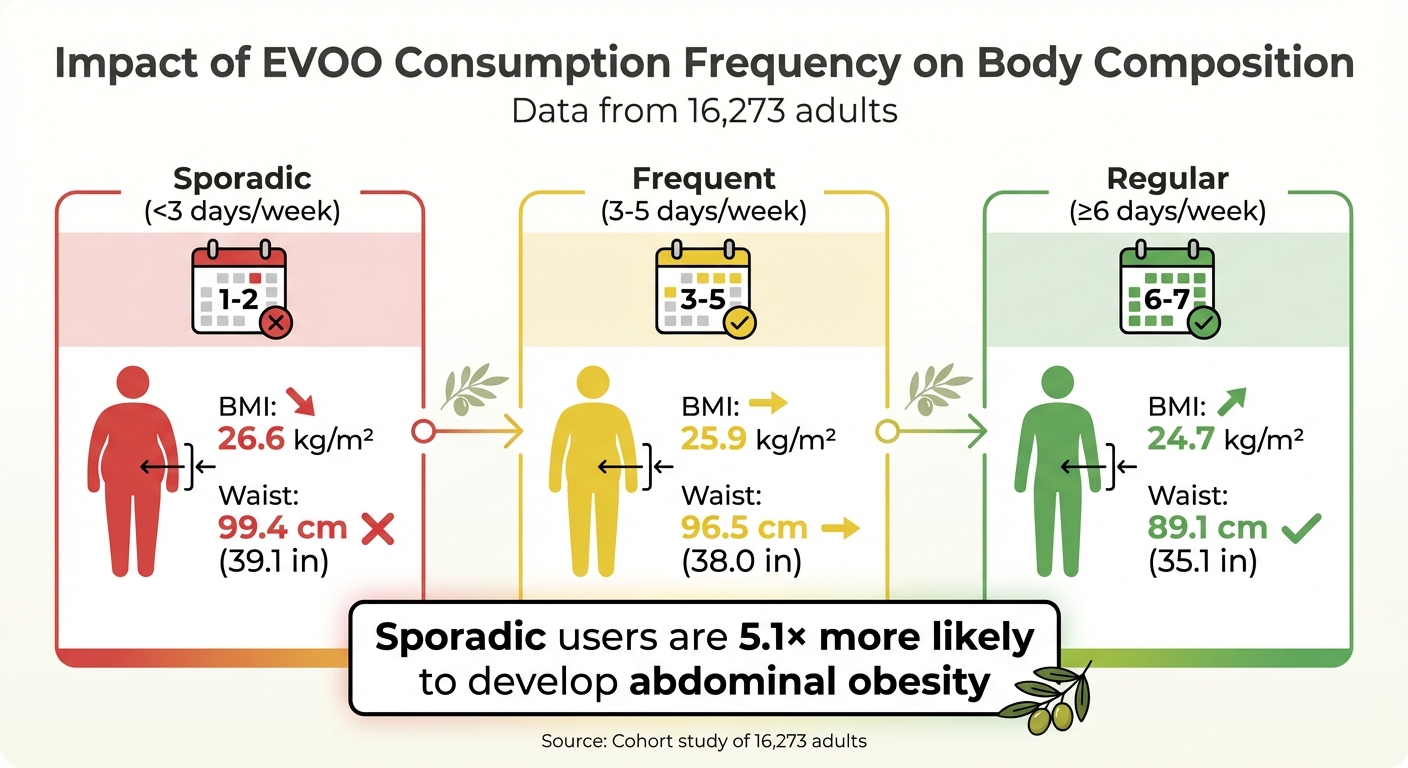
Olive Oil Consumption Frequency and Body Composition: BMI and Waist Circumference Comparison
Olive oil isn't just a flavorful addition to meals - it plays a role in weight management by influencing key metabolic processes. Its effects begin at the molecular level and impact various systems in the body.
Oleoylethanolamide and Appetite Control
One of olive oil's standout components, oleic acid, transforms into a compound called oleoylethanolamide (OEA) in the small intestine. This transformation is more than just chemistry - it actively helps regulate appetite and fat metabolism. When you consume extra virgin olive oil, oleic acid enters intestinal cells via the CD36 receptor. There, it's converted into OEA, which acts as a "molecular sensor", connecting fat intake to feelings of fullness.
OEA works in several ways:
- It stimulates the vagus nerve, signaling the hypothalamus to suppress hunger.
- It activates PPAR-alpha, a nuclear receptor that increases fat burning and reduces fat storage.
- It blocks hunger-promoting molecules, like anandamide, from interacting with cannabinoid receptors.
But that's not all. OEA also enhances the breakdown of free fatty acids in muscle and liver cells and reduces fat transport to storage areas, contributing to lower overall fat mass.
High-Phenol EVOO and Belly Fat Reduction
While olive oil aids in appetite control, certain types, like high-phenol extra virgin olive oil (HP-EVOO), take it a step further by directly targeting fat accumulation. Not all olive oils are created equal - HP-EVOO stands out due to its concentrated bioactive compounds.
A study published in Frontiers in Nutrition (September 2025) examined data from 16,273 adults and found a striking connection between regular EVOO consumption and reduced abdominal fat. Participants who consumed about 2 tablespoons of EVOO at least six days a week had a significantly smaller average waist circumference (89.1 cm or 35.1 in) compared to sporadic users (99.4 cm or 39.1 in). Additionally, those with irregular EVOO intake were 5.1 times more likely to develop abdominal obesity, regardless of their overall diet quality.
"Non-regular EVOO intake emerges as a strong risk factor for visceral adiposity, irrespective of overall diet quality."
– Antonio Moschetta, Department of Interdisciplinary Medicine, University of Bari "Aldo Moro"
The phenolic compounds in HP-EVOO, particularly oleocanthal and oleacein, play a crucial role in reducing belly fat. They inhibit inflammatory pathways like NF-κB and COX, which are linked to metabolic dysfunction in abdominal fat tissue. These compounds also limit fat cell enlargement and reduce macrophage activity in fat deposits - two major contributors to metabolic syndrome. For example, a study conducted by the University of Palermo in October 2020 involved giving 23 subjects with metabolic syndrome 4 tablespoons of high-oleocanthal EVOO daily for two months. The results? Significant reductions in body weight, waist size, and the Fatty Liver Index, along with a healthier balance between visceral and subcutaneous fat.
| EVOO Intake Frequency | Mean BMI (kg/m²) | Mean Waist Circumference (cm/in) |
|---|---|---|
| Sporadic (<3 days/week) | 26.6 | 99.4 (39.1 in) |
| Frequent (3–5 days/week) | 25.9 | 96.5 (38.0 in) |
| Regular (≥6 days/week) | 24.7 | 89.1 (35.1 in) |
(Data from a cohort of 16,273 adults)
Conclusion: Research-Supported Benefits of Olive Oil for Weight Management
Scientific studies consistently highlight the role of high-quality extra virgin olive oil (EVOO) in supporting weight management. Regular consumption of fresh, high-phenolic EVOO has been linked to reduced weight gain and improved metabolic health.
The key lies in the bioactive compounds found in fresh EVOO, particularly its anti-inflammatory and metabolic properties. These compounds, however, degrade over time, making it essential to prioritize fresh, ultra-premium olive oil to achieve the benefits observed in clinical research. This reinforces the importance of incorporating EVOO into your daily routine for long-term health.
Replacing less nutritious fats with EVOO has also been shown to help curb weight gain over time. According to the Harvard T.H. Chan School of Public Health:
"Switching from butter to olive oil is a simple change with big potential impact".
Consistency is crucial. Studies show that infrequent EVOO consumption can lead to a higher risk of abdominal fat accumulation. For instance, individuals who consume EVOO fewer than six days per week are 5.1 times more likely to develop abdominal obesity compared to regular users. By making EVOO a daily staple, you allow its oleic acid, polyphenols, and other beneficial compounds to work together to regulate appetite, enhance fat oxidation, and reduce inflammation.
For the best results, choose EVOO that is fresh and high in polyphenols. Brands like Big Horn Olive Oil meet these standards, offering freshly harvested, cold-pressed EVOO delivered within three months of harvest. This ensures the potency needed to support your weight management goals while seamlessly fitting into your everyday diet.
FAQs
How much EVOO should I use per day for weight loss?
Consuming 1 to 2 tablespoons (15–30 grams) of Extra Virgin Olive Oil (EVOO) daily could help with weight management and may even reduce abdominal fat. These benefits are often attributed to its monounsaturated fats and nutrient-rich profile.
Does EVOO help you lose belly fat specifically?
Extra Virgin Olive Oil (EVOO) has been associated with a reduction in abdominal fat and may aid in decreasing belly fat, even without following a highly restrictive diet. Research points to its nutritional qualities as a key factor in encouraging healthier fat distribution throughout the body.
How can I tell if an EVOO is high in polyphenols?
To find an extra virgin olive oil (EVOO) with high polyphenol levels, check the label for phrases like “early harvest” or “high polyphenol content.” Freshness is crucial, so opt for oils harvested within the last 12 to 18 months to ensure they retain their polyphenols.