

Scientific Studies on Olive Oil in Healing Rituals
Olive oil has been a cornerstone of healing practices for centuries, and modern science is now validating its health benefits. Here's what you need to know:
- Ancient cultures like the Greeks and Romans used olive oil for ceremonies, medicine, and skincare.
- Modern studies show olive oil improves wound healing, reduces inflammation, and protects against oxidative stress.
- Key compounds like oleocanthal and hydroxytyrosol deliver anti-inflammatory and antioxidant effects.
- Extra virgin olive oil (EVOO) is particularly effective due to its high concentration of bioactive compounds.
- Clinical trials have demonstrated its ability to promote skin hydration, speed up wound recovery, and lower inflammation markers.
Takeaway: Olive oil bridges ancient healing practices with modern science, offering a natural, accessible option for health and skincare. Proper storage (dark containers, room temperature) preserves its therapeutic properties.
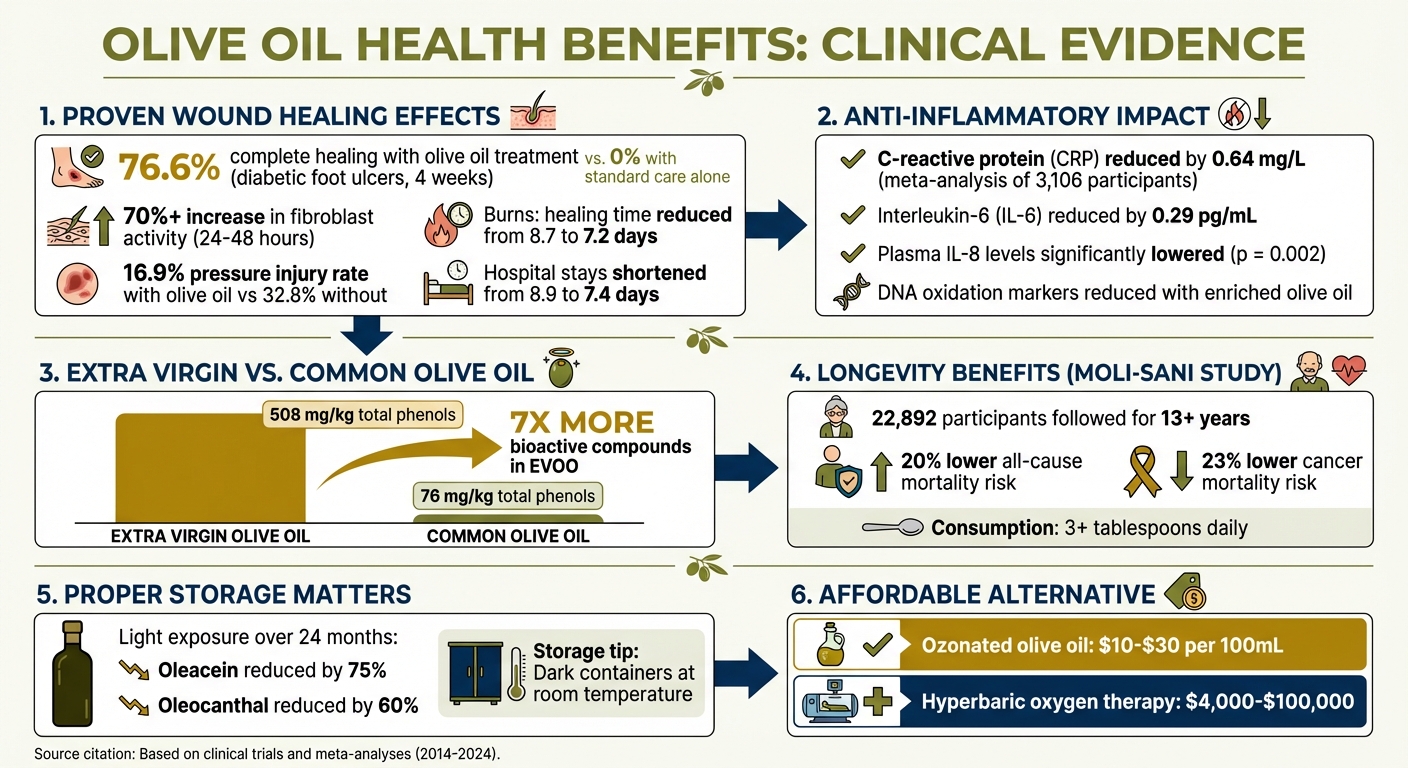
Olive Oil Health Benefits: Clinical Study Results and Key Statistics
Scientific Evidence on Olive Oil's Healing Properties
Wound Healing Effects
Recent clinical trials highlight olive oil as a promising treatment for wound care. One notable study, conducted between February and August 2017 at Shahid Mohammadi Hospital in Bandar Abbas, Iran, focused on 60 patients with Type 2 diabetes suffering from grade 1 and 2 foot ulcers. Participants were divided into two groups: the intervention group received daily olive oil dressings alongside standard care (saline irrigation and oral antibiotics), while the control group received only the standard care. After four weeks, 76.6% of patients in the olive oil group experienced complete healing, compared to 0% in the control group.
The healing properties of olive oil are attributed to its phenolic compounds, such as hydroxytyrosol, tyrosol, and oleocanthal. These compounds significantly enhance fibroblast activity - boosting it by over 70% within 24 to 48 hours - and stimulate the production of vascular endothelial growth factor (VEGF), which is critical for forming new blood vessels.
Another study, conducted in 2015 at a university hospital in Izmir, Turkey, examined the effects of topical extra virgin olive oil on 129 intensive care patients. The results showed that patients treated with olive oil had a lower incidence of pressure injuries (16.9%) compared to the control group (32.8%).
These findings lay the groundwork for comparing olive oil's effectiveness against more conventional treatments.
Comparative Studies with Standard Treatments
Research comparing olive oil to standard wound care methods further underscores its therapeutic benefits. A 2024 trial in Hormozgan Province, Iran, involved 123 adults with Wagner grade 1–2 diabetic foot ulcers. Participants applied 5 mL of ozonated olive oil daily for four weeks. Compared to the standard care group, those using olive oil showed better outcomes in wound severity scores (22.3 vs. 26.1), HbA1c levels (7.1% vs. 7.7%), and hs-CRP levels (2.9 mg/L vs. 3.6 mg/L). The results indicated faster healing and improved blood sugar control in the olive oil group.
"Topical olive oil dressing promoted the healing of DFU and it can be recommended as a safe and effective treatment in this regard." - Diabetes & Metabolic Syndrome: Clinical Research & Reviews
Olive oil has also proven effective in treating burns. In a study involving patients with burns covering 10–20% of their total body surface area, oral olive oil reduced healing times from 8.7 to 7.2 days and shortened hospital stays from 8.9 to 7.4 days. Additionally, the cost of ozonated olive oil - ranging from $10 to $30 for a 100 mL bottle - makes it an affordable alternative to advanced treatments like hyperbaric oxygen therapy, which can cost anywhere between $4,000 and $100,000.
Anti-Inflammatory and Antioxidant Benefits of Olive Oil
Reducing Inflammation
Extra virgin olive oil (EVOO) packs a powerful anti-inflammatory punch, thanks to compounds that work similarly to standard anti-inflammatory drugs. One standout compound is oleocanthal, which creates that familiar throat-stinging sensation - just like ibuprofen. Oleocanthal targets the same enzymes, COX-1 and COX-2, that non-steroidal anti-inflammatory drugs aim to inhibit.
"Oleocanthal was also identified as the responsible for the throat irritant or stinging sensation produced by some EVOOs, similar to that caused by the non-steroidal anti-inflammatory drug ibuprofen." - Clinical Nutrition
Between July 2016 and June 2019, the APRIL study, led by Gabriel Olveira at the Biomedical Research Institute of Málaga, explored these effects in 91 participants with obesity and prediabetes. For 30 days, participants replaced their usual cooking oil with EVOO rich in oleocanthal and oleacein (508 mg/kg total phenols compared to just 76 mg/kg in common olive oil). The results? A notable reduction in interferon-γ (P = 0.041), along with improvements in antioxidant status, body weight, and blood glucose levels.
Backing these findings, a meta-analysis of 30 randomized controlled trials involving 3,106 participants revealed that olive oil interventions lowered C-reactive protein (CRP) - a key inflammation marker - by an average of 0.64 mg/L. It also reduced interleukin-6 (IL-6) levels by 0.29 pg/mL. These reductions are meaningful since chronic low-grade inflammation is linked to delayed healing and metabolic issues.
These anti-inflammatory effects work hand-in-hand with olive oil's antioxidant properties, which we’ll explore next.
Protecting Against Oxidative Stress
Olive oil is more than a cooking staple - it’s a shield against oxidative stress. Its antioxidant compounds, like hydroxytyrosol and tyrosol, neutralize harmful free radicals that can damage cells during recovery. These phenols activate the Nrf2 pathway, a key regulator of the body’s antioxidant defenses. This activation boosts the production of protective enzymes, including superoxide dismutase (SOD) and glutathione peroxidase (GPx), which protect DNA, proteins, and cell membranes from oxidative harm.
"Nrf2 is considered the principal regulator of redox homeostasis and its activation inhibits pro-inflammatory mediators such as cytokines, COX-2 and iNOS." - Monica Bucciantini et al.
The NUTRAOLEUM study, conducted at the University of Granada from February to July 2014, highlighted these protective effects. Researchers monitored 51 healthy adults who consumed 30 mL daily of functional olive oil enriched with 389 ppm of triterpenes (oleanolic and maslinic acids). Compared to standard virgin olive oil, the enriched version significantly reduced urinary 8-hydroxy-2'-deoxyguanosine, a marker of DNA oxidation, and lowered plasma interleukin-8 (IL-8) levels (p = 0.002).
Hydroxytyrosol and tyrosol are also highly bioavailable, with absorption rates ranging from 40% to 95%. This high bioavailability explains why EVOO, which contains about seven times more total biophenols than common olive oil (508.4 mg/kg versus 76.83 mg/kg), delivers such pronounced health benefits.
Modern Applications of Olive Oil in Healing Practices
Use in Skincare and Therapeutic Products
Extra virgin olive oil (EVOO) has found its way from the kitchen to skincare and therapeutic products, thanks to its rich blend of beneficial compounds. Packed with phenolic compounds like hydroxytyrosol and oleocanthal, EVOO is now a key ingredient in anti-aging and wound-healing formulations.
One clinical trial highlighted how organic EVOO improved skin hydration and promoted early-stage corneocyte growth, signaling enhanced skin regeneration.
"While petrolatum exerted a stronger occlusive effect by reducing TEWL and desquamation, EVOO uniquely promoted epidermal renewal by increasing epidermal turnover." - R.S.-d.l.T., University of Granada
Wild Olive Oil, derived from Olea europaea var. sylvestris, offers an even higher phenolic content than traditional EVOO. It enhances skin elasticity while maintaining a lighter, less greasy feel. Clinical studies have also shown EVOO's effectiveness in treating pressure ulcers, diabetic foot wounds, and nipple sores, with 89.2% of patients preferring it over lanolin.
These advancements bridge the gap between ancient remedies and modern skincare science.
Limitations and Future Research
Despite its promising applications, olive oil-based treatments face certain limitations. Much of the evidence comes from in vitro and animal studies, with a noticeable lack of large-scale human clinical trials to confirm long-term benefits. Additionally, the absence of regulatory standards for polyphenol content leads to inconsistencies - EVOO's phenolic concentration can vary widely, from 150 to 700 mg/L, depending on the olive variety and processing methods.
Storage conditions also play a critical role in maintaining the oil's therapeutic properties. A 2025 study by the University of Perugia simulated real-world storage of Umbrian EVOO over 24 months. Researchers Francesca Blasi and Federica Ianni found that light exposure reduced oleacein levels by 75% and oleocanthal by 60%.
"A standardized approach to using polyphenol content as a quality marker during storage remains lacking, despite extensive research." - Francesca Blasi, et al.
To move forward, research must focus on creating polyphenol standards as quality benchmarks and conducting extensive clinical trials to measure EVOO's cumulative effects on skin health over time. In the meantime, consumers can preserve EVOO's therapeutic benefits by storing it in dark containers at room temperature.
sbb-itb-4066b8e
Olive Oil's Secret: The Natural Remedy That Beats Ibuprofen! Dr. Mandell
Conclusion: Olive Oil as a Bridge Between Tradition and Science
Olive oil beautifully connects the wisdom of ancient Mediterranean cultures with the rigor of modern scientific research. What was once a cornerstone of traditional diets has now been backed by clinical studies, reinforcing its role in promoting health and longevity.
Recent research highlights olive oil's impressive health benefits. For example, the APRIL study revealed that swapping regular cooking oil for extra virgin olive oil (EVOO) for just one month led to significant reductions in inflammatory markers and blood glucose levels in individuals with obesity and prediabetes. Similarly, the Moli-sani Study, which followed 22,892 Italian adults for over 13 years, found that consuming more than three tablespoons of olive oil daily was linked to a 20% lower risk of all-cause mortality and a 23% lower risk of cancer mortality.
"No other oils can provide as many benefits as extra virgin olive oil can. It's the far superior oil." – Julia Zumpano, Registered Dietitian, Cleveland Clinic
The secret to EVOO’s health-promoting properties lies in its phenolic compounds, such as hydroxytyrosol, oleocanthal, and oleacein. These compounds are known to protect cells from oxidative damage, reduce inflammation (comparable to the effects of ibuprofen), and support tissue repair.
What sets olive oil apart is its ability to serve as both a nourishing food and a therapeutic agent. The European Food Safety Authority acknowledges that olive oil polyphenols help shield blood lipids from oxidative stress, blending ancient healing traditions with modern scientific validation. To retain these benefits, proper storage - like keeping EVOO in dark containers - is key to preserving its bioactive compounds.
Extra virgin olive oil isn't just a nod to tradition; it’s a testament to how ancient practices can align with and inspire modern health innovations. From its role in daily nutrition to its therapeutic potential, EVOO continues to prove its value in both the kitchen and the laboratory.
FAQs
What role does olive oil play in wound healing?
Scientific studies suggest that olive oil can play a role in wound healing, thanks to its anti-inflammatory, antioxidant, and tissue-repairing qualities. Research indicates that applying olive oil directly to wounds may help improve tissue appearance, reduce fluid buildup, and speed up recovery - especially in cases like diabetic foot ulcers.
Beyond topical use, including olive oil in your diet might also support healing. Its phenolic compounds, such as hydroxytyrosol and oleocanthal, are known to reduce inflammation and oxidative stress. These properties encourage cellular repair and tissue regeneration, making olive oil a natural choice for aiding recovery.
What are the main health-promoting compounds found in olive oil?
Olive oil stands out for its impressive mix of compounds that provide numerous health perks. Among these are phenolic compounds like oleocanthal and oleacein, which act as potent antioxidants. These compounds are known for their anti-inflammatory effects and their ability to support heart health. On top of that, olive oil is rich in monounsaturated fats, especially oleic acid, which helps maintain healthy cholesterol levels and contributes to overall cardiovascular well-being.
Thanks to these natural elements, olive oil has earned its place in everything from age-old healing traditions to today’s health-focused diets.
What is the best way to store extra virgin olive oil to preserve its health benefits?
To keep extra virgin olive oil (EVOO) at its best and preserve its healthful properties, how you store it makes all the difference. The key? Keep it in a cool, dark place far from heat and light. These elements can break down the oil, diminishing its quality. Aim for a storage temperature around 39°F (4°C). If you want to go the extra mile, freezing it at 0°F (−18°C) can help extend its shelf life while protecting its beneficial compounds.
Another tip: use airtight, opaque containers. This helps shield the oil from oxygen and light, both of which can trigger oxidation and reduce its potency. By storing EVOO correctly, you’ll help it retain those all-important antioxidants and phenols - key components that contribute to its health-boosting properties.