

Spiritual Benefits of Olive Oil in Ruqyah
Here’s the short answer: olive oil in ruqyah is allowed, but it does not heal by itself. I’d keep the issue simple: Qur’an recitation and du'a are the core of ruqyah, and olive oil is only a tool some people use after reciting over it.
If you want the whole topic in plain English, this article comes down to a few points:
- Healing comes from Allah alone
- Olive oil can be used as a means, not as a power
- The Qur’an mentions the blessed olive tree
- Hadith mention eating olive oil and putting it on the body
- Made-up claims, fixed rituals, and guaranteed results should be rejected
- Ruqyah should not replace medical or mental health care
In other words: if you recite Qur’an over olive oil, then apply a small amount, that can be fine. But I would not treat the oil like a charm, a shield, or a cure on its own.
A few facts help frame this:
- The article points to 1 Qur’anic reference often used in this topic: Surah An-Nur 24:35
- It also lists 5 common recitations people use in ruqyah oil:
- Al-Fatihah
- Ayat al-Kursi (2:255)
- Al-Baqarah 2:285–286
- Al-Ikhlas
- Al-Falaq
- An-Nas
- It gives 3 main warnings:
- don’t say the oil heals by itself
- don’t invent steps with fixed numbers or timings
- don’t stop seeing doctors or mental health professionals
The main takeaway is simple: use olive oil, if you choose, in a clean and limited way; keep your trust in Allah; and stay away from superstition.
This makes the practice easier to understand before getting into the details.
Protection from Magic & the Evil Eye Part Two. - Mufti Menk
sbb-itb-4066b8e
Why Olive Oil Holds Spiritual Significance in Islam
Olive oil has a special place in Islamic teaching because the Qur'an mentions it and authentic prophetic guidance refers to it as well. That's why many Muslims view it as a blessed and permissible means in ruqyah. At the same time, the point matters: olive oil is used as a supporting means in ruqyah, not as an independent remedy.
The Qur'anic Reference to the Blessed Olive Tree
Surah An-Nur 24:35, the Verse of Light, describes Allah's light as being lit from the oil of a blessed olive tree. Classical tafsir explains the phrase "neither of the east nor of the west" as a sign of purity and blessing, not as proof that olive oil cures illness on its own. In plain terms, the Qur'an gives the olive tree honor, but it does not present olive oil as a stand-alone spiritual cure.
Olive Oil in Prophetic Tradition
Prophetic narrations encourage the use of olive oil in food and for external application. That helps explain why some Muslims use it as a blessed means in ruqyah. But there's an important limit here. Hadith specialists classify the popular claim that olive oil cures seventy diseases, including leprosy, as forged, so it should not be used as religious proof.
Because of that, Muslims who use olive oil in ruqyah treat it as a vessel for Qur'anic recitation, not as a cure by itself.
How Olive Oil Is Used in Ruqyah
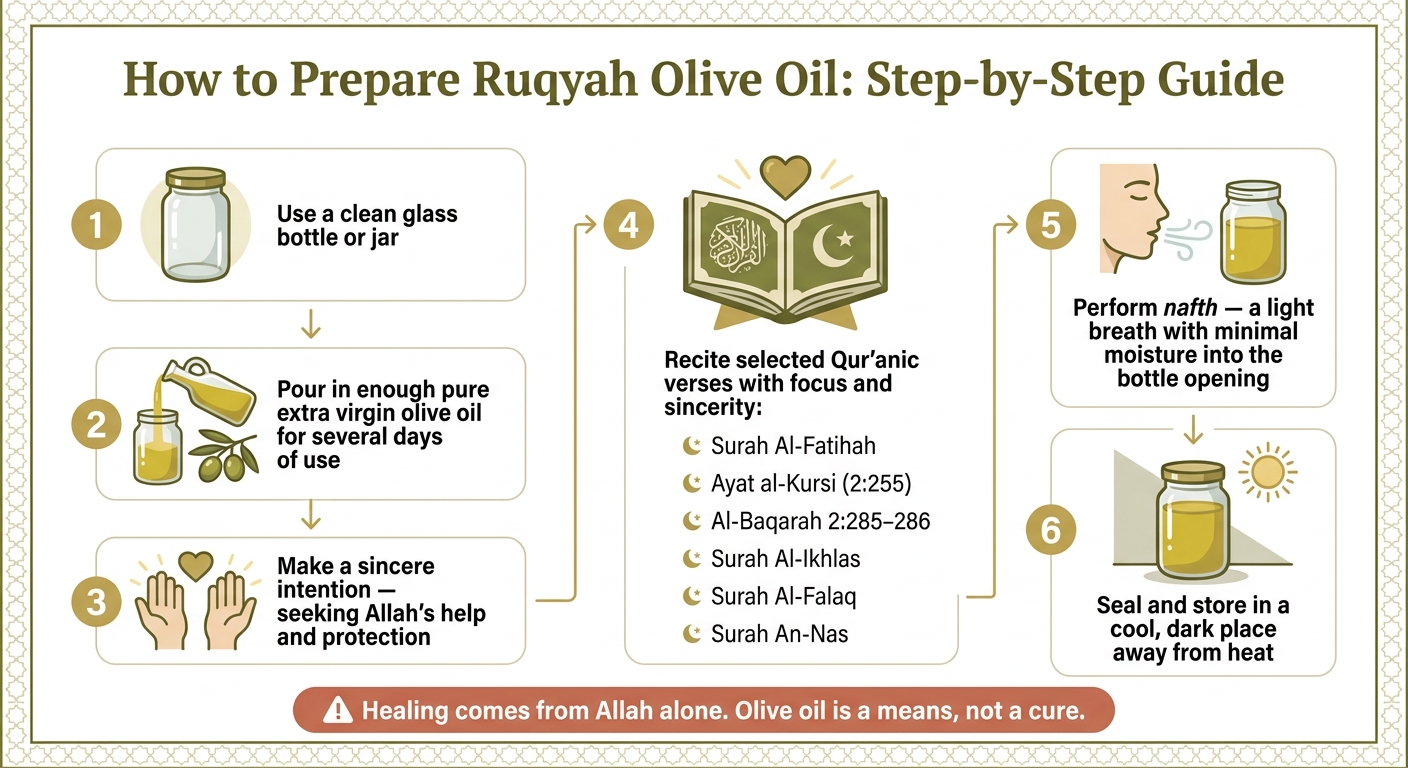
How to Prepare Ruqyah Olive Oil: Step-by-Step Guide
The practice is simple: recitation comes first, olive oil comes second. That order matters. The oil is just a medium for external use, while the ruqyah itself is in the recitation and du'a.
What Ruqyah with Olive Oil Typically Involves
A person recites selected Qur'anic verses and authentic supplications over a container of olive oil. After that, they perform nafth - a light breath with minimal moisture - into the oil, then apply it externally.
People often apply the oil to the forehead, temples, chest, joints, or other places where they feel discomfort. In plain terms, it's a simple routine: recite, do nafth, then use the oil on the body.
The verses most often recited over the oil include Surah Al-Fātiḥah, Ayat al-Kursī (2:255), the last two verses of Surah Al-Baqarah (2:285–286), and the three Quls: Surah Al-Ikhlāṣ, Al-Falaq, and An-Nās. These passages are often chosen because authentic hadith point to their protective and healing qualities. Authentic du'a for healing and protection are also recited alongside these verses.
How to Prepare Ruqyah Olive Oil: Step by Step
The process should stay simple, not turned into something complicated.
- Use a clean glass bottle or jar.
- Pour in enough pure extra virgin olive oil for several days of use.
- Make a sincere intention that this is for seeking Allah's help and protection.
- Recite the selected verses above with focus and sincerity.
- Perform nafth - a light breath with minimal moisture - into the opening of the bottle.
- Seal and store the bottle in a cool, dark place, away from heat and disrespectful locations.
Choosing Pure, High-Quality Olive Oil
Once the spiritual use is understood, the physical quality of the oil still matters. Choose fresh extra virgin olive oil in a dark bottle with a clear harvest or bottling date.
For body use, a fresh, well-labeled extra virgin olive oil is the practical pick. It is chosen for its purity and cleanliness as a permissible medium, not because the oil itself carries any spiritual power.
Common Misconceptions About Olive Oil in Ruqyah
Olive Oil Does Not Heal on Its Own
This point needs to stay crystal clear. Olive oil is a permissible means, not the source of healing. Healing comes from Allah alone.
People sometimes attach claims and rituals to olive oil that are not found in the Qur'an or Sunnah. That is where confusion starts. Reciting over olive oil does not turn it into something else. It remains oil. Any good that comes from using it is tied to Allah's response to the recitation and the believer's sincere intention, not to some built-in spiritual power in the oil.
Once that baseline is set, the next step is to stay away from added practices that have no proof behind them.
Avoid Exaggerated Claims and Invented Rituals
A lot of mistakes in this area come from overblown promises and made-up rituals. For example, claims that drinking ruqyah olive oil for seven nights will remove all sihr, or that rubbing it on the body will guarantee that jinn never come near you, have no basis in the Qur'an or authentic Sunnah. There is no guarantee of results. Everything depends on Allah's will.
Invented rituals are another problem. This can include things like applying the oil in a fixed numbered sequence or keeping a bottle under your pillow as a protective device. Once people start treating these acts as required, or as if they always work, they cross into religious innovation (bid'ah).
A simple test can help sort this out:
- Is there a clear text from the Qur'an or an authentic hadith for the practice?
- Is the act being treated as mandatory?
- Does it start to look like a charm, talisman, or superstitious ritual?
If the answer is no to the first question and yes to the others, the practice is likely an unsupported addition.
Safe Use and Key Takeaways
Permissible Use vs. Mistaken Beliefs
The line between sound practice and superstition can be easy to blur. But the core rule is simple: treat olive oil as a means, not as a power in itself. Here's the difference.
| Practice | Permissible Use | Mistaken Belief |
|---|---|---|
| Source of healing | Allah alone heals | Believing the oil itself repels jinn or illness independent of Allah's will |
| How it's used | Reciting Qur'an and authentic du'a over the oil, then applying it externally | Following fixed counts, timings, or other unverified rituals |
| Expectations | Hoping for benefit while continuing medical care | Expecting a guaranteed, fast cure or abandoning doctors because the oil will fix it |
Conclusion: Keep the Practice Simple and Faith-Centered
Olive oil has an honored place in Islamic tradition and is valued as a wholesome food. Using it as part of ruqyah is permissible when the practice stays rooted in clean oil, sincere recitation, and a heart turned toward Allah.
Only Allah heals; olive oil and ruqyah are means. Olive oil is simply one lawful means a Muslim may use while asking for His help.
Keep the practice simple: recite, use the oil modestly, seek medical care when needed, and rely on Allah alone. That keeps the act tied to worship, not superstition. It also helps guard the practice from drifting into claims or rituals that have no basis.
FAQs
Can I drink ruqyah olive oil?
Yes - ruqyah olive oil can be consumed in small amounts.
In this practice, Quranic verses are recited over clean extra virgin olive oil. The oil is then either taken by mouth or applied to the body, with the intention (niyyah) of seeking Allah’s healing and protection.
It is not a substitute for medical or psychological care, but it can be used alongside it.
Who can recite ruqyah over olive oil?
Anyone who practices ruqyah in the Islamic tradition can recite Qur’anic verses over olive oil. This is usually done over a clean glass bottle, with the intention (niyyah) of seeking Allah’s help.
People often recite Al-Fatiha, Ayat al-Kursi, the final verses of Al-Baqarah, and the three Quls, then blow lightly into the bottle after each recitation.
How often should I use ruqyah olive oil?
You can apply ruqyah-recited olive oil topically once a week, such as on Thursday night or before Jumuʿah, while making duʿa for healing and protection.
For consumption, take 1 tablespoon at breakfast with the intention of shifā’ (healing). Use fresh, high-quality extra virgin olive oil, and store it in a cool, dark place.