

Sterol Composition Testing: Step-by-Step Guide
Sterol composition testing is a precise method for analyzing the sterol profile of olive oil, primarily used to verify its quality and detect potential adulteration. This process follows the International Olive Council (IOC) standards and involves saponification, isolation of sterols, and analysis via gas chromatography with a flame ionization detector (GC-FID).
Here’s what you need to know:
- Purpose: Identifies plant sterols to confirm olive oil’s origin and detect contamination (e.g., seed oils, animal fats).
- Key Marker: β-sitosterol should make up at least 93% of total sterols in extra virgin olive oil (EVOO).
- Equipment: Includes a GC-FID system, silica-based solid-phase extraction (SPE) cartridges, and reagents like potassium hydroxide and BSTFA for derivatization.
- Procedure: Involves preparing the sample, isolating sterols, and analyzing them to ensure compliance with IOC standards.
- Adulteration Clues: Elevated campesterol or brassicasterol levels indicate seed oil contamination, while high cholesterol suggests animal fat.
Sterol testing is an effective tool for maintaining EVOO quality and ensuring compliance with international standards.
Interpreting Olive Oil Test Results
sbb-itb-4066b8e
Equipment and Materials Needed
Sterol composition testing calls for precise laboratory tools and high-quality reagents. At the heart of this process is a gas chromatograph (GC) with a flame ionization detector (FID), which is used to separate and measure individual sterols. A fused-silica capillary column with low- to mid-polarity polysiloxane is ideal - commonly a 95% dimethyl-5% diphenyl-polysiloxane column such as DB-5 or HP-5. According to Jill Winkler-Moser from the USDA, "Gas chromatography (GC) is the most common method for analyzing phytosterol content and composition".
Laboratory Equipment
In addition to the GC-FID system, you’ll need equipment for saponification, the process of breaking down oils to release sterols. This includes round-bottom flasks with reflux condensers or capped test tubes, along with heating blocks or water baths that maintain temperatures between 140°F and 176°F (60°C to 80°C). An analytical balance is crucial for weighing oil samples, typically ranging from 0.3 g to 5 g.
To isolate the sterol fraction from lipids, solid-phase extraction (SPE) cartridges with silica, C18, or aminopropyl phases are used. A rotary evaporator or nitrogen gas stream manifold will concentrate extracts and remove solvents. Additionally, internal standards like 5α-cholestane, 5α-cholestanol, or betulin are necessary for accurate quantification and to adjust for variations in injection volume.
Reagents and Solvents
The following reagents and solvents are essential for isolating and analyzing sterols effectively:
- Potassium hydroxide (KOH) in ethanol or methanol (1–2.5 N) for saponification.
- Nonpolar solvents such as hexane, diethyl ether, or methyl-tert-butyl ether (MTBE) for extracting unsaponifiable matter.
- Distilled water and saturated sodium chloride solutions for phase separation and washing.
- Derivatization reagents, such as BSTFA (N,O-bis(trimethylsilyl)trifluoroacetamide) with 1% TMCS, often mixed with pyridine, to convert sterols into volatile forms suitable for GC analysis.
- High-purity chloroform for redissolving derivatized sterols before injection.
It’s important to note that diethyl ether and hexane are highly flammable, so all extractions should be performed in a fume hood with proper ventilation.
Finally, pure sterol standards - like cholesterol, campesterol, stigmasterol, β-sitosterol, and brassicasterol - are available from suppliers such as Sigma, Steraloids, and Matreya. These standards are critical for identifying unknown peaks and ensuring accurate quantification.
Testing Procedure
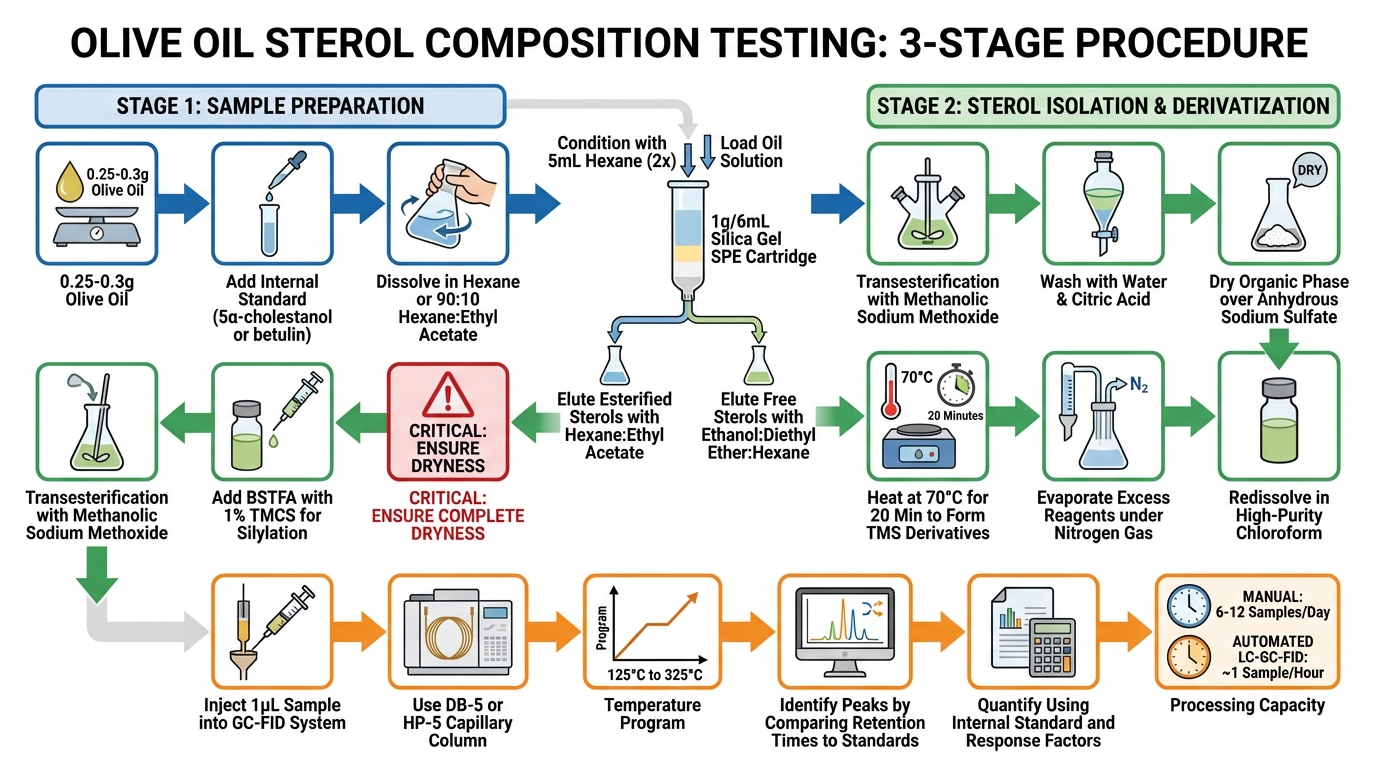
Sterol Composition Testing Process for Olive Oil Quality Analysis
The testing process involves three key stages: preparing the sample, isolating and derivatizing sterols, and performing the GC-FID analysis. Each step must be carried out with precision to achieve reliable results. Once the sample is ready, sterol isolation and derivatization are essential for accurate GC-FID performance.
Sample Preparation
Start by weighing 0.25–0.3 g of olive oil into a clean test tube. Add an internal standard, such as 5α-cholestanol or betulin, to ensure accurate quantification. Dissolve the oil in either hexane or a 90:10 mixture of hexane and ethyl acetate to prepare it for solid-phase extraction (SPE).
Condition a 1 g/6 mL silica gel SPE cartridge by rinsing it twice with 5 mL of hexane. Load your oil solution onto the prepared cartridge. First, elute esterified sterols using a hexane:ethyl acetate mix. Then, use a more polar mixture of ethanol, diethyl ether, and hexane to elute free sterols.
Sterol Isolation and Derivatization
To release bound sterols, perform transesterification with methanolic sodium methoxide. Afterward, wash the sample with water and citric acid. Dry the organic phase over anhydrous sodium sulfate to eliminate any moisture.
The next step is silylation, which converts sterols into trimethylsilyl (TMS) ethers. Ensure the sterol fraction is completely dry before proceeding, as moisture can interfere with silylation. Add BSTFA with 1% TMCS (or Sylon BFT with pyridine) to the dried sterols and heat the mixture at 70°C for 20 minutes to form TMS derivatives. Once the reaction is complete, evaporate any excess reagents under nitrogen gas. Finally, redissolve the sterols in high-purity chloroform to prepare them for injection.
GC-FID Analysis
Inject 1 µL of the prepared sample into a GC-FID system equipped with a DB-5 or HP-5 capillary column. Use a temperature program ranging from 125°C to 325°C to separate the sterols. Identify the sterol peaks by comparing their retention times to standards like cholesterol, campesterol, stigmasterol, and β-sitosterol.
During the analysis, the flame ionization detector (FID) generates a chromatogram with distinct peaks for each sterol. On standard polysiloxane columns, the sterols typically elute in the following order: cholesterol, brassicasterol, campesterol, campestanol, stigmasterol, sitosterol, sitostanol, and Δ5-avenasterol. Quantify each sterol using the internal standard and appropriate response factors. Following ISO 12228 methods, you can process 6–12 samples per day. However, automated LC-GC-FID systems can significantly boost efficiency, allowing for approximately one sample per hour.
Interpreting Results and Checking Compliance
IOC Sterol Standards

When analyzing the GC-FID chromatogram, it's essential to compare it with the IOC sterol standards. The apparent β-sitosterol value is the most important metric. This figure combines β-sitosterol with related sterols like sitostanol, Δ5-avenasterol, Δ5,23-stigmastadienol, and clerosterol. To meet IOC standards, this combined value must constitute at least 93.0% of the total sterol content.
Other sterol markers also play a critical role:
- Campesterol: Must stay below 4.0%.
- Brassicasterol: Should be at trace levels, no higher than 0.1%, as higher levels suggest rapeseed oil contamination.
- Cholesterol: Naturally found in olive oil at very low levels (typically less than 0.1%). If cholesterol exceeds 0.5%, it indicates contamination with animal fats.
- Total sterol content: Needs to be at least 1,000 mg/kg to confirm the oil's authenticity.
For clarity, here’s a breakdown of the IOC sterol limits and their implications:
| Sterol Component | IOC Standard Limit | Indicator |
|---|---|---|
| Cholesterol | ≤ 0.5% | Animal fat contamination |
| Brassicasterol | ≤ 0.1% | Rapeseed oil adulteration |
| Campesterol | < 4.0% | Seed oil mixing (sunflower/soy) |
| Stigmasterol | < Campesterol | Purity verification |
| Apparent β-sitosterol | ≥ 93.0% | Primary authenticity indicator |
| Δ7-stigmastenol | ≤ 0.5% | High-linoleic oils (sunflower/safflower) |
These sterol markers are essential for ensuring compliance with IOC standards and verifying the authenticity of extra virgin olive oil (EVOO). They provide a reliable framework for interpreting sterol profiles.
Detecting Adulteration
Abnormal sterol percentages can point to specific types of adulteration. For example, campesterol levels above 4.0% strongly suggest adulteration, though some monovarietal oils naturally approach this limit. In authentic EVOO, stigmasterol levels should typically stay below campesterol - a reversed ratio can indicate tampering. Similarly, Δ7-stigmastenol levels exceeding 0.5% may reveal the presence of high-linoleic seed oils.
Interestingly, certain monovarietal oils, like Cornicabra, naturally push the boundaries of the campesterol limit. Between 1997 and 2002, researchers studied 334 samples of Cornicabra virgin olive oil from Toledo and Ciudad Real, Spain. They found that 25% to 85% of annual production exceeded the 4.0% campesterol limit, with values ranging between 3.4% and 4.5%. Professor G. Fregapane highlighted this issue:
"Many manufacturers are forced to mix Cornicabra virgin olive oil with other olive oil varieties to avoid exceeding the legal campesterol limit, with the paradoxical result that the authenticity of this prized product is lost".
This underscores the importance of confirming the oil's varietal origin before assuming high campesterol levels are due to adulteration.
Conclusion
Sterol composition testing plays a key role in confirming the authenticity and purity of extra virgin olive oil. This process, which includes steps like sample preparation and GC-FID analysis, ensures compliance with IOC standards and identifies potential adulterants.
Phytosterols such as β‑sitosterol serve as reliable markers for olive oil authenticity. Meanwhile, elevated levels of campesterol or stigmasterol can indicate adulteration with oils like corn, soybean, or sunflower - even at concentrations as low as 5%.
Beyond detecting fraud, sterol testing provides additional insights. It can help trace the olive variety, geographical origin, and harvest date of the oil. Furthermore, maintaining the proper sterol profile not only ensures authenticity but also preserves the health benefits of phytosterols, which include anti-inflammatory, antibacterial, and LDL-cholesterol–lowering properties.
Advancements in testing methods have made this process even more efficient. Techniques like Solid-Phase Extraction (SPE) and miniaturized protocols have reduced solvent use and analysis time, while achieving recovery rates between 90% and 103% in laboratory settings. This is especially critical for producers and quality control teams, as studies show that about 28% of oils fall outside established sterol limits.
At Big Horn Olive Oil, we are committed to upholding these rigorous testing standards, ensuring the quality and authenticity of our extra virgin olive oil.
FAQs
Can authentic EVOO naturally exceed the campesterol limit?
Yes, genuine Extra Virgin Olive Oil (EVOO) can naturally have campesterol levels that exceed the 4% limit. Studies show that certain olive oils, such as Cornicabra virgin olive oil, may naturally surpass this threshold. This is a result of natural variation and doesn’t imply a compromise in quality or authenticity.
Why does the sterol fraction have to be derivatized before GC-FID?
The sterol fraction undergoes derivatization before GC-FID analysis to improve its volatility, stability, and detectability. This step, typically achieved through silylation, converts the hydroxyl groups in sterols into derivatives that are more volatile and thermally stable. These modifications enhance both the separation and detection capabilities of gas chromatography with flame ionization detection (GC-FID).
What test issues can falsely suggest olive oil adulteration?
Testing methods for olive oil can sometimes lead to false indications of adulteration. Issues like the presence of seed oils, refined oils, or incorrect origin labeling are common culprits. To detect these, techniques such as measuring sterol content, UV absorption, spectroscopy, and isotope analysis are used. However, errors in testing or misinterpreting results can also lead to inaccurate conclusions.