

Sustainability in Olive Harvesting: Organic vs. Conventional Practices
Organic olive farming emits less CO₂, uses more renewable energy, and consumes less energy overall compared to conventional farming. However, conventional methods deliver higher yields and economic productivity. Here's what you need to know:
- Organic farming: Emits 0.33 kg CO₂ per kg of olives, uses 67.27% renewable energy, and requires 8.81 MJ of energy per kg.
- Conventional farming: Emits 0.67 kg CO₂ per kg of olives, uses 15.13% renewable energy, and requires 11.37 MJ of energy per kg.
- Organic methods prioritize natural fertilizers and fewer machine operations, while conventional systems rely on synthetic inputs and machinery for higher efficiency.
- Organic farms receive higher subsidies, balancing income differences with conventional farms.
Quick Comparison:
| Criteria | Organic Farming | Conventional Farming |
|---|---|---|
| CO₂ Emissions (per kg) | 0.33 kg | 0.67 kg |
| Renewable Energy Use | 67.27% | 15.13% |
| Energy Consumption (per kg) | 8.81 MJ | 11.37 MJ |
| Revenue (per acre) | $1,879 | $2,363 |
| Subsidies (per acre) | $317 | $220 |
Both methods have trade-offs. A mix of techniques, like semi-mechanical harvesting and better tree management, can improve outcomes for farmers and the planet.
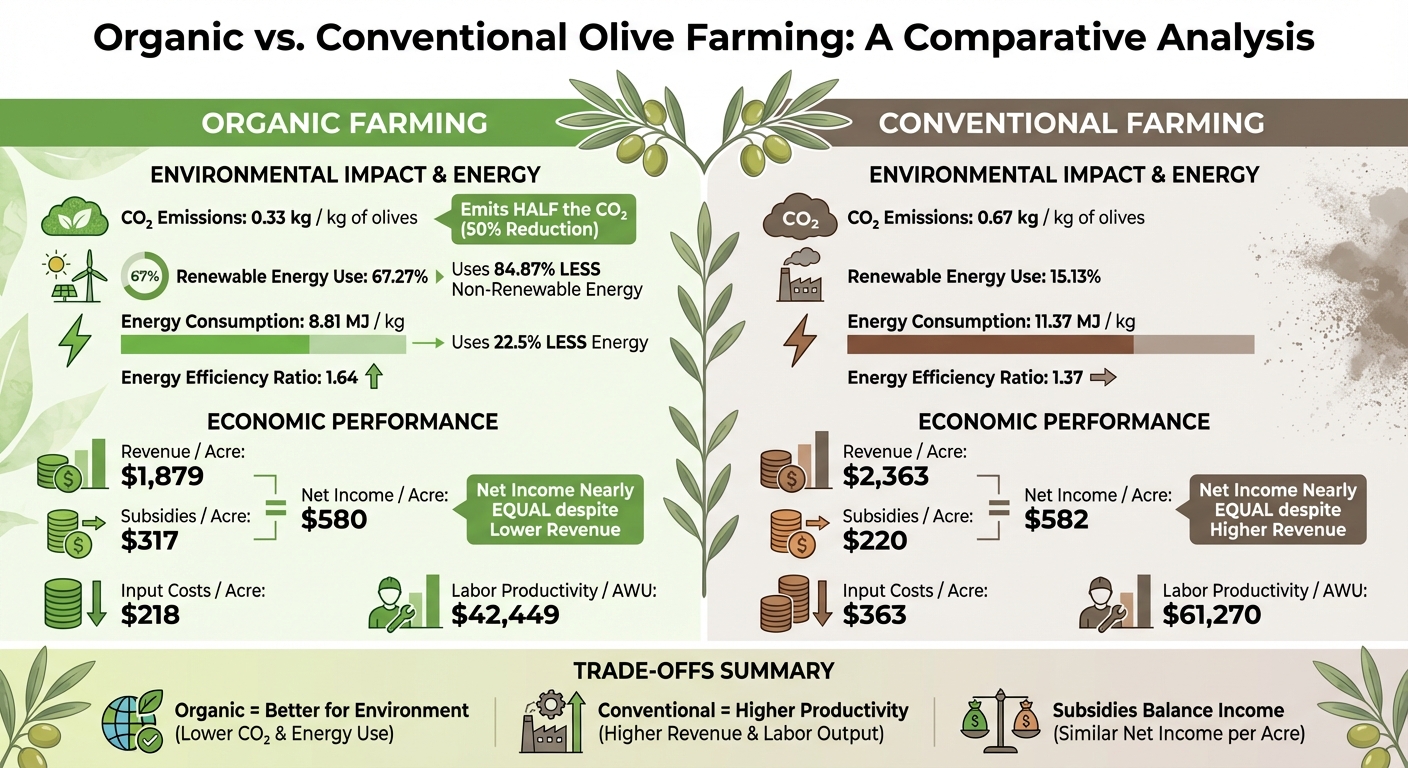
Organic vs Conventional Olive Farming: Environmental and Economic Comparison
Transforming a Conventional Orchard to an Organic Climate Farm | Part I: Olive Pruning
sbb-itb-4066b8e
1. Organic Harvesting Methods
Organic harvesting methods go beyond traditional farming by offering measurable benefits for the environment, particularly in terms of emissions and energy use.
Environmental Impact
When it comes to reducing emissions, organic olive harvesting stands out. Studies indicate that organic orchards emit just 0.33 kg of CO₂-equivalent per kilogram of fruit - almost half the emissions of conventional methods. To put this into perspective, producing 1,000 kg (2,205 lbs) of olives organically prevents the release of around 340 kg (749 lbs) of CO₂-equivalent compared to standard farming practices.
Energy and Resource Efficiency
Organic farming also excels in energy efficiency. It requires only 8.81 megajoules of energy per kilogram of fruit, cutting energy use by 22.5% compared to conventional methods. Even more impressive, organic orchards achieve an energy efficiency ratio of 1.64, outperforming the 1.37 ratio of conventional systems. With 67.27% of their energy coming from renewable sources, organic farms set a strong example for sustainable energy use.
This reduction in energy usage not only lowers operational costs but also positions organic farming as a leader in sustainable agricultural practices.
Pathways to Sustainability
Organic harvesting promotes sustainability through a combination of practical strategies:
- Switching to organic fertilizers: By using compost and natural soil amendments instead of synthetic fertilizers, energy consumption drops and greenhouse gas emissions shrink.
- Reducing management intensity: Organic orchards require fewer tractor passes and less fuel for tasks like pruning and soil management, further cutting emissions.
- Relying on renewable energy: Using renewable energy sources not only lowers emissions but also shields farmers from fluctuating fossil fuel prices.
These methods reshape the way energy is used in olive farming, paving the way for a more sustainable future in the industry.
2. Conventional Harvesting Methods
Conventional olive harvesting focuses on maximizing production, often at the expense of environmental considerations. These practices rely heavily on machinery and synthetic inputs, which lead to higher energy consumption and greenhouse gas emissions. While they enable large-scale production, they come with significant environmental trade-offs.
Environmental Impact
Conventional olive orchards release about 0.67 kg of CO₂-equivalent per kilogram of fruit. To put that into perspective, producing 1,000 kg (2,205 lbs) of olives generates roughly 670 kg (1,477 lbs) of CO₂-equivalent emissions. The primary culprits behind these emissions include the production and use of synthetic fertilizers and the operation of diesel-powered machinery. A study conducted by Sakine Ozpinar at Canakkale Onsekiz Mart University in August 2025 highlights how these inputs drive the environmental costs associated with conventional farming practices.
Energy and Resource Efficiency
Conventional systems demand 11.37 megajoules of energy per kilogram of fruit, which is about 29% more than organic methods. Of this energy, 84.87% comes from non-renewable sources, making these practices heavily reliant on fossil fuels. The energy efficiency ratio for conventional systems stands at 1.37, noticeably lower than the 1.64 seen in organic farming. This reduced efficiency stems from the energy-intensive production of synthetic fertilizers and the fuel consumption of heavy machinery used for tasks like harvesting and soil management.
Pathways to Sustainability
To address these challenges, conventional growers can take steps to reduce their environmental footprint and improve energy efficiency. Some strategies include:
- Optimizing the use of synthetic fertilizers: Reducing application rates can cut both emissions and the indirect energy required for fertilizer production.
- Improving fuel efficiency in machinery: Adopting more efficient equipment for harvesting, soil preparation, and pruning can lower direct fuel consumption.
- Shifting to renewable energy sources: Increasing renewable energy use from the current 15.13% to levels closer to the 67.27% observed in organic farming can significantly reduce environmental impacts.
Advantages and Disadvantages
When comparing organic and conventional olive harvesting, it’s clear that each approach offers its own set of pros and cons, impacting farmers, consumers, and the environment differently. These trade-offs help explain why both methods continue to thrive in the olive industry.
Environmental performance leans in favor of organic farming, as previously discussed. But beyond environmental considerations, the economic differences between the two systems are striking.
Economic productivity shows notable contrasts. In 2020, conventional olive farms generated approximately $2,363 per acre (or €1,944/ha) in sales revenue, compared to $1,879 per acre (or €1,545/ha) for organic farms. Labor productivity also favored conventional methods, with earnings reaching about $61,270 per Annual Work Unit (AWU), while organic systems managed around $42,449 per AWU.
However, the picture changes when CAP subsidies come into play. Organic farms receive higher subsidies - around $317 per acre (or €644/ha), compared to $220 per acre (or €448/ha) for conventional farms. These subsidies help level the playing field, bringing net income close to equal: organic farms achieve roughly $580 per acre (or €1,181/ha), while conventional farms slightly edge ahead at $582 per acre (or €1,184/ha). As stated in Agricultural and Food Economics:
CAP subsidies are shown to be an effective instrument for promoting the conversion to organic farming in olive groves since they cancel out the differences in profitability between these two production systems.
Input costs further highlight the differences. Conventional farms spend about $363 per acre (or €738/ha) on intermediate consumption, which includes fertilizers, pesticides, and fuel. Organic farms, by contrast, incur lower costs - around $218 per acre (or €444/ha). These reduced expenses not only improve profitability but also encourage more sustainable farming practices. Organic farms often display greater stability in income, even when faced with market and environmental fluctuations.
Conclusion
Neither organic nor conventional harvesting methods alone can fully address the challenges of sustainability. Organic methods are better for protecting the environment and improving soil health, while conventional practices often deliver greater productivity and labor efficiency. By combining the strengths of both approaches, farmers can create a more balanced and sustainable system.
Semi-mechanical harvesting provides a practical middle ground. These methods can double the efficiency of manual labor while being gentler on trees compared to industrial harvesters. Rolland Rosenthal, Ranch Manager at Rosenthal Olive Ranch, highlights the advantages:
Managing four guys [for mechanical harvesting], rather than 100 guys [for hand harvesting], is a lot more economical and the equipment will always be there when you need it.
This efficiency is particularly important since harvesting can account for 50% to 80% of total production costs.
In addition to improved harvesting techniques, effective tree management plays a key role in sustainability. Properly spacing trees - approximately 25 feet apart - and heavy annual pruning improve airflow, naturally reducing pest issues. Karen Bond, Co-owner of Bondolio, shares her insight:
We also heavily prune the trees each year and have no leaves in the center. Italian olive growers said a bird should be able to fly through their trees.
This method reduces the need for chemical treatments while ensuring the trees remain healthy.
Maintaining quality is critical, regardless of the harvesting method. Processing olives within 12 hours of harvesting preserves antioxidant levels and prevents degradation. Additionally, using polypropylene netting under trees during harvest - whether by hand or machine - keeps the fruit off the soil and cushions it from damage. These practices, when combined, create a well-rounded and effective approach.
The future of sustainable olive harvesting lies in blending the best aspects of each method. By incorporating mechanical tools, optimizing tree care, and focusing on timely processing, farms can achieve both environmental goals and economic success.
Big Horn Olive Oil exemplifies these practices in producing their Ultra Premium Extra Virgin Olive Oil.
FAQs
Why do organic olive groves emit less CO₂ per pound of olives?
Organic olive groves produce lower CO₂ emissions per pound of olives thanks to their eco-friendly practices. By minimizing the use of fertilizers and relying on natural rainfed irrigation, they cut down on greenhouse gas emissions. In contrast, conventional systems often depend on resource-heavy methods and higher input levels, which contribute to greater emissions.
Can conventional farms cut emissions without losing yield?
Conventional farms have the potential to cut emissions by adopting practices such as fine-tuning fertilizer application and enhancing the efficiency of their machinery. That said, these farms often produce 15–30% more yield compared to other methods. This advantage, however, might be jeopardized if emissions are reduced without rethinking management approaches. Careful planning is key to finding the right balance between lowering emissions and sustaining high productivity levels.
How does semi-mechanical harvesting affect sustainability and costs?
Semi-mechanical harvesting offers a middle ground between speed and environmental considerations. It significantly cuts labor costs and boosts harvesting speed, reaching rates of 200–400 kg per hour. However, this method comes with trade-offs, including higher CO₂ emissions and a fruit damage rate of 10–20%, which surpasses that of manual harvesting. While it is less harmful to the environment than fully mechanized systems, it still leaves a larger environmental footprint compared to traditional manual methods. For large-scale operations, it strikes a balance by delivering efficiency and cost savings, albeit with some ecological compromises.