

Sustainable Olive Farming: Soil Health and Water Use
Healthy soil and efficient water use are transforming olive farming. By improving soil's ability to retain water and adopting smarter irrigation strategies, farmers are reducing water use by up to 67% while maintaining or even boosting yields and olive oil quality. Key practices include:
- Recycling organic residues like pruning waste and olive mill byproducts to enrich soil.
- Using cover crops such as clover or alfalfa to prevent erosion, regulate soil temperature, and add nutrients.
- Reducing or eliminating tillage to preserve soil structure and improve water infiltration.
- Applying regulated deficit irrigation (RDI) during less sensitive growth phases, cutting water use by 21% or more without yield loss.
These methods not only conserve resources but also enhance olive oil quality, with higher polyphenol content and improved flavor profiles. Tools like soil moisture sensors and irrigation models help farmers optimize their practices, ensuring both productivity and resource efficiency.
Bottom line: Combining soil health improvements with efficient water management is key to producing high-quality olive oil while conserving resources.
How Regenerative Agriculture Helped Create the World’s Most Powerful Olive Oil
sbb-itb-4066b8e
Improving Soil Health in Olive Groves
Healthy soil is the backbone of any thriving olive grove. It requires a balance of nutrient cycling, organic matter buildup, and minimal disruption to the soil. These efforts create a solid base for orchards that can better handle environmental challenges while consistently producing quality fruit. Organic practices like these pave the way for additional strategies that improve water use and boost productivity.
Recycling Organic Residues
Turning organic waste from olive production into nutrient-rich soil amendments is a game-changer. For example, composting solid olive mill waste with shredded prunings in equal parts (1:1 ratio) is an effective method. Research from the University of Perugia over eight years found that this approach sequestered 50.87% of organic carbon, increased soil carbon stocks by 55.91 tons per hectare, and tripled or even quadrupled nitrogen and available phosphorus levels.
Fresh olive mill wastewater (OMW) offers another option. In Crete, applying 50 liters of fresh OMW per tree immediately after production boosted soil potassium and nitrate levels without affecting pH, ensuring proper degradation.
Shredding and returning pruning residues to the soil is another practical step. These materials supply essential nutrients while reducing farm waste. However, growers should be cautious with high carbon-to-nitrogen (C:N) materials like wood chips, which can temporarily lock up nutrients unless supplemented with additional nitrogen.
Using Cover Crops and Organic Amendments
Cover crops play a vital role in soil health by preventing erosion and adding nutrients. Leguminous plants like Medicago sativa (alfalfa) and Trifolium spp. (clover) are particularly effective because they fix atmospheric nitrogen, replenishing what’s lost during harvest.
A study at La Conchuela Farm in Cordoba, Spain (2000–2006), highlighted the benefits of cover crops. On heavy clay soil in a young olive grove, a barley cover crop maintained soil organic matter at 2.0%, compared to 1.4% under conventional tillage and just 1.0% under no-tillage. Additionally, the cover crop reduced the runoff coefficient to 1.2%, a stark contrast to the 11.9% seen in bare no-tillage systems.
Cover crops also help regulate soil temperature. During summer, soil under cover crops can be up to 36°F cooler than bare soil, reducing heat stress on roots and conserving moisture.
Animal manures offer another excellent way to improve soil. Manures from cattle and sheep, which decompose more slowly, provide longer-lasting benefits to soil organic matter compared to poultry or hog manure. For the best results, use manure with a C:N ratio between 14:1 and 18:1.
Reducing Soil Disturbance
Minimizing soil disturbance is essential for maintaining soil structure and improving water retention. Excessive tillage accelerates the breakdown of organic matter and reduces water infiltration. In Southern Italy's Basilicata region, a study on a mature rainfed olive grove (2007–2009) demonstrated that a no-tillage system combined with spontaneous cover crops and annual pruning residue recycling stored 45% more water in deeper soil layers (3.3–6.6 feet) than conventionally tilled systems - all without sacrificing olive yields.
"I am arguing against indiscriminate conversion of biomass and organic wastes to fuels. The humus capital, which is substantial, deserves being maintained because good soils are a national asset."
– Hans Jenny, Soil Scientist
Frequent tillage can also create a compacted layer, known as a ploughpan, at depths of 4–8 inches. This layer restricts root growth and limits water infiltration. By eliminating tillage and managing weeds with mowing or shredding 3–5 times a year, farmers can preserve the soil's natural pore structure. This allows water to move freely to deeper layers, ensuring steady organic matter decomposition and a continuous nutrient supply. These practices not only protect soil health but also tie into broader water management strategies, creating a more resilient orchard system.
Managing Water Use in Olive Farming
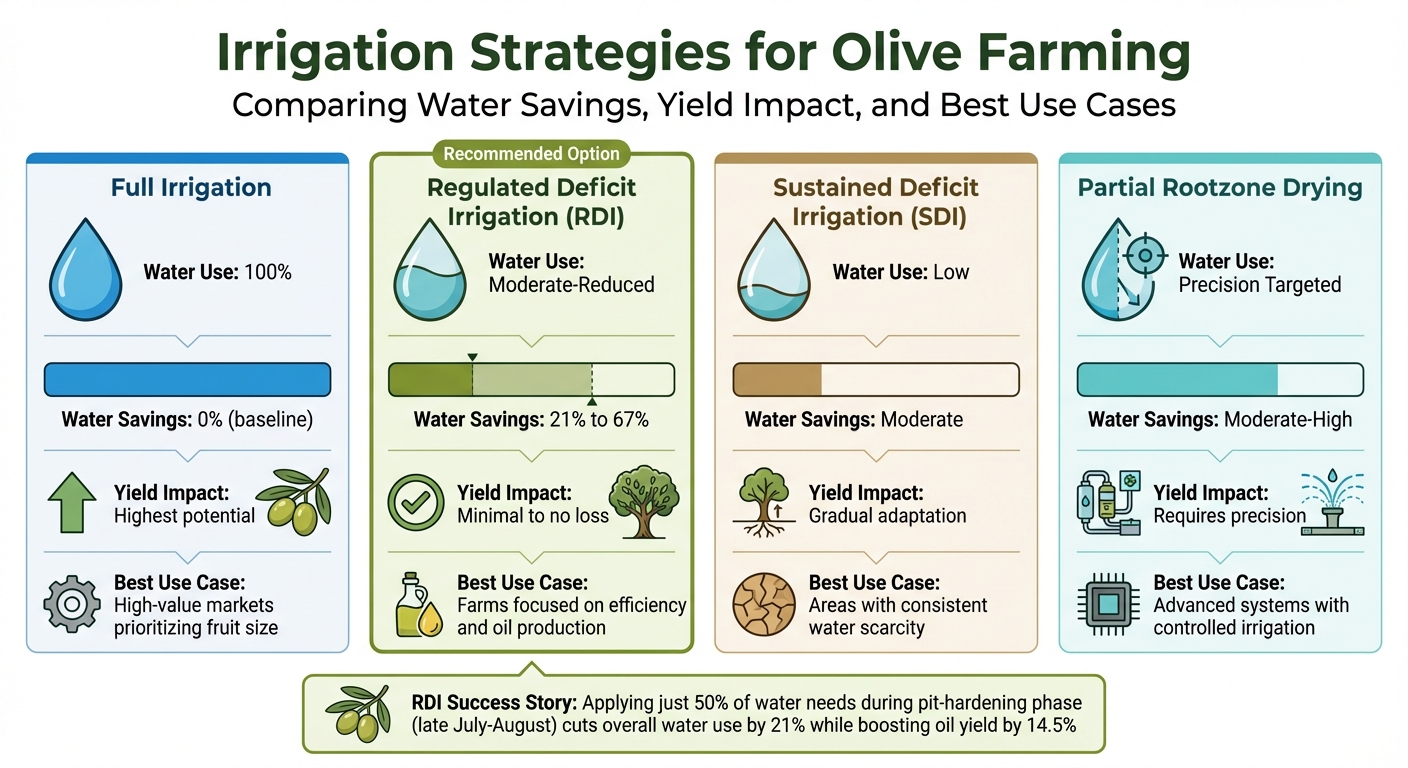
Irrigation Strategies for Olive Farming: Water Savings and Yield Impact Comparison
Water is a crucial resource in olive farming, especially in Mediterranean regions where summer droughts are common. Smart water management not only conserves this resource but also enhances olive oil yields and quality. The key lies in understanding when olive trees need more water and when they can tolerate less.
Here’s how farmers can improve water retention, optimize irrigation, and strengthen drought resilience in olive groves.
Increasing Soil Water Retention
The foundation of effective irrigation is soil that holds moisture well. Adding organic materials like biochar can significantly improve this capacity. For example, a 2022 field experiment in Surbo, Italy, demonstrated the impact of biochar. Researchers applied it at a rate of 20 metric tons per hectare (around 9 US tons per acre) to an organic olive grove (cv. Leccino). Even with a 67% reduction in irrigation during the pit-hardening phase, the biochar-treated plots maintained yields of 3,070 kg/ha (approximately 2,740 lbs/acre). Under full irrigation, yields reached 3,756 kg/ha (about 3,350 lbs/acre).
In addition, combining no-tillage practices with the use of recycled pruning residues and cover crops helps retain soil moisture. These methods can lower topsoil temperatures by as much as 36°F, reducing evaporation. They also increase soil organic carbon by 2 to 3 tons per hectare annually, which improves soil structure and water retention.
Efficient Irrigation Practices
One effective way to manage water use without sacrificing productivity is Regulated Deficit Irrigation (RDI). This technique involves reducing or stopping irrigation during the pit-hardening phase - late July through late August - when olive trees are less sensitive to water stress. A study at the University of Bari Aldo Moro from May 2017 to November 2018 found that applying just 50% of the crop's water needs during this phase cut overall water use by 21% while boosting oil yield by about 14.5% compared to full irrigation.
Timing is everything. Olive trees require water during key growth stages: floral development (mid-April), early fruit development (June), and oil accumulation (late August to mid-September). Outside of these periods, particularly during pit hardening, trees can handle significant water reductions. Tools like stem water potential measurements help farmers irrigate only when necessary, reducing waste while maintaining tree health.
| Irrigation Strategy | Water Savings | Yield Impact | Best Use Case |
|---|---|---|---|
| Full Irrigation | 0% (baseline) | Highest potential | High-value markets prioritizing fruit size |
| Regulated Deficit (RDI) | 21% to 67% | Minimal to no loss | Farms focused on efficiency and oil production |
| Sustained Deficit (SDI) | Moderate | Gradual adaptation | Areas with consistent water scarcity |
| Partial Rootzone Drying | Moderate-High | Requires precision | Advanced systems with controlled irrigation |
Efficient irrigation is just one piece of the puzzle. Building tree resilience is equally important for managing water use sustainably.
Building Drought Resistance
Balanced nutrition plays a key role in improving drought resistance. Essential nutrients like nitrogen, phosphorus, potassium, and boron strengthen trees against water stress. Recycling pruning residues can also provide these nutrients naturally.
"The slowing of fruit development - known as the pit hardening phase - is considered as the less sensitive period of olive trees to water deficit, when it is possible to reduce or interrupt irrigation without a significant reduction in yield or in oil quality." – Justino Sobreiro, Instituto Politécnico de Beja
Adopting agroecological practices adds another layer of drought resilience. For instance, growing leguminous cover crops like Medicago sativa or Trifolium species not only enriches the soil with nitrogen but also supports beneficial insects. Coupled with no-tillage management and organic amendments, these practices improve soil structure, allowing rainfall during autumn and winter to penetrate deeply - up to 6.5 feet or more. This creates a moisture reserve that olive roots can tap into during the dry summer months.
Combining Soil and Water Management
Bringing soil and water management together can significantly boost water storage, improve drought resilience, and enhance crop yields. This approach builds on time-tested soil practices while enhancing water efficiency. By blending methods like no-tillage, cover crops, and organic amendments with advanced irrigation strategies, farmers can create a system that supports long-term productivity.
Agroecological Methods in Olive Farming
Using a mix of practices often delivers the best results in olive farming. For instance, no-tillage techniques prevent soil crusting and compaction, ensuring that rainfall during autumn and winter penetrates deeply - up to 6.5 feet. Cover crops, such as Medicago sativa or Trifolium species, shield the soil, recycle nitrogen, and help moderate soil temperatures. Additionally, recycling pruning residues back into the soil replenishes essential nutrients and increases organic matter without the environmental risks associated with burning.
A study conducted in Ferrandina, Italy, between 2007 and 2009, compared a sustainable management system - featuring no-tillage, cover crops, and residue recycling - with conventional tillage in a mature, rainfed olive grove (cv. Maiatica). The sustainable approach resulted in a 45% increase in water storage within the deepest soil layers (100–200 cm) during 2007, providing a vital moisture reserve for roots during the dry summer months. It also improved soil macroporosity by 10%.
Incorporating biochar and regulated deficit irrigation into farming practices can further enhance water efficiency. For example, combining biochar with deficit irrigation allowed farmers to maintain similar yields while cutting water usage by 67%. These strategies not only optimize soil and water usage but also contribute to producing high-quality olive oil with consistent characteristics.
Tracking Soil and Productivity Improvements
To maximize the benefits of these methods, farmers need to systematically monitor soil moisture and productivity. Installing gypsum resistivity blocks - up to 6.5 feet deep - can help track soil moisture levels and confirm how well winter rainfall infiltrates the soil. Meanwhile, measuring stem water potential provides insights into when trees genuinely need irrigation, moving away from rigid watering schedules.
Tools like CropWat and OliveCan simulation models allow growers to refine water usage, predict yields, and assess carbon balance. Additionally, water footprint analysis breaks down water use into green water (rainfall), blue water (irrigation), and gray water (pollution dilution), helping farmers evaluate their environmental impact. The HydroSOStainable index goes a step further by linking irrigation efficiency with quality measures - tracking improvements in phenolic compounds, oleic acid levels, and sensory traits like bitterness and fruitiness. These tools collectively provide a detailed view of sustainability, confirming that integrated approaches directly contribute to producing premium olive oil.
Impact on Premium Olive Oil Production
Quality and Freshness Through Better Farming
Sustainable farming practices are reshaping the production of extra virgin olive oil, enhancing its flavor, nutritional value, and shelf life. For example, regulated deficit irrigation has been shown to increase phenolic compounds by over 30% and oleuropein levels by 20%. This not only boosts the oil's bitterness and pungency but also improves oxidation resistance. It even alters the fatty acid profile, raising oleic acid levels by more than 5% and reducing linoleic acid by over 10%.
Paola Sánchez-Bravo and her team at Universidad Miguel Hernández de Elche noted:
"Deficit irrigation can improve fruit quality by raising the dry matter percentage and the levels of healthy bioactive compounds."
Other techniques, like applying biochar and recycling agricultural residues, further enrich the soil. These methods increase extractable organic carbon by 25% and nitrogen by 44%, creating a nutrient-dense environment that supports consistent fruit quality. This commitment to quality directly translates into fresher products and higher market value. For instance, Big Horn Olive Oil ensures their extra virgin olive oils are cold-pressed within three months of harvest, demonstrating the impact of these approaches.
Environmental and Consumer Advantages
The environmental benefits of sustainable olive farming are hard to ignore. Deficit irrigation can reduce water usage by as much as 67%, while organic fertilization methods help cut N₂O emissions. These efforts resonate with consumers, too. Studies reveal that shoppers are willing to spend about $1.10 more per 2.2 lbs of olive oil if it's produced using water-saving techniques. Certifications like the hydroSOS quality index further reassure buyers, guaranteeing that higher prices reflect not just environmental responsibility but also superior physical, chemical, and sensory attributes.
Conclusion
Sustainable olive farming isn't just about growing olives; it's about creating an environment where groves thrive and produce consistently high-quality oil. Practices like deficit irrigation, cover cropping, and using organic amendments help improve soil health and water management, ensuring groves remain productive year after year.
By focusing on water efficiency and soil fertility, methods such as deficit irrigation and organic amendments not only lead to better yields but also improve the quality of the olives themselves. For producers like Big Horn Olive Oil, these techniques ensure their ultra-premium extra virgin olive oil meets the high standards of freshness and flavor that consumers demand.
Sustainability also has a direct impact on the oil's health benefits. Higher polyphenol levels and other beneficial compounds result from these eco-friendly practices, creating oils with richer flavors and added nutritional value.
Beyond the groves, this approach supports the broader ecosystem. It conserves water, encourages biodiversity, and helps groves adapt to challenges like droughts and climate changes. Experts agree that these strategies strengthen the resilience of both the environment and the farming systems.
FAQs
What are the benefits of recycling organic materials in olive farming?
Recycling organic materials such as olive pomace, vegetable water, and compost plays a key role in olive farming. It replenishes vital nutrients in the soil, increases organic matter, and improves the soil's water retention capacity. These changes contribute to healthier, more fertile soil, which ultimately supports better crop yields over time.
Beyond improving soil health, this approach helps cut down on waste and reduces environmental pollution, creating a more eco-friendly farming cycle. By adopting organic recycling methods, olive farmers not only enhance their productivity but also safeguard natural resources for the generations to come.
What are the benefits of using regulated deficit irrigation in olive farming?
Regulated deficit irrigation (RDI) is a smart farming technique aimed at conserving water while ensuring olive trees stay healthy, produce quality fruit, and yield high-grade oil. By strategically controlling water supply during key growth phases, farmers can make the most of their water resources without sacrificing the productivity of their olive groves.
This approach is especially beneficial in areas facing drought or limited water availability. RDI not only helps protect the environment but also improves water-use efficiency, making olive farming more sustainable and cost-effective in the long run.
What role do cover crops play in maintaining healthy soil in olive farming?
Cover crops play an important role in boosting soil health in olive orchards. By contributing organic matter, they help raise soil organic carbon levels and improve the soil's structure. This enhanced structure allows the soil to hold water more efficiently, reduces compaction, and helps protect against erosion.
Beyond that, cover crops help preserve nutrients by keeping the soil stable and encouraging better water absorption. Over time, these benefits lead to stronger, more productive olive trees while promoting sustainable agricultural practices.