

How to Test Olive Oil for Polyphenols
Polyphenols are key to olive oil's health benefits, offering antioxidant and anti-inflammatory properties. Testing for polyphenols ensures you're getting these benefits, as many oils fall short of the recommended levels. Here's what you need to know:
- Taste Test: High-polyphenol oils are bitter and cause a peppery throat sensation, sometimes leading to a "cough test."
- Lab Testing: Methods like HPLC provide accurate polyphenol measurements but can be pricey ($250–$500 per sample).
- Polyphenol Levels: Aim for oils with at least 250 mg/kg for health benefits; 500–800 mg/kg offers stronger effects, while 1,000+ mg/kg is rare and intense in flavor.
- Storage Tips: Keep oils in dark glass bottles, away from heat and light, to preserve polyphenols.
Testing your olive oil provides clarity on its quality and health value. For precise results, combine sensory evaluation with lab analysis. Proper storage and choosing oils from recent harvests are also essential.
Methods for Testing Polyphenols in Olive Oil
At-Home Taste Test Method
You don’t need fancy lab equipment to get a sense of whether your olive oil has a good amount of polyphenols - your taste buds can do a lot of the work.
Start by pouring about a tablespoon of olive oil into a small glass. Hold the glass in your hand for about 30 seconds to warm the oil and help release its aromas. Take a deep sniff. If you notice fresh, grassy, or fruity scents, it’s often a sign of higher quality and fresher phenolic content.
Next, take a small sip and let it coat your tongue. Pay attention to two key sensations: a pleasant bitterness, which suggests high oleuropein levels, and a delayed spicy or stinging feeling in your throat, which indicates oleocanthal.
High-polyphenol olive oils often trigger what’s known as the "cough test." This is when the oil’s pungency causes you to reflexively cough after swallowing. Enthusiasts sometimes even count the number of coughs to gauge potency. Unlike lower-quality oils, this spiciness doesn’t hit immediately - it builds and lingers for 15–30 seconds after you swallow.
While this sensory approach gives you a quick and practical way to assess your oil, lab testing is the only way to get precise measurements.
Laboratory Testing Methods
For exact polyphenol measurements, laboratory analysis is the way to go. High-Performance Liquid Chromatography (HPLC) is considered the most accurate method, capable of identifying individual compounds with a margin of error of ±5-10%. However, it’s pricey, costing between $300 and $500 per sample, and takes 2–4 hours to complete. Another option, Quantitative Nuclear Magnetic Resonance (qNMR), delivers results faster - within 30–60 minutes - and costs slightly less at $250–$400 per sample.
If you’re looking for a more affordable route, the Folin-Ciocalteu method might be an option. It costs between $50 and $150 per sample, but it’s less precise and tends to overestimate polyphenol content. Results from this method can vary by ±15-20% depending on the lab.
When reviewing a Certificate of Analysis (COA) for olive oil, make sure the testing lab has ISO 17025 accreditation and follows International Olive Council (IOC) standards. A trustworthy COA for high-quality oils will provide a detailed breakdown of specific compounds, like oleocanthal and oleacein, rather than just listing a single "total" polyphenol value.
sbb-itb-4066b8e
How to know if your Olive Oil is PACKED with Polyphenols? #shorts
How to Read Polyphenol Test Results
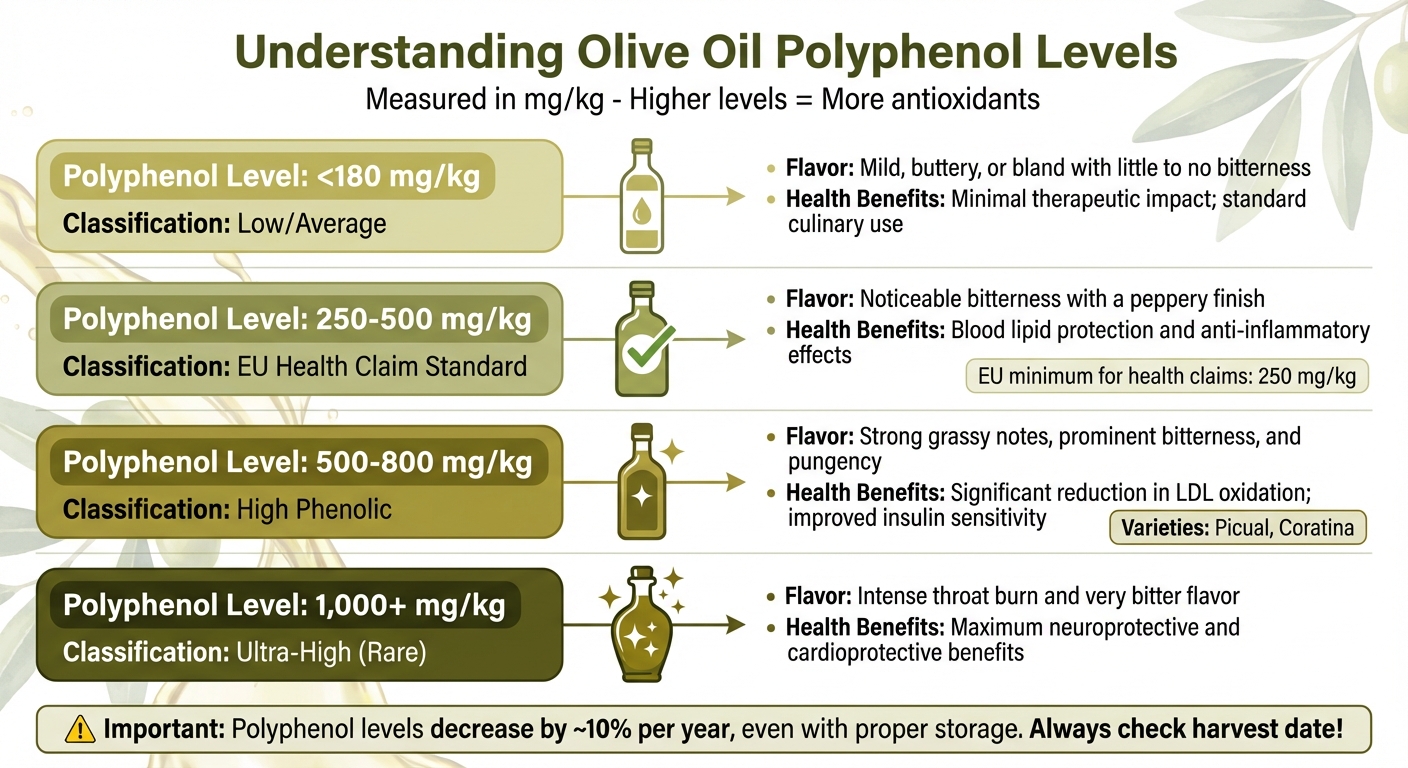
Olive Oil Polyphenol Levels: Health Benefits and Flavor Profile Guide
Polyphenol Level Ranges Explained
When you receive polyphenol test results, understanding the numbers is crucial for assessing your olive oil's quality. These results are measured in mg/kg, with higher numbers indicating more antioxidants - and by extension, greater potential health benefits.
One important benchmark is 250 mg/kg, which the European Union and the European Food Safety Authority (EFSA) established as the minimum level required for olive oil to claim it helps protect blood lipids from oxidative stress. Unfortunately, many commercial olive oils fall short of this standard, with the average supermarket variety hovering around 180 mg/kg - not enough to qualify for any health-related claims.
For higher-quality oils, look for polyphenol levels in the 500–800 mg/kg range. These oils, often made from early-harvest varieties like Picual or Coratina, offer notable anti-inflammatory and cardiovascular benefits. Oils surpassing 1,000 mg/kg are rare and deliver the highest neuroprotective and cardioprotective advantages. However, be prepared for an intense flavor - these oils are exceptionally bitter and can cause a distinct throat burn.
It’s also worth noting that polyphenol content decreases over time. Even under ideal storage conditions, levels drop by about 10% per year. That’s why checking the harvest date (not just the bottling date) is vital to determine the oil's true potency.
These ranges not only help you evaluate health benefits but also guide you in choosing oils that match your flavor preferences. The table below summarizes the key ranges for easy reference.
Polyphenol Levels Comparison Table
| Polyphenol Level (mg/kg) | Classification | Flavor Profile | Health Benefits |
|---|---|---|---|
| <180 | Low/Average | Mild, buttery, or bland with little to no bitterness | Minimal therapeutic impact; standard culinary use |
| 250–500 | EU Health Claim Standard | Noticeable bitterness with a peppery finish | Contributes to blood lipid protection and anti-inflammatory effects |
| 500–800 | High Phenolic | Strong grassy notes, prominent bitterness, and pungency | Significant reduction in LDL oxidation; improved insulin sensitivity |
| 1,000+ | Ultra-High | Intense throat burn and very bitter flavor | Maximum neuroprotective and cardioprotective benefits |
Varieties like Big Horn Olive Oil's Picual and Coratina EVOOs naturally tend to have higher polyphenol levels. These early-harvest oils typically fall into the high phenolic category, offering the bold, peppery flavors that signal antioxidant-rich content.
Tips for Accurate Testing and Preserving Polyphenols
Select Fresh, High-Quality Olive Oils
Getting accurate test results starts with choosing fresh, high-quality olive oils. The quality of the oil you start with directly impacts the reliability of your results. Check the harvest date - not the bottling date - and aim for oils harvested within the past 12 months. Oils from early-harvest green olives can have up to 80% more polyphenols than those made from fully ripened olives. Varieties like Koroneiki, Picual, and Coratina are known for their higher phenolic content, making them excellent choices for testing.
Packaging plays a huge role too. Always test oils stored in dark glass bottles because UV light can break down polyphenols quickly. In fact, just two months of UV exposure can compromise an oil's Extra Virgin status. Brands like Big Horn Olive Oil, which use opaque bottles and early-harvest varieties like Picual and Coratina, provide a solid base for accurate polyphenol testing.
For dependable results, send your samples to accredited labs that use established testing standards. This ensures your measurements reflect the true polyphenol content, which is key for evaluating health benefits.
Once you've chosen a high-quality olive oil, proper storage becomes essential to maintain its polyphenol levels.
Storage Methods to Preserve Polyphenol Content
Even the best olive oils lose their potency if stored the wrong way. The main culprits behind polyphenol loss are light, heat, and oxygen - all of which speed up degradation. To protect your oil, store it in a dark cupboard or pantry at a steady temperature between 57°F and 68°F. Avoid placing bottles on countertops near windows or stoves, where they're exposed to constant heat and light.
Keep bottles tightly sealed to limit oxygen exposure, and skip decorative cruets that don’t have airtight seals. Studies suggest that bag-in-box packaging does a better job of preserving phenolic content than even stainless steel containers with nitrogen headspace. If you buy oil in bulk, transfer small amounts into a dark glass bottle for daily use, while keeping the rest sealed in a cool, dark spot.
Refrigeration might seem like a good idea, but it’s not. The repeated cooling and warming cycles can harm both the flavor and shelf life without doing much to preserve polyphenols. To get the most out of your olive oil, stick to fresh batches from the latest harvest and aim to use them within 12 to 18 months. Proper storage not only safeguards the health benefits but also ensures the oil retains its full flavor.
Conclusion
Testing olive oil for polyphenols is a practical way to confirm both its quality and health benefits. A simple at-home taste test can help you detect compounds like oleocanthal, known for their health-promoting properties, while laboratory testing using HPLC provides detailed, accurate measurements to back up health claims. Research indicates that a staggering 90% of commercial olive oils don’t meet the European Union's standard of 250 mg/kg for health claims. Moreover, an impressive 99% of olive oil's health benefits are tied to its phenolic compounds, not the oil itself.
This guide highlights methods that help you make better choices, from the telltale throat sting signaling high polyphenols to verifying quality through lab certifications. Oils backed by recent third-party lab results (dated within the last six to twelve months) are more reliable, while vague terms like “Pure” or “Light” often disguise refined oils with diminished health value.
Brands like Big Horn Olive Oil simplify the process by offering Ultra Premium Extra Virgin Olive Oils from high-phenolic varieties such as Picual and Coratina. Their dedication to freshness - cold-pressing olives within two hours of harvest and delivering the oils within three months - ensures maximum polyphenol content. Additionally, their use of opaque bottles protects these delicate compounds from light exposure, which can degrade quality in as little as two months, potentially stripping the oil of its Extra Virgin status. This approach highlights how careful testing and proper storage can preserve the oil’s health benefits.
Whether you’re relying on a quick taste test or reviewing HPLC lab results, the goal remains clear: choose olive oils that deliver real therapeutic benefits. By combining proper testing techniques with mindful storage, you can confidently select oils that support heart health and deliver the antioxidant power they promise.
FAQs
Can I estimate polyphenols without lab testing?
It’s impossible to accurately measure the polyphenol content of olive oil just by relying on sensory cues like taste or smell - they’re simply not precise enough. To determine the exact levels, laboratory techniques such as HPLC (High-Performance Liquid Chromatography) or spectrophotometry are necessary. These methods provide the detailed analysis needed for precise measurement.
Which lab test is best for polyphenols?
The most reliable lab test for measuring polyphenols in olive oil is High-Performance Liquid Chromatography (HPLC). Known for its accuracy, this method excels at identifying and quantifying individual polyphenols, providing dependable and precise results.
How fast do polyphenols drop after harvest?
Polyphenols in olive oil tend to break down rapidly after harvesting, particularly when exposed to heat, moisture, or oxygen during storage. These elements speed up the degradation process, causing a noticeable reduction in polyphenol levels over time. To slow this process, it’s essential to store olive oil in a cool, dark place, which helps maintain its polyphenol content for a longer period.