

Trace Metals in Olive Oil: Role of AAS
Olive oil can contain tiny amounts of metal, and those tiny amounts can still matter. From the research, the main point is simple: iron (Fe) and copper (Cu) affect oil shelf life, while lead (Pb), cadmium (Cd), arsenic (As), and chromium (Cr) matter most for safety checks. And AAS is one of the main lab tools used to measure them at very low levels.
If I had to boil the article down fast, I’d say this:
- Fe and Cu speed up oxidation and can shorten shelf life.
- Pb, Cd, and As are checked against safety limits.
- AAS can measure metals at very low concentrations, down to about 0.06 µg/kg in some cases.
- GFAAS is used for lower-level metals like Pb, Cd, As, Ni, and Cr.
- FAAS is more suited to routine checks when metals are present at higher levels.
- Metal levels can change based on soil, sprays, equipment, processing, and packaging.
- Some studies found oils made by pressing had more Cu, Fe, and Pb than oils made by centrifugation.
- Reported extra virgin olive oil values in one large Italian dataset stayed below listed limits, such as:
- Fe: up to 582 µg/kg vs. limit of 3,000 µg/kg
- Pb: up to 22.1 µg/kg vs. limit of 100 µg/kg
- As: up to 4.0 µg/kg vs. limit of 100 µg/kg
A quick way to look at it: some metals hurt oil quality first, while others are checked mainly for food safety. That is why labs use AAS for both quality control and compliance work.
| Metal group | Main issue | What the article shows |
|---|---|---|
| Fe, Cu | Oxidation, shorter shelf life | Main drivers of rancidity risk |
| Pb, Cd, As, Cr | Safety and legal checks | Need close low-level monitoring |
| Mn, Ni, Zn | Process or handling clues | Can point to contamination sources |
Bottom line: if you want to know whether olive oil is more likely to lose quality fast, or whether it may have a metal compliance issue, AAS is one of the main methods used to get that answer.
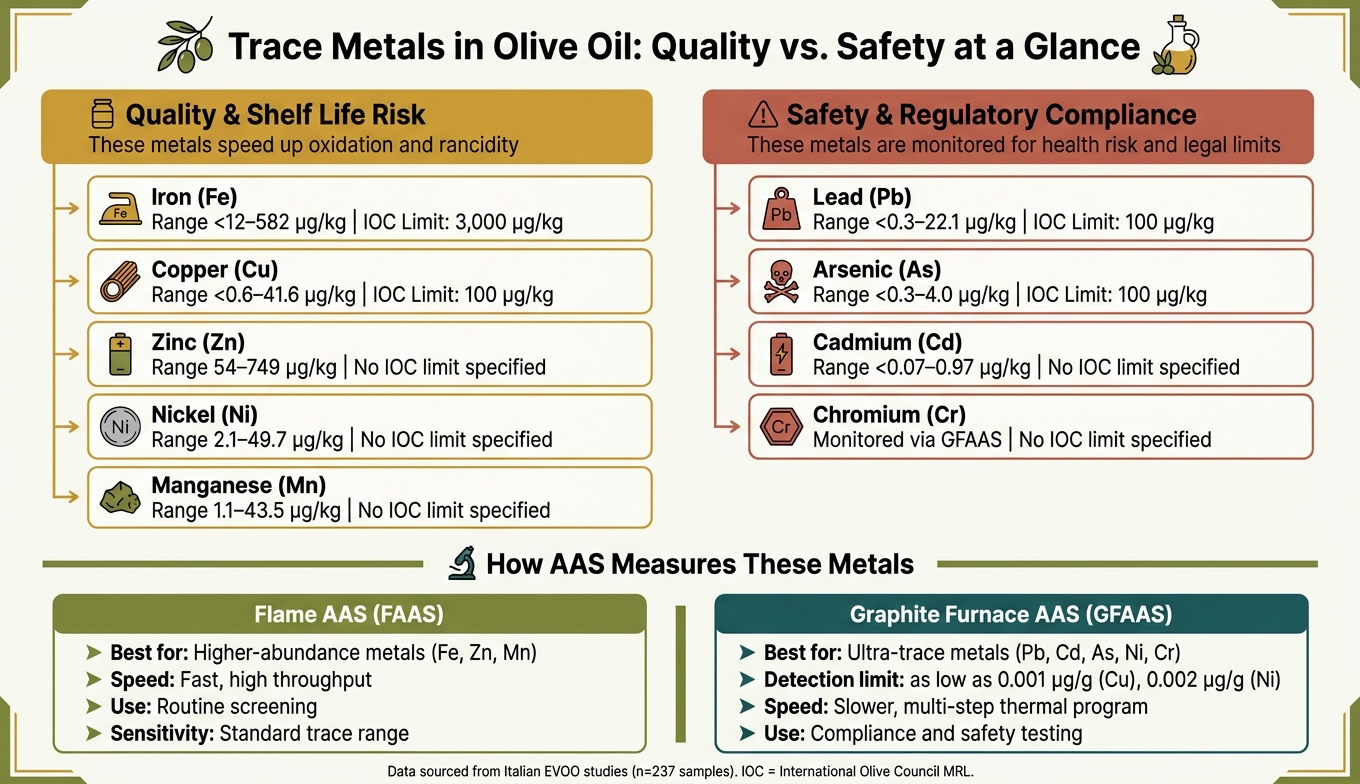
Trace Metals in Olive Oil: Quality vs. Safety at a Glance
Key Trace Metals in Olive Oil and What Studies Report
AAS studies usually zero in on two groups of metals: those that speed up oxidation and those that can trigger compliance issues. Across olive oil samples from different origins, the data tends to show the same broad pattern. AAS is the tool most often used to turn tiny trace-metal differences into results people can act on.
Metals Linked to Quality, Shelf Life, and Rancidity
Iron and copper are closely tied to oil breakdown. Even in small amounts, both work as pro-oxidants and can speed up rancidity. That puts freshness at risk and can chip away at the phenolic antioxidants that help set premium EVOO apart.
In one study of 237 Italian EVOO samples, iron ranged from <12 to 582 µg/kg, with a median of 77 µg/kg. That sits well below the IOC limit of 3,000 µg/kg. In the same study, copper had a median of 3.2 µg/kg.
Manganese, nickel, and zinc also show up often in AAS testing. When these metals run higher, they usually point to contamination during growing, processing, or storage.
The same tests also pick up metals that matter less for taste and more for control and compliance.
Metals Linked to Health Risk and Regulatory Compliance
Lead, cadmium, and arsenic are tracked for health risk and regulatory compliance. In Italian EVOO studies, lead had a median of 0.9 µg/kg and a maximum of 22.1 µg/kg, which is within the IOC limit of 100 µg/kg. Arsenic ranged from less than 0.3 to 4.0 µg/kg.
Researchers monitor these metals closely because even low concentrations can matter over long periods of exposure.
Summary Table: Key Metals and Their Implications
| Metal | Reported Range in EVOO (µg/kg) | Main Concern | IOC MRL |
|---|---|---|---|
| Iron (Fe) | <12 – 582 | Oxidation | 3.0 mg/kg (3,000 µg/kg) |
| Copper (Cu) | <0.6 – 41.6 | Oxidation | 0.1 mg/kg (100 µg/kg) |
| Zinc (Zn) | 54 – 749 | Oxidation | Not specified |
| Nickel (Ni) | 2.1 – 49.7 | Oxidation | Not specified |
| Manganese (Mn) | 1.1 – 43.5 | Oxidation | Not specified |
| Lead (Pb) | <0.3 – 22.1 | Safety/compliance | 0.1 mg/kg (100 µg/kg) |
| Arsenic (As) | <0.3 – 4.0 | Safety/compliance | 0.1 mg/kg (100 µg/kg) |
| Cadmium (Cd) | <0.07 – 0.97 | Safety concern | Not specified |
These concentration patterns show why AAS plays such a big role in olive oil testing. From here, the next piece is the method itself: how AAS measures these metals in an oil matrix.
sbb-itb-4066b8e
How AAS Works for Olive Oil Testing
AAS measures how much element-specific light free atoms absorb after the sample is atomized. In plain English, each metal responds to its own wavelength of light, so the instrument has to be set up separately for each one.
That one-metal-at-a-time setup is exactly why AAS works well for trace-metal testing in olive oil. It gives labs a clean way to target the metals they care about, then choose the mode that fits the job: FAAS for routine screening or GFAAS for ultra-trace work.
Flame AAS vs. Graphite Furnace AAS
The two main modes of AAS do different jobs in olive oil testing.
Flame AAS (FAAS) uses a high-temperature flame. It works best for elements present at higher levels, which makes it a good fit for fast routine screening.
Graphite Furnace AAS (GFAAS), also called Electrothermal AAS (ETAAS), heats a small graphite tube with electricity instead of using a flame. Labs often use GFAAS for trace metals such as lead, cadmium, arsenic, nickel, and chromium. In olive oil testing, detection limits can go as low as 0.001 µg/g for copper and 0.002 µg/g for nickel.
| Feature | Flame AAS (FAAS) | Graphite Furnace AAS (GFAAS) |
|---|---|---|
| Best for | Higher-abundance minerals | Pb, Cd, As, Cu, Ni, Cr |
| Sensitivity | Routine trace range | Ultra-trace range |
| Speed | Fast; high throughput | Slower; multi-step thermal program |
| Matrix handling | Requires low-viscosity liquids | Handles viscous oil matrices |
Sample Preparation for an Oil Matrix
Olive oil isn't an easy sample. It's thick, rich in organic material, and that can interfere with atomization or distort the result if the prep step isn't done well.
Labs usually deal with this by using microwave-assisted digestion, wet digestion, dry ashing, or direct sampling. Microwave-assisted digestion is common because it can deliver recovery rates above 95% for trace elements. Dry ashing takes more time and can lead to losses of volatile elements.
Direct sampling takes a different route. The oil is weighed straight onto a graphite platform and placed into the furnace, so digestion is skipped. That can cut down contamination risk and save time.
Clean handling matters at every step. AAS is sensitive enough to pick up metals from glassware, reagents, or even the lab setting itself. If that control slips, the precision and recovery data in a validation report don't mean much.
What Method Performance Looks Like in Practice
When researchers report AAS performance for olive oil, the method tends to produce steady numbers. Precision, measured as relative standard deviation (RSD), usually falls between 2.6% and 4.2% for metals such as cadmium, chromium, copper, manganese, and lead when GFAAS is used.
Recovery rates from validated digestion methods usually fall between 81% and 120%, and microwave-assisted digestion often goes past 95%.
Those figures matter because they show whether the metal levels reported are dependable enough for safety checks and compliance decisions.
What Research Shows About AAS Results in Olive Oil
Once the method is validated, AAS becomes a practical way to see how trace metals shift with processing, origin, and cultivar.
Published AAS Studies and Their Main Findings
Published studies use AAS to compare olive oils by process, origin, and cultivar. The metals checked most often are copper (Cu) and iron (Fe) because they can speed up lipid oxidation and cut EVOO shelf life. Researchers also track lead (Pb), cadmium (Cd), and arsenic (As) for safety and regulatory compliance. In plain terms, metal levels matter for both legal compliance and oil identity.
Processing method can change those levels in a clear way. Research by Brkljaca and colleagues found that olive oils made by traditional pressing consistently had higher concentrations of Cu, Fe, and Pb than oils made by centrifugation. The likely reason is simple: pressing means longer contact with metal equipment surfaces.
Another study looked at Spanish and Moroccan olive oils using GF-AAS after microwave digestion. The researchers found that Moroccan samples had much higher lead levels than the Spanish samples, which points to the role of local conditions and production practices.
Those metal patterns do more than flag contamination. They can also help tell oils apart.
How AAS Supports Authenticity and Origin Studies
AAS-based multi-element fingerprints can help identify origin, cultivar, and harvest year. When researchers pair those profiles with PCA or PLS, they can separate oils by region, cultivar, or year. That makes AAS useful not just for screening, but also for origin checks.
Research on three Portuguese single-variety EVOOs - 'Galega,' 'Cobrançosa,' and 'Picual' - used both Flame AAS and GF-AAS. The results showed that Fe and Mn were the strongest markers for identifying the olive cultivar, while Na, Cu, Zn, and Ni changed with harvest season.
Elements like cesium (Cs) and rubidium (Rb) can also help with geographic traceability because they move from soil to fruit with relative ease and remain through extraction. Put together, this multi-element method gives researchers a practical way to verify origin claims and support premium EVOO quality control.
Study Design and Results: Summary Table
| Country/Region | Olive Oil Type | Metals Measured | AAS Mode | Sample Preparation | Main Conclusion |
|---|---|---|---|---|---|
| Croatia | Virgin Olive Oil | Cd, Cu, Fe, Pb, Ni | ETAAS | Dry ashing (300°C/450°C) | Pressing yields higher Cu, Fe, and Pb than centrifugation |
| Spain & Morocco | Virgin, Refined, Pomace | Cd, Cr, Cu, Mn, Pb | GF-AAS | Microwave digestion | Moroccan oils showed higher Pb levels than Spanish oils |
| Portugal | Single-variety EVOO ('Galega,' 'Cobrançosa,' 'Picual') | 14 metals, including Ca, Mg, Fe, Na, Cu, Zn, Ni, Pb, Cd, and As | Flame AAS & GF-AAS | Wet acid digestion | Fe and Mn discriminate cultivar; Na, Cu, Zn, and Ni vary with harvest season |
What AAS Means for Safety, Quality Control, and Next Steps
Why Trace-Metal Monitoring Supports Premium EVOO Quality
These findings matter most when they shape batch release and storage choices. For premium EVOO, trace-metal monitoring helps protect shelf life. The reason is simple: metals like Fe and Cu speed up oxidation, and that can shorten how long the oil stays at its best.
IOC limits are 0.1 mg/kg for arsenic, copper, and lead, and 3.0 mg/kg for iron. Some EVOO samples have shown copper at 0.11–0.18 mg/kg, which is slightly over the limit and often tied to late-season copper sulfate use. That’s where routine AAS testing comes in. It gives producers a clear way to catch out-of-spec batches before release. It can also show whether tanks, containers, or other storage materials are adding Fe or Cu to the oil.
How AAS Compares to Other Analytical Methods
That day-to-day role stands out even more when AAS is set next to other lab methods.
| Method | Sensitivity | Multi-Element | Typical Use Case in Olive Oil |
|---|---|---|---|
| AAS (Flame/GFAAS) | High, especially GFAAS | Single-element | Routine monitoring of legislated metals (Pb, Cu, Fe, As) |
| ICP-OES | Moderate | Yes | Rapid screening of major minerals (Ca, Mg, Na) and nutritional profiles |
| ICP-MS | Very high | Yes (45+ elements) | Geographical fingerprinting, authenticity research, and high-end safety audits |
AAS is a cost-effective option for targeted metal testing, with the sensitivity needed for this kind of work. ICP-MS gives labs much broader coverage and ultra-trace detection, but the equipment and operating costs are much higher.
Conclusion: Key Takeaways from the Research
Across the studies, the pattern stays the same. Three points stand out: Cu and Fe are tied to oxidation and shelf-life risk, Pb, Cd, and As are the main safety concerns, and AAS - especially GFAAS - remains a practical, validated tool for tracking both, helping with compliance and authenticity in premium EVOO.
FAQs
Why do tiny metal levels matter in olive oil?
Tiny traces of metals can have a big effect on olive oil. Iron and copper, for example, can speed up oxidation. That means the oil can turn rancid sooner, lose shelf life, and take on off flavors.
Heavy metals like lead and arsenic need close control too. Even at low levels, they can pose health risks. At Big Horn Olive Oil, strict testing helps support safety, quality, and IOC standards.
Which metals affect quality vs. safety?
Trace metals are monitored for two main reasons: quality and safety.
Iron and copper mostly affect quality. When iron levels get too high, it can speed up rancidity and spoilage. Too much copper can shorten shelf life and change flavor.
Lead and arsenic are checked for safety. Both are highly toxic and offer no nutritional value. The IOC sets strict maximum residue levels to help ensure compliance and protect consumers.
When is GFAAS used instead of FAAS?
GFAAS is used instead of FAAS when you need higher sensitivity to detect trace elements at very low concentrations.
FAAS is a standard analytical method. But when element levels drop below the detection limits of flame-based methods, GFAAS becomes the better choice. That makes it important for analyzing some quality-related and toxic metals in olive oil.