

How Transparent Pricing Promotes Fair Trade in Olive Oil
Transparent pricing is reshaping the olive oil industry by addressing issues like fraud, unfair revenue distribution, and consumer mistrust. Here's what you need to know:
- Fraud in Olive Oil: Mislabeling and deceptive practices cost the global food sector $10–$15 billion annually. For example, a 2016 scam involved falsely labeling 2,000 tons of olive oil as "100% Italian", worth over $15 million.
- Consumer Demand for Transparency: 94% of buyers want traceability tools, and 74% are willing to pay more for verified supply chain information.
- Producer Challenges: Farmers in conventional supply chains often receive only 15% of a bottle's revenue, while retailers take 50%. Fraud and pricing manipulation further reduce their earnings.
- Transparent Models Work: Companies like Big Horn Olive Oil provide clear pricing, traceability through QR codes and blockchain, and fairer revenue distribution. Their Ultra Premium EVOO is priced at $8.99 per bottle, ensuring both quality and fair payment to producers.
Transparent pricing not only builds trust with consumers but also supports equitable practices for farmers, making it a smarter choice for everyone involved.
1. Big Horn Olive Oil
Pricing Transparency
Big Horn Olive Oil keeps things simple when it comes to pricing. Their Ultra Premium EVOO is available for $8.99 per bottle, while their 25-Year Aged Dark Balsamic Vinegar is priced at $12.99. To guarantee freshness, every bottle includes harvest dates and pressing details, ensuring the oil is used within three months of production.
The company takes traceability seriously, using RFID tags and QR codes to track the olive oil's journey - from the tree to harvesting, pressing, and finally, bottling. This advanced tracking system, often called "infotracing", promotes transparency and accountability throughout the supply chain.
Producer Equity
By maintaining clear pricing and reducing reliance on middlemen, Big Horn Olive Oil ensures that farmers receive fair compensation. Transactions are meticulously documented using blockchain technology, creating a secure, tamper-proof record of payments and product history. This system not only allows producers to confirm they’ve been paid fairly but also provides consumers with reassurance that their purchase directly benefits the individuals responsible for cultivating and harvesting the olives.
Consumer Trust
Fair payment practices and supply chain transparency go a long way in building trust with consumers. Studies show that when supply chain details are verified and shared, customers are more likely to trust the authenticity of the product. By providing detailed information - such as the olive variety and pressing times - Big Horn Olive Oil gives buyers confidence in the quality and authenticity of what they’re purchasing.
2. Conventional Olive Oil Supply Chains
Pricing Transparency
Conventional olive oil supply chains are anything but straightforward when it comes to pricing. The layered system - spanning production, intermediaries, and retail - leaves consumers in the dark, without reliable benchmarks for what they should be paying. Between October 2023 and October 2024, olive oil prices nearly doubled, adding to the confusion.
Labels are often the only source of information for buyers, but verifying their claims can be costly, sometimes requiring DNA testing. A 2015 investigation revealed a troubling example: around 7,000 metric tons of North African olive oil were mixed with domestic oil, falsely labeled as Italian, and sold for tens of millions of dollars.
This lack of transparency stands in stark contrast to models like Big Horn Olive Oil, which offer clear and open pricing, setting a benchmark for comparison.
Producer Equity
The lack of transparency in pricing also extends to how revenue is distributed, and the results are far from fair. Farmers in conventional supply chains typically see only about 15% of the revenue from each bottle of olive oil, while retailers take home about 50%. This imbalance can force producers to sell at prices that don’t even cover their costs. For instance, in 2025, Tunisia saw a 40.1% increase in olive oil export volumes, yet export revenues fell by 28.9%, totaling roughly $761 million. Much of this oil was resold through EU countries at prices well below Tunisia's official minimum export price of $3.62 per kg (approximately $1.64 per lb).
"Some market participants pushed prices at origin below production costs, preventing fair value distribution across the supply chain and putting further pressure on traditional growers' profitability."
– UPA (Union of Small Farmers and Ranchers)
Adding insult to injury, penalties for fraud, such as mislabeling, are laughably low. Fines range from just $2,200 to $13,200, even when the illegal profits amount to millions.
Consumer Trust
This lack of fairness and transparency undermines consumer trust. While clear pricing and fair compensation for producers can build confidence, conventional supply chains fall short. A staggering 87% of consumers believe the revenue distribution in olive oil supply chains is unfair. And when people learn that about 10% of food products globally are affected by fraud - costing the industry between $10 billion and $15 billion annually - it’s no surprise that trust in olive oil takes a hit.
An EU test report from 2021 found that nearly 40% of tested Extra Virgin Olive Oil didn’t meet official quality standards, with over 14% carrying incorrect labels. Francesco Bimbo, a researcher at the University of Foggia, highlights the broader issue:
"Potential consumer losses due to overpayments for a false claim are higher than manufacturer gains, suggesting that labelling fraud results in welfare losses and not just in welfare transfers."
Market Impact
The opaque nature of conventional supply chains creates fertile ground for fraud. One example: fraudulent use of Protected Geographic Indication (PGI) logos in the EU generates an estimated $2.45 billion in illegal revenues each year. Meanwhile, consolidation among a few major producers gives them significant control over pricing. Authentic "100% Italian" extra virgin olive oil typically sells for $8.50–$9.60 per kg (around $3.86–$4.35 per lb), while EVOO of unspecified origin is priced much lower, at $4.25–$5.32 per kg (about $1.93–$2.41 per lb). These pricing disparities create strong incentives for unethical operators to mislabel their products, further distorting the market. The consequences? Producers lose out, and consumer confidence continues to erode.
REAL QUALITY OLIVE OIL in a SEA Of FAKES- INTERVIEW With OWNER of CANAAN PALESTINE
sbb-itb-4066b8e
Pros and Cons
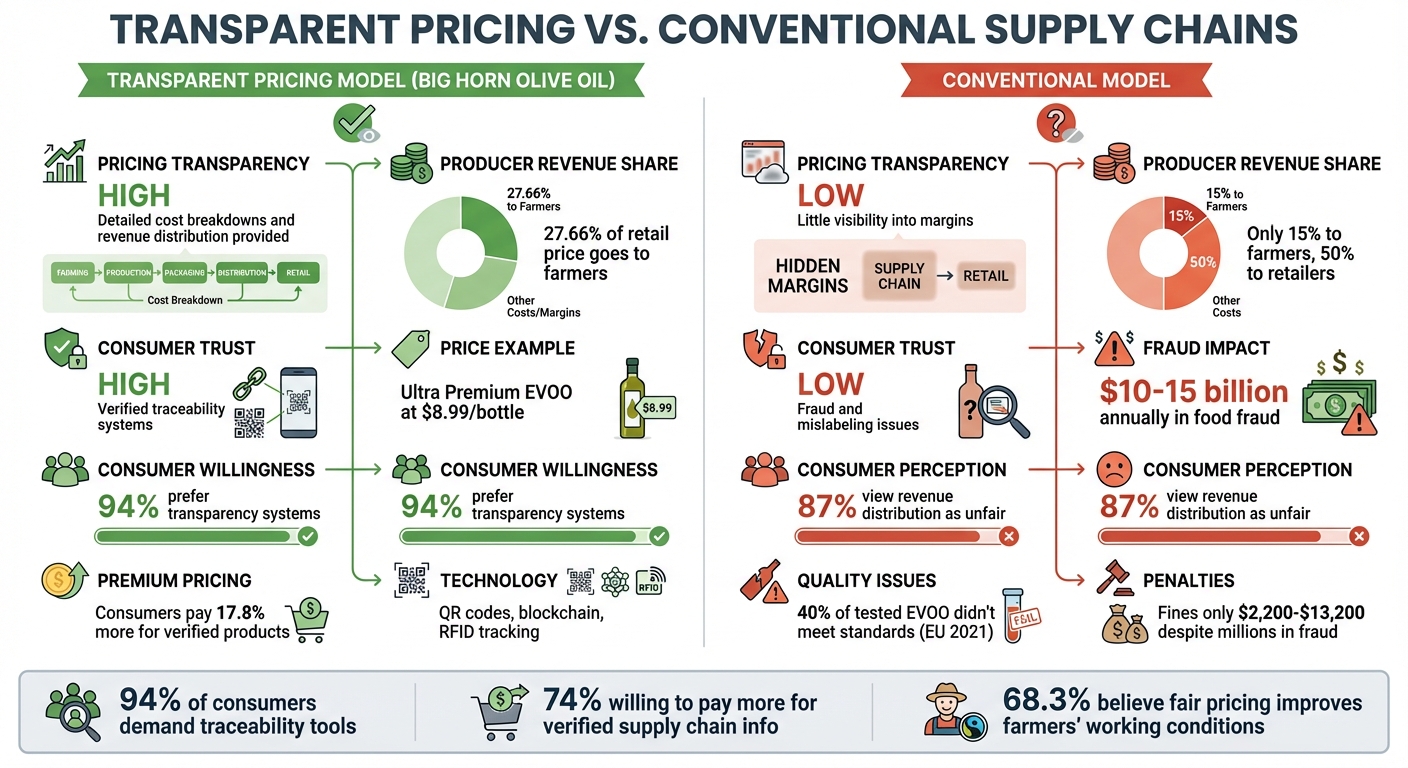
Transparent vs Conventional Olive Oil Pricing: Revenue Distribution and Consumer Impact
Transparent pricing and conventional pricing models each bring distinct outcomes for producers, consumers, and the broader market. Here's a comparison of their key features:
| Feature | Big Horn Olive Oil (Transparent Model) | Conventional Supply Chains |
|---|---|---|
| Pricing Transparency | High; provides detailed cost breakdowns and revenue distribution, fostering consumer trust. | Low; offers little visibility into intermediary margins. |
| Producer Equity | Promotes fairer revenue distribution; farmers typically receive about 27.66% of the revenue compared to 15% in conventional chains. | Often skewed; farmers receive around 15%, while retailers capture about 50%. |
| Consumer Trust | High; supported by traceability systems that verify product authenticity. | Low; prone to fraud and mislabeling issues. |
| Market Impact | Supports premium pricing; consumers are willing to pay an average of 17.8% more for products with verified traceability. | Limited by price competition and frequent risks of fraudulent practices. |
Although implementing traceability systems can increase production costs by 3% to 15.5%, a striking 94% of consumers favor their adoption, highlighting strong demand for transparency.
"A lack of market transparency and information asymmetries can lead to inefficient markets and give those with access to the most accurate data disproportionate power."
– European Commission
While transparent pricing demands upfront investments in technology and coordination, it directly addresses critical issues like producer exploitation and consumer mistrust. On the other hand, conventional pricing systems, though seemingly straightforward, often conceal hidden costs - such as fraud and inequitable revenue distribution - that can erode trust and market stability over time. This analysis sets the stage for further exploration of how transparent pricing can reshape the olive oil industry.
Conclusion
Transparent pricing is a game-changer for addressing long-standing inequities in the olive oil industry. With 87% of consumers viewing the current revenue distribution as unfair, the need for change is undeniable. By shedding light on how revenue travels through the supply chain, transparent pricing ensures that farmers - who often receive just 15% of retail revenue - are paid more fairly.
And here's the thing: transparency works. Research shows that consumers are willing to pay up to 17.8% more for products with verified traceability, with 94% preferring systems that ensure transparency. This isn’t about charity - it’s a smart, sustainable business approach that ties quality, authenticity, and fair compensation into one package. Companies like Big Horn Olive Oil are proof of this concept in action, setting a benchmark for how transparency can drive real change.
Big Horn Olive Oil stands out by openly sharing details about sourcing, production, and pricing. This openness not only reduces the risk of fraud but also ensures a more equitable distribution of revenue across the supply chain.
"Supply chain transparency is not just about the company itself accessing information, but also making it accessible to external stakeholders, including customers, investors and regulators." – IBM
Choosing products from transparent companies isn’t just a purchase - it’s an investment in a fairer olive oil industry. When you support these brands, you’re helping create a system where farmers are treated more equitably. In fact, 68.3% of consumers believe fair pricing directly improves farmers’ working conditions. Transparent pricing doesn’t just reshape the supply chain - it transforms it into one built on fairness and integrity.
FAQs
How does transparent pricing support fair revenue for olive oil producers?
Transparent pricing plays a key role in ensuring olive oil producers are compensated fairly, as it reflects the genuine market value of their products. By cutting down on intermediaries, producers receive payments that not only cover their production costs but also provide a fairer share of the profits.
This method ties closely to fair trade principles, promoting stability and fairness throughout the supply chain. With transparency at the forefront, producers can dedicate their efforts to maintaining high-quality standards while being rewarded appropriately for their labor.
What methods are used to ensure olive oil can be traced back through the supply chain?
Traceability in olive oil supply chains relies on technologies such as blockchain, QR codes, and RFID tags. These tools allow producers to monitor and document every stage of the olive oil's journey - from the grove where the olives are harvested to the moment the product reaches the consumer. This creates a clear and verifiable record of its path.
By adopting these systems, producers can share detailed insights about their olive oil, including its origin, production methods, and quality. This level of transparency not only strengthens consumer trust but also supports ethical practices by aligning with principles of fair trade and responsible production.
Why do consumers value olive oil with verified traceability and pay more for it?
Consumers are often ready to spend extra on olive oil that comes with verified traceability. Why? It guarantees they’re getting a product with a clear, documented origin - from the olive grove to the bottle. This level of transparency reassures buyers about the oil's purity and freshness, giving them confidence in its quality.
Beyond that, traceability frequently goes hand in hand with ethical and fair-trade practices. It supports small-scale farmers and promotes sustainable farming methods. This combination not only fosters trust but also empowers consumers to make socially conscious choices while savoring premium olive oil.