

Ultimate Guide to Olive Tree Symbolism
The olive tree has symbolized peace, wisdom, and renewal for over 8,000 years. From ancient Greek myths to religious texts and modern diplomacy, its significance spans cultures and eras. Key highlights include:
- Greek Mythology: Athena's olive tree gift to Athens symbolized wisdom and utility, while Homer’s Odyssey tied the olive tree to loyalty and stability.
- Religion: In the Bible, the olive branch marked peace after the flood. Olive oil has been central in Christian, Jewish, and Islamic rituals, symbolizing divine light and healing.
- Olympic Traditions: Ancient athletes were crowned with olive wreaths, representing virtue and achievement.
- Modern Diplomacy: The olive branch appears in symbols like the UN emblem and was even left on the Moon during Apollo 11.
Olive trees endure for thousands of years, regenerating even after destruction, making them a timeless emblem of resilience and renewal. This guide explores how the olive tree connects ancient wisdom with modern ideals of peace and prosperity.
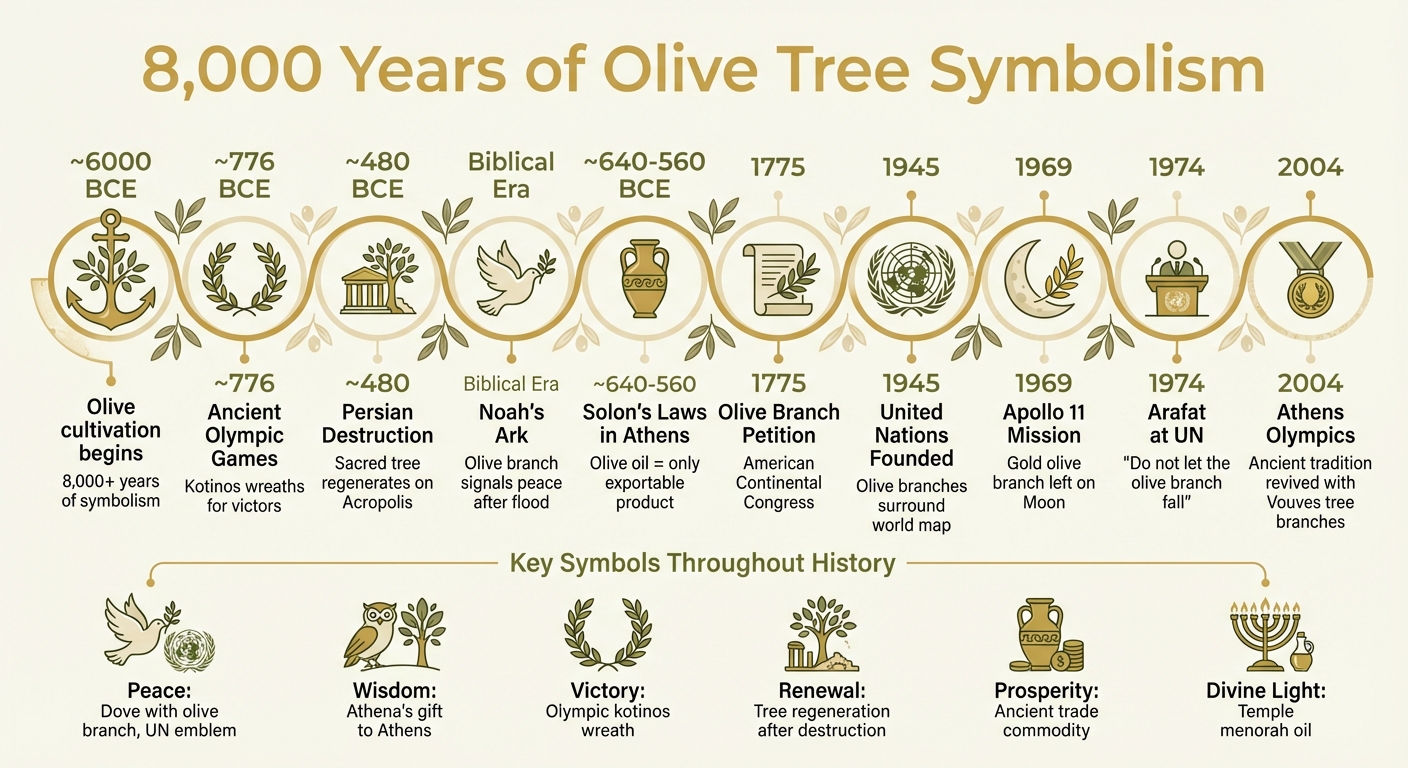
8,000 Years of Olive Tree Symbolism: From Ancient Greece to Modern Diplomacy
The Symbolic Meaning of The Olive Tree
sbb-itb-4066b8e
Olive Tree Symbolism in Ancient Greek Mythology
In Greek mythology, the olive tree holds a profound place, symbolizing divine wisdom, loyalty in marriage, and renewal after hardship. These themes are vividly brought to life through various myths, each highlighting the tree's sacred significance.
Athena's Gift to Athens
One of the most famous myths tells of a divine competition between Athena, the goddess of wisdom, and Poseidon, the god of the sea, on the Acropolis. To win the favor of the city's people, Poseidon struck a rock with his trident, creating a saltwater spring known as the "Erechtheis." While impressive, the spring was of limited practical use. In contrast, Athena struck the ground, and from it grew the first olive tree, Maria Elaia. This tree provided food, oil for light and medicine, and wood for construction - making it a gift of lasting value. King Cecrops declared Athena's offering superior, and the city was named Athens in her honor, symbolizing the triumph of wisdom over brute force.
The olive tree's resilience was further demonstrated during the Persian destruction of the Acropolis in 480 BC. According to Herodotus, the sacred tree miraculously sprouted new growth - reaching nearly three feet tall - on the same day it was burned. This act of regeneration became a powerful symbol of hope and rebirth. Later, the Erechtheion temple, built between 421 and 406 BC, was designed to protect the sacred sites of this legendary contest. In 1952, the American School of Archaeology replanted an olive tree on the Acropolis using a preserved branch from wartime destruction, continuing its legacy.
This foundational myth sets the tone for other stories that celebrate the olive tree's enduring symbolism.
The Olive Tree in Homer's Odyssey
In Homer’s Odyssey, the olive tree takes on deeply personal and symbolic meaning, representing both the strength of marriage and the stability of home. Odysseus crafted his marriage bed from an olive tree that remained rooted in the ground, making it immovable. This detail became a secret known only to him and his closest confidants, serving as the ultimate proof of his identity when he returned after 20 years. The unshakable bed, tied to the olive tree, symbolized marital loyalty and the enduring foundation of his household.
Beyond this, olive oil played a significant role in the rituals of hospitality and renewal. It was used in bathing and anointing, symbolizing purity and the restoration of one’s spirit. Through these associations, the olive tree became a symbol of both personal and communal continuity.
Deucalion and Pyrrha: The Olive Branch as Renewal
After the great flood, Deucalion and Pyrrha received an olive branch as a sign that the waters had receded and dry land had returned. This branch, a token of divine reconciliation, marked the restoration of life after catastrophic destruction. Its resilience in harsh conditions cemented the olive tree as a symbol of hope and new beginnings.
This theme of renewal underscores the olive tree’s lasting presence in ancient stories, where it consistently represents perseverance and the promise of a fresh start.
Religious and Spiritual Meaning of the Olive Tree
The olive tree has long been revered in religious traditions, embodying themes of peace, spiritual enlightenment, and the enduring connection to the divine. Its symbolic significance spans multiple faiths, weaving through ancient texts and sacred rituals.
The Olive Branch in Biblical Narratives
In Genesis 8:11, the olive branch emerges as a powerful symbol of reconciliation. When a dove returned to Noah's Ark with a freshly plucked olive leaf, it marked the end of the flood and the restoration of peace between God and humanity. While the original Hebrew text mentions an olive "leaf", St. Jerome's 4th-century Latin translation described it as a "branch" (ramum olivae).
Early Christian thinkers like Tertullian and St. Augustine emphasized the olive branch as a representation of divine reconciliation and the calming of wrath. This imagery also carries into the New Testament. In Romans 11:17-24, the Apostle Paul uses the metaphor of grafting wild olive branches (Gentile believers) into a cultivated olive tree (symbolizing Israel's covenant). This act of grafting reflects themes of spiritual unity and renewal through grace, reinforcing the olive branch as a timeless emblem of peace and harmony.
Olive Oil in Religious Ceremonies
Olive oil has played a central role in religious rituals, symbolizing divine favor and sanctity. In both Judaism and Christianity, it was used to anoint kings, priests, and prophets, marking them as chosen by God. Even today, olive oil is integral to sacraments like baptisms and confirmations, where it signifies the presence of the Holy Spirit. The Hebrew word for "Messiah", meaning "anointed one", directly connects spiritual authority to the act of anointing with olive oil.
The Garden of Gethsemane, whose name translates to "olive press", adds another layer of symbolism. The pressing of olives to extract oil mirrors the spiritual transformation that can arise from facing and enduring life's challenges.
Olive Oil Lamps as Symbols of Eternal Light
In biblical texts, pure olive oil was required to fuel the lamps in the Tabernacle and the Temple in Jerusalem. The menorah, which burned exclusively with olive oil, symbolized the eternal presence of God. This concept is celebrated in the story of Hanukkah, where a single day's supply of oil miraculously lasted for eight days.
The symbolism of olive oil as a source of divine light transcends religious boundaries. In the Quran (24:35), the olive tree is described as "blessed", and its oil is likened to divine illumination. Ruth Goudy explains:
"In the New Testament, Jesus is known as the 'light of the world,' and so the Olive is integral to this metaphor. In fact, olive in Greek means 'to shine'".
The process of crushing olives to release their oil is often seen as a metaphor for human refinement - how life's pressures and trials can lead to spiritual growth and transformation. Across faiths, the olive tree and its derivatives remain enduring symbols of hope, renewal, and divine presence.
The Olive Tree in Ancient Olympic Traditions
The ancient Olympic Games, dating back to 776 BCE, held the olive tree in high regard as a symbol of divine blessing and athletic achievement. Instead of today’s gold medals or monetary rewards, winners were honored with a simple olive wreath, known as the kotinos. This wreath represented not just physical prowess but also moral virtue and the favor of the gods.
Olive Wreaths for Victorious Athletes
The kotinos was the sole prize given to Olympic champions, elevating its recipient to an almost legendary status. Unlike modern competitions where multiple medals are awarded, only one athlete per event received this sacred crown. The Persian general Tiritantaechmes famously marveled at this tradition, saying:
"Good heavens! Mardonius, what kind of men are these against whom you have brought us to fight? Men who do not compete for possessions, but for virtue."
Winning the olive wreath often brought lifelong recognition. Athletes like Diagoras of Rhodes, who won twelve crowns across various games, became icons of their time. Victors were frequently rewarded with privileges such as tax exemptions, cementing their status in society.
Beyond the wreath, olive oil played a significant role in the games. Athletes would anoint their bodies with it before competing to protect their skin and later cleanse themselves using a mix of oil and sand. These practices tied the olive tree’s sacred and practical uses directly to the spirit of the games.
Sacred Olive Trees of Olympia
The branches used for the olive wreaths came from a wild olive tree known as Elaia Kallistephanos, meaning "the one that makes beautiful crowns." This tree grew in a sacred grove near the Temple of Zeus at Olympia, and legend attributes its planting to Heracles in honor of Zeus.
The harvesting of these branches was a deeply ceremonial act. A young boy, referred to as the pais amphithales, would use golden tools to carefully cut the branches. These were then taken to the Temple of Hera, where the Hellanodikai, the judges of the games, crafted them into crowns.
This ancient tradition found new life in modern times. During the 2004 Olympic Games in Athens, organizers revived the practice, crowning medalists with olive wreaths made from the branches of the Vouves olive tree in Crete. This tree, estimated to be between 2,000 and 4,000 years old, bridged the gap between the ancient and modern worlds, connecting the games to their Bronze Age roots.
Peace, Prosperity, and the Olive Tree Across Cultures
The Olive Branch as a Symbol of Peace
In ancient Rome, carrying an olive branch was a clear sign of peaceful intentions. Envoys used it to communicate that they came in peace, not with hostility. This symbolism has carried through centuries, embedding itself in diplomatic traditions.
In July 1775, the American Continental Congress adopted the Olive Branch Petition in a last-ditch effort to avoid war with Great Britain. Though unsuccessful, the gesture highlighted the olive branch's deep association with peace. Decades later, in November 1974, Palestinian leader Yasser Arafat reinforced this imagery at the United Nations General Assembly when he declared:
"Today I have come bearing an olive branch and a freedom-fighter's gun. Do not let the olive branch fall from my hand."
The olive tree itself, known for its slow growth and valuable oil, has come to symbolize long-term stability and the rewards of peaceful coexistence. Beyond its symbolic role, it has also been a key player in economic strength throughout history.
The Olive Tree and Economic Prosperity
Olive oil was not just a dietary staple in ancient times - it was a driving force of trade and industry. The Phoenicians and Greeks spread its use far and wide through their trading networks. In Athens, olive oil held such economic importance that Solon's laws (circa 640–560 BCE) allowed it to be the only exportable product. Owning olive trees was as valuable as owning gold or land.
The scale of olive oil production in the Roman Empire was massive. Large estates could produce between 50,000 and 100,000 liters (13,200 to 26,400 gallons) annually. Olive oil was so essential that Emperor Septimius Severus even collected it as a tax, redistributing it among the population. Its uses were diverse - it served as food, lamp fuel, a cleanser for athletes, a base for perfumes, and even as medicine. Between the 3rd and 5th centuries CE, olive cultivation spurred economic growth in regions like Syria and Cilicia. These historical roots continue to influence the olive tree's association with prosperity today.
Modern Representations of Peace and Prosperity
The olive branch's historical significance has carried over into modern symbols of diplomacy and unity. In 1945, the United Nations chose an emblem featuring a world map surrounded by olive branches, representing its mission to promote global peace and security. Similarly, the Great Seal of the United States displays a bald eagle clutching an olive branch with 13 olives and 13 leaves, symbolizing the original colonies and the country's dedication to peace.
Even in space, the olive branch has made its mark. During the Apollo 11 mission in July 1969, astronaut Neil Armstrong left a gold olive branch replica on the Moon as a gesture of goodwill from humanity. Nations like Cyprus, Eritrea, and Israel include olive branches in their flags or emblems, while law enforcement agencies worldwide use the symbol on their badges to signify their peacekeeping roles.
The olive branch has also played a role in pivotal moments of diplomacy. During the Camp David Accords in September 1978, U.S. President Jimmy Carter facilitated an exchange of olive branches between the leaders of Israel and Egypt as a gesture of their commitment to peace. Today, the phrase "extending an olive branch" remains a powerful metaphor in political language, symbolizing efforts to ease tensions or begin negotiations.
The Olive Tree as a Symbol of Endurance and Renewal
The Olive Tree's Longevity and Resilience
Olive trees are remarkable survivors, enduring for centuries - even millennia. In Greece, some have been documented to live between 2,000 and 4,000 years. This incredible lifespan cements the olive tree’s role as a symbol of renewal in myths and traditions. Take the Vouves olive tree in Crete, for example. Estimated to be 2,000–4,000 years old by the University of Crete, this ancient tree boasts a trunk circumference of about 41 feet (12.5 meters), still produces olives, and even provided branches for victory wreaths at the 2004 Athens and 2008 Beijing Olympics.
What gives olive trees this extraordinary longevity? Their cambium cells resist the typical aging process. Even when cut down or burned, olive trees regenerate by sending up new shoots from their roots, essentially rebuilding themselves over time. As the inner wood decomposes, the tree continues to grow outward.
Historical accounts from as far back as 480 BC highlight their ability to regenerate after destruction. These trees are also well-adapted to harsh conditions. Their waxy leaves help conserve moisture, and their deep roots tap into water sources that other plants can’t reach. Though they grow slowly - taking about 20 years to reach full fruit production - they can bear fruit for over 150 years.
This resilience not only defines the olive tree but also serves as a metaphor for humanity’s pursuit of renewal and healing.
Healing and Renewal in Historical Traditions
The olive tree’s symbolism extends beyond its physical endurance. It has long represented healing and rebirth. In ancient stories, the olive leaf signified renewal after the flood.
Olive oil, derived from these trees, has been central to healing practices for centuries. Ancient physicians used it to treat wounds, inflammation, and digestive problems. Hippocrates even referred to olive oil as "the great healer". Early Christians used it for anointing the sick, blending spiritual and physical healing, while in ancient temples, olive oil fueled sacred lamps, symbolizing eternal light and divine presence.
The olive tree’s ability to survive and regenerate has also become a profound metaphor for resilience. As Olea Legacy explains:
"The olive tree's ability to survive and renew itself has been used as a powerful analogy for the endurance of the Jewish people through millennia of persecution and diaspora".
Even today, the Garden of Gethsemane in Jerusalem is home to olive trees estimated to be over 900 years old. Their root systems may date back to the time of Jesus, serving as living witnesses to history.
Conclusion
The olive tree, with its deep historical roots, remains a powerful symbol even today. Over the centuries, it has come to represent peace, prosperity, and renewal, weaving together practicality and spirituality in its significance.
Ancient civilizations revered the olive tree as both a crucial resource and a sacred gift. This dual importance has cemented its place in human history. Its biological traits, like the ability to thrive for centuries and regenerate, echo these symbolic values. As Ruth Goudy, The Flower Writer, beautifully puts it:
"The olive tree... is a symbol of friendship and reconciliation, cleansing and healing, light, victory and richness and, above all, a sign of peace".
Beyond its cultural and symbolic legacy, the olive tree continues to play a vital role in modern life. Olive oil, rich in healthy fats, has been proven to reduce cholesterol and support heart health. Premium producers, like Big Horn Olive Oil, uphold this tradition by ensuring their extra virgin olive oils are cold-pressed within just two hours of harvest, delivering unmatched freshness and quality.
From ancient mythology to today’s kitchens, the olive tree connects 8,000 years of human history. It continues to inspire practices and traditions that nourish both the body and the soul.
FAQs
Why does the olive branch mean peace?
The olive branch is a well-known symbol of peace, tracing its origins back to ancient Greek mythology. According to the myth, the goddess Athena presented the olive tree to the city of Athens as a gift, embodying peace, wisdom, and prosperity. Over the centuries, the olive branch has been widely recognized as a gesture of goodwill and reconciliation, reinforcing its association with peace across different societies.
What does the olive tree symbolize in Christianity, Judaism, and Islam?
In Christianity, the olive tree is a powerful symbol of peace, hope, and reconciliation. The olive branch, in particular, is often associated with peace, while the Mount of Olives holds deep sacred significance within Christian tradition.
In Judaism, the olive tree represents longevity, endurance, and hope. Olive oil plays a central role in religious practices, such as during Hanukkah, where it commemorates the miracle of the oil that lasted eight days.
In Islam, the olive tree is seen as a symbol of blessings and divine favor, reflecting its deep historical and spiritual importance in Islamic teachings and traditions.
What makes olive trees so long-lived and resilient?
Olive trees are known for their incredible longevity and toughness. Even if their trunk is damaged or begins to decay, they can regrow from their roots, allowing them to survive for thousands of years. These trees also have deep root systems that let them draw water and nutrients from poor soil or during droughts, helping them flourish in challenging environments. Their genetic traits contribute to this resilience, making them enduring symbols of wisdom and strength.