

Understanding Olive Oil Grading Systems
Olive oil labels like "Extra Virgin" or "Pure" aren't just marketing - they indicate quality, processing methods, and flavor. Here's a quick breakdown:
- Extra Virgin Olive Oil (EVOO): Highest quality, made mechanically, with no more than 0.8% free fatty acids. Free of flavor defects.
- Virgin Olive Oil: Slightly lower quality than EVOO, allowing up to 2.0% free fatty acids and minor flavor flaws.
- Refined Olive Oil: Chemically processed to remove imperfections. Low acidity (≤ 0.3%) but lacks natural taste and aroma.
- Olive Oil: A blend of refined and virgin oils, with up to 1.0% free fatty acids.
- Olive-Pomace Oil: Made from olive pressing byproducts, often refined and blended.
Quality is regulated by international bodies like the International Olive Council (IOC) and regional organizations like the USDA and California Olive Oil Council (COOC). These groups test for chemical composition, sensory quality, and authenticity to ensure standards are met. For the best choice, look for certification seals, low acidity levels, and oils packaged in dark bottles to preserve quality.
Quick Tip: Avoid "Refined", "Pomace", or "Pure" oils if you're seeking high-quality, flavorful olive oil.
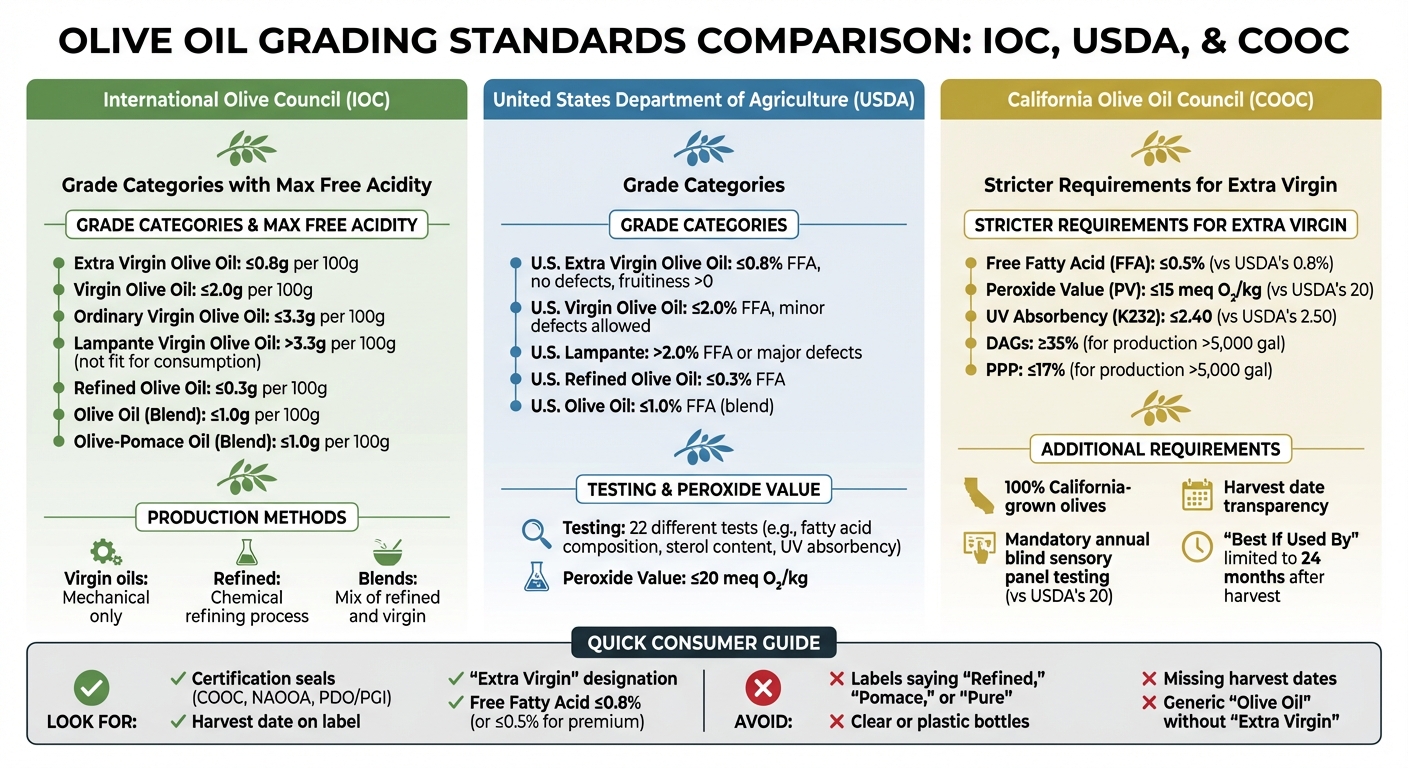
Olive Oil Grading Standards Comparison: IOC vs USDA vs COOC
Olive Oil Standards
International Olive Oil Grading Standards
The International Olive Council (IOC) plays a pivotal role in establishing consistent standards for olive oil quality worldwide. These guidelines ensure that olive oil is classified uniformly, making it easier for global markets to assess and trust its quality.
IOC Grade Categories
The IOC categorizes olive oil based on how it’s produced and its chemical makeup. Here’s a breakdown of the main grades:
- Virgin Olive Oils: This group includes Extra Virgin, Virgin, and Ordinary Virgin olive oils. They are made strictly through mechanical processes without any chemical intervention.
- Lampante Virgin Olive Oil: This oil has a free acidity level exceeding 3.3 g/100g, making it unsuitable for consumption without refining. It’s typically used for industrial purposes or further processing.
- Refined Olive Oil: Produced by refining virgin olive oils, this grade has a very low free acidity (0.3 g/100g or less). However, the refining process strips away many natural antioxidants.
- Olive Oil: Often labeled simply as "olive oil", this is a blend of refined olive oil and virgin olive oil, with a free acidity of up to 1.0 g/100g.
- Olive-Pomace Oil: Derived from the byproducts of olive pressing, this category includes crude pomace oil (for refining), refined pomace oil (with free acidity up to 0.3 g/100g), and blended pomace oil (with free acidity up to 1.0 g/100g).
The table below provides a quick comparison of these grades:
| Grade Category | Max Free Acidity (per 100g) | Production Method | Fitness for Consumption |
|---|---|---|---|
| Extra Virgin Olive Oil | 0.8g | Mechanical only | Direct consumption |
| Virgin Olive Oil | 2.0g | Mechanical only | Direct consumption |
| Ordinary Virgin Olive Oil | 3.3g | Mechanical only | Depends on local laws |
| Lampante Virgin Olive Oil | >3.3g | Mechanical only | Not fit; requires refining |
| Refined Olive Oil | 0.3g | Refining of virgin oils | Depends on local laws |
| Olive Oil (Blend) | 1.0g | Blend of refined & virgin oils | Direct consumption |
| Olive-Pomace Oil (Blend) | 1.0g | Blend of refined pomace & virgin oils | Direct consumption |
These classifications form the backbone of the IOC’s quality assurance processes.
Testing Parameters Used for Grading
To ensure the integrity of olive oil grades, the IOC employs a combination of chemical and sensory tests. These tests not only verify quality but also help identify potential fraud.
- Free Fatty Acid Testing: Known as COI/T.20/Doc. No 34, this test measures the breakdown of triglycerides, which reflects the quality of the olives and how well they were handled.
- Peroxide Value Testing: Using COI/T.20/Doc. No 35, this method evaluates oxidation levels, providing insights into the oil’s freshness and shelf life.
- UV Spectrophotometric Investigation: COI/T.20/Doc. No 19 detects oxidation and determines if refined oils have been mixed with virgin oils.
- Stigmastadiene and Wax Testing: These tests help identify contamination with seed oils and confirm the authenticity of the extraction process. They are also used to detect pomace oil.
One of the most critical assessments is the organoleptic evaluation, outlined in COI/T.20/Doc. No 15. This sensory test relies on trained tasting panels to identify flavors and defects. To qualify as Extra Virgin, an oil must have a median defect score of zero and a median fruitiness score greater than zero. This step is essential because it can detect flaws like fusty, musty, or rancid notes that might not show up in chemical analyses.
These rigorous testing methods ensure that olive oil meets the highest standards, safeguarding both consumers and producers.
United States Olive Oil Grading Standards
The United States has its own system for assessing olive oil quality, complementing the international standards set by the International Olive Council (IOC). In 2010, the USDA updated its grading system to better align with global practices. According to the Agricultural Marketing Service, this update aimed to "facilitate the marketing of olive oil and olive-pomace oil, employ terms consistent with the marketplace, provide definitions for olive oil and olive-pomace oil, promote truth in labeling, and provide a basis for enforcement by State and Federal agencies if these products are mislabeled". While the U.S. system reflects many international guidelines, it also incorporates additional local quality measures.
USDA Grading Criteria
The USDA, like the IOC, relies on a combination of chemical and sensory tests to evaluate olive oil. It divides olive oil into two main categories: Olive Oil, which is extracted directly from olives, and Olive-Pomace Oil, which is derived from olive pomace using solvents. Within these categories, there are five specific grades based on chemical properties and sensory qualities.
- U.S. Extra Virgin Olive Oil: The highest grade, requiring no detectable defects, a fruitiness score above zero, and a free fatty acid (FFA) content of no more than 0.8 grams per 100 grams.
- U.S. Virgin Olive Oil: Allows for minor defects (median score between 0 and 2.5) and an FFA content of up to 2.0 grams per 100 grams.
- U.S. Virgin Olive Oil Not Fit For Human Consumption (Lampante): Oils in this category have significant defects (median score above 2.5) or an FFA content exceeding 2.0 grams per 100 grams.
For processed oils, the USDA defines:
- U.S. Refined Olive Oil: A neutral-flavored oil with an FFA content of 0.3 grams per 100 grams or less.
- U.S. Olive Oil: A blend of refined and virgin oils with an FFA content of up to 1.0 gram per 100 grams.
To ensure purity and quality, the USDA conducts 22 different tests, including checks for fatty acid composition, sterol content, and UV absorbency.
California Olive Oil Council (COOC) Standards
In addition to federal standards, regional programs like the California Olive Oil Council (COOC) enforce stricter guidelines. This voluntary certification program requires a maximum FFA level of 0.5%, which is more stringent than the USDA's 0.8% limit. The COOC also mandates a Peroxide Value (PV) of no more than 15 meq O₂/kg, compared to the USDA's limit of 20 meq O₂/kg.
Producers with annual production exceeding 5,000 gallons must also meet specific thresholds for DAGs (≥ 35%) and PPP (≤ 17%). Additionally, oils must pass an annual blind sensory panel evaluation to qualify for the COOC seal.
The COOC certification guarantees that the oil is entirely California-grown and comes from the latest harvest. If a label claims the oil is from "California", all olives must be sourced from the state. For regional claims, at least 85% of the oil must originate from that specific area. Unlike the USDA, which often operates on an "honor system" due to limited oversight, the COOC enforces mandatory annual testing for members who wish to use its seal.
| Parameter | USDA Standard | COOC Standard |
|---|---|---|
| Free Fatty Acid (FFA) | ≤ 0.8% | ≤ 0.5% |
| Peroxide Value (PV) | ≤ 20 meq O₂/kg | ≤ 15 meq O₂/kg |
| UV Absorbency (K232) | ≤ 2.50 | ≤ 2.40 |
| DAGs / PPP | Not Required | Required for >5,000 gal |
| Origin Requirement | Not Specified | 100% California-grown |
sbb-itb-4066b8e
Regional Grading Systems and Certifications
Building on the international and U.S. grading systems discussed earlier, regional certifications add another layer of assurance for olive oil quality.
Country-Specific Grading Systems
In many olive oil–producing regions, stricter local certifications are in place to ensure both quality and authenticity. These systems not only protect the integrity of the product but also help strengthen consumer confidence.
In Europe, the Protected Designation of Origin (PDO), referred to as DOP in Italy, represents the highest level of regional certification. For an olive oil to earn a PDO label, every step - growing, production, and bottling - must occur within a specific area. This process adheres to strict local traditions and quality standards. For example, an Italian olive oil with a DOP seal guarantees that it was entirely produced in the designated region.
The European Union also recognizes Protected Geographical Indication (PGI), or IGP, which applies to larger geographic areas. Unlike PDO, PGI requires only one stage of production to take place in the specified region. While PGI still ensures quality, it is less rigorous than PDO, making it essential for consumers to understand the difference when seeking the most authentic products.
In the United States, regional organizations like the California Olive Oil Council (COOC) have developed their own stringent standards. The OOCC/CDFA certification is considered one of the toughest quality benchmarks globally. California's standards include advanced chemical tests, such as PPP and DAGs, which detect aged or heat-treated oils. Additionally, California certifications often require a significant percentage of the oil to originate from the claimed region, ensuring authenticity.
How Certifications Build Consumer Confidence
Regional certifications work alongside broader grading systems to provide independent verification, offering consumers peace of mind. For instance, the North American Olive Oil Association (NAOOA), which represents over 66% of olive oil consumed in the U.S. and Canada, runs a certified seal program for third-party verification. According to the NAOOA:
"our members are committed to meeting or exceeding the standards set by the International Olive Council (IOC)".
These certification programs rely on a combination of chemical testing and blind sensory evaluations. In blind tastings, trained experts use standardized blue glasses to mask the oil's color, eliminating potential bias. This dual approach ensures that certified oils meet both measurable quality standards and sensory expectations.
Harvest date transparency is another important feature of regional certifications. For example, the COOC seal guarantees traceability, confirming that the oil comes from the most recent harvest and is made exclusively from California-grown olives. Additionally, COOC standards limit "Best If Used By" dates to no more than 24 months after harvest, protecting consumers from buying stale oil.
Instead of navigating complex technical details, consumers can look for certifications like the COOC seal, NAOOA Certified Seal, or European PDO/PGI labels. These marks of approval confirm that the olive oil is high-quality, authentic, and verified by experts.
How Big Horn Olive Oil Meets Quality Standards
Freshness and Quality Standards
Big Horn Olive Oil goes beyond the standard requirements for Extra Virgin Olive Oil (EVOO), adhering to stricter benchmarks. While the USDA and International Olive Council permit a Free Fatty Acid (FFA) content of up to 0.8% for EVOO, Big Horn Olive Oil aligns with the more demanding California Olive Oil Council standard of ≤ 0.5% FFA. This lower acidity level ensures the oil retains its freshness and distinctive flavor from the moment it's bottled.
The journey to exceptional freshness starts at the harvest. All olives are cold-pressed within two hours of picking, and the oils are delivered within three months to reduce exposure to temperature variations. This process helps preserve natural antioxidants and maintain the oil’s signature green aroma. To further guarantee quality, Big Horn Olive Oil uses advanced testing methods like DAGs (1,2-diacylglycerols) and pyropheophytins, which assess the oil's age and overall quality.
Storage and bottling are equally meticulous. The oils are kept in sealed stainless steel tanks with nitrogen blanketing at controlled temperatures of 59–64°F (15–18°C). They are then bottled in colored glass to block light and prevent spoilage. These steps help maintain high levels of phenols and natural antioxidants, such as Vitamin E, which not only enhance the oil's health benefits but also improve its stability during cooking. These rigorous practices ensure that Big Horn Olive Oil consistently delivers premium-quality products.
Product Selection
Big Horn Olive Oil’s dedication to quality extends to its diverse product lineup. The company offers Ultra Premium EVOOs made from single-origin olives, such as Picual and Coratina. Each oil undergoes thorough chemical and sensory analysis to confirm it meets the highest standards, including zero sensory defects and a fruitiness rating above zero - key indicators of true Extra Virgin status. The oils’ slightly bitter taste and vibrant green aroma highlight their high antioxidant levels.
In addition to olive oils, Big Horn Olive Oil features aged balsamic vinegars imported from Modena, Italy. These include the Traditional 18-Year Aged Dark Balsamic Vinegar and the Molto Denissimo 25-Year Aged Dark Balsamic Vinegar. Starting at just $8.99, these products make premium quality accessible while maintaining the high standards that set Big Horn Olive Oil apart.
Conclusion: Selecting Quality Olive Oil
Key Points to Remember
Choosing the right olive oil comes down to understanding the grading systems and certifications that ensure quality. Extra Virgin Olive Oil, for example, must meet strict standards, including a free acidity level of no more than 0.8% as per USDA and IOC guidelines. Some certifications, like the California Olive Oil Council (COOC), go even further, requiring a maximum of 0.5% free acidity. Lower acidity not only signals better freshness but also enhances flavor and antioxidant content.
Look for certification seals from trusted organizations like the COOC or the North American Olive Oil Association (NAOOA). These seals confirm that the oil has undergone rigorous chemical and sensory testing. As the California Olive Oil Council explains:
"assurance that the oil they purchase is in fact extra virgin grade"
Pay attention to the label. Check for a harvest date to ensure freshness and opt for oils packaged in dark glass bottles, which shield the oil from damaging light exposure. These small details can make a big difference in preserving quality.
Steer clear of oils labeled "Refined", "Pomace", or "Pure", as these are not true Extra Virgin Olive Oils. The USDA’s updated grading standards aim to promote accurate labeling and consistent quality. Following these guidelines will help you identify oils that meet high standards.
Producers who adhere to these rigorous criteria stand out. For instance, certified Ultra Premium oils from Big Horn Olive Oil meet the stricter 0.5% FFA requirement, offering exceptional flavor, peak freshness, and the full range of health benefits associated with top-quality olive oil.
FAQs
What does 'free fatty acids' mean in olive oil grading?
Free fatty acids (FFA) measure the fatty acids that have separated from triglycerides in olive oil. This is expressed as the percentage of oleic acid per 100 grams of oil and serves as a crucial marker of the oil's quality and freshness.
To meet international standards, extra virgin olive oil must have an FFA level of 0.8% or lower. Generally, the lower the FFA level, the better the oil's quality, reflecting careful handling and proper production of the olives. On the flip side, higher FFA levels can point to poor processing or the use of damaged olives, which may negatively impact both the oil’s flavor and its potential health benefits.
What makes regional certifications like COOC different from international olive oil standards?
Regional certifications, such as the California Olive Oil Council (COOC), set stricter standards compared to international guidelines. To earn a COOC certification, olive oil must be produced using 100% California-grown olives, undergo annual chemical and sensory testing, and meet a tighter free acidity limit of ≤0.5%. The COOC also enforces harvest traceability and requires producers to renew their certification yearly, ensuring consistent quality and accountability.
On the other hand, international standards - like those from the International Olive Council (IOC) - are less stringent in certain areas. For instance, the IOC defines extra virgin olive oil with a higher free acidity limit of ≤0.8%, does not require regional origin, and does not demand annual certification. These distinctions underscore the focus on local quality and rigorous oversight in certifications like COOC.
Why should you check the harvest date on olive oil labels?
When choosing olive oil, always check the harvest date on the label. This detail is key to understanding the oil's freshness. Olive oil is best enjoyed within one to two years of harvest, as its flavor and nutritional benefits gradually diminish over time.
Opting for olive oil with a recent harvest date guarantees a product with the best taste, aroma, and health benefits. This is particularly crucial for premium options like Ultra Premium Extra Virgin Olive Oil, where freshness plays a major role in delivering the full experience.