

USDA vs. EU Organic Standards for Olive Oil
USDA and EU organic certifications for olive oil ensure high-quality, chemical-free products, but their rules differ. Both prohibit synthetic pesticides, GMOs, and require at least 95% organic ingredients. However, the EU mandates pesticide residue investigations and origin labeling, while the USDA uses risk-based testing and optional origin labeling. The EU also has a shorter 2-year conversion period for organic farming compared to the USDA’s 3 years. For olive oil lovers, understanding these differences helps in choosing products that align with your preferences.
Key Differences:
- Pesticide Testing: EU requires mandatory investigations; USDA uses a risk-based approach.
- Conversion Period: EU requires 2 years; USDA mandates 3 years.
- Labeling: EU mandates origin details; USDA does not.
- Logo: EU organic leaf is required; USDA seal is optional.
- Virgin Oil Defect Standards: EU allows higher defect thresholds than USDA.
Quick Tip: Look for olive oils with both USDA and EU certifications for the highest assurance of quality and compliance with both standards.
FAQ: What to look for on an Olive Oil Label | Does Organic Matter?
sbb-itb-4066b8e
USDA Organic Standards for Olive Oil
The USDA National Organic Program (NOP) establishes the guidelines for labeling products as "organic" in the United States. For olive oil producers, this involves adhering to stringent rules throughout the entire process - from planting the trees to bottling the oil. Key among these rules is the prohibition of synthetic substances, GMOs, and ionizing radiation at any stage of production.
Core USDA Certification Requirements
To meet USDA organic standards, the land used for cultivation must go through a three-year period free of prohibited substances before any harvest can occur. This ensures that residues from synthetic pesticides or fertilizers are no longer present in the soil.
Producers are also required to maintain an Organic System Plan (OSP), which outlines their farming practices, materials used, and record-keeping processes. Soil fertility must be managed using natural methods such as tillage, crop rotations, and cover crops. If pests or diseases arise, farmers must first attempt control using mechanical or biological methods. Only substances listed on the National List of Allowed and Prohibited Substances (7 CFR §§205.600–205.606) can be used as a last resort - for example, copper-based fungicides or sulfur under specific conditions.
Processing facilities must ensure organic olives and oil are kept separate from non-organic products and avoid contact with any prohibited substances during extraction and storage. Annual on-site inspections are conducted to verify that the OSP is up-to-date and that operations comply with USDA regulations.
When it comes to labeling, the USDA has different tiers based on the organic content of a product. For a product to carry the "Organic" label and display the USDA seal, at least 95% of its ingredients must be organic. Products labeled "Made with organic [specified ingredients]" only need 70% organic ingredients. Additionally, any operation earning more than $5,000 annually from organic sales is required to obtain certification.
Voluntary Grading for Extra Virgin Olive Oil
In addition to organic certification, olive oil producers can opt for voluntary quality grading to further verify the oil's excellence. It's important to note that organic certification and quality grading are separate systems. An olive oil can be certified organic without being graded as "Extra Virgin", and vice versa.
The USDA Agricultural Marketing Service (AMS) offers a voluntary grading program that evaluates olive oil quality through chemical and sensory analysis. To achieve the "U.S. Extra Virgin Olive Oil" grade, the oil must have a free fatty acid content of no more than 0.8 grams per 100 grams (measured as oleic acid). It must also pass a sensory test, showing zero defects and a fruitiness score above zero. Oils labeled as "U.S. Virgin" are allowed a higher free fatty acid content - up to 2.0 grams per 100 grams - and can have a median defect score between zero and 2.5.
Not all organic olive oils qualify for a quality grade. However, producers who wish to display both "organic" and "Extra Virgin" labels must meet the production standards set by the NOP as well as the quality standards outlined by the AMS. These rigorous USDA requirements set a strong benchmark, which will be compared to EU standards in later sections.
EU Organic Standards for Olive Oil
The European Union enforces strict regulations to ensure the quality and authenticity of olive oil through Delegated Regulation (EU) 2022/2104 and Implementing Regulation (EU) 2022/2105, both effective as of November 24, 2022. These rules set clear quality benchmarks that all olive oil sold within the EU - whether organic or conventional - must meet.
Core EU Certification Requirements
For olive oil to qualify as Extra Virgin under EU standards, its free acidity must be below 0.8%. Additionally, it must pass an organoleptic evaluation conducted by a certified taste panel. These panels assess the oil for defects (which must be absent) and fruitiness (which must score above zero) to confirm its quality.
The EU goes beyond chemical testing, requiring national authorities to perform conformity checks using advanced methods. These include:
- Stigmastadienes and Sterenes Analysis: Detects the presence of seed or refined oils in olive oil.
- ECN 42 Method: Compares actual versus theoretical triacylglycerol content to uncover adulteration with other vegetable oils.
- UV Spectrophotometry: Measures oxidation levels and checks for heat or chemical treatments.
Producers and packaging facilities must maintain detailed records, and packaging operations require prior approval to ensure traceability. This system enables authorities to trace every bottle back through the supply chain, reducing the risk of fraud. These stringent analytical and sensory evaluations form the backbone of the EU’s olive oil quality assurance process.
Integration with PDO/PGI Designations
Organic olive oil carrying a PDO (Protected Designation of Origin) or PGI (Protected Geographical Indication) label must meet not only the EU’s baseline standards but also specific regional criteria tied to production methods and origin. These geographical labels ensure that the oil is not only organic and high-quality but also authentically tied to its region of production.
National authorities collaborate to ensure consistent application of these standards across all EU member states, regardless of where the oil is produced. This approach stands in contrast to the regulatory framework used in the United States, highlighting differences in how the two regions oversee olive oil quality and authenticity.
Similarities Between USDA and EU Organic Standards
Although there are regulatory differences between the USDA and EU organic standards, both systems are built on shared principles aimed at protecting consumers and the environment. For instance, both prohibit the use of synthetic fertilizers and synthetic pesticides in olive cultivation. They also share a strict zero-tolerance policy for genetically modified organisms (GMOs), ensuring no intentional use of GMOs in organic production.
Another key similarity is the requirement that organic products must consist of at least 95% organic ingredients. Both systems also enforce rigorous traceability through independent and regular inspections, ensuring accountability at every step. These common rules create a strong foundation for comparing the unique aspects of each certification system.
The Organic Equivalency Agreement, introduced in 2012, further bridges the gap between the two standards. This agreement allows products certified under EU standards to feature the USDA organic logo, and vice versa. For example, The Furies Olive Oil, produced in Greece's Achaia region, displays both the DIO (EU code GR-BIO-01) and USDA organic logos, enabling it to be sold seamlessly in both markets. Similarly, Dell'Orto Extra Virgin Olive Oil holds dual certification from the USDA and CCPB, an EU-authorized inspection body.
"As of 2012, the United States and the European Union have an Equivalency Agreement that recognizes the inspection and certification of the respective country." – Jennifer Angelopoulos, Author, The Furies Olive Oil
Both systems also prioritize environmental sustainability. They promote practices like improving soil health, fostering biodiversity, and maintaining ecological balance through methods such as natural composting, biological pest control, and ecosystem conservation. These shared commitments highlight the reliability of both certifications for environmentally conscious consumers.
Differences Between USDA and EU Organic Standards
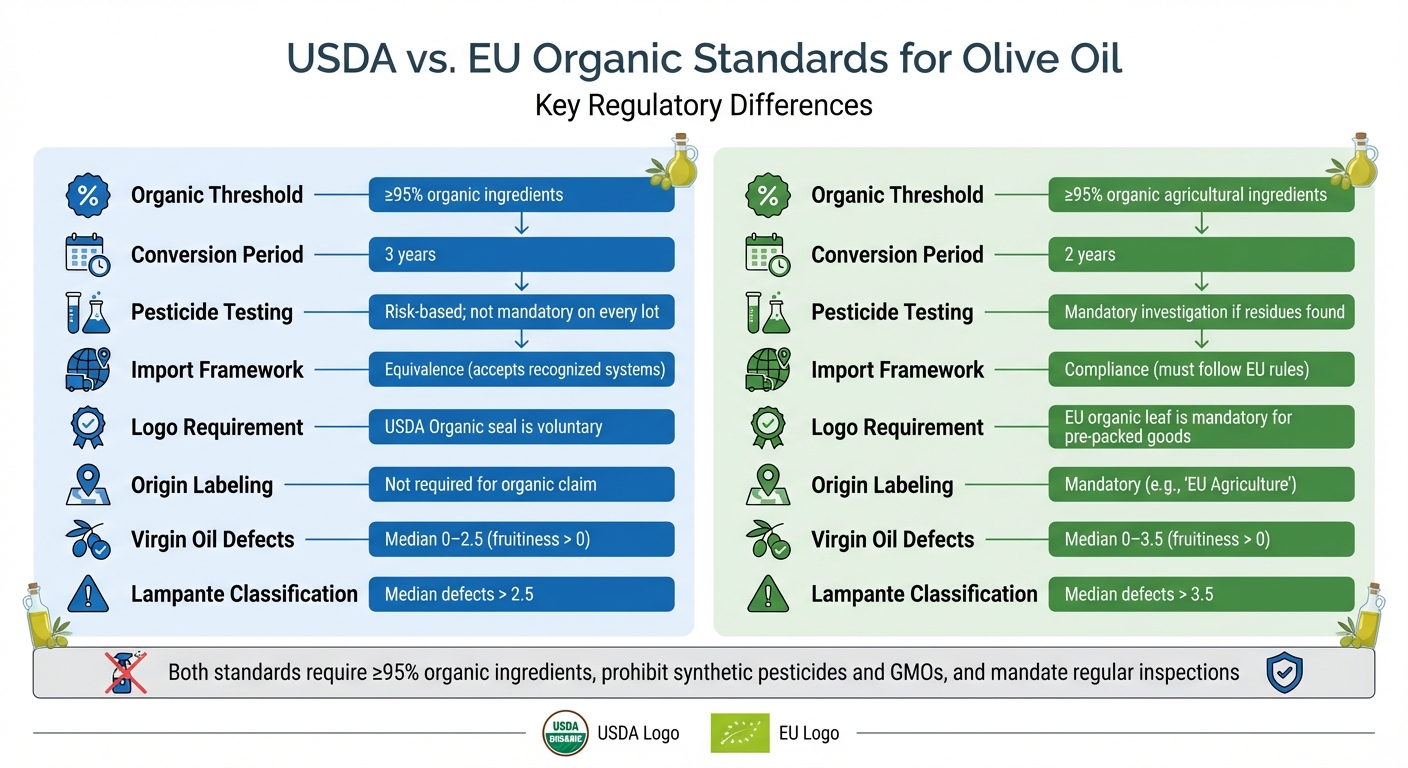
USDA vs EU Organic Olive Oil Standards Comparison
While both the USDA and EU organic standards share foundational principles, their enforcement methods and criteria for quality assessment reveal notable differences. Here's a closer look at what sets them apart.
The EU operates under a "compliance" model, as outlined by Regulation 2018/848. This means that producers outside the EU must adhere directly to EU regulations, rather than relying on equivalent local standards. On the other hand, the USDA uses an "equivalence" framework, recognizing certifications from approved foreign systems.
One major difference lies in pesticide residue testing. Since 2022, EU rules mandate investigations whenever pesticide residues are detected. The USDA National Organic Program (NOP), however, employs a risk-based approach, where testing isn't required for every batch. Nutrada explains:
"Previously, finding pesticide residues in an organic product was awkward but not necessarily actionable, there was no formal investigation requirement. Now, any detection triggers a mandatory investigation by the operator and their control body".
Another distinction is the conversion period for transitioning to organic status. For olive groves, the EU requires a 2-year conversion period before the first organic harvest, whereas the USDA mandates a longer 3-year period. Labeling requirements also differ: the EU mandates origin labeling (e.g., "EU Agriculture") and requires the organic leaf logo on pre-packed goods. In contrast, the USDA Organic seal is optional, and origin labeling is not required for organic claims.
Differences extend to sensory grading standards as well. Both systems apply identical criteria for Extra Virgin Olive Oil (zero defects, fruitiness > 0). However, the USDA enforces stricter standards for Virgin Olive Oil, allowing a median of defects only between 0 and 2.5. The EU permits a higher threshold, with defects up to 3.5. Consequently, under USDA guidelines, "Lampante" classification begins at defects over 2.5, while the EU sets this threshold at over 3.5.
USDA vs. EU Standards Comparison Table
| Parameter | EU Organic (Regulation 2018/848) | USDA National Organic Program (NOP) |
|---|---|---|
| Organic Threshold | ≥95% organic agricultural ingredients | ≥95% organic ingredients |
| Conversion Period | 2 years | 3 years |
| Pesticide Testing | Mandatory investigation if residues found | Risk-based; not mandatory on every lot |
| Import Framework | Compliance (must follow EU rules) | Equivalence (accepts recognized systems) |
| Logo Requirement | EU organic leaf is mandatory for pre-packed goods | USDA Organic seal is voluntary |
| Origin Labeling | Mandatory (e.g., "EU Agriculture") | Not required for organic claim |
| Virgin Oil Defects | Median 0–3.5 (fruitiness > 0) | Median 0–2.5 (fruitiness > 0) |
| Lampante Classification | Median defects > 3.5 | Median defects > 2.5 |
| Certifying Bodies | Accredited by EU member state authority | Must be USDA-accredited |
| 5% Non-organic Allowance | Agricultural ingredients only (from approved list) | Any ingredient if organic form is unavailable |
These differences highlight how each system's certification approach can influence product labeling, consistency, and consumer expectations.
What These Standards Mean for Consumers
When you see USDA or EU organic certifications on olive oil, it’s more than just a label - it’s a promise. These certifications ensure minimal chemical exposure through strict third-party testing and guarantee full traceability from the grove to the bottle. Plus, organic olive oils often contain higher levels of antioxidants and polyphenols, compounds known for their anti-inflammatory and heart-supporting properties.
Choosing certified organic olive oil also benefits the environment. It supports soil health and biodiversity while encouraging sustainable farming practices. As Terra Centuria explains:
Certifications represent a rigorous process ensuring consumers receive agricultural products produced through environmentally sustainable and chemical-free methods.
Organic groves rely on ecological pest management rather than synthetic chemicals, helping to protect wildlife habitats. These practices also contribute to fighting climate change by incorporating regenerative agriculture techniques. Understanding these standards makes it easier to identify premium-quality olive oils.
How to Choose High-Quality Organic Olive Oil
Armed with knowledge about certifications, here are some practical tips for selecting top-notch organic olive oil.
- Look for certification logos: The EU organic leaf logo is required on pre-packaged European products, while the USDA Organic seal is widely recognized in the U.S. Both confirm that at least 95% of the ingredients are organic, ensuring a consistent level of quality.
- Check the origin label: EU regulations require clear statements like "EU Agriculture", "non-EU Agriculture", or specific country names. This traceability helps you verify the source and growing conditions of the oil.
- Prioritize freshness: Opt for cold-pressed oils and pay attention to the harvest date. Fresher oils retain more nutrients and flavor. Additionally, EU regulations mandate pesticide residue testing, whereas USDA testing is based on risk assessments.
How Big Horn Olive Oil Meets Premium Standards
Big Horn Olive Oil takes these standards seriously, meeting and exceeding USDA and EU certification requirements. Their Ultra Premium Extra Virgin Olive Oils are cold-pressed within just two hours of harvest, locking in the antioxidants and polyphenols that make olive oil so nutritious. This quick processing ensures that their oils retain both their health benefits and vibrant flavors.
Freshness is a cornerstone of Big Horn Olive Oil’s approach. They deliver olive oil within three months of harvest, giving customers access to products at their peak quality. Their commitment to transparency - from grove to bottle - aligns perfectly with the principles of organic certification.
Their product lineup includes standout options like Estate Reserve Ultra Premium EVOO, Picual Extra Virgin Olive Oil, and Coratina Extra Virgin Olive Oil. They also offer premium aged balsamic vinegars, such as the Molto Denissimo 25-Year Aged Dark Balsamic Vinegar, showcasing their dedication to traditional and meticulous production methods.
Conclusion
Knowing the distinctions between USDA and EU organic standards helps you make smarter choices when buying high-quality olive oil. Both certifications require at least 95% organic ingredients and ban synthetic pesticides, GMOs, and most artificial additives. However, the EU takes a stricter stance with mandatory pesticide residue checks, origin labeling requirements, and a "compliance" framework for imports, ensuring more transparency and traceability.
The EU organic leaf logo provides clear details about where the olives were grown - whether within the EU, outside the EU, or in a specific country. On the other hand, the USDA organic seal confirms adherence to stringent organic practices but doesn’t mandate country-of-origin labeling. For added confidence, seek out olive oils with both certifications. This ensures the product meets the highest standards from each system.
These certifications go beyond rules - they reflect a dedication to sustainable farming, healthier soil, and protecting biodiversity. Whether you care about environmental impact, health benefits, or knowing the origin of your food, understanding these standards allows you to choose olive oils that align with your values and expectations for quality.
FAQs
Is EU organic olive oil “better” than USDA organic?
EU organic olive oil is often regarded as adhering to stricter standards compared to USDA organic certification. This reputation stems from its more thorough inspections and its emphasis on chemical-free, eco-conscious practices. One key distinction is that EU standards completely ban synthetic additives, which enhances the perception of its purity and quality. That said, both certifications uphold the production of premium organic olive oils, ensuring high standards across the board.
Does “USDA Organic” guarantee extra virgin quality?
The “USDA Organic” certification confirms that olives are cultivated without synthetic fertilizers or pesticides and adhere to rigorous organic farming guidelines. However, this label alone doesn't assure the olives are of extra virgin quality. That designation is based on separate chemical and sensory evaluations. If extra virgin quality matters to you, make sure to look for both certifications.
What should I look for on the label to verify origin and freshness?
To verify the origin and freshness of olive oil, pay attention to certification seals such as USDA Organic or PDO (Protected Designation of Origin). These seals confirm the oil's quality and where it comes from. Additionally, look for the harvest or bottling dates on the label. Olive oil is at its best when produced within the past 18 to 24 months. These details help ensure you're choosing a product that meets rigorous standards and is fresh.