

Vallée des Baux-de-Provence Olive Oil: AOP Explained
The Vallée des Baux-de-Provence olive oil stands out thanks to its AOP (Protected Designation of Origin) certification, ensuring strict quality and production standards. Located in southern France's Alpilles massif, this region produces some of the finest olive oils, accounting for 10–15% of France's total olive oil and 25% of French AOP-certified oils. The AOP label guarantees every step of production, from olive cultivation to bottling, happens locally and adheres to traditional methods.
Key Facts:
- AOP Certification: Introduced in 1997, ensuring regional authenticity and quality.
- Production Rules: Includes tree age, spacing, harvesting methods, and mechanical extraction only.
- Olive Varieties: Salonenque, Aglandau, Grossane, and Verdale form the core blend.
-
Oil Styles:
- Fruité Vert: Green, peppery notes, ideal for salads and vinaigrettes.
- Maturé: Smooth, with flavors like cocoa and truffle, perfect for warm dishes.
- Quality Checks: Every batch undergoes chemical tests and blind tastings.
Look for the red and gold AOP logo to ensure you’re getting certified Vallée des Baux-de-Provence olive oil. Proper storage - away from heat, light, and air - helps maintain its flavor and quality for up to two years.
What AOP Means for Olive Oil
The AOP Concept Explained
AOP, or Appellation d'Origine Protégée, translates to Protected Designation of Origin. This European Union certification ensures that a product’s name and production are firmly tied to a specific geographic region. Put simply, an AOP label guarantees that every step of production - from cultivating the raw ingredients to the final processing - happens within a defined area, using traditional methods.
A key focus of AOP is the concept of terroir, which refers to the unique combination of soil, climate, and local expertise that shapes a product’s character. In France, products must first earn the national AOC designation before they can qualify for AOP status, adding an extra layer of scrutiny and quality assurance.
These principles are at the heart of the production methods in Vallée des Baux-de-Provence.
How AOP Shapes Olive Oil Production
In Vallée des Baux-de-Provence, the AOP designation isn’t just a label - it represents a commitment to strict guidelines. Producers must adhere to detailed specifications, known as the cahier des charges, which dictate nearly every aspect of olive oil production.
"The objective: to value and safeguard everything that makes the particularity of the agriculture and the terroir and to boost the local economy." - Huiles et Olives AOP Les Baux-de-Provence
These rules cover a range of factors, including:
- Tree age and spacing: Trees must be at least 5 years old, with a minimum of 4 meters between them.
- Yield limits: A maximum of 10 tons of olives per hectare is allowed.
- Harvesting methods: Olives must be picked directly from the tree or caught in nets, never gathered from the ground.
- Extraction process: Only mechanical methods are allowed, with no chemical additives other than water.
Even the timing is tightly controlled. Olives must be delivered to the mill within 2 days of harvest and processed within 3 days unless they’re intended for the matured style of oil. These stringent standards ensure that every bottle meets the highest quality expectations.
What AOP Means for Consumers
For consumers, the AOP label is a promise of quality and authenticity. When you spot the red and gold logo on a bottle, it signifies that the oil has passed independent chemical tests and blind tastings, ensuring it consistently meets extra virgin standards.
"Thanks to regular checks, consumers can be sure of the consistent quality of products made in the pure Provençal tradition." - Les Baux de Provence Tourist Office
AOP-certified oils must meet a strict maximum free acidity level of 1.5 grams per 100 grams, keeping them firmly within the extra virgin category. Additionally, full traceability is required, meaning every step - from the grove to the mill to the bottle - is documented and regulated. For anyone questioning the authenticity of their olive oil, the AOP label eliminates all doubt, guaranteeing a product steeped in tradition and excellence.
What Makes Vallée des Baux-de-Provence Olive Oil Different
Terroir and Climate
Nestled in the rugged Massif des Alpilles, which rises to about 1,300 feet between the Rhône and Durance rivers, the Vallée des Baux-de-Provence boasts limestone-rich soils that set it apart. These calcium-heavy soils, with a pH of 8.5, might challenge most crops, but olive trees thrive here and have done so for centuries. Late autumn brings cold, drying winds that sweep through the valley, naturally encouraging compact olive tree growth. This helps minimize bruising before harvest and contributes to the region's reputation for high-quality olive oil. Impressively, this area accounts for 15% of France's total olive oil production and a quarter of all French AOP-certified olive oils. The town of Mouriès alone is home to an astounding 75,000 to 80,000 olive trees.
This extraordinary environment not only shapes the region's character but also supports a variety of olive types, each contributing to its celebrated oil.
Approved Olive Varieties
"The Vallée des Baux-de-Provence is one of the very rare olive-growing regions where several varieties are cultivated, which makes the complexity and richness of this terroir." - Syndicat AOP Huiles et Olives de la Vallée des Baux-de-Provence
Unlike many olive oil regions that focus on a single variety, this AOP region stands out for its diversity. It requires a blend of at least two of its four main olive varieties, each bringing unique qualities to the oil:
| Variety | Role | What It Adds |
|---|---|---|
| Salonenque | Main | Creaminess, sweetness, and smooth texture |
| Aglandau | Main | Pungency and a robust, full-bodied structure |
| Grossane | Main | Sweetness with distinct grapefruit aromas |
| Verdale | Main | Herbaceous notes and a green apple character |
| Picholine | Secondary (max 10%) | Intense fruitiness with a touch of bitterness |
By 2030, AOP regulations will require that 85% of trees in certified orchards belong to these four main varieties, ensuring the preservation of the region's signature flavor profile.
Flavor Profiles and Blending Rules
The combination of these local varieties results in two distinct oil styles, each with its own character.
Fruité Vert (Green Fruit) is crafted from olives milled within 24 hours of harvest. This oil is fresh and vibrant, offering notes of artichoke, grass, and green apple, with a signature peppery finish. It is typically labeled as "Vierge Extra."
Maturé (Matured Olive) is made using olives stored for 4 to 5 days before milling. Controlled fermentation during this period softens the bitterness, creating a smoother, rounder oil. Expect aromas of candied olives, cocoa, sourdough, truffle, and mushroom. Due to its unique process, it is labeled "Huile d'olive maturée" rather than "Vierge Extra."
"Olive oil from the Vallée des Baux-de-Provence is the result of the know-how of millers, who blend at least two of the four main varieties... to create a pure fruit juice with unique flavours." - Les Baux de Provence
This region is one of the few in France allowed to produce the Maturé style, a tradition passed down through generations. These blending rules and techniques highlight the AOP's dedication to quality and authenticity, ensuring each bottle reflects the region's rich history and expertise.
AOP Production Standards and Quality Checks
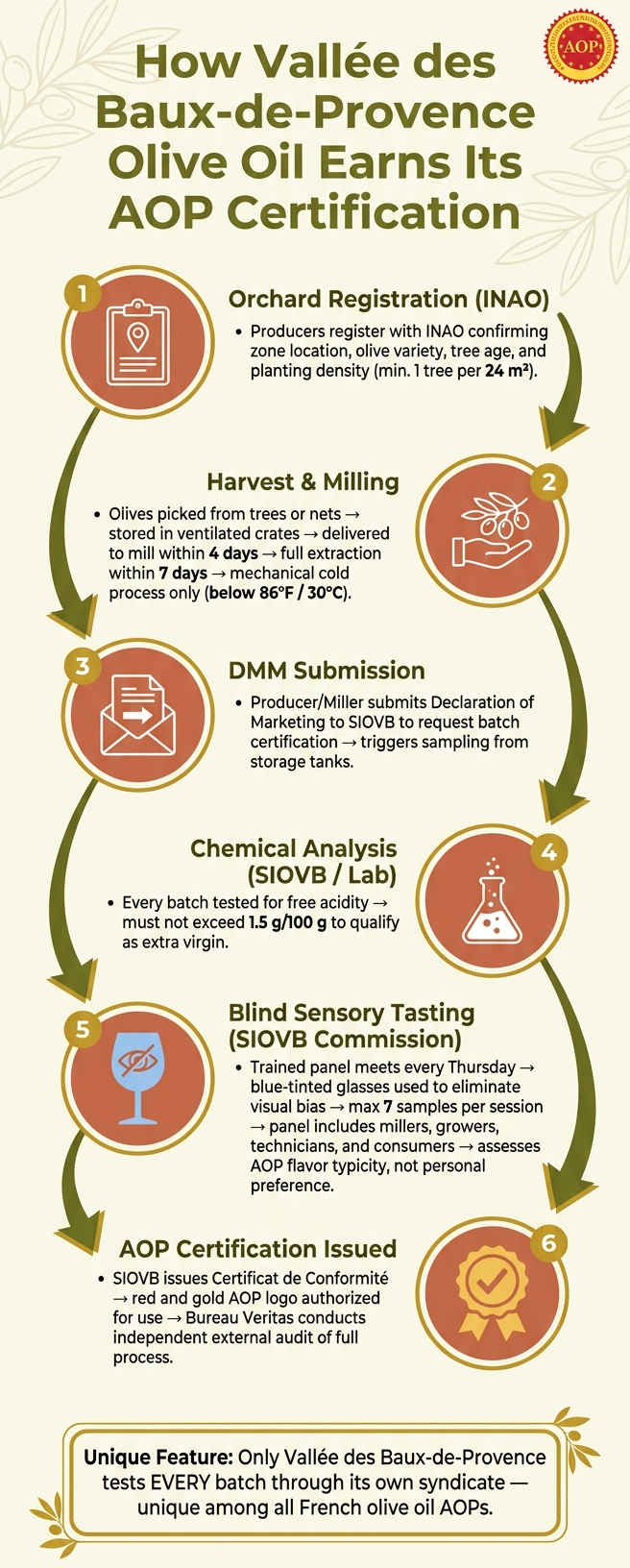
Vallée des Baux-de-Provence AOP Olive Oil Certification Process
The production standards and quality checks behind AOP-certified Vallée des Baux-de-Provence olive oil ensure that every bottle upholds its celebrated heritage. Achieving the AOP label is no small feat - it’s a meticulous, tightly controlled process. As the SIOVB puts it:
"A demanding label earned through rigorous controls and tasting tests."
Harvesting and Milling Rules
The journey starts in the olive groves. Olives are harvested directly from the trees or collected from nets (net-collected olives must be gathered within three days). Once picked, they’re stored in ventilated, slotted crates and taken to the mill within four days, with the entire process - from harvest to extraction - completed within seven days.
Extraction relies solely on mechanical methods, ensuring an authentic cold process. The olive paste is kept below 86°F (30°C) during processing, and only water is allowed as an additive. Approved techniques include washing, decantation, centrifugation, and filtration.
Chemical and Sensory Testing
Every batch of olive oil undergoes rigorous chemical analysis to confirm that free acidity levels do not exceed 1.5 g/100 g. Beyond this, a sensory evaluation is conducted by a trained, blind-tasting panel using blue-tinted glasses to avoid visual bias. Each tasting session is limited to seven samples to maintain accuracy.
The tasting panel, which meets every Thursday, includes a mix of millers, olive growers, technicians, and everyday consumers. Their role isn’t to judge personal preference but to assess whether the oil meets the expected characteristics of the Vallée des Baux-de-Provence AOP. As an SIOVB representative explains:
"Their objective is not to judge if the oil pleases them or not, but to say if it corresponds to the typicity expected in the AOP of the Vallée des Baux-de-Provence."
This thorough testing process makes Vallée des Baux-de-Provence unique among French olive oil AOPs - it’s the only one where every batch is examined by its own syndicate.
Traceability and the Certification Process
Traceability plays a crucial role in maintaining the integrity of AOP olive oil. Producers must register their orchards with INAO before harvest to confirm adherence to requirements such as zone location, olive variety, tree age, and planting density. For orchards planted after 1997, the minimum density is one tree per 24 m² (about 258 ft²).
When producers are ready to market their oil, they submit a Declaration of Marketing (DMM) to the SIOVB. This triggers sampling from storage tanks, followed by chemical and sensory testing. Only batches that pass both evaluations receive a certificat de conformité, allowing the use of the AOP’s red and gold logo.
To ensure compliance across the board, Bureau Veritas conducts independent external audits throughout the production process.
| Certification Step | Responsible Body | What It Checks |
|---|---|---|
| Orchard Registration | INAO | Zone location, variety, tree age, planting density |
| DMM Submission | Producer/Miller | Request to market the AOP batch |
| Chemical Testing | SIOVB / Lab | Free acidity ≤ 1.5 g/100 g |
| Sensory Panel | SIOVB Commission | Blind tasting for AOP flavor typicity |
| Final Certification | SIOVB | Issuance of the certificate of conformity |
| External Audit | Bureau Veritas | Independent verification of the full process |
sbb-itb-4066b8e
How to Choose, Store, and Cook with Vallée des Baux-de-Provence AOP Olive Oil
To truly savor the authentic taste of Vallée des Baux-de-Provence olive oil, it's essential to follow the AOP standards for selection, storage, and cooking.
Reading AOP Labels
When shopping, always check for the red and gold AOP logo. This label guarantees the oil has met the strict certification requirements. Look specifically for "Huile d'olive de la Vallée des Baux-de-Provence" on the label, along with the AOP designation.
"The 'Appellation d'Origine Protégée' label certifies the quality of the product and the authenticity of its region of origin."
It's also important to look for a harvest year or "best before" date. Since olive oil is essentially a fresh product, its quality depends on its freshness. Once you've found the right bottle, proper storage becomes crucial to maintain its flavor and quality.
How to Store Olive Oil Properly
To protect olive oil's delicate flavor, keep it away from light, heat, and air. Avoid placing it near sunny windows, stoves, or ovens, as high temperatures (above 104°F or 40°C) can degrade its nutrients and flavor. If your oil becomes cloudy in cooler weather, don't worry - this happens naturally when temperatures drop to around 41–50°F (5–10°C) and doesn’t impact its quality. For the best taste, aim to use the oil within two years of its production date. Proper storage ensures the oil retains its exceptional flavor, enhancing every dish.
Flavor Pairings and Cooking Tips
To fully appreciate the flavors of Vallée des Baux-de-Provence olive oil, consider these pairing and cooking suggestions:
| Fruité Vert (Green Fruitiness) | Olives Maturées (Matured) | |
|---|---|---|
| Flavor | Peppery, slightly bitter with hints of fresh grass and artichoke | Smooth, rounded with notes of cacao, truffle, and candied olive |
| Best Raw Uses | Perfect for salads, ceviche, and fresh dishes | Great drizzled over warm soups or roasted vegetables |
| Best Cooked Uses | Ideal for light sautés, grilled fish, and vinaigrettes | Complements mashed potatoes, pan-seared scallops, and grilled game |
With a smoke point of around 410°F (210°C), this olive oil is versatile enough for both finishing dishes and cooking. By using it thoughtfully, you can elevate the flavors in any meal.
Why AOP Certification Matters for Premium Olive Oil
AOP certification is a hallmark of quality, deeply rooted in tradition and verified through independent oversight. Every bottle of Vallée des Baux-de-Provence AOP olive oil undergoes stringent testing to ensure it meets these high standards. This rigorous process not only strengthens consumer confidence but also solidifies the oil's reputation as a premium product.
One of the standout features of AOP-certified olive oil is its health advantages. AOP standards require cold mechanical extraction - meaning the oil is produced solely through mechanical processes, without chemical solvents or heat exceeding 86°F (30°C). This method helps retain the oil's natural polyphenols and antioxidants, which are key to its health benefits. The result? An oil rich in oleic acid (Omega-9), comprising 65% to 80% of its composition. This monounsaturated fat is well-known for reducing LDL ("bad") cholesterol and promoting heart health.
"By regularly consuming monounsaturated fatty acids... we lower the level of 'bad cholesterol' (LDL) and decrease the number of heart diseases." - SIOVB
The impact of AOP certification extends beyond health. It also highlights the dedication to regional authenticity and small-scale, high-quality production. For example, strict yield limits are enforced, capping production at 6 metric tons of olives per hectare under normal conditions. This careful regulation ensures that every bottle reflects the region's commitment to excellence and authenticity. Together, these elements make the AOP designation a trusted symbol of superior quality.
FAQs
Is Vallée des Baux-de-Provence AOP olive oil always extra virgin?
Not all AOP Vallée des Baux-de-Provence olive oil qualifies as extra virgin. While a large portion does, the certification also covers virgin olive oil, including types like olive maturée (matured olive oil). Regardless of classification, every AOP oil must adhere to strict regional production rules and pass detailed quality assessments to maintain the high standards required by the certification.
How can I tell if a bottle is truly AOP-certified?
When shopping for Vallée des Baux-de-Provence olive oil, check for the official red and gold AOP logo on the label. This mark, granted by the Institut National des Appellations d’Origine and the European Commission, confirms that the oil complies with rigorous regional and quality standards. Additionally, the packaging will clearly display the Designation of Origin, ensuring the oil's authenticity and its adherence to traditional production methods.
Which foods pair best with Fruité Vert vs. Maturé?
Fruité Vert olive oil brings a fresh, herb-like flavor with hints of artichoke and green apple. It’s a fantastic match for salads, raw veggies, grilled fish, and tomato-based dishes. You can also drizzle it over grilled meats or use it for moderate-heat cooking to enhance your meals.
On the other hand, Maturé olive oil offers milder, richer flavors such as black olive and cacao. It pairs beautifully with Mediterranean stews, roasted vegetables, hearty legume soups, creamy risottos, and even goat cheese.