

Virgin vs. Refined Olive Oil: Cancer Prevention Benefits
Virgin olive oil and refined olive oil differ significantly in their impact on health, particularly cancer prevention. Virgin olive oil is minimally processed, preserving high levels of antioxidants like polyphenols, oleocanthal, and hydroxytyrosol. These compounds protect cells from oxidative stress, reduce inflammation, and help prevent DNA damage linked to cancer. Refined olive oil, however, loses most of these bioactive compounds during chemical processing, leaving it with limited protective benefits.
Key Takeaways:
- Virgin Olive Oil: Retains antioxidants, supports cancer prevention, and reduces tumor risks.
- Refined Olive Oil: Lacks antioxidants and offers minimal cancer prevention benefits.
- Polyphenol Content: Virgin olive oil contains 40–1,000 mg/kg, while refined oil has negligible levels.
Quick Comparison:
| Feature | Virgin Olive Oil | Refined Olive Oil |
|---|---|---|
| Processing Method | Mechanical (cold-pressed) | Chemical and heat treatments |
| Antioxidant Content | High (polyphenols, tocopherols) | Very low to negligible |
| Cancer Prevention | Strong evidence | Limited evidence |
| Key Compounds | Oleocanthal, Hydroxytyrosol | Mostly removed |
For cancer prevention, virgin olive oil is the clear choice due to its preserved antioxidants and bioactive compounds.
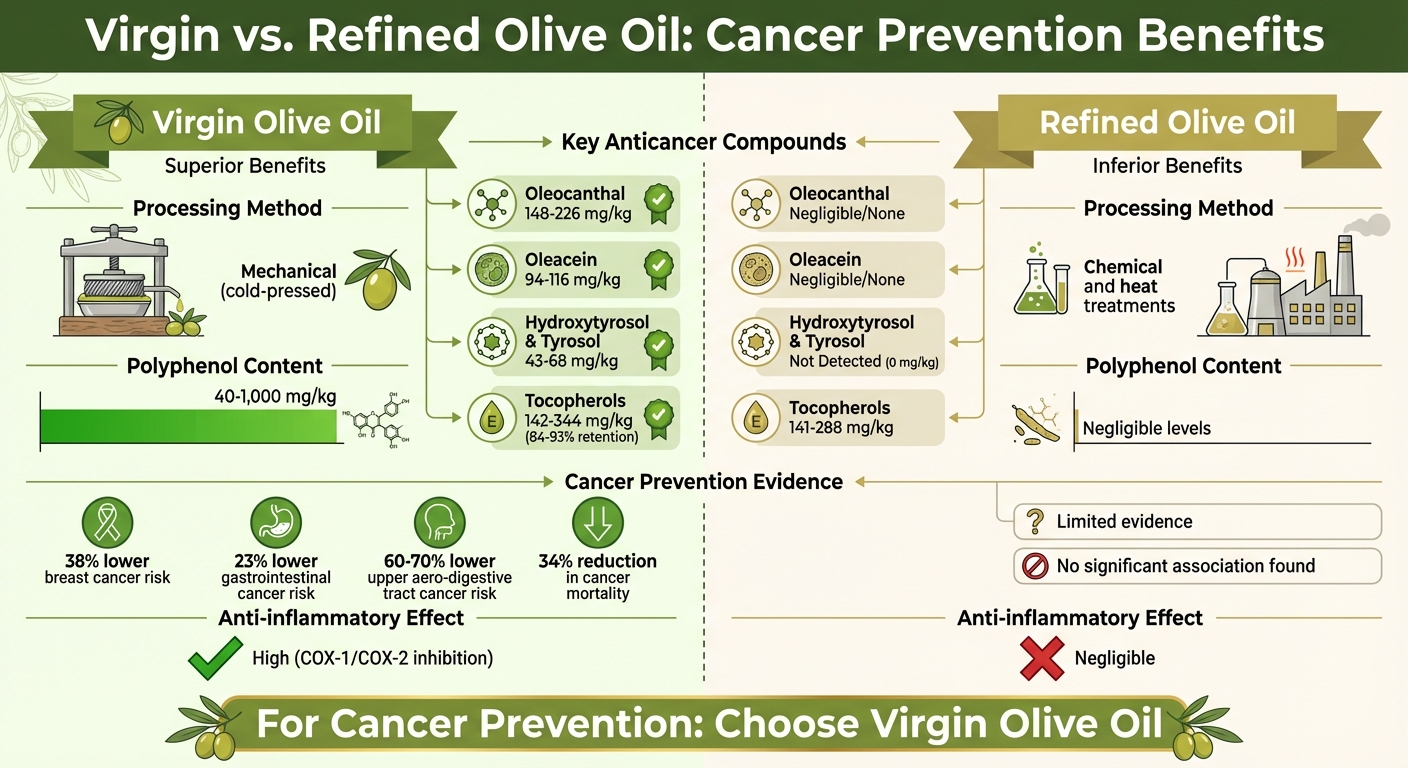
Virgin vs Refined Olive Oil: Cancer Prevention Benefits Comparison
Antioxidant Levels: Virgin vs. Refined Olive Oil
Polyphenol Content Comparison
Virgin olive oil holds onto its polyphenol content thanks to its mechanical processing methods. On the other hand, refined olive oil loses nearly all its polyphenols during chemical processing. For example, during the neutralization stage, antioxidants like hydroxytyrosol and tyrosol are almost entirely removed, dropping from 43–68 mg/kg to undetectable levels. Paolo Lucci from the University of Udine explains:
"Refining was found to have a marked effect on total hydroxytyrosol and tyrosol contents, as they are completely removed in the early steps of the refining procedure".
Tocopherols, also known as Vitamin E, are more resistant to refining. While their levels are reduced by 7% to 16%, many refined oils still retain over 200 mg/kg. Since polyphenols are the primary protectors against oxidation, followed by unsaturated fatty acids, their removal significantly weakens the oil's ability to resist oxidative damage.
Antioxidant Retention Data Table
| Antioxidant Compound | Virgin/Crude Oil Level | Refined Oil Level | Retention Status | Cancer-Related Function |
|---|---|---|---|---|
| Total Hydroxytyrosol & Tyrosol | 43–68 mg/kg | Not Detected (0 mg/kg) | ~100% Loss | Protects lipids from oxidative stress; inhibits colon and leukemia cell proliferation |
| Oleocanthal | 148–226 mg/kg | Negligible/None | Near Total Loss | Inhibits COX-1 and COX-2 enzymes; reduces inflammation-linked cancer risks |
| Oleacein | 94–116 mg/kg | Negligible/None | Near Total Loss | Strong antioxidant; inhibits colorectal cancer development |
| Tocopherols (Vitamin E) | 142–344 mg/kg | 141–288 mg/kg | 84%–93% Retention | Protects cell membranes and DNA from oxidative damage |
This table highlights the stark contrast between virgin and refined olive oils when it comes to antioxidant retention. Virgin olive oil maintains a much higher antioxidant content, reinforcing its potential role in cancer prevention. Interestingly, any polyphenols found in commercial "olive oil" - which is often a blend of refined and virgin oils - come exclusively from the virgin oil added back after the refining process.
sbb-itb-4066b8e
Cancer Prevention Research: Virgin Olive Oil
Gastrointestinal Cancer Studies
Virgin olive oil has been shown to offer protective benefits against gastrointestinal cancers. According to a meta-analysis, individuals with high olive oil consumption experienced a 23% lower risk of developing gastrointestinal cancers (RR = 0.77). For cancers in the upper aero-digestive tract, the risk reduction was even more pronounced, ranging from 60% to 70% (RR between 0.3 and 0.4).
A 2024 study published in Cancers explored the impact of Extra Virgin Olive Oil (EVOO) within a Southern Italian cohort. The findings revealed that higher EVOO consumption was strongly linked to a lower risk of gastrointestinal cancers and reduced overall cancer mortality. The study highlighted EVOO as a key component of the Mediterranean diet, offering protection against tumor formation.
Virgin olive oil's cancer-preventive effects are rooted in its biochemical properties. For instance, its phenolic compounds help regulate CB1 receptors in the colon by decreasing DNA methylation, which limits cell proliferation. Additionally, maslinic acid - a compound found in virgin olive oil - activates AMPK and inhibits mTOR, processes that work together to reduce colorectal cancer cell migration.
The benefits of virgin olive oil aren’t limited to gastrointestinal cancers; they extend to breast and colorectal cancers as well.
Breast and Colorectal Cancer Studies
The protective effects of virgin olive oil are also evident in breast cancer prevention. A meta-analysis of epidemiological studies found that individuals with the highest olive oil consumption had a 38% lower risk of breast cancer (RR = 0.62) compared to those with the lowest consumption. Another analysis reported a 33% reduction in risk (RR = 0.67).
One of the key compounds responsible for these effects is hydroxytyrosol, which has been shown to reduce breast cancer stem cell renewal. It also suppresses epithelial-to-mesenchymal transition (EMT) by modulating proteins like SLUG and SNAIL, and it promotes autophagy more effectively than oleuropein.
Further evidence comes from a systematic review published in the Journal of Functional Foods in November 2022. This review analyzed four randomized clinical trials and found that consuming olive oil for three to eight weeks improved cancer risk biomarkers in healthy adults. Specifically, it reduced oxidized DNA bases and inflammation markers, both of which are associated with tumor development.
Cancer Prevention Research: Refined Olive Oil
How Refining Reduces Antioxidants
Refined olive oil starts its journey as lampante oil, a low-grade product unfit for consumption due to its high acidity and undesirable taste. To make it consumable, lampante oil undergoes a series of chemical and physical treatments - such as degumming, neutralization with sodium hydroxide, bleaching, and deodorization. While these processes remove free fatty acids and unpleasant flavors, they also strip away nearly all phenolic compounds. For instance, hydroxytyrosol and tyrosol, which typically range from 43–68 mg/kg, become virtually undetectable after refining.
The refining process doesn’t stop there. Deodorization, which exposes the oil to high temperatures (around 392°F to 446°F), further reduces its antioxidant content. Physical neutralization can eliminate 100% of squalene, a compound thought to have cancer-preventive potential. Additionally, phytosterols - natural antioxidants - are reduced by about 30%.
"The problem of this treatment is that most of refining processes removing also the substances that contribute to the healthy properties and stability of olive oils." – Said Gharby, Chemical Data Collections
These extensive changes drastically undermine the oil's natural health-promoting properties.
Limited Scientific Evidence
Refined olive oil’s reduced antioxidant profile leaves little room for it to play a significant role in cancer prevention. The bioactive compounds responsible for anticancer effects - like polyphenols such as oleocanthal and hydroxytyrosol - are almost entirely absent in refined oils. These compounds are known for their ability to reduce oxidative stress, curb inflammation, and induce cancer cell death. Without them, refined olive oil lacks the key mechanisms tied to cancer prevention.
While refined olive oil retains its monounsaturated fatty acid content, primarily oleic acid, studies suggest that fatty acids alone don't deliver the same protective benefits as the full spectrum of bioactive components found in virgin olive oil. Furthermore, the refining process reduces the oil's oxidative stability, making it more vulnerable to degradation and less effective at preventing lipid oxidation or DNA damage - both of which are linked to cancer development.
Many commercially available olive oils, especially those not labeled "virgin" or "extra virgin", are blends of refined oil mixed with a small amount of virgin olive oil to improve flavor and nutrient content. According to Paolo Lucci, "polyphenols present in commercial olive oils come mostly from the virgin olive oil blended with refined oil". This means that any health benefits from such blends are largely due to the virgin oil component, not the refined base.
In short, refined olive oil’s lack of antioxidants and bioactive compounds significantly limits its potential to contribute to cancer prevention when compared to virgin olive oil.
Side-by-Side Comparison: Cancer Prevention Benefits
Cancer Prevention Comparison Table
The contrast between virgin and refined olive oils is striking, especially when you look at their impact on cancer prevention. Virgin olive oil retains critical bioactive compounds that are stripped away during the refining process.
| Feature | Virgin/Extra Virgin Olive Oil | Refined Olive Oil |
|---|---|---|
| Production Method | Mechanical (cold-pressed) | Chemical solvents and heat |
| Polyphenol Content | High (40–1,000 mg/kg) | Very low to negligible |
| Key Anticancer Compounds | Oleocanthal, Oleacein, Hydroxytyrosol | Mostly removed during refining |
| Anti-inflammatory Effect | High (COX-1/COX-2 inhibition) | Negligible |
| DNA Protection | Reduces oxidized DNA bases (8-OHdG) | Limited evidence of protection |
| Cancer Mortality Risk | Associated with 34% lower risk | No significant association found |
| Breast Cancer Prevention | 62% reduction in PREDIMED trial | Insufficient scientific support |
| Impact on Tumor Growth | Triggers apoptosis and limits metastasis | Limited scientific support |
The data clearly highlight virgin olive oil’s biochemical edge in cancer prevention.
Why Virgin Olive Oil Performs Better
Virgin olive oil’s superior cancer-preventing properties come down to its unique bioactive compounds. These include secoiridoids like oleocanthal and oleacein, which refined oils lack entirely. While these compounds make up just 1–2% of extra virgin olive oil, they pack a punch when it comes to health benefits. Oleocanthal, for instance, acts as a natural anti-inflammatory, targeting COX-1 and COX-2 enzymes - similar to the way ibuprofen works.
"Virgin olive oils are the oils extracted mechanically from olives and with no other treatments... Only virgin olive oils preserve their minor compounds." – Raquel Moral and Eduard Escrich, Department of Cell Biology, Physiology and Immunology, Universitat Autònoma de Barcelona
Refined olive oil, while still a source of healthy monounsaturated fats like oleic acid, lacks the nutraceutical fraction - the part responsible for modulating cancer pathways, protecting DNA, and inducing apoptosis. A study involving 12,161 Spanish adults showed that daily consumption of virgin olive oil was linked to a 34% reduction in all-cause mortality, whereas refined oil blends offered no comparable benefits. The refining process eliminates the very compounds that make virgin olive oil a powerful ally in cancer prevention, leaving refined oil with far less protective capacity.
Conclusion: Selecting Olive Oil for Health Benefits
Main Differences Between Virgin and Refined Olive Oil
Virgin olive oil stands apart because its mechanical extraction method preserves polyphenols, which are key to its health benefits, especially in cancer prevention. Unlike virgin and extra virgin olive oils, which are obtained through crushing and pressing, refined oils undergo chemical extraction with solvents and high heat. This process strips away the bioactive compounds that make virgin oils so beneficial.
While refined oils still provide healthy monounsaturated fats, they lack the nutraceutical fraction that gives virgin olive oil its powerful health-enhancing properties. As one expert aptly puts it:
"The phenol content of the olive oil provides the health benefits."
This highlights that phenols are the driving force behind the health advantages of virgin olive oil. Studies show that consuming virgin olive oil can reduce all-cause mortality by 34%, cardiovascular mortality by 57%, and cancer mortality by 17%. In contrast, refined oils show no significant impact on these metrics. Interestingly, the minor compounds in extra virgin olive oil - though they make up just 1–2% of its composition - are responsible for the majority of its unique health benefits.
The Importance of Fresh, Premium Olive Oil
Freshness plays a vital role in maintaining the polyphenol content of olive oil. These compounds are at their peak immediately after production and gradually decrease over time. Premium oils harvested during the "first veraison", or early ripening stage, are especially rich in cancer-fighting compounds like oleocanthal. A telltale sign of high oleocanthal content is the peppery, stinging sensation at the back of your throat - an indicator of a high-quality product.
When choosing olive oil for its health benefits, focus on fresh, premium extra virgin varieties. For example, Big Horn Olive Oil offers Ultra Premium Extra Virgin Olive Oils that are cold-pressed within two hours of harvest and delivered fresh within three months. These oils boast polyphenol levels exceeding 5 mg of hydroxytyrosol per 20 g, meeting the European Food Safety Authority's standard for oxidative stress protection. With bioactive compounds that the body absorbs at rates above 50%, just two tablespoons daily can lead to noticeable health improvements in as little as three weeks.
The amazing discoveries of olive oil | Dr. Limor Goren
FAQs
How can I tell if an olive oil is truly extra virgin?
To spot real extra virgin olive oil, start by checking for certification labels from reputable organizations. These labels indicate the oil has met strict quality standards. Next, look at the harvest date - freshness is key, so aim for oil produced within the last year. High-quality extra virgin olive oil should also have a fruity aroma and a balanced taste, free of any off-flavors or defects.
Authentic extra virgin olive oil is produced using mechanical methods with minimal processing. This approach helps retain its natural qualities, including the flavor and nutrients that make it so prized.
Does cooking with extra virgin olive oil reduce its polyphenols?
Cooking with extra virgin olive oil can affect its polyphenol levels, particularly when exposed to high heat. For instance, frying at 356°F can lead to a notable decrease in hydroxytyrosol and tyrosol, two beneficial compounds. On the other hand, using a microwave for 10 minutes causes only slight reductions. Boiling, however, may result in phenols breaking down and leaching into the water. The impact largely hinges on the cooking method and the temperature applied.
How much extra virgin olive oil should I use daily for benefits?
For health benefits, it’s suggested to consume at least 4 tablespoons (approximately 50 grams) of extra virgin olive oil daily. For optimal cardiovascular support, aim for 20–30 grams per day.