

5 Ways Producers Prevent Child Labor in Olive Oil
Child labor affects millions worldwide, especially in agriculture, and the olive oil industry is not exempt. Ethical producers are addressing this issue with five key strategies:
- Third-Party Audits: Independent evaluations ensure compliance with international labor laws, identifying and addressing risks through corrective actions and public accountability.
- Digital Product Passports (DPPs): Blockchain-based tracking systems document every step of production, verifying ethical practices and deterring fraud.
- Ethical Certification Programs: Certifications like Fairtrade and Rainforest Alliance enforce strict labor standards and remediation processes for violations.
- Employee Training & Reporting Systems: Workers are trained to identify risks, verify ages, and use confidential reporting systems to address violations.
- Community Education Programs: Producers collaborate with local organizations to improve access to education and reduce reliance on child labor by addressing economic challenges.
These measures not only protect vulnerable children but also promote transparency and accountability in the olive oil supply chain. Consumers can support these efforts by choosing brands committed to ethical sourcing.
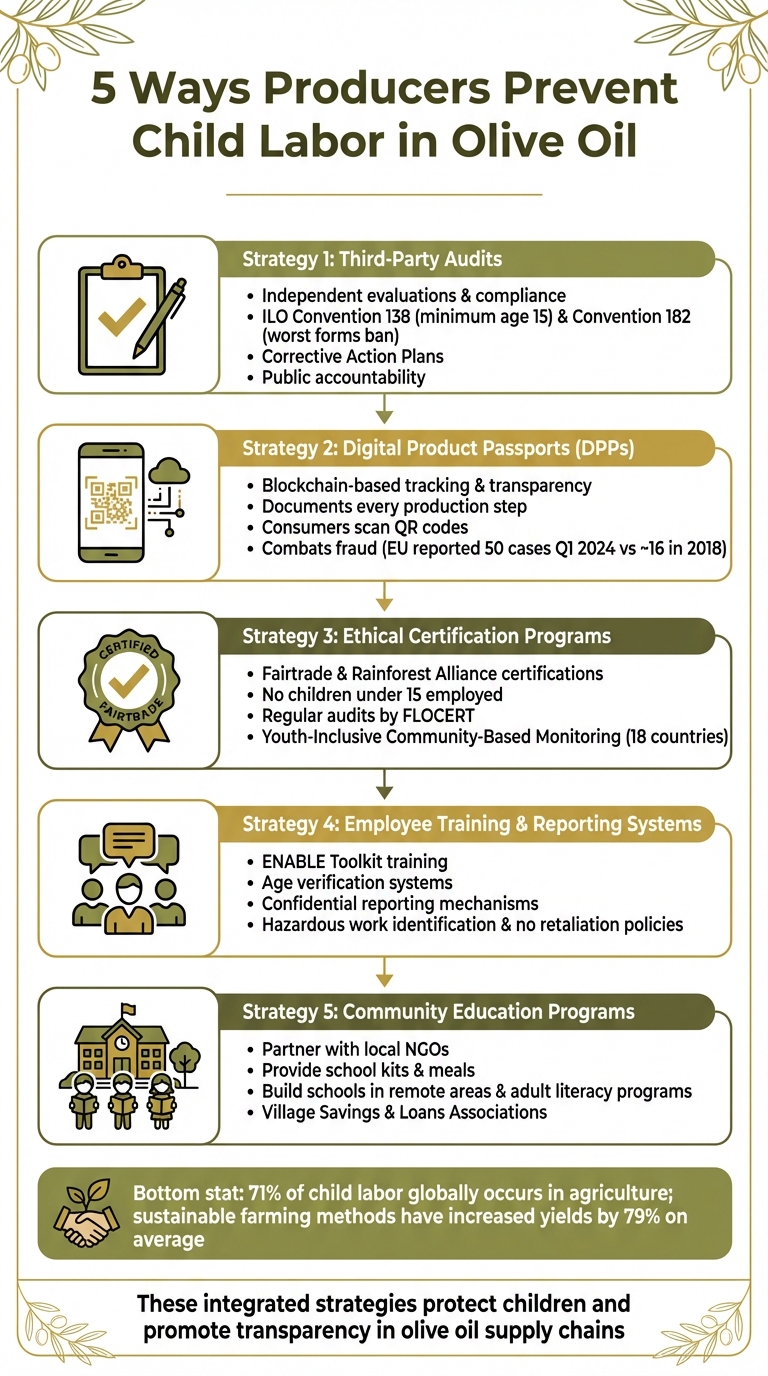
5 Strategies Producers Use to Prevent Child Labor in Olive Oil Production
1. Third-Party Audits
Independent audits play a crucial role in addressing child labor concerns in olive oil production. These assessments, conducted by third parties, evaluate working conditions across the entire supply chain - from company headquarters to individual farms. As Richa Mittal, Executive Vice President and Chief Innovation Officer at the Fair Labor Association, puts it:
"Fair Labor Accreditation for agriculture is unique from other certifications in that it offers independent validation of the human rights due diligence program at the headquarters of the companies and at the farm level for specific commodities."
These audits are grounded in international standards, such as ILO Convention 138, which establishes a minimum working age of 15 years (14 in less-developed countries), and ILO Convention 182, which bans the worst forms of child labor. Auditors verify compliance by meticulously reviewing documents like birth certificates, school records, and medical reports.
Producers also identify high-risk areas and implement Independent External Monitoring (IEM). This process involves on-site interviews with workers, farmers, and local groups to uncover potential violations. If issues are detected, auditors enforce Corrective Action Plans (CAPs), which are then re-evaluated through follow-up audits. These steps ensure transparency and help establish stronger safeguards against exploitation.
Publicly sharing audit results adds another layer of accountability. This transparency creates tangible consequences for companies that fail to uphold ethical standards, encouraging better practices across the industry.
sbb-itb-4066b8e
2. Digital Product Passports
Digital Product Passports (DPPs) take supply chain transparency to the next level by digitally documenting every step of a product's journey. For olive oil, this means tracking its path from the specific olive tree it came from, through every production stage, and even including metrics related to sustainability. By logging each phase of production, DPPs help minimize the risk of unethical practices hiding in the process.
This digital record is secured through blockchain technology, which ensures that the data - whether related to production or labor - cannot be tampered with. Consumers can easily access this information by scanning a QR code on the product's packaging. This instant access to verified data strengthens both compliance efforts and consumer confidence.
DPPs work hand in hand with third-party audits to maintain transparency throughout the supply chain. For example, in November 2024, Turkish olive oil producer Murat Kalavaoglu Oil implemented Spherity's VERA DPP solution to align with EU and German regulations aimed at addressing human rights risks in supply chains. Carsten Stöcker from Spherity highlights the importance of DPPs:
"Digital Product Passports (DPPs) can facilitate compliance with these regulations by providing a clear record of supply chain activities and certifications, helping producers avoid fines and legal risks while enhancing their brand's reputation for responsible sourcing."
DPPs also play a critical role in combating fraud. In the first quarter of 2024, the EU reported 50 cases of olive oil fraud - more than three times the number reported in 2018. By securely storing certifications for fair labor practices and compliance with ethical standards, DPPs make it much easier for regulators and consumers to verify that no child labor or other unethical practices were involved in production.
3. Ethical Certification Programs
Certification programs like Fairtrade and Rainforest Alliance play a key role in validating ethical practices through independent, globally recognized standards. These programs align their requirements with International Labour Organization (ILO) conventions, ensuring that no child under 15 is employed and that children under 18 are not involved in work that could harm their education or development.
To enforce these standards, organizations such as FLOCERT - an ISO-17065 accredited body - conduct regular on-site audits and unannounced inspections. These inspections are guided by risk indicators or specific allegations, and any serious violations that go unaddressed can lead to the suspension of certification. This ensures that products failing to meet ethical guidelines cannot carry the certification mark.
The Rainforest Alliance takes a proactive "assess-and-address" approach to child labor, focusing on tackling its root causes rather than simply hiding the problem. This method goes beyond basic compliance by addressing the economic and social factors that often lead to child labor.
When child labor is identified, these programs implement detailed remediation protocols. They collaborate with national child protection agencies and local authorities to ensure affected children are safely reintegrated into school and supported for their long-term well-being. Fairtrade's Youth-Inclusive Community-Based Monitoring and Remediation (YICBMR) system, active in 18 countries, empowers local communities to identify risks and protect vulnerable children. As Anthony Badu, a Fairtrade YICBMR monitor, highlights:
Community participation and active involvement eliminates the defensive position and enhances ownership and cooperation.
These community-driven efforts and remediation protocols are essential to combating child labor on an industry-wide scale.
In February 2025, the Rainforest Alliance partnered with Nespresso and Kyagalanyi Coffee Ltd to launch the Rwenzori Education, Livelihoods, and Gender Project in Uganda. This initiative focuses on training aligned with Rainforest Alliance standards while working to increase household income, addressing the economic pressures that often lead to child labor. This is especially relevant given that around 71% of children involved in child labor globally work in agriculture.
4. Employee Training and Reporting Systems
Effective training programs equip supply chain workers to recognize and address early indicators of child labor. Alongside tools like third-party audits and digital passports, customized training strengthens the ethical foundation of operations. For instance, the ENABLE Toolkit teaches personnel to identify child labor risks using monitoring methods focused on human welfare.
A major part of these programs is understanding hazardous work, which includes tasks that could harm a child’s health, safety, or moral development. Employees learn to implement systems for verifying ages, ensure proper permits are in place, and secure parental consent when needed. A 2019 study highlighted that combining age-verification measures with summer schools created safer environments for children involved in work.
Confidential reporting systems are another critical element, offering workers a safe way to report issues that might otherwise go unnoticed by management or during audits. This is particularly vital in remote agricultural regions, where informal child labor can often evade detection. The Fair Labor Association emphasizes:
"Companies of all sizes and in all countries are responsible for ensuring that they know the risks of child labor in their own operations and in all tiers of their supply chains and take proactive steps to address those risks".
Training on grievance mechanisms ensures workers understand how to report violations without fear of retaliation. These systems not only help identify and address issues but also provide the information needed to remove children from unsafe work and connect them with education or social services. Through initiatives like the Cooperation on Fair, Free, Equitable Employment (COFFEE) Project, Verité has been working in Mexico to train producers, agronomists, and field technicians on international standards and Mexican laws related to forced and child labor.
At Big Horn Olive Oil, our dedication to ethical practices is evident in our comprehensive employee training and transparent reporting systems. These efforts ensure that every part of our supply chain upholds the highest standards of safety and fairness while contributing to broader community initiatives to combat child labor.
5. Community Education Programs
Addressing child labor in a meaningful way requires tackling the circumstances that push families to rely on it. Community education programs aim to address these underlying issues by collaborating with local schools, NGOs, and civil society organizations to create accessible and affordable education systems. These initiatives go beyond simply removing children from labor; they focus on building sustainable solutions that empower communities and provide long-term alternatives.
Producers often partner with NGOs to eliminate barriers to education. For instance, they supply school kits containing textbooks, uniforms, and other essentials, set up school meal programs, and help families obtain birth certificates needed for school enrollment. In remote agricultural areas, some programs even fund the construction of schools and provide housing for teachers to reduce travel distances [27,32]. For children who have dropped out, bridging classes with accelerated learning methods help them catch up and reintegrate into formal education systems [27,32].
The most impactful programs take a multi-faceted approach. In 2024, Mondelēz International's Cocoa Life program expanded its Child Labor Monitoring & Remediation Systems to 89% of its communities - reaching 2,480 communities in West Africa. Following 240,000 household interviews, they established local Child Protection Committees to strengthen community capacity. As Matthias Lange, Executive Director of the International Cocoa Initiative, explains:
There are many root causes to child labour: lack of access to education, poverty, lack of access to health, safe water etc. So, if you want to tackle such a complex issue, you need to attack it from various angles.
Programs for adults are just as crucial. Literacy initiatives, especially for women, create environments where children are more likely to attend school instead of working. Additionally, Village Savings and Loans Associations, along with training in alternative income-generating activities, help stabilize family finances, reducing the need for child labor. The Fair Labor Association emphasizes this collaborative approach:
by working with governments, local communities, civil society organizations (CSOs), and unions, companies can be a catalyst for systemic level change within communities and within their supply chains.
Big Horn Olive Oil extends its commitment to ethical sourcing by actively supporting community education programs. These efforts provide families with real alternatives to child labor while fostering stronger, more resilient communities for the future. Through these initiatives, education becomes a cornerstone for sustainable change and community well-being.
Conclusion
Addressing child labor in the olive oil industry requires tackling the problem at its roots. As the ECLT Foundation explains:
Addressing one area without the others is like draining an overflowing bathtub without turning off the tap - progress will always be partial and temporary.
The five strategies - audits, digital passports, ethical certifications, employee training, and community education - work best when used together. This approach not only enhances product quality but also uplifts communities by promoting fair labor practices and transparency.
Globally, millions of children in agriculture remain vulnerable, yet change is achievable. For example, sustainable farming methods have boosted yields by an average of 79%, stabilizing family incomes and reducing the reliance on child labor. The International Labour Organization has also highlighted how well-designed policies have significantly curbed child labor.
Producers who adopt these rigorous standards ensure every purchase supports ethical supply chains. As a consumer, you can contribute by choosing brands that verify their practices through independent audits and digital tracking systems. Look for products with digital passports that trace olive oil to its source and certifications like the Fair Labor Code, which enforce international labor standards. The Fair Labor Association underscores the importance of publishing assessment results, stating:
ensure brand accountability, and help consumers make more informed decisions about the products they buy.
Big Horn Olive Oil exemplifies this commitment by embedding transparency and accountability into every stage of production. Their dedication to Ultra Premium Extra Virgin Olive Oils reflects a broader mission to prioritize ethical sourcing. Supporting brands that champion fair labor practices not only delivers exceptional quality but also protects children, strengthens communities, and fosters sustainable livelihoods. Every purchase becomes a step toward a more ethical future.
FAQs
How can I verify an olive oil brand is child-labor free?
To confirm that an olive oil brand avoids child labor, start by checking for solid social compliance measures. Look for independent audits or assessments that verify their practices. Certifications or accreditations, such as those from the Fair Labor Association, are also key indicators of ethical standards. Additionally, review their supply chain transparency reports, which can provide insight into how they ensure ethical practices at every level. These steps can help you gauge the brand's dedication to maintaining fair and responsible labor practices.
What is a Digital Product Passport, and how do I use it?
A Digital Product Passport (DPP) is a system that digitally stores and shares key details about a product, such as its origin, quality, and compliance with regulations. It also provides insights into how environmentally friendly the product is. To make this information accessible, producers often use tools like QR codes or RFID tags.
These tools allow consumers and regulators to easily verify the product’s authenticity and ensure it meets required standards, creating a more transparent and trustworthy supply chain.
What should I look for on labels to confirm ethical sourcing?
To ensure products are ethically sourced, look for certifications like the GoodWeave label. This label guarantees that no child or forced labor was used and promotes better working conditions for workers. Similarly, third-party certifications such as Fair Labor Accreditation verify systems designed to safeguard workers' rights. These certifications serve as a reliable way to confirm that ethical standards were upheld during production.