

Adulteration Detection: Lab vs. At-Home Methods
If you want proof that olive oil was mixed or mislabeled, home checks are not enough. Lab testing is the only way to confirm it.
Here’s the short version: smell, taste, color, label details, and the fridge test may help you spot a problem. But they cannot tell you for sure whether an oil contains cheaper oils or refined olive oil. Lab tools can. They check oxidation, fatty acids, sterols, triglycerides, and molecular fingerprints to find signs that a bottle is not what it claims.
If I were giving you the whole article in 30 seconds, I’d put it like this:
-
Purity and quality are different.
- An oil can be 100% olive oil and still taste old, flat, or rancid.
- An oil can also seem fine at first and still be a blend.
-
Home methods are for warning signs, not proof.
- Taste and aroma may point to staleness or defects.
- Color and cloudiness tell you very little.
- The fridge test is unreliable.
-
Lab methods look at chemistry.
- Acidity: EVOO must be under 0.8% free acidity.
- Peroxide value and UV tests: show oxidation and may flag refined-oil mixing.
- GC-FID, sterols, and ΔECN42: help spot seed oils or low-level blending.
- FTIR: about 98% accuracy in classifying oil types.
- GC-MS: about 94.5% accuracy in geographical checks.
- Labels still matter when you shop.
How to spot FAKE Olive Oil | 7 science-backed tips
sbb-itb-4066b8e
Quick Comparison
| Method | What it can do | What it can’t do | Time | Cost |
|---|---|---|---|---|
| Taste, smell, appearance | Spot flat, rancid, or odd oil | Confirm adulteration | Immediate | $0 |
| Label review | Help you screen bottles before buying | Prove purity or origin claims | Immediate | $0 |
| Fridge test | Very little | Reliably detect blending | Hours | $0 |
| Lab screening | Flag chemical issues and likely mixing | Stand alone in every case | Minutes to hours | Moderate |
| Lab confirmatory testing | Confirm adulteration and sometimes identify the added oil | N/A | Days to weeks | High |
Bottom line: use your senses to judge condition, use the label to screen risk, and use lab testing when you need proof.
Lab Methods Used to Detect Adulteration
No single test can prove adulteration on its own. Labs use a mix of validated methods because each one looks at a different chemical signal. That matters, since lab testing is far more precise than anything a shopper can do at home.
Chemical Indices: Acidity, Peroxide Value, and UV Absorbance
These tests are usually the first step in checking oil quality. Free acidity measures the share of free fatty acids in the oil. That number goes up when olives are damaged or handled poorly before pressing. To qualify as extra virgin olive oil, free acidity must stay below 0.8%.
Peroxide value, or PV, measures early oxidation. In plain English, it shows how far the oil has moved toward rancidity.
UV spectrophotometry adds one more check. K232 picks up early oxidation, while K270 and ΔK can help flag refined-oil blending.
These tests are good at spotting obvious issues. But they can't tell you exactly which foreign oil was added or how much ended up in the blend.
Composition Profiling: Fatty Acids, Sterols, and Triglycerides
Composition profiling looks at the oil's chemical fingerprint. Gas chromatography (GC-FID) measures fatty acids such as oleic, linoleic, and palmitic acid, then compares those levels with International Olive Council ranges. If linoleic acid comes back high, that can hint at a high-linoleic seed oil like sunflower or soybean.
Sterol profiling digs deeper. Sterols can point to the plant source of the oil. Higher brassicasterol may suggest canola oil, while odd campesterol-to-stigmasterol ratios can hint at other vegetable oils. Stigmastadienes matter too, because they form during high-heat refining. That makes them useful for spotting refined olive oil or pomace oil mixed into extra virgin oil.
For low-level blending, labs also use ΔECN42. This test compares the sample's theoretical and actual ECN42 values. Even small gaps can point to adulteration below 5%.
Advanced Screening: NIR, Mass Spectrometry, DNA, and Sensory Panels
Beyond the standard set of tests, labs now lean more on tools that read the sample's full molecular fingerprint instead of hunting for one marker at a time. FTIR and near-infrared (NIR) spectroscopy measure molecular vibrations fast and without destroying the sample. FTIR has shown about 98% accuracy in classifying different oil types. As Stella A. Ordoudi of Aristotle University of Thessaloniki notes:
"FTIR spectroscopy offers a strong candidate screening tool for rapid, non-destructive and early detection of unauthorized virgin olive oil blends with other edible oils."
Mass spectrometry, including GC-MS and LC-MS, along with NMR, comes into play when the job calls for tight precision. That's often the case with geographical authentication or more polished fraud that standard tests may miss. GC-MS has shown a 94.5% accuracy rate in geographical authentication. DNA/PCR methods can also help identify the olive cultivar, which helps when origin claims are being checked.
Certified sensory panels fill in a gap that instruments can't always cover. Trained tasters can spot defects like fusty, musty, and rancid notes that chemical tests may miss. Sensory analysis confirms grade, not purity.
Labs then compare the sample's molecular profile with known olive oil markers. These tools are powerful, but they also need lab access, trained analysts, and instrument-level verification.
At-Home Methods and Their Real Limits
At home, you can catch warning signs. But only lab testing can confirm adulteration.
What Taste, Aroma, and Appearance Can Reveal
Taste, smell, and appearance can tell you something is off. They just can't prove an oil is pure.
Fresh, high-quality extra virgin olive oil often smells like cut grass, fresh herbs, green almond, tomato leaf, or artichoke. That peppery burn in the throat can point to oleocanthal, a polyphenol tied to fresh olive oil. But here's the catch: refined oils have very little flavor, so small amounts mixed into olive oil can be hard to notice. A blend with refined oil may simply taste dull or flat, not blatantly fake.
So these signs are useful. They can help you spot a likely problem. They cannot tell you whether there's a hidden blend.
Color and clarity don't help much either. EVOO can range from bright green-gold to deep golden-yellow based on the olive variety and when it was picked. One color isn't more "real" than another. And if the oil turns cloudy in the cold, that doesn't mean much by itself. That cloudiness often comes from natural waxes and fats crystallizing.
Why the Fridge Test and Other DIY Checks Fall Short
The fridge test sounds simple, but it doesn't hold up well in practice. Natural fatty-acid profiles vary by cultivar, which means both pure oils and blended oils can react in similar ways when chilled.
As Dan Flynn, former Executive Director of the UC Davis Olive Center, put it:
"While it is true that refined oils will not coagulate in the cold, it is also true that some olive oil varieties will not coagulate either."
That's the big limit with home checks: they can make you suspicious, but they can't confirm composition or origin. For that, you need lab analysis.
Reading Labels as a Buying Tool
Since home methods can't prove purity, the label is your best filter before you buy.
The harvest date is usually the most useful detail because it tells you when the olives were pressed. A "best by" date is much less helpful. It's often set 18 to 24 months out no matter when the oil was made, so it doesn't say much about freshness. If a bottle leaves out the harvest date, that's worth noticing.
Origin matters too. A bottle labeled "Product of Italy" may legally mean it was bottled in Italy even if the olives came from Tunisia, Greece, or Spain. That's why a named estate, mill, or region gives you a better trail to follow. Seals like PDO (Protected Designation of Origin), PGI (Protected Geographical Indication), and the California Olive Oil Council (COOC) seal can also help. These programs require oils to meet set chemical and sensory standards.
Then check the packaging. Good olive oil should come in dark glass or opaque tin. Clear glass and plastic let in light, which breaks down polyphenols and flavor over time.
| Label Detail | What to Look For | Why It Matters |
|---|---|---|
| Harvest Date | Specific month and year | Confirms when the olives were pressed |
| Origin | Named estate, mill, or PDO/PGI designation | Helps with traceability and lowers the risk of low-quality blends |
| Certification Seal | COOC, PDO, or PGI | Shows the oil met set chemical and sensory standards |
| Packaging | Dark glass or opaque tin | Helps protect polyphenols from light damage |
Lab vs. At-Home Methods: Side-by-Side Comparison
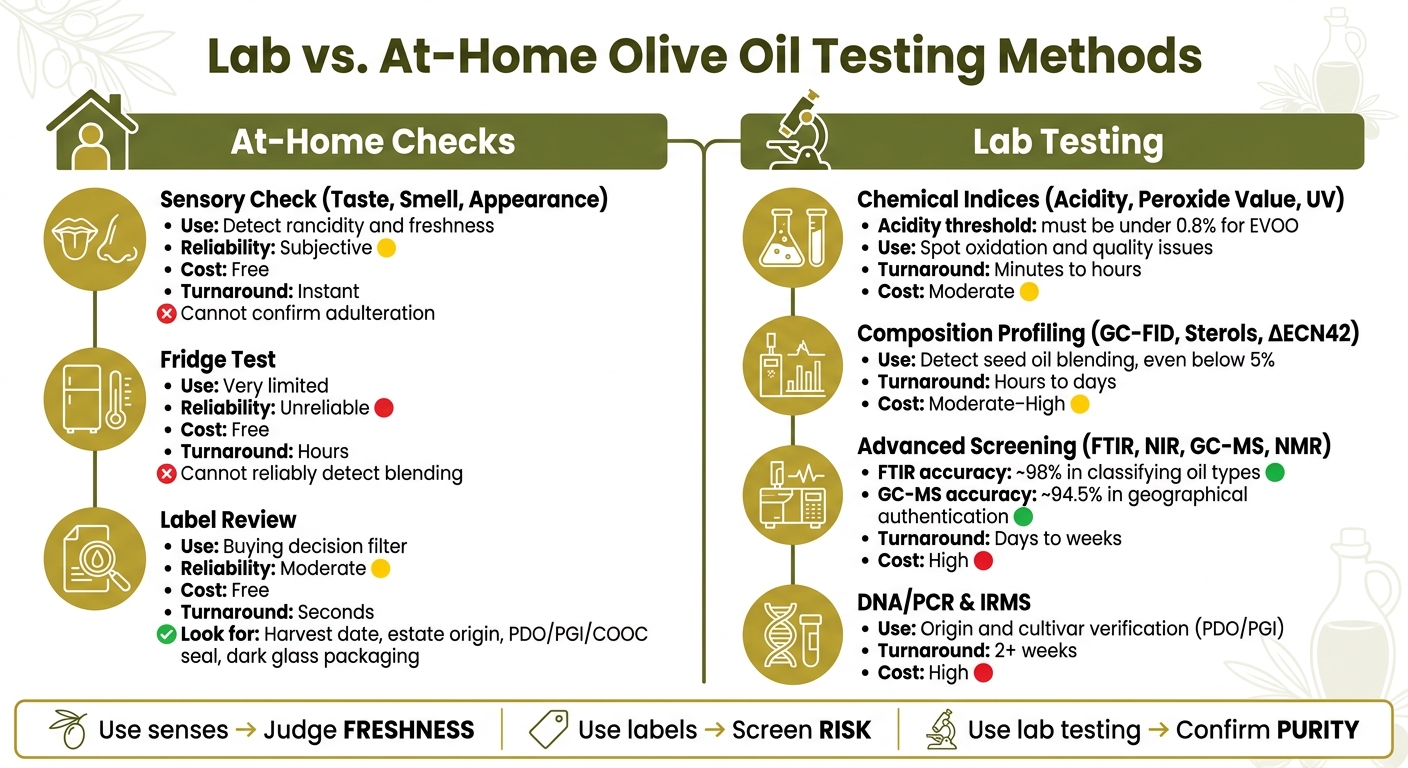
Lab vs. At-Home Olive Oil Testing: Methods, Accuracy & Cost Compared
The key issue isn’t whether you can notice that something seems off at home. It’s whether you can prove adulteration.
Labels and sensory checks can help you spot red flags. But when it comes to confirming that an oil has been mixed, altered, or falsely presented, lab testing is the only way to know for sure.
Where Lab Testing Has the Edge
Lab testing can spot foreign-oil markers, detect low-level blending, and verify origin with much more precision than home checks.
That gap matters most when fraud is hard to see. If re-refined oils have been filtered and processed so they look clean and clear, a home check won’t reliably catch the problem. In that case, labs need to analyze degraded triglycerides and polar compounds to expose it.
Where At-Home Checks Still Help
At-home checks still have a place. Taste, aroma, and label review can point to rancidity, staleness, or plain mislabeling.
What they can’t do is prove purity.
Cost, Speed, and Practical Use for Consumers
Here’s the practical trade-off at a glance.
| Method Type | Main Use | Reliability | Typical Use Case | Turnaround Time | Relative Cost |
|---|---|---|---|---|---|
| At-Home (Sensory) | Detect rancidity and freshness | Subjective | Daily household use | Instant | None |
| At-Home (Label Review) | Buying decision filter | Moderate | Retail shopping | Seconds | None |
| Lab Screening (Spectroscopy) | Rapid purity screening | High | Batch screening and quality control | Minutes to hours | Moderate |
| Lab Confirmatory (GC-MS, HPLC) | Compliance and adulterant ID | Very High | Legal enforcement and certification | Days to weeks | High |
| Lab (IRMS, PCR/DNA) | Origin and variety authentication | Very High | PDO/PGI verification | 2+ weeks | High |
For most shoppers, that means home checks work best as a first pass. They’re fast, free, and useful for everyday buying. Lab methods take more time and money, but they’re the tools used when the goal is proof, not just suspicion.
Conclusion: How to Judge Purity and Quality
Purity and freshness are not the same thing. That distinction matters.
At-home checks can help you spot rancidity, staleness, or other signs that an oil is past its prime. But they can't prove whether a product has been adulterated. And older physical tests just don't hold up against modern fraud. That's why lab analysis is still the standard when you need proof.
Lab testing is the only reliable way to confirm purity. No DIY check comes close to that level of certainty.
The takeaway is simple:
- Lab testing confirms purity. Sensory checks and DIY tests can't detect sophisticated adulteration.
- Use at-home checks for freshness, not purity. A grassy aroma and a peppery finish can point to quality. Flat or greasy notes can point to age or defects.
- Labels are your first filter. Look for harvest dates, estate origins, and third-party certification seals instead of vague "best by" dates.
Use your senses to judge freshness, labels to screen options, and lab testing when you need proof.
FAQs
When should I get olive oil lab tested?
Get olive oil lab tested when you need high-precision confirmation of authenticity, fatty acid composition, or compliance with strict quality standards.
At-home checks rely on aroma and taste. But lab analysis is needed to detect specific adulterants, including seed oils, and to measure markers like free fatty acidity, peroxide value, and UV absorption for freshness and extra virgin status.
Can lab tests tell which oil was added?
Yes. Modern lab tests can tell which oils were mixed into extra virgin olive oil because each one leaves its own chemical fingerprint.
Labs check for specific markers. For example:
- Filbertone points to hazelnut oil
- Brassicasterol points to canola oil
- Sesamin and sesamolin point to sesame oil
To find these compounds, labs use tools like gas chromatography and mass spectrometry.
What label details matter most before buying?
Prioritize labels that give clear, specific details instead of fuzzy wording. Check for the harvest date, the olive varieties, and the oil’s exact place of origin. Also pay close attention to phrases like “packed in” or “bottled in.” Those terms can hide where the olives were actually grown.
Certifications like PDO or COOC can also point to stricter quality standards. Big Horn Olive Oil includes these details to support informed buying and help shoppers verify what they’re getting.