

Almería vs. Jaén: Olive Oil Comparison
If you want one short answer, here it is: Jaén is the better pick for bold, peppery olive oil and everyday hot cooking, while Almería fits you better if you want smaller-batch oil that is smoother, more aromatic, and often organic.
I’d break it down like this:
- Jaén is the volume leader, with about 20% of world olive oil output and around 66 million olive trees
- Jaén oils are usually Picual-led, more bitter, and more peppery
- Almería oils come from a broader mix of olive types, so the taste is often softer and more varied
- Jaén is easier to find in the U.S.
- Almería is more of a specialty buy, often tied to organic farming and dry growing areas like Tabernas
- For cooking use, Jaén fits roasting and sautéing, while Almería often works well for salads and finishing
If you’re shopping fast, focus on three things on the bottle: olive variety, harvest date, and origin label. Picual often means a stronger oil. Arbequina or Hojiblanca often means a softer one.
Quick Comparison
| Area | Jaén | Almería |
|---|---|---|
| Main style | Bold and peppery | Smoother and more aromatic |
| Main olive type | Picual (90%+) | Picual, Arbequina, Hojiblanca, Lechín |
| Scale | Very large | Small-batch |
| Best use | Roasting, sautéing, everyday cooking | Salads, dipping, finishing |
| U.S. availability | Easy to find | Harder to find |
| Farming focus | Large mill and cooperative output | Small estates, strong organic focus |
So if you want a strong all-around kitchen oil, I’d lean toward Jaén. If you want a bottle with a softer profile and more place-driven character, I’d look at Almería.
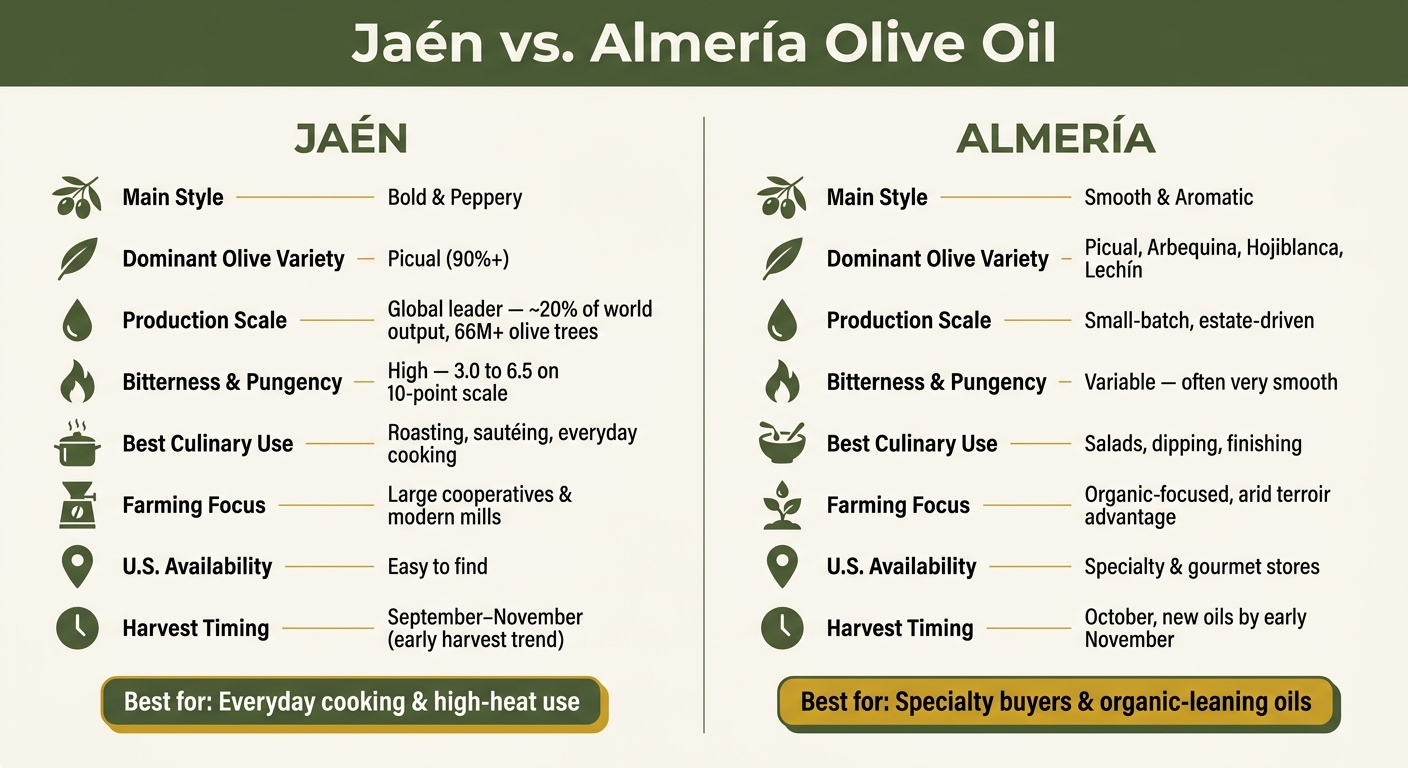
Jaén vs. Almería Olive Oil: Side-by-Side Comparison
Jaén: Large-Scale Picual Production and a Classic Bold Profile
Jaén is Spain's olive oil giant. The province produces about 20% of the world's olive oil from more than 66 million olive trees. That kind of output shapes supply, pricing, and reach across the market. It also explains why Jaén is often treated as the reference point for Andalusian olive oil.
Typical Flavor Profile of Jaén Oils
Picual sits at the center of Jaén's identity. It makes up more than 90% of the province's production and about 25% of all olive oil produced worldwide.
In the glass, Jaén Picual usually starts with green fruit notes like tomato leaf, artichoke, fresh-cut grass, and green almond. Then comes the part many people remember: a firm bitterness and a peppery kick. Its intensity often falls between 3.0 and 6.5 on a 10-point scale.
That bold edge isn't random. Picual tends to have high polyphenol levels, which help explain its bitterness, pungency, and long shelf life. Those traits also make it a strong pick for high-heat cooking, including sautéing and roasting.
Production Methods at Scale
Jaén's mills, known as almazaras, rely on systems built for volume and speed. Many use mechanical vibration harvesting, cold extraction below 27°C (80.6°F), and tight handling that moves olives from grove to mill within 24 hours of harvest.
More producers are also moving toward early harvest, with picking done between September and November. The trade-off is pretty clear: lower oil yield, but more polyphenols and a sharper green flavor profile. Nobleza del Sur, a family estate with roots dating to 1640, is one example of a producer that has built an award-winning name around this style.
Market Strength and Global Visibility
Jaén's market presence is backed by the Aceite de Jaén PGI, while several smaller PDOs mark more specific subzones under tighter standards. For U.S. shoppers, Jaén oils are some of the easiest Spanish EVOOs to find. If you want to check origin and get a sense of style, look for the PGI or a PDO on the label.
Almería, by contrast, tends to stand out through smaller lots and a more niche flavor profile.
sbb-itb-4066b8e
Almería: Smaller Output, More Variety, and Strong Organic Appeal
Almería sits at the other end of the spectrum from Jaén. It’s not about scale. It’s about a dry, sun-drenched growing area that shapes the oil in a very different way. The province is home to the Tabernas desert, considered the driest place in Europe, with just 200 mm (7.8 inches) of annual rainfall and more than 3,000 hours of sunshine each year. If Jaén is known for size and Picual, Almería stands out for smaller lots, a broader mix of olive varieties, and a premium organic focus.
Climate, Terroir, and Olive Varieties
That harsh dryness does more than limit output. It also makes organic farming much easier. Low humidity means fewer pests, so organic certification is far more workable here than in wetter parts of Spain. On top of that, much of the land was once used for cereal crops or left uncultivated, which means the soil has faced relatively little farming pressure. For growers aiming for organic certification, that’s a big plus.
Instead of leaning on one main variety like Jaén does with Picual, Almería works with a broader mix that includes Arbequina, Hojiblanca, Picual, and Lechín de Granada, also called "El Pais." That range helps cut pest risk and gives producers more room to blend oils with different traits. The native Lechín is especially well suited to the area. It handles drought well and produces a smooth, golden oil.
Flavor Profile and Production Style
Almería oils are usually aromatic, smooth, and less pungent than Jaén Picual. They also tend to be less bitter, which makes them easier for many people to enjoy right away.
Harvest in Almería is one of the earliest in Spain, usually beginning in October, with new-season oils reaching the market by early November. That timing isn’t accidental. Producers pick early on purpose, trading some volume for more aroma and a sharper focus on quality.
Niche Market Position
Almería isn’t trying to win on output. Its producers lean into small-batch, premium EVOO instead. A good example is Oro del Desierto, a family-run estate in Tabernas built around limited-production certified organic EVOO. The brand has also earned top honors at the New York International Olive Oil Competition. For specialty buyers and home cooks who want a desert-grown oil with more character, that kind of record carries weight.
Those contrasts stand out most when Almería and Jaén are placed side by side on flavor, production, and shelf presence.
Almería vs. Jaén: Flavor, Production, and Market Presence Side by Side
These differences make more sense when you line them up.
| Feature | Jaén | Almería |
|---|---|---|
| Dominant Variety | Picual (90%+) | Picual, Arbequina, Hojiblanca |
| Flavor Profile | Bold, grassy, green tomato, fig leaf | Aromatic, nuanced, and often softer |
| Bitterness & Pungency | High; peppery finish (3–6.5 scale) | Variable; can be very smooth |
| Production Style | Cooperatives and modern mills | Small estates, place-driven production |
| Sustainability Focus | Large-scale efficiency | Organic advantage from arid growing conditions |
| Production Volume | Global leader | Small-batch desert production |
| Market Visibility | High - global powerhouse | Emerging - specialty and gourmet focus |
Flavor Differences in the Bottle
Jaén oils tend to come across as bolder and more peppery. Almería oils, by contrast, are often softer on the palate and more aromatic. Put simply, if Jaén feels punchy, Almería often feels more delicate.
Production Philosophy and Quality Priorities
Jaén leans toward scale, cooperative systems, and efficient milling. Almería leans toward small-batch production, estate identity, and organic farming. Those choices don’t just affect how the oil is made - they shape how it tastes and how people use it in the kitchen.
What U.S. Buyers Should Look For
For U.S. shoppers, variety and freshness date usually matter most on the label. Picual is a strong pick for roasting and sautéing, while Almería Arbequina or Hojiblanca often fits salads and finishing better. If you’re standing in the aisle wondering which bottle makes more sense, that’s a good starting point.
Conclusion: Which Region Fits Your Taste and Cooking Style
After comparing them side by side, the choice comes down to flavor and how you plan to use the oil.
Jaén is a strong match if you want bold EVOO that holds up well under heat. Almería makes more sense if you’re after smaller-batch, organic-leaning oils with a bit more variation from bottle to bottle.
Put simply: Jaén is the stronger all-purpose cooking oil, while Almería is the more distinct specialty bottle.
Key Points to Remember
- Jaén: Picual-led, high-volume, bold, and heat-stable.
- Almería: Smaller-scale, more varied, and shaped by dry terroir - the better fit if you want an organic-leaning oil with a clear sense of place.
FAQs
How can I tell if a bottle is really from Jaén or Almería?
Check for an official PDO or PGI label. These marks show that the extra virgin olive oil was made and bottled under that region’s rules.
For most shoppers, these labels are the main thing to look for. Jaén often includes regional marks or olive variety labels like Picual, while Almería’s production is still in an earlier stage.
Which olive oil is better if I dislike bitter flavors?
If bitter flavors put you off, skip the dominant Picual variety. It tends to be intense, robust, and bitter.
Go with Arbequina instead. It’s mild, delicate, and fruity, often with notes of apple or almond. Jaén is best known for Picual, but it also produces small amounts of Arbequina for people who prefer a softer taste.
Does organic olive oil from Almería taste different from Jaén oil?
Yes. Organic olive oil from Almería can taste different from oil from Jaén because of terroir, including altitude, soil, and climate.
Jaén is known for a bold Picual profile, with more bitterness and peppery notes. Almería, with its intense sun and big shifts between daytime and nighttime temperatures, can produce more layered aromas and subtler flavor differences, even when growers use the same olive varieties.