

Ancient Healing: Vinegar in Greek and Roman Times
Vinegar wasn’t just a kitchen ingredient for the Greeks and Romans - it was a multi-purpose tool for health, food, and survival. Both civilizations relied on its medicinal, culinary, and practical benefits, but they used it in different ways:
- In Medicine: Greeks used vinegar in remedies like oxymel (vinegar and honey) to treat digestion, poisoning, and suffocation. Romans used it for wound care and as a disinfectant during epidemics.
- As a Beverage: Greeks drank diluted vinegar for digestion and memory, while Romans drank posca (vinegar and water) to stay hydrated and avoid unsafe water.
- In Military and Daily Life: Spartans used vinegar in their diet to prevent blood clotting, and Roman soldiers relied on it for energy and sanitation.
These ancient practices shaped how vinegar is still used today in health and culinary applications.
Quick Comparison
| Aspect | Greece | Rome |
|---|---|---|
| Medicine | Targeted remedies (oxymel) | General use (wound care, plagues) |
| Signature Drink | Diluted vinegar | Posca |
| Military Use | Dietary aid (Spartans) | Hydration and sanitation |
| Culinary Role | Prevented blood clotting in recipes | Used in sauces and salads |
Even modern vinegar production and usage echo these ancient methods, from fermentation techniques to its role as a health booster.
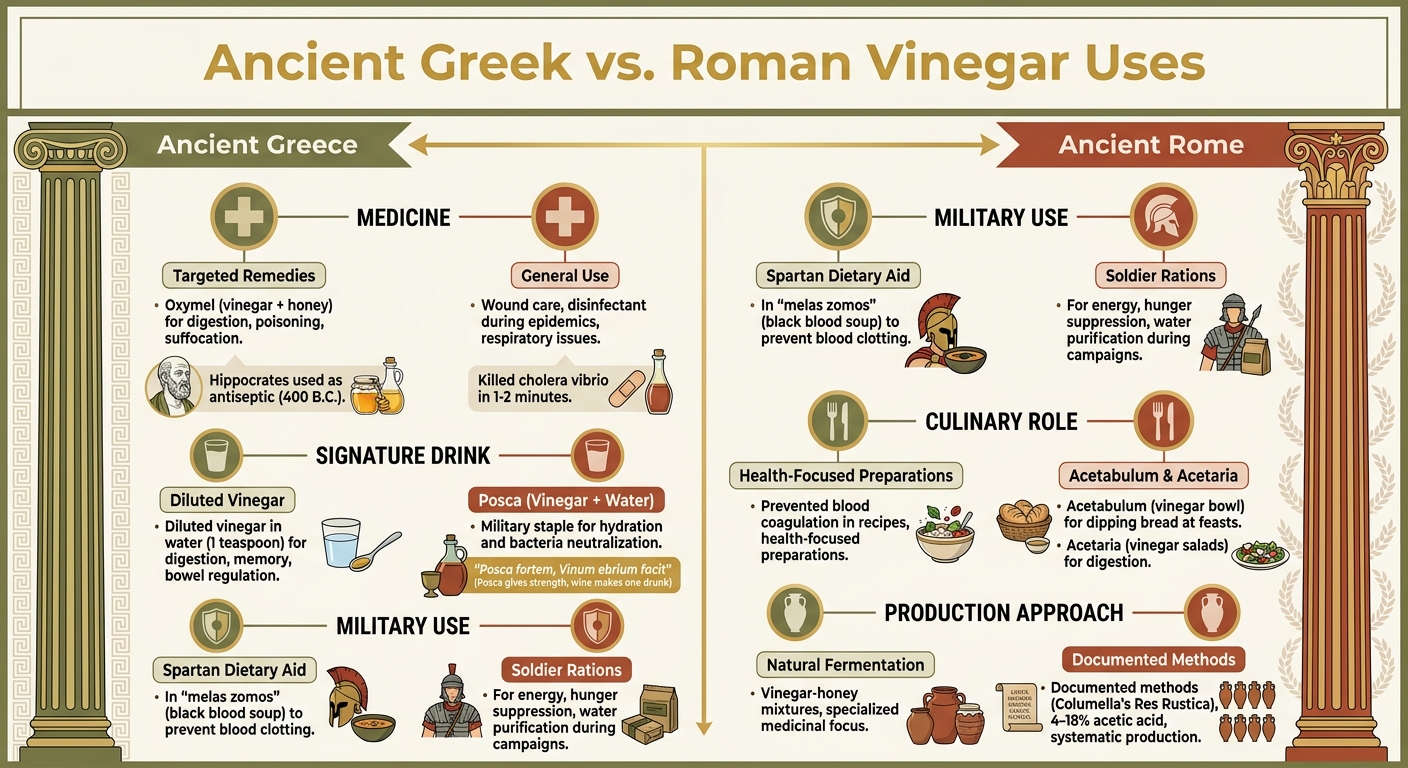
Ancient Greek vs Roman Vinegar Uses: Medicine, Military, and Daily Life
1. Greek Medicinal Uses of Vinegar
The ancient Greeks seamlessly blended culinary and medicinal practices, and vinegar stood out as a key ingredient in their approach to healthcare.
Medicinal Prescriptions
For the Greeks, vinegar wasn't just a kitchen staple - it was a trusted remedy. Hippocrates, often referred to as the father of medicine, recognized vinegar's ability to kill germs and used it as an early antiseptic as far back as 400 B.C. Bonnie K. McMillen, R.N., B.S.N., from the University of Pittsburgh at Bradford, highlights this historical usage:
"In the year 400 B.C., Hippocrates, the father of medicine, used vinegar to treat his patients. This naturally occurring germ killer was one of the very first medicines."
Greek physicians prescribed vinegar for a variety of ailments. For instance, when dealing with mushroom poisoning, they combined vinegar with honey, soda, or salt, often inducing vomiting to expel toxins. The physician Diphilus recommended:
"Vomiting should follow the drink. Hence mushrooms ought to be prepared in the first instance with vinegar, or with honey and vinegar, or honey and salt alone, since in this way the choking element is removed."
Vinegar was also used to counteract the effects of hemlock poisoning. Its "hot" properties, when mixed with pepper, created a remedy to neutralize the poison. For cases of suffocation, a mixture of vinegar and pepper - or vinegar combined with nettle and pepper-berry - was believed to have resuscitative effects. Theophrastus recorded this practice:
"Their resuscitation is effected by an infusion of vinegar and pepper or nettle pounded with the pepper-berry."
These remedies highlight vinegar's role not just in emergencies but also in routine healthcare.
Beverage Forms
The Greeks also consumed vinegar for its internal health benefits. A common practice involved diluting a teaspoon of vinegar in water to aid digestion, regulate bowel movements, and even enhance memory. One popular preparation, oxymel - a mixture of vinegar and honey - became a staple in Greek medicinal recipes.
Spartans, known for their disciplined lifestyle, incorporated vinegar into their austere diet. A notable example is "melas zomos" (black blood soup), where vinegar's acidity prevented blood from clotting. Spartans also drank vinegar as part of their health regimen. The philosopher Chrysippus praised the quality of Egyptian and Cnidian vinegars, while Sphettian vinegar was noted for its sharpness.
This dual role of vinegar, both as a beverage and a medicinal aid, reflected its importance in daily life.
Military and Health Applications
Vinegar's uses extended beyond ingestion. It was applied topically for immediate relief from jellyfish stings, bee stings, and skin inflammations, including sunburns. Its ability to "quell the fire" of irritation made it a go-to remedy for soldiers and civilians alike.
Heracleides of Tarentum observed vinegar's unique effects on digestion:
"Vinegar causes some things exposed to the air to curdle, and it acts similarly on the contents of the stomach; yet it also dissolves things in the mass, because of course there are different humours mingled within us."
This understanding of how vinegar interacted with the body's humors cemented its role in Greek medicine. Whether in military settings or everyday healthcare, vinegar proved to be an essential and versatile tool.
sbb-itb-4066b8e
2. Roman Medicinal Uses of Vinegar
The Romans, inspired by Greek medical traditions, found inventive ways to use vinegar, or acetum - a term derived from vinum acetum, meaning "sour wine." They incorporated it into medicine, military practices, and everyday life.
Medicinal Prescriptions
Roman doctors, influenced by Hippocrates, prescribed vinegar for treating wounds and respiratory issues. It was seen as a purifying agent, effective at eliminating harmful intestinal germs. During epidemics, vinegar became a go-to disinfectant for washing hands, fruits, and vegetables. Remarkably, later studies confirmed that wine vinegar could kill cholera vibrio and intestinal bacteria within one to two minutes. During plagues, inhaling vinegar from a sponge was thought to offer protection against infection.
Columella, a Roman author, detailed vinegar's production and medicinal uses in his agricultural text, Res Rustica. He approached vinegar-making as both a culinary art and a medical science.
Beverage Forms
Vinegar wasn't just for medicine; it played a role in daily hydration and nutrition. Romans created posca, a mix of vinegar and water, which became a staple drink for soldiers and commoners. Its importance was captured in the saying:
"Posca fortem, Vinum ebrium facit" (Posca gives strength, wine makes one drunk).
At Roman feasts, diners used a vinegar bowl, called an acetabulum, to dip bread, refreshing their palates and aiding digestion. Apicius, a Roman gourmet, even developed recipes for acetaria, herbal vinegar-based salads served between courses to promote digestion.
Military and Health Applications
For Roman soldiers, vinegar was more than a drink - it was a survival tool. Posca helped neutralize bacteria in unsafe water during campaigns, acting as an early form of rehydration. It also curbed hunger, helping soldiers sustain energy during long marches. Pliny the Elder, in his Naturalis Historia, noted that vinegar "adds flavor and pleasure to life".
| Application | Roman Practice | Health Benefit |
|---|---|---|
| Military Ration | Posca (vinegar + water) | Neutralized bacteria, suppressed hunger |
| Dining | Acetabulum (vinegar bowl) | Refreshed the palate, aided digestion |
| Epidemic Protection | Sponge soaked in vinegar | Inhaled to guard against contagion |
| Sanitation | Washing produce and hands | Disinfected against harmful pathogens |
Additionally, vinegar's preservative qualities were crucial. With acetic acid levels ranging from 4% to 18%, it helped preserve food, ensuring a steady supply across the Roman Empire.
Comparing Greek and Roman Approaches
Both ancient Greece and Rome recognized vinegar's healing properties, but their approaches reflected their unique cultural priorities. The Greeks, guided by Hippocrates around 400 B.C., viewed vinegar as a natural germ killer and used it for targeted remedies. One of their notable creations, oxymel, combined vinegar with honey to produce a tonic believed to aid digestion and treat various ailments.
The Romans, on the other hand, took a more systematic route. Building on Greek practices, they integrated vinegar into many aspects of daily life, including military rations, nutrition, and even agricultural writings. Columella's Res Rustica detailed methods for producing different types of vinegar, turning it into a widely-used resource. Roman soldiers relied on posca - a mix of vinegar and water - for hydration and protection, while the upper class used the acetabulum at banquets to improve digestion.
| Category | Ancient Greece | Ancient Rome |
|---|---|---|
| Primary Medicinal Use | Targeted treatments (Hippocrates) | General remedial use (Pliny the Elder) |
| Signature Drink | Oxymel: vinegar and honey-based tonic | Posca: vinegar and water; military staple |
| Culinary Application | Used in Spartan melas zomos to prevent blood coagulation | Featured in sauces and salads |
| Production Strengths | Early use of vinegar-honey mixtures for health | Documented diverse production methods |
| Daily Life Weaknesses | Limited evidence of military integration | Sometimes considered a "poor man's" wine alternative |
This comparison underscores how each civilization's values influenced their use of vinegar. The Greeks leaned into its natural properties and focused on specialized medicinal uses, while the Romans emphasized standardization and accessibility. From soldiers in the field to elite banquets, vinegar played a role in Roman life that was both practical and versatile. These distinct historical approaches have had a lasting impact, shaping modern vinegar production and its varied applications.
How Ancient Vinegar Practices Influence Modern Production
The process for making vinegar today closely mirrors the methods used in ancient times. It begins with naturally sweet cider fermenting into an alcoholic beverage, followed by a second fermentation that transforms it into vinegar. This timeless technique not only produced vinegar but also established its role as a health tonic - a tradition that continues to this day.
Hippocrates, the renowned physician from 400 B.C., was among the first to highlight vinegar's antimicrobial properties. The acetic acid responsible for these benefits in ancient Greece remains a key component in modern vinegar, supporting its reputation as a health-boosting ingredient. Today, balsamic vinegar is a popular choice for digestive health and general wellness, while apple cider vinegar is prized for its rich nutrient profile. It contains over 30 essential nutrients, including 12 minerals, several vitamins, amino acids, enzymes, and pectin, which is linked to heart health.
Modern premium vinegar producers have taken inspiration from these ancient practices, refining them to create high-quality products. Companies like Big Horn Olive Oil maintain traditional slow fermentation and aging techniques to craft exceptional balsamic vinegars. Sourcing from Modena, Italy, they age their vinegars in wooden barrels, preserving the high antioxidant levels that were highly valued during Roman times. Their products, such as the Traditional 18-Year Aged Dark Balsamic Vinegar and Molto Denissimo 25-Year Aged Dark Balsamic Vinegar, exemplify this blend of historical methods and health-focused benefits.
These long-standing practices still influence how vinegar is used in modern diets. The ancient Romans used an acetabulum - a small vinegar bowl placed on dining tables for dipping bread to promote digestion. This tradition parallels how health-conscious individuals today use balsamic vinegar as a digestive aid or palate cleanser. Even the practice of diluting a teaspoon of vinegar in water for digestive and bowel support reflects remedies that have been passed down for thousands of years.
Wrapping It All Up
Looking back at our comparison, it's clear that both Greek and Roman civilizations used vinegar in ways that reflected their distinct approaches to health and daily life. The Greeks crafted oxymel, a mix of vinegar and honey, as a medicinal tonic, while the Romans introduced posca, a vinegar-water drink that became a staple for hydration among soldiers and civilians alike. As the Romans wisely said:
"Posca fortem, Vinum ebrium facit" (Posca gives strength, wine makes one drunk).
Interestingly, ancient uses of vinegar, like its role in altering blood coagulation, still find parallels in modern culinary practices. Roman authors such as Columella documented vinegar production methods that laid the groundwork for techniques still admired today.
From dining tables to battlefields, vinegar's adaptability was evident in both cultures. Its role in sanitation remains relevant even now, highlighting its enduring importance. Modern vinegar producers continue to draw inspiration from Roman innovations, like slow fermentation and aging in wooden barrels. These age-old methods help preserve the quality and tradition of vinegar-making.
Brands like Big Horn Olive Oil (https://bhooc.com) pay homage to these ancient practices, blending centuries-old wisdom with modern craftsmanship. Each bottle they produce carries forward a legacy of skill and healing that dates back over two thousand years.
FAQs
What’s the difference between oxymel and posca?
Oxymel and posca are two ancient drinks that both feature vinegar but serve different roles due to their unique ingredients. Oxymel blends honey, vinegar, and water, offering a sweet flavor alongside its antimicrobial benefits. On the other hand, posca, a Roman creation, combines water, wine vinegar, salt, and herbs, making it a salty, mineral-rich drink ideal for rehydration, especially for soldiers and laborers. While oxymel highlights the sweetness of honey, posca focuses on practicality and restoring energy.
Did vinegar really make ancient water safer to drink?
In ancient Greek and Roman times, vinegar played a crucial role in making water safer to drink. Thanks to its antimicrobial properties, it helped reduce harmful microbes, making it a practical solution for improving water quality. Beyond that, vinegar was also used in wound care and various medicinal applications, showcasing its role in promoting health and preventing infections in these early societies.
Is it safe to use vinegar today the way Greeks and Romans did?
Yes, using vinegar as the ancient Greeks and Romans did is generally safe, provided it’s properly diluted and used with care. While modern science backs its antimicrobial properties and certain health benefits, it also emphasizes the need for responsible use to prevent any potential risks.