

Anointing Oils in Christianity: Health and Symbolism
Anointing oils have been a cornerstone of Christian rituals for centuries, blending spiritual meaning with practical health benefits. These oils, rooted in biblical traditions, serve as symbols of consecration, healing, and devotion. From the Biblical Holy Anointing Oil mentioned in Exodus to modern blends like frankincense, myrrh, and spikenard, each oil carries unique significance.
Key Highlights:
- Biblical Holy Anointing Oil: A sacred mixture from Exodus 30, symbolizing sanctification and divine approval.
- Frankincense & Myrrh: Represent Jesus’s divinity and sacrifice, with proven anti-inflammatory and calming properties.
- Spikenard: Known for its calming effects, it was used by Mary of Bethany to anoint Jesus, symbolizing devotion and sacrifice.
- Rose of Sharon: Represents Christ's beauty and purity, used in healing and consecration practices.
- Olive Oils (Picual & Coratina): Essential in Christian rituals, offering both spiritual symbolism and skin-soothing properties.
Quick Overview:
These oils are used for:
- Healing: Following James 5:14, anointing the sick with prayer.
- Consecration: Setting apart individuals, objects, or spaces for sacred purposes.
- Devotion: Enhancing prayer and worship experiences.
While modern producers like Big Horn Olive Oil craft high-quality blends, the oils themselves remain symbolic, pointing to God's presence and power rather than possessing inherent healing abilities. Their enduring use reflects the timeless connection between faith, physical care, and spiritual trust.
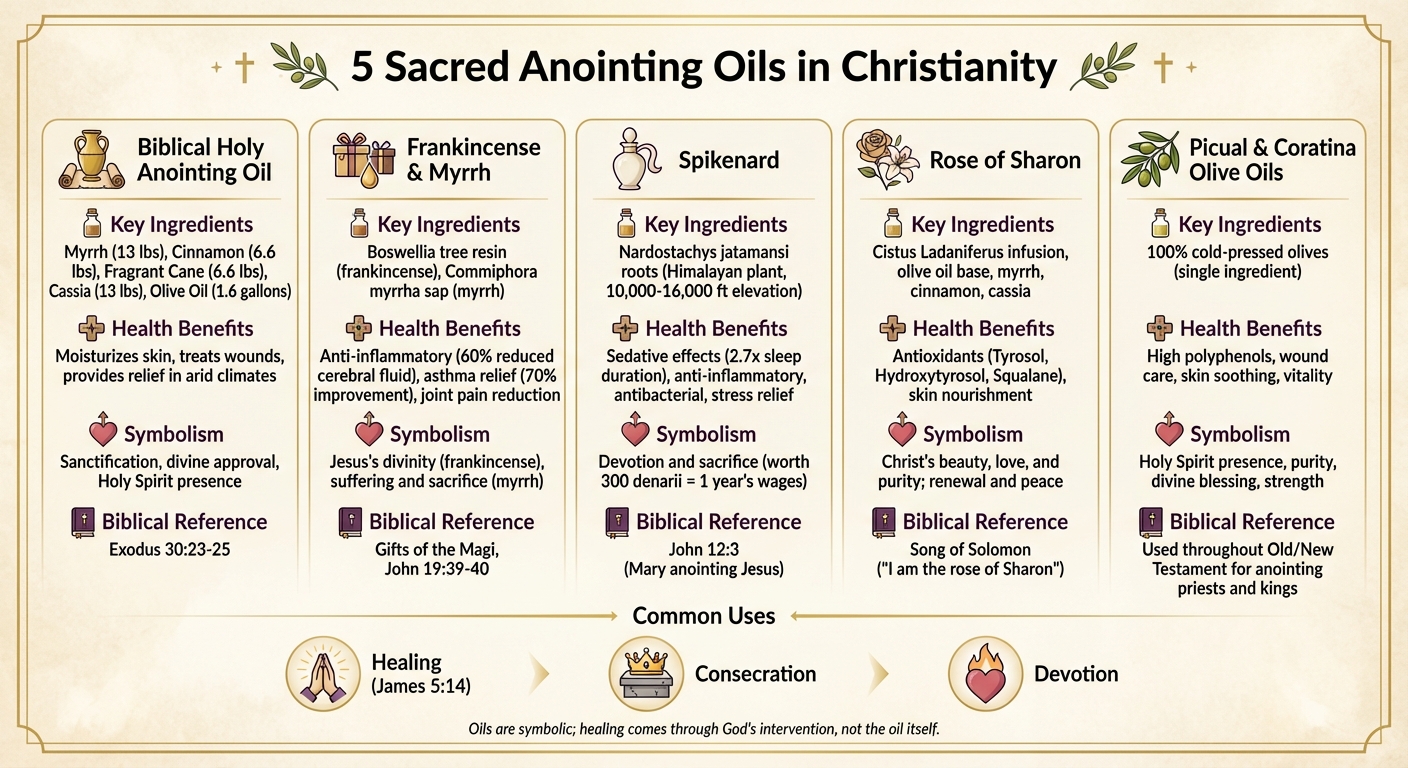
5 Christian Anointing Oils: Ingredients, Benefits, and Symbolism Comparison
1. Biblical Holy Anointing Oil
Ingredients and Composition
Exodus 30:23–25 outlines the recipe for the Biblical Holy Anointing Oil, a sacred mixture made from five key ingredients: liquid myrrh, cinnamon, fragrant cane (kaneh bosem), cassia, and olive oil. The recipe specifies quantities like 13 pounds of liquid myrrh, 6.6 pounds each of cinnamon and fragrant cane, 13 pounds of cassia, and 1.6 gallons of olive oil. Ancient preparation methods involved boiling the spices to extract their essences, creating a concentrated blend.
Olive oil formed the base of this mixture, while each spice contributed unique qualities. Myrrh was linked to burial and sacrifice, cinnamon was cherished for its sweet aroma, and cassia for its intense fragrance. The identity of "fragrant cane" is still debated among scholars, with possibilities ranging from sweet flag (Acorus calamus) to palmarosa (Cymbopogon martinii) or even cannabis.
Health Benefits
While its sacred nature was paramount, the oil also offered practical health benefits. In ancient Middle Eastern cultures, anointing oil was used to moisturize skin in arid climates and to treat wounds or illnesses. It provided both care for the body and relief for dry skin. Today, this tradition continues through modern wellness practices, with companies like Big Horn Olive Oil (https://bhooc.com) producing high-quality olive oils that reflect the historical use of essential oils.
These physical benefits complemented the oil's spiritual significance, making it integral to both health and worship.
Symbolic Significance
The Biblical Holy Anointing Oil was used to sanctify, setting apart individuals and objects for divine purposes. This act of consecration symbolized a shift from the ordinary to the sacred, affirming God's approval for specific roles. In Christian theology, the title "Christ" (meaning "The Anointed One") emphasizes Jesus' role as the ultimate consecrated King and Priest.
"You shall consecrate them so they will be most holy, and whatever touches them will be holy." – Exodus 30:29
The oil also represented the tangible presence of the Holy Spirit, symbolizing guidance, empowerment, spiritual renewal, and physical restoration. This dual role - spiritual and physical - made it a cornerstone of ancient and modern religious practices.
Christian Practices and Usage
In ancient Israel, the oil was strictly reserved for sacred purposes, such as anointing the Tabernacle, its furnishings, and consecrating priests and kings. Unauthorized replication of the formula was considered a serious offense. Some traditions, like those of the Armenian, Coptic, and Assyrian Churches, claim their holy oil contains traces of the original oil blessed by Moses. For instance, the Coptic Church has only prepared their holy myron 34 times in history.
Today, anointing oil plays a role in Christian healing practices. Following James 5:14, church elders use oil to anoint the sick, praying for their recovery and spiritual strength. This practice bridges ancient tradition with contemporary faith.
sbb-itb-4066b8e
2. Frankincense and Myrrh Oil
Ingredients and Composition
Frankincense comes from the resin of Boswellia trees, such as B. sacra and B. carterii, while myrrh is harvested from the dried sap of Commiphora myrrha. Both resins contain active compounds that give them their unique properties. Frankincense is rich in boswellic acids, incensole acetate, and mustakone, while myrrh offers aromatic essential oils with a sharp, slightly bitter scent.
The chemical structure of these oils reveals why they work so well. For example, boswellic acids can block inflammatory markers like 5-Lipoxygenase, and incensole acetate activates TRPV3 channels in the brain, which contributes to its calming and mood-enhancing effects. Mustakone, a sesquiterpenoid in frankincense, even shows antimalarial properties. Both frankincense and myrrh belong to the Burseraceae family, which explains their complementary nature.
Health Benefits
Modern science backs up what ancient traditions already knew. A 2011 study in Cancer found that 60% of brain tumor patients who took 4.2 grams of frankincense daily experienced reduced cerebral fluid, compared to just 26% in the placebo group. For asthma sufferers, 70% reported less wheezing and better breathing after taking 300 milligrams daily for six weeks.
Frankincense's anti-inflammatory benefits also extend to joint health. In one study, taking 1 gram daily for eight weeks significantly reduced joint swelling and pain compared to a placebo. Its benefits even go as far as oral health. High school students with gingivitis saw noticeable reductions in oral inflammation after chewing gum containing 100–200 milligrams of frankincense for two weeks.
In Traditional Chinese Medicine, frankincense and myrrh are often paired to address blood stagnation, inflammation, and pain. They also promote respiratory health by blocking leukotrienes, compounds that can cause bronchial tightening.
Symbolic Significance
The gifts of the Magi - gold, frankincense, and myrrh - carry deep meaning. Frankincense symbolized Jesus's divinity and His role as the High Priest, representing prayers rising to God. Myrrh, on the other hand, was linked to suffering and death, foreshadowing Jesus's embalming and burial.
"Gold (Jesus's kingship) frankincense (Jesus's deity) and myrrh (Jesus's suffering and sacrifice)" - Guille Gimenez
The Bible reinforces this symbolism. Isaiah 60:6 foretold that nations would bring gold and frankincense to honor the Lord. At Jesus's death, Nicodemus brought about 75 pounds of myrrh and aloes to prepare His body for burial (John 19:39–40). Revelation 8:3–4 adds another dimension, describing the smoke of incense - often frankincense - rising with the prayers of the saints before God. These enduring symbols connect ancient rituals to modern practices.
Christian Practices and Usage
Frankincense and myrrh remain significant in Christian traditions today. For example, the Orthodox Patriarchate of Constantinople uses an ancient recipe for chrism that includes 64 ingredients.
In line with James 5:14–15, church elders use anointing oil to pray for healing. Small bottles (12 ml) typically cost $8–$12, while larger 500 ml containers can reach up to $150. When choosing anointing oil, look for 100% pure and natural products without synthetic additives. Always perform a patch test before regular topical use.
3. Spikenard Oil
Ingredients and Composition
Spikenard oil comes from the dried roots and rhizomes of Nardostachys jatamansi, a perennial plant native to the Himalayan regions of Nepal, India, and China. This plant thrives at elevations of 10,000–16,000 feet (3,000–5,000 meters). The oil itself is extracted through steam distillation, producing a thick, amber liquid with a distinct earthy and musky aroma.
Its chemical makeup is what makes it so effective, particularly for relaxation. The oil is primarily composed of sesquiterpenes (around 50%), sesquiterpenols (10–15%), and aldehydes (5%). Among its key components, valeranone stands out for its sedative effects on the central nervous system, while nardol and jatamansone contribute to its grounding fragrance. A study on rodents even showed that valerena-4,7-diene, another compound in spikenard, extended sleep duration by 2.7 times - comparable to the effects of chlorpromazine. This unique blend of compounds defines both its scent and its therapeutic qualities.
Health Benefits
Spikenard's calming properties were noted as early as the first century CE by physicians like Dioscorides and Galen. Modern studies back up these historical uses, highlighting its anti-inflammatory and antibacterial properties, which can help soothe skin irritations and maintain a clear complexion. Its antioxidant properties also provide an added layer of protection against fungal infections.
Beyond physical health, spikenard is prized for its emotional benefits. It acts as a natural stress reliever, helping to ease anxiety and promote emotional balance. Traditionally, it has also been used to support blood pressure regulation and cardiovascular health. However, like all essential oils, it should be diluted with a carrier oil (1–2% concentration) before topical use, and a patch test is recommended. These combined effects make spikenard a tool for both physical and emotional well-being, aligning with the broader tradition of using oils for holistic care in Christian practices.
Symbolic Significance
In Christian tradition, spikenard carries deep symbolic meaning. In the first century, a pound of pure nard was worth 300 denarii - about a year’s wages for a laborer. This high value made it a symbol of devotion and sacrifice. When Mary of Bethany anointed Jesus with spikenard, she was offering her most precious possession.
"Then Mary took a pound of very costly oil of spikenard, anointed the feet of Jesus, and wiped His feet with her hair. And the house was filled with the fragrance of the oil." - John 12:3
This act not only showed Mary’s deep devotion but also foreshadowed Jesus’s upcoming death and burial. Her anointing symbolically prepared His body for what was to come. The extravagant cost of spikenard also underscored Jesus’s identity as the Messiah and King.
Christian Practices and Usage
Spikenard continues to play a meaningful role in Christian rituals, blending its practical benefits with its spiritual significance. It’s mentioned several times in Scripture, including the Song of Solomon and the Gospels of Matthew, Mark, and John. In addition to Mary’s well-known act of anointing Jesus’s feet, another woman is recorded as anointing His head with spikenard (Mark 14:3). Traditionally, spikenard was stored in alabaster jars, and breaking one of these jars symbolized an irreversible act of sacrifice.
In Eastern Orthodox traditions, spikenard is still used during Holy Week and in the preparation of chrism oil for anointing priests and altars. Today, many Christians incorporate spikenard into healing services, ordinations, and meditation to evoke a sense of peace and spiritual grounding. For personal use, adding 3–5 drops of spikenard oil to a diffuser can help create a calming environment for prayer or relaxation. However, buyers should be mindful that cheaper substitutes like lavender, valerian, or patchouli oils are sometimes sold in place of true biblical spikenard.
4. Rose of Sharon Oil
Ingredients and Composition
Rose of Sharon Oil continues the biblical tradition of sacred anointing oils, blending time-honored spices with a distinctive herbal infusion. Olive oil is typically the primary base, though some variations include coconut oil or other natural oils. What makes this oil stand out is its infusion of Cistus Ladaniferus, which not only gives it a unique aroma but also enriches it with antioxidants like Tyrosol, Hydroxytyrosol, and Squalane.
The formulation often incorporates traditional spices such as myrrh, cinnamon, aromatic cane, and cassia, enhancing its depth and fragrance. Olive oil, symbolizing resilience and the ability to bear good fruit even in adversity, plays a crucial role in creating effective anointing blends. This combination of meaningful ingredients distinguishes Rose of Sharon Oil in modern anointing practices.
Symbolic Significance
In Christian tradition, Rose of Sharon Oil is a powerful symbol of the beauty, love, and purity of Jesus Christ. Its name is inspired by the Song of Solomon: "I am the rose of Sharon, and the lily of the valleys." Many interpret this as a messianic reference, linking the oil to Christ's identity and mission. It represents renewal, peace, and the enduring presence of the Holy Spirit, making it a cherished element in worship and prayer.
"The Rose of Sharon symbolizes Christ's beauty, love, and purity. This anointing oil is perfect for enhancing moments of worship, prayer, and personal devotion."
– Mount of Olives
Christian Practices and Usage
Rose of Sharon Oil has found a special place in modern Christian rituals, building on its rich symbolic heritage. It is widely used in healing and prayer ministries. A common practice involves applying 1–2 drops of the oil to the right thumb and tracing a cross on the forehead while saying, "In the name of the Father, and of the Son, and of the Holy Spirit." This simple yet profound ritual often accompanies prayers for healing, peace, or deliverance.
The oil is also used in consecration ceremonies, where it sets apart pastors, missionaries, or even church furnishings for sacred purposes. Many believers anoint the door frames of their homes to invite the Holy Spirit and encourage harmony within the household. For personal devotion, some apply the oil to pulse points like the wrists or use it as a moisturizer after bathing, creating a holistic anointing experience that nurtures both body and spirit.
5. Picual Extra Virgin Olive Oil
Ingredients and Composition
Picual Extra Virgin Olive Oil stands out as a pure and unadulterated product, crafted with care to maintain its natural properties. Big Horn Olive Oil's version is made from a single ingredient - cold-pressed Picual olives. This method ensures the oil is unrefined, preserving its natural compounds and avoiding any chemical processing.
In Christian liturgy, olive oil plays a foundational role in the preparation of sacred oils: the Oil of the Sick, the Oil of Catechumens, and Holy Chrism. While Holy Chrism incorporates balsam or other aromatic elements, the other two oils rely on pure olive oil. Historical findings, such as a 4th-century shipwreck near Mallorca, highlight the longstanding value of olive oil from southern Spain, a region closely tied to the cultivation of Picual olives. This historical connection underscores the deep roots of Picual olives in both spiritual and practical applications.
Health Benefits
Picual olive oil's health benefits complement its spiritual significance in Christian rituals. Its high polyphenol content is known for aiding in wound care, soothing skin irritations, and promoting vitality. These properties align with its traditional use in healing practices. In ancient times, athletes used olive oil to boost physical strength, a tradition mirrored in Christian sacraments like Baptism and Confirmation, where it symbolizes spiritual fortitude through the Holy Spirit.
"Olive oil has a wide range of meaning. It is nourishment, it is medicine, it gives beauty, it prepares us for battle and it gives strength." - Pope Benedict XVI
In the Sacrament of the Anointing of the Sick, Picual olive oil's role extends beyond the physical. It becomes a medium for invoking spiritual healing and comfort, bridging the gap between body and soul.
Symbolic Significance
Picual Extra Virgin Olive Oil carries deep spiritual meaning, symbolizing the presence of the Holy Spirit. It serves as a visible sign of God's guidance, protection, and blessing. Through anointing with this oil, believers connect with a tradition that transforms ordinary moments into sacred experiences.
The use of olive oil in biblical history is profound. In the Old Testament, it was used to anoint priests, kings, and prophets such as Aaron, Saul, and David, marking them as chosen by God. Even the term "Christian" stems from the Greek word Christos, meaning "anointed one", highlighting the enduring connection between olive oil and Christian identity. Picual olive oil continues this legacy, bridging ancient practices with modern spiritual rituals and emphasizing care for both the body and spirit.
Christian Practices and Usage
Picual olive oil is prepared and used in ways that honor its sacred and symbolic importance. It is often poured into a dedicated container, such as an oil stock or glass dropper bottle, and blessed through prayer. A common practice involves placing 1–2 drops of the oil on the right thumb and drawing a cross on the forehead while reciting, "In the name of the Father, and of the Son, and of the Holy Spirit".
To maintain its quality, the oil should be stored at room temperature (68–72°F) in a dark, dry place. Beyond personal anointing, Picual olive oil is also used in church ceremonies, including consecrating altars, blessing liturgical objects like chalices, and anointing the walls of new churches during dedication rituals.
6. Coratina Extra Virgin Olive Oil
Ingredients and Composition
Big Horn Olive Oil’s Coratina Extra Virgin Olive Oil is made exclusively from cold-pressed Coratina olives, ensuring it retains its natural essence. This purity mirrors its use in Christian liturgy, where olive oil plays a vital role in sacred traditions. For example, the Oil of the Sick and the Oil of Catechumens are crafted from pure olive oil, reflecting its spiritual and ceremonial importance. Unlike Holy Chrism, which is blended with balsam, these oils rely solely on unaltered olive oil for their sacred purpose.
Health Benefits
Coratina olive oil isn’t just valued for its purity - it’s also recognized for its health benefits. Traditionally, olive oil has been used to treat wounds and provide relief from ailments, a practice that aligns with its role in the Sacrament of the Anointing of the Sick. This sacrament brings both physical and spiritual comfort. Similarly, in Baptism, the Oil of the Catechumens signifies divine strength and protection, symbolizing the ability to overcome evil. These qualities enhance its role in both physical well-being and spiritual practices.
Symbolic Significance
Coratina Extra Virgin Olive Oil carries deep spiritual significance in Christian worship. It represents purity, healing, divine blessings, and the presence of the Holy Spirit. When used for anointing, it transforms ordinary moments into sacred experiences, setting individuals and objects apart for God’s purpose.
Christian Practices and Usage
The tradition of using pure olive oil in Christian rituals is ancient and enduring. Coratina olive oil is often used in church ceremonies to consecrate altars, bless liturgical vessels, and anoint church walls during dedication rites. These practices highlight the connection between physical elements and spiritual devotion, creating a bridge between personal faith and communal worship.
We Studied Anointing in the Bible (Here’s What We Found)
Pros and Cons
Each anointing oil carries distinct advantages and limitations, both in spiritual practices and health-related uses. Understanding these nuances ensures you select the right oil for your needs.
Biblical Holy Anointing Oil holds profound spiritual significance because it adheres to the recipe detailed in Exodus 30. Today, its use is largely symbolic, reflecting its deep roots in scripture and tradition.
Frankincense and Myrrh Oil is rich in symbolism, tied to Christ's birth and crucifixion. This makes it particularly meaningful for healing prayer ministries. However, improper use can detract from its intended sacramental purpose. In many Catholic and Orthodox traditions, anointing is viewed as a sacrament that imparts grace, while Protestant denominations often see it as a symbolic act paired with prayer.
Spikenard and Rose of Sharon Oils represent deep devotion in worship. Their use is primarily symbolic, as these oils lack inherent medicinal properties. As Ángel Manuel Rodríguez of the Biblical Research Institute explains:
"The oil itself has no healing power. Healing occurs through the intervention of the Lord in response to the prayer offered to Him".
Extra Virgin Olive Oils, like Big Horn Olive Oil's Picual and Coratina varieties, offer both spiritual and practical benefits. They form the biblical basis for most anointing practices and also provide health benefits, such as skin care and wound treatment. When stored properly at room temperature (68–72°F) in a dark cupboard, they retain their purity and symbolic importance. However, their theological role is symbolic, serving as a reminder of God's presence rather than a source of power. Their versatility and scriptural connection make them a practical option for both liturgical use and personal devotion.
Conclusion
Anointing oils bring together the physical and spiritual in a way that feels deeply meaningful. Ingredients like cinnamon and myrrh, known for their anti-inflammatory and antibacterial properties, reflect the spiritual idea of sanctification - where oil represents cleansing and being set apart for a sacred purpose. This dual role turns a seemingly simple act into something much deeper: a physical expression of faith that nourishes both body and soul.
This practice endures because it gives believers a tangible way to demonstrate their spiritual trust. As Heather Riggleman puts it:
"Anointing with oil is the physical act of expressing the spiritual truth: we belong to God and we trust ourselves completely into His care".
Through this act, prayer becomes something you can see and feel, bridging the gap between abstract faith and real-world action.
Modern Christians continue to embrace anointing oils because they bring together ancient traditions and the needs of today. Whether following the biblical recipe from Exodus 30:23-25 or opting for simpler blends like Big Horn Olive Oil's Picual variety, believers find purpose and comfort in this timeless ritual. These oils are used in various ways - consecrating roles, supporting the sick, or simply serving as daily reminders of God's presence.
While the therapeutic benefits of the oils, rich in natural extracts, can ease physical discomfort, they complement rather than overshadow the spiritual meaning. The oil itself is symbolic, pointing to God’s power rather than possessing any inherent healing abilities.
This blend of care for the body and devotion to the spirit explains why anointing oils remain meaningful across different faith communities and through the ages. They create a sensory connection to worship, offering comfort and peace during life’s hardest moments - a practice that fulfills both physical and spiritual needs.
FAQs
Do anointing oils actually heal?
Anointing oils hold a special place in both symbolic and practical applications. They are commonly used during prayers for healing, serving as a physical representation of faith and devotion. While their application is deeply meaningful in spiritual practices, there’s no definitive proof that they directly cure physical conditions. Instead, healing is seen as the work of God and the Holy Spirit, with the oils acting as a tangible expression of belief and trust in divine intervention.
Which oil is best for prayer or healing?
Extra virgin olive oil holds a special place in prayer and healing practices, deeply rooted in its biblical significance. It represents the Holy Spirit and Christ's suffering, serving as a powerful symbol in spiritual rituals. Beyond its symbolism, olive oil has historically been valued for its dual role in both spiritual and medicinal traditions, making it a meaningful and purposeful choice for these practices.
Is it safe to put anointing oils on skin?
Anointing oils are typically safe for skin when used correctly and are often a part of spiritual rituals. That said, certain essential oils in these blends might irritate the skin or even cause harm to cells. To minimize any risks, make sure to dilute the oil properly and proceed carefully, particularly if your skin tends to be sensitive.