

Balsamic Vinegar of Modena: Certification Explained
Balsamic Vinegar of Modena is protected by strict certifications ensuring its origin and quality. Two key certifications, PGI and PDO, define the production rules:
- PGI (Protected Geographical Indication): Made with a mix of grape must (20–90%), wine vinegar (10–80%), and up to 2% caramel. Aging starts at 60 days, with "aged" products requiring 3+ years.
- PDO (Protected Designation of Origin): Uses 100% cooked grape must from specific grapes, aged for at least 12 years. "Extra-aged" products require 25+ years and are bottled in a unique 100 ml bulb-shaped glass.
Both certifications require production in Modena or Reggio Emilia, but PDO enforces stricter rules, including no additives and specific bottle designs. These certifications guarantee the vinegar's quality and protect against imitations.
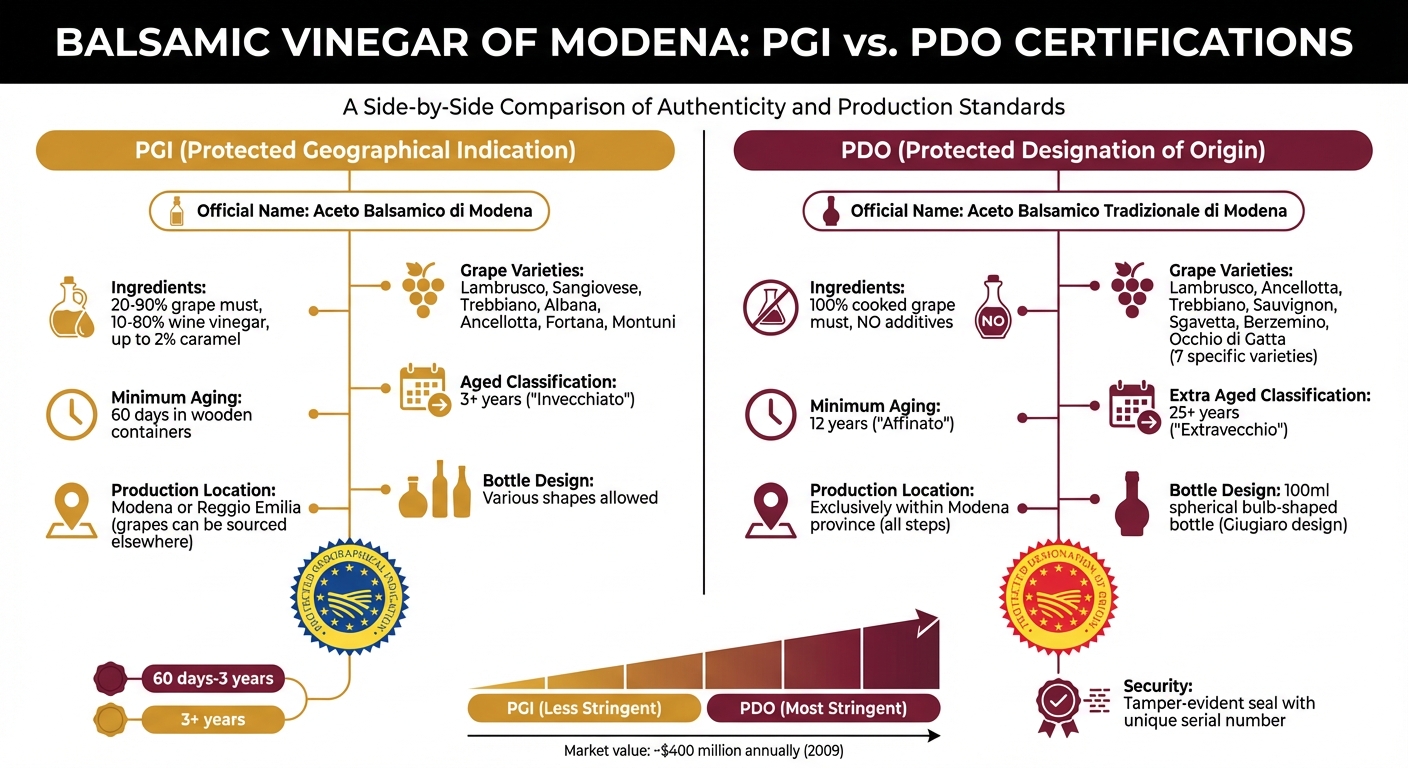
PGI vs PDO Balsamic Vinegar Certification Comparison
Certification Standards for Balsamic Vinegar of Modena
Balsamic Vinegar of Modena is protected by two key certification systems that ensure its authenticity and quality: the Protected Geographical Indication (PGI) and the Protected Designation of Origin (PDO). Each certification comes with specific production rules and guarantees for consumers.
Protected Geographical Indication (PGI)
The PGI certification, officially known as Aceto Balsamico di Modena, allows a blend of ingredients that includes 20–90% grape must, 10–80% wine vinegar, and up to 2% caramel for color consistency. Producers can also incorporate vinegar aged for 10 years into the mix.
To meet PGI standards, the vinegar must age for at least 60 days in wooden containers. Products labeled "invecchiato" (aged) must undergo a minimum of 3 years of aging. The final product must also have a total acidity of at least 6%. While the production, processing, and aging must take place in Modena or Reggio Emilia, the grape must itself can be sourced from outside these areas.
The PDO certification, however, enforces even stricter guidelines.
Protected Designation of Origin (PDO)
PDO certification, known as Aceto Balsamico Tradizionale di Modena, represents the pinnacle of balsamic vinegar production. Unlike PGI, this designation requires 100% cooked grape must derived from seven specific grape varieties: Lambrusco, Ancellotta, Trebbiano, Sauvignon, Sgavetta, Berzemino, and Occhio di Gatta. No additives are permitted.
The aging process for PDO vinegar is rigorous, with a minimum requirement of 12 years. Vinegars aged for at least 25 years earn the prestigious "Extravecchio" (extra-old) status. Every step of production - from harvesting the grapes to bottling - must occur exclusively in the province of Modena. To further distinguish PDO vinegar, it is packaged in a signature 100 ml bulb-shaped bottle, designed by Giorgetto Giugiaro, making it instantly recognizable.
sbb-itb-4066b8e
Production Rules and Requirements
Certified Balsamic Vinegar of Modena follows strict guidelines to ensure the quality and authenticity of its products. These rules cover everything from grape selection to production geography, helping distinguish genuine balsamic vinegar from imitations. By adhering to these standards, certified products honor traditional methods and the region's rich history. This commitment to quality is central to our story and passion for authentic flavors.
Grape Varieties and Ingredients
The grape varieties and ingredient standards differ between the two certifications: PGI (Protected Geographical Indication) and PDO (Protected Designation of Origin).
PGI Balsamic Vinegar of Modena allows several grape varieties, including Lambrusco, Sangiovese, Trebbiano, Albana, Ancellotta, Fortana, and Montuni. The grape must must meet specific requirements, such as a minimum total acidity of 8 g/kg, a net dry extract of at least 55 g/kg, and a density of 1.240 at 68°F (20°C). The finished product is also limited to a maximum of 100 mg/L of sulfur dioxide.
For PDO Traditional Balsamic Vinegar of Modena, the rules are even stricter. Only 100% cooked grape must is allowed, with no additives permitted. This certification is limited to seven grape varieties: Lambrusco, Ancellotta, Trebbiano, Sauvignon, Sgavetta, Berzemino, and Occhio di Gatta. The fresh must must have a saccharometer reading of at least 15°, and cooking must be done over an open flame at a minimum of 176°F (80°C). As the Consorzio Tutela explains:
Traditional Balsamic Vinegar of Modena is the only condiment in the world produced solely from cooked grape must without any other added substances.
Beyond the ingredients, the production location plays a crucial role in ensuring authenticity.
Production Location Requirements
Both PGI and PDO certifications enforce strict geographical rules, but the requirements vary slightly.
For PDO Traditional Balsamic Vinegar of Modena, every step - from grape growing and harvesting to processing, aging, and bottling - must occur within the province of Modena. Any product made outside this area cannot legally carry the PDO designation.
PGI Balsamic Vinegar of Modena is somewhat more flexible. While the assembly, processing, and maturation must take place in the provinces of Modena and Reggio Emilia, the grapes themselves can be sourced from outside these regions.
These geographical restrictions are essential for maintaining authenticity. The designated areas provide natural "acetaie" (vinegar lofts) with ideal temperature variations and ventilation for fermentation. Additionally, the region's grapes have the perfect balance of sugars and acidity needed for authentic balsamic vinegar production. For PDO-certified products, grape cultivation is capped at 16 tons per hectare to ensure quality.
These controls not only uphold tradition but also guarantee that consumers receive genuine balsamic vinegar with every purchase.
Aging Requirements and Classifications
Aging plays a crucial role in shaping the flavor, texture, and overall character of balsamic vinegar. It’s not just about taste - these aging distinctions also set the standards for quality and legal certifications, ensuring the authenticity of the product.
PGI Aging Standards
For Balsamic Vinegar of Modena with a PGI certification, the aging process starts with a minimum of 60 days in wooden containers. This short aging period allows the grape must and wine vinegar to integrate, developing the essential qualities required for certification.
Producers looking to achieve a higher-quality designation can age their vinegar for three years or more, earning the "invecchiato" (aged) label. This extended aging results in a thicker, richer product with deeper sweetness and complexity. Over time, natural evaporation in the wooden barrels concentrates the vinegar, increasing its density. These densities typically range from 1.060 to over 1.25 at 68°F (20°C).
In comparison, PDO-certified vinegars demand even longer aging durations to achieve their distinguished profiles.
PDO Aging Categories
Traditional Balsamic Vinegar of Modena PDO follows a far more extensive aging process. The "Affinato" (aged) classification requires at least 12 years of aging in wooden barrels. As Acetaia Leonardi notes:
Traditional balsamic vinegar of Modena DOP is aged for at least 12 years in wooden barrels and this is the secret providing its unique and complex flavour.
For the highest level of distinction, the "Extravecchio" (extra aged) classification mandates a minimum of 25 years of aging. The official product specifications state:
The wording 'Extravecchio' ('extra aged') may be used for products that have been aged for no less than 25 years.
During this prolonged aging process, the vinegar is transferred through barrels made from various woods such as oak, chestnut, mulberry, and juniper. Each type of wood contributes unique aromas, enhancing the vinegar’s depth and creating the signature sweet-sour balance that defines authentic Traditional Balsamic Vinegar of Modena. This complexity makes it a perfect companion for premium olive oils in gourmet dressings.
| Certification Level | Minimum Aging Period | Classification Name |
|---|---|---|
| PGI (Standard) | 60 Days | Aceto Balsamico di Modena PGI |
| PGI (Aged) | 3 Years | Invecchiato |
| PDO (Standard) | 12 Years | Affinato |
| PDO (Extra Aged) | 25 Years | Extravecchio |
How to Identify Certified Balsamic Vinegar
Understanding how to recognize authentic balsamic vinegar is key to avoiding imitations. Genuine products come with specific labels and packaging that set them apart from generic alternatives.
Certification Seals and Labels
The easiest way to check if balsamic vinegar is authentic is by looking for official certification marks. For PGI (Protected Geographical Indication) products, you’ll find the blue and yellow PGI seal alongside the name "Aceto Balsamico di Modena". PDO (Protected Designation of Origin) products, on the other hand, will display "Aceto balsamico tradizionale di Modena" followed by "denominazione di origine protetta" or the abbreviation D.O.P..
The ingredients list also tells you a lot about the product's quality. Authentic PGI balsamic vinegar typically contains 20% to 90% grape must and 10% to 80% wine vinegar, with up to 2% caramel as an optional additive. If wine vinegar is listed first, expect a tangier flavor; if grape must comes first, the vinegar will likely be sweeter and thicker. PDO products are even simpler - they consist of 100% cooked grape must with no additives.
Be cautious of marketing terms on PDO labels. Words like "Extra", "Fine", or "Select" are not allowed under certification rules. The only age-related term permitted is "Extravecchio", which indicates the vinegar has been aged for at least 25 years.
Finally, take a close look at the bottle design and seals to confirm authenticity.
Bottle and Packaging Standards
For PDO balsamic vinegar, the packaging is strictly regulated. The bottle must be spherical with a rectangular base, made from heavy glass. This design is required for all PDO products and is only available in 10, 20, or 40 cl volumes. Any other bottle shape or size is a red flag.
Each PDO bottle also comes with a tamper-evident seal featuring a unique serial number that breaks when opened. If the seal is missing, damaged, or reusable, the product’s authenticity cannot be guaranteed. For PGI products, neck seals are common indicators of aging: burgundy seals signify aging between 60 days and 3 years, while gold seals indicate aging beyond 3 years.
These strict packaging and labeling standards ensure that certified balsamic vinegar meets the high production criteria expected by consumers.
| Feature | PGI Balsamic Vinegar | PDO Traditional Balsamic Vinegar |
|---|---|---|
| Certification Seal | Blue and yellow PGI logo | Red and yellow PDO seal |
| Bottle Shape | Various shapes allowed | Spherical with rectangular base |
| Available Volumes | Multiple sizes | Only 10, 20, or 40 cl |
| Tamper Seal | Standard certification seal | Non-reusable with serial number |
| Forbidden Terms | None specified | "Extra", "Fine", "Select", etc. |
Legal Protections and Consumer Guarantees
Strict production and packaging standards are just part of the story. Legal protections also play a key role in ensuring both the authenticity of balsamic vinegar and the trust of consumers.
The Consortium's Enforcement Role
The Consorzio Tutela Aceto Balsamico di Modena, officially recognized by the Italian Ministry of Agricultural, Food and Forestry Policies (MIPAAF), is the watchdog for authentic balsamic vinegar. This organization actively monitors global markets to crack down on counterfeit products and prevent misuse of the Modena name.
"The task of the Consorzio is to carry out public functions of promotion, defense and protection of the product, in Italy as internationally." – Consorzio Tutela Aceto Balsamico di Modena
Representing 50 companies within the production chain, the Consortium's work isn’t confined to Italy. For instance, in February 2026, it launched an initiative to promote and protect the product in markets like China and South Korea. These efforts aim to safeguard the integrity of the Modena designation on a global scale.
For Traditional Balsamic Vinegar (PDO), the Consortium ensures every batch meets strict standards. Before bottling, each batch undergoes thorough analytical and sensory evaluations conducted by a panel of expert tasters. Additionally, independent certification bodies appointed by the Ministry verify compliance at every stage, from ingredient sourcing to the final product's taste and texture.
What Certification Guarantees Consumers
When you buy certified balsamic vinegar, you’re purchasing a product backed by a rigorous verification process. Certification ensures that essential production steps - like raw material assembly, processing, and aging - happen exclusively within the provinces of Modena and Reggio Emilia.
Legal protections reinforce this authenticity. In 2019, the European Court of Justice ruled that while generic terms like "vinegar" and "balsamic" can be used freely, the full name "Aceto Balsamico di Modena" is legally protected. This means producers outside the designated region cannot use the name.
Certified products also go through mandatory quality testing before they hit the shelves. Each batch is analyzed for key factors such as color, density, acidity, and flavor. These combined legal safeguards and quality checks give consumers confidence that they’re getting a genuine, high-quality product.
Big Horn Olive Oil: Certified Balsamic Vinegar from Modena
Big Horn Olive Oil takes pride in sourcing top-quality balsamic vinegars directly from Modena, adhering to the strict standards of PGI and PDO certifications. Their lineup includes traditional PDO-certified balsamic vinegars and PGI-certified options, as well as infused varieties, all crafted following the time-honored methods of Modena.
For those seeking aged balsamic, Big Horn offers an 18-year aged traditional balsamic for $8.99 and a premium Molto Denissimo 25-year aged variety for $12.99. Both are meticulously produced using PDO methods, ensuring they contain only pure cooked grape must, aged in wooden barrels, with no additives, thickeners, or wine vinegar. Meanwhile, their PGI-certified vinegars maintain the geographical authenticity and production standards required by the certification.
Big Horn Olive Oil's selection showcases the certified processes and standards outlined earlier, giving customers the opportunity to enjoy balsamic vinegars that meet the highest levels of quality and authenticity.
Conclusion
Certification systems for Balsamic Vinegar of Modena play a key role in maintaining production standards, honoring centuries-old artisan practices, and shielding consumers from deceptive products. When the European Commission added Balsamic Vinegar of Modena to the register of protected geographical indications in 2009, it secured the integrity of a market valued at roughly $400 million annually.
These certifications do more than enforce quality - they help consumers make informed decisions. By understanding the distinctions between PDO and PGI standards, you can choose the vinegar that best suits your culinary needs. For example, PDO vinegars are crafted from 100% cooked grape must and aged for at least 12 years, while PGI vinegars combine grape must with wine vinegar and require a minimum aging period of 60 days. Both certifications guarantee the product's origin and ensure it undergoes strict quality checks before hitting the shelves.
The Consorzio Tutela Aceto Balsamico di Modena further upholds these standards by evaluating certified bottles for characteristics like color, density, aroma, and flavor. This independent oversight not only safeguards traditional production methods but also supports authentic producers who continue to honor time-honored techniques.
FAQs
Which certification should I choose: PGI or PDO?
If you're deciding between the two, choose PGI for a product that adheres to specific standards and comes from Modena or Reggio Emilia. On the other hand, PDO has stricter requirements, allowing only grape must as an ingredient and demanding extended aging. Both guarantee quality, but PDO is the go-to choice for those looking for a more traditional and premium experience.
How can I spot fake “Modena” balsamic on a label?
To spot fake "Modena" balsamic vinegar, look for the PGI logo or the Consortium seal - these are official markers of authenticity. The label should clearly state “Traditional Balsamic Vinegar of Modena” and adhere to strict aging and ingredient requirements. If these elements are missing, the product is likely not authentic.
What’s the best way to use aged balsamic in cooking?
Aged balsamic vinegar shines as a finishing touch, adding depth to a variety of dishes. Drizzle it over fresh salads, creamy cheeses, or ripe fruit to create a perfect balance of sweetness and tang. It’s equally great for enhancing grilled meats, roasted vegetables, or a hearty risotto. For the best results, add it at the very end of cooking or just before serving to keep its rich, layered flavors intact.