

Top 7 Benefits of Biodiversity in Olive Groves
Biodiversity helps olive groves produce more steadily, lose less soil, and rely less on sprays and fertilizer. In the research cited here, cover crops cut erosion by 85.6%, improved water infiltration to 109 mm/hour vs. 52 mm/hour in bare soil, and helped farms reduce pesticide use by at least 50%.
If I had to sum up the whole article in plain English, it’s this:
- More plant and insect life helps control pests
- Covered soil holds water and resists erosion
- Healthier soil supports root growth and tree vigor
- Pollinators and mixed habitats can help fruit set
- Birds and other wildlife add pest pressure relief
- Ground cover can help groves handle heat and drought
- Lower input use can trim long-term costs and support cleaner production
This matters if you grow olives, buy olive oil, or manage land in dry regions. The main idea is simple: when I keep soil covered, cut heavy tillage, and leave room for habitat, the grove can do more work on its own.
Quick Comparison
| Benefit | What it helps most | Example from the article |
|---|---|---|
| Natural pest control | Fewer pest outbreaks | Pesticide use cut by 50%+ |
| Soil structure and fertility | Root growth and nutrient cycling | Soil carbon gains of 9.0 to 16.1 Mg C/ha |
| Less erosion and better water retention | Topsoil and moisture storage | Erosion cut by 85.6% |
| Pollination and insect support | Fruit set and yield stability | Yield gains of 10%+ in some compatible cultivars |
| Bird and wildlife habitat | Extra insect control | 165+ bird species recorded in one project |
| Climate resilience and carbon storage | Heat and drought stress | Daytime air up to 4°F cooler |
| Lower input costs and cleaner production | Farm costs and oil profile | Input spending about 22% lower |
So before getting into the details, the takeaway is clear: a grove with more life in it is often easier to keep productive over time.
Why Biodiversity Matters in Olive Groves
Main ecosystem services in olive production
Biodiversity helps olive groves do the day-to-day work that keeps them productive. Soil microbes, groundcover plants, and beneficial insects all play a part.
Ground cover improves water infiltration and helps control erosion. In one study, infiltration reached 109 mm/hour in cover plots, compared with 52 mm/hour in tilled bare soil. It also helps store more carbon. Vegetative cover can double soil carbon sequestration, and spontaneous cover crops in Andalusia stored up to 642 kg of carbon per hectare per year without reducing yields. On sloped ground, diverse vegetation helps hold soil in place. And natural enemies of olive pests - including parasitic wasps, predatory beetles, and birds - help keep pest pressure down.
These services feed straight into the seven benefits below.
How biodiversity fits into grove management
These services don’t happen by accident. They depend on routine grove decisions, season after season. Biodiversity is either built up or stripped away by choices like whether to till between rows, whether to leave wild plants in place, and whether to use herbicides or let cover crops grow.
Management has a strong effect on biodiversity in olive groves. Conventional systems with bare soil and frequent tillage tend to support the lowest plant diversity and the fewest beneficial insects. Groves with cover crops and low-till practices support more plant diversity than conventionally tilled groves. In plain terms, management choices decide whether these gains stick around.
The next seven sections show what that looks like in the field.
sbb-itb-4066b8e
How Native Grasses are Boosting an Olive Grove
1. Natural Pest Control
The first benefit is simple and direct: biodiversity helps control pests without leaning so hard on sprays.
Ecosystem Service Provided
When an olive grove has diverse ground cover and nearby habitat, pest predators are more likely to stick around. Predatory insects, parasitic wasps, spiders, birds, and bats all help suppress olive fruit fly (Bactrocera oleae) and olive moth (Prays oleae). This is known as conservation biological control: keeping ground cover, shrubs, hedgerows, and nearby habitat in place so natural enemies can survive and reproduce.
Field data back this up. In a controlled study in southern Spain, plots with ground cover between olive rows supported 45 spiders and 109 parasitoids per plot, compared with 32 spiders and zero parasitoids in bare-soil plots. In plain terms, cover crops help build the predator and parasitoid populations that keep pests in check.
Impact on Olive Tree Health
When natural enemies are present in good numbers, they cut pest feeding damage before it gets out of hand. Research on Prays oleae found that olive damage fell from about 10% to below 5% when natural enemies were active. That matters because less feeding damage supports canopy condition, tree vigor, and reproductive capacity.
This kind of biological control can also trim input needs. The LIFE "Olivares Vivos" project reported that biodiversity-friendly management reduced pesticide use by at least 50% on participating farms. Fewer sprays help protect beneficial insects and reduce disruption in the grove.
Economic Value
The payoff isn’t only ecological. Studies in Mediterranean olive groves estimated that natural enemies increased olive oil revenue by about €186 per hectare ($75 per acre), with higher gains in groves surrounded by more natural habitat. For U.S. olive growers, especially in California, that sends a clear message: putting money into biodiversity can pay back over time, acre by acre.
Natural pest control leads straight into the next advantage: better soil health.
2. Better Soil Structure and Fertility
Biodiversity helps build the soil that olive trees rely on.
Ecosystem Service Provided
Ground cover helps water soak into the soil and cuts runoff. Over time, it also adds soil organic matter and stores more soil carbon. In Andalusian olive groves, studies found that spontaneous cover crops stored 9.0–16.1 Mg C/ha more in the top 15 cm of soil than non-cover sites after more than 8 years. Those same systems also returned about 19.5 kg N/ha/year, 2.48 kg P/ha/year, and 24.3 kg K/ha/year to the soil. Put simply, cover crops feed the soil while helping it hold together.
Conventional tillage pushes things in the other direction. In a 15-year study of a rainfed olive grove, conventional tillage led to a 42.3% loss in total soil carbon stock, or about 2.1 Mg C/ha/year across the soil profile.
That shift in the root zone is a big reason tree performance changes over time.
Impact on Olive Tree Health
These soil gains show up belowground first, then in tree vigor. When soil structure improves, olive roots can spread deeper and farther. Loose, well-aggregated soil cuts compaction and helps roots reach water and nutrients that might otherwise stay out of reach. Research in cover-cropped olive groves shows higher aggregate stability and less compaction than in bare soils, which helps roots keep working through both dry and wet periods.
This is especially important in dry regions. Roots need access to stored moisture, not just rainfall at the surface. Trees growing in fertile, well-structured soil can tap deeper moisture reserves and are less likely to depend on emergency irrigation. Stronger root systems also leave trees less exposed to diseases that often take hold when plants are stressed by lack of water or poor nutrition.
Lower Long-Term Costs
The payoff takes time, but it helps protect yields and trim input needs over the long run. The economic case is mostly about preservation: less erosion, lower input use, and steadier yields. Mediterranean trials show conservation systems cutting erosion by over 85% and reducing soil carbon losses linked to sediment runoff by about 76% compared with tilled soils. Over a 10–20 year period, that can translate into lower fertilizer costs, less irrigation demand, and fewer expenses tied to land degradation.
3. Less Erosion and Better Water Retention
Ground cover helps hold olive-grove soil in place. When soil sits bare, rain hits it head-on and washes away topsoil and nutrients.
Ecosystem Service Provided
In Mediterranean olive orchards, conservation management with cover crops cut erosion by 85.6% and runoff by 37.6% compared with tilled, bare soil. That’s a huge shift. Instead of losing soil every time heavy rain shows up, the orchard holds on to far more of what the trees need.
A three-year field trial found the same pattern: soil loss fell from about 46.7 metric tons per hectare per year under tillage to just 6.5–7.9 with mixed cover crops. Put simply, cover crops act like a living shield. They soften the force of rainfall, slow water moving across the surface, and give that water more time to soak into the ground.
That matters because better infiltration keeps more rainfall in the root zone instead of letting it run off. As organic matter builds up, the soil can absorb and store more water for later use. And when the soil stays stable, the plant and insect communities in the grove are in better shape too, which helps pollination and biological control.
Impact on Olive Tree Health
When topsoil stays put, olive roots have more room and more resources. A deeper, steadier soil profile lets roots spread farther and reach stored moisture during dry spells. That’s especially important in California’s dry summers and in other U.S. olive-growing regions.
Better infiltration also means less water stress during key growth stages like flowering and early fruit development. In plain terms, trees are less likely to struggle when timing matters most, which supports more steady fruit set and canopy vigor.
There’s also a cost side to this. Less erosion means fewer nutrients lost from the field, less pressure on irrigation, and fewer dollars spent fixing damaged soil over time. Stable, moist ground also supports flowering plants and helpful insects that aid pollination.
4. Better Pollination and Beneficial Insect Support
Ecosystem Service Provided
Flowering ground cover does more than protect soil. It also helps the insects that keep olive groves productive.
In cultivars that set more fruit when pollen comes from another variety, bees, hoverflies, and other helpful insects can improve fruit set and make yields more stable. Diverse flowering ground cover draws in more pollinators and supports natural enemies as well. Sown flowering mixtures attract far more pollinators than unmanaged native vegetation, including honey bees (Apis mellifera), mining bees, megachilid bees, and bumble bees (Bombus spp.). They also support parasitoids and spiders that help keep olive fruit fly, black scale, and other pests under control. That extra insect activity supports both fruit set and pest control at the same time.
Impact on Olive Tree Health
Steadier fruit set can help smooth out crop swings and reduce strain on the tree.
When fruit set is more consistent from one season to the next, trees are less likely to fall into extreme alternate bearing, where a heavy crop one year is followed by a very light crop the next. That back-and-forth can wear trees down over time. More stable fruit set, supported by both wind and insect pollination, helps trees stay in better condition across several seasons. Predatory insects add another layer of support by limiting pest feeding that can weaken leaves and reduce vigor.
Effect on Oil Quality and Yield Stability
In compatible cultivars, cross-pollination can improve fruit set, fruit weight, and oil yield.
Research on several olive cultivars, including Koroneiki, Picual, and Manzanilla, found that cross-pollination consistently led to higher fruit set percentages, greater fruit weight, and better oil content than self-pollination, especially in self-incompatible cultivars. Sources also report yield increases of 10% or more in compatible cultivars when compatible pollinizer varieties are present and cross-pollination takes place.
5. More Habitat for Birds and Wildlife
Ecosystem Service Provided
Birds and other wildlife do more than make an olive grove feel alive. They help keep the grove steady over time. When growers keep ground cover in place, leave hedgerows, and protect patches of native vegetation, the grove can support birds, reptiles, and small mammals all year. And bird surveys show this isn't just theory.
The scale stands out. The Olivares Vivos project tracked 20 olive groves in Spain and recorded more than 165 bird species, along with over 500 wild plant species and around 60 ant species. In Lebanese olive groves, another study found 73 bird species - including 22 confirmed breeding species - across resident birds, summer visitors, wintering birds, and migratory passage migrants. These were working commercial groves, not untouched nature reserves.
The physical setup of the grove also makes a big difference. Research from southern Spain found that ground cover increased bird abundance 1.4-fold and species richness 11.4-fold compared with bare-ground plots, and hedgerows also had a strong positive effect on bird communities. In plain English: when a grove has more shelter, food, and plant life, more birds show up. They use these groves for breeding, wintering, and as stopover points during migration.
Impact on Olive Tree Health
Birds also help with pest control. They feed on insects and larvae in the canopy and understory, which adds one more line of defense for the trees.
Surveys in central Spain recorded 648 birds from 30 species across different grove types, and species richness fell as management intensified. That's the tradeoff. Bare-soil, simplified systems tend to support fewer birds, which means fewer of the pest-suppression services those birds can provide.
Long-Term Economic Value per Acre
Over time, bird habitat can help lower pest pressure and trim input needs. Small changes can support that habitat:
- Nest boxes, perches, and water troughs near vegetation can improve nesting and hunting sites.
- Stone piles, shrub banks, and vegetated stream edges are also worth keeping.
That same habitat structure can also help groves cope with heat and drought.
6. Greater Climate Resilience and Carbon Sequestration
Biodiversity does more than support wildlife habitat. It also helps olive groves handle heat, drought, and uneven rainfall.
Ecosystem Service Provided
When groves keep diverse ground cover and build organic matter, the soil does more work for the trees. It stores more carbon, holds more water, and softens temperature swings around the root zone.
Data from long-term trials in Andalusia, Spain, show how much this can matter. Groves with spontaneous cover crops stored 9.0 to 16.1 metric tons of carbon per hectare more in the top 6 inches (15 cm) of soil than similar bare-soil sites after more than eight years. Bare soil might look tidy, but the tradeoff can be steep. In one Mediterranean case study, conventional tillage led to a 42.3% loss in total soil organic carbon stock.
Climate models point in the same direction: as heat and rainfall stress grow, the biggest carbon-uptake losses show up in low-diversity groves.
Impact on Olive Tree Health
A grove with ground cover and canopy shade creates its own small climate buffer. That cover cools the grove, slows wind, and cuts evaporation. Put simply, the system becomes less harsh on hot days.
Research on olive-based agroforestry systems found that understory air temperatures can be up to 4°F cooler during the day than in open, bare-soil fields. For growers in California's Central Valley and other hot U.S. regions, that kind of temperature drop can make a real difference during heat waves. Trees are more likely to keep functioning instead of shutting down under stress.
This also takes some pressure off irrigation and other inputs. When the grove holds moisture longer and loses less water to heat and wind, growers don't have to fight the weather quite as hard.
Long-Term Economic Value per Acre
The business case is pretty direct. Groves that build soil carbon with cover crops, organic amendments, and less tillage tend to lose less soil to erosion, use fewer inputs, and perform better in dry years.
Climate projections suggest that rainfed groves without adaptation measures could face yield declines of around 7% or more by 2030–2050. Systems that adjust with better soil water management show smaller drops. That can mean less erosion, steadier production, and lower drought-related losses.
7. Lower Input Costs and Cleaner Production
Ecosystem Service Provided
Those same ecosystem services can cut recurring farm input costs, too. When biodiversity returns to a farm, growers often need less fertilizer and fewer crop-protection products. In Spain, farms that restored biodiversity spent about 22% less on those inputs than conventional farms.
The link to emissions and nutrient losses is just as clear. Life-cycle assessments show that 55% to 95% of olive oil’s greenhouse-gas load comes from the farming stage, mostly because of fertilizers and pesticides. That same stage can account for up to 100% of eutrophication impact as well.
Impact on Olive Tree Health
Using fewer inputs can also protect the living system under the trees. Lower synthetic use tends to support soil organisms, and that matters more than many people think. Healthy soil isn’t just “dirt” - it’s an active system that helps trees handle stress and keep producing.
In Cyprus, organic olive groves had more beneficial soil organisms than conventionally managed plots. Their oils also showed 28.7% higher polyphenols.
Long-Term Economic Value per Acre
The savings don’t stop after one season. They build over time.
Practices like minimal tillage, pruning residue covers, and integrated pest management are usually cost-neutral in the short term. Over the longer run, they tend to bring in more profit.
High-Biodiversity vs. Low-Diversity Groves: A Quick Comparison
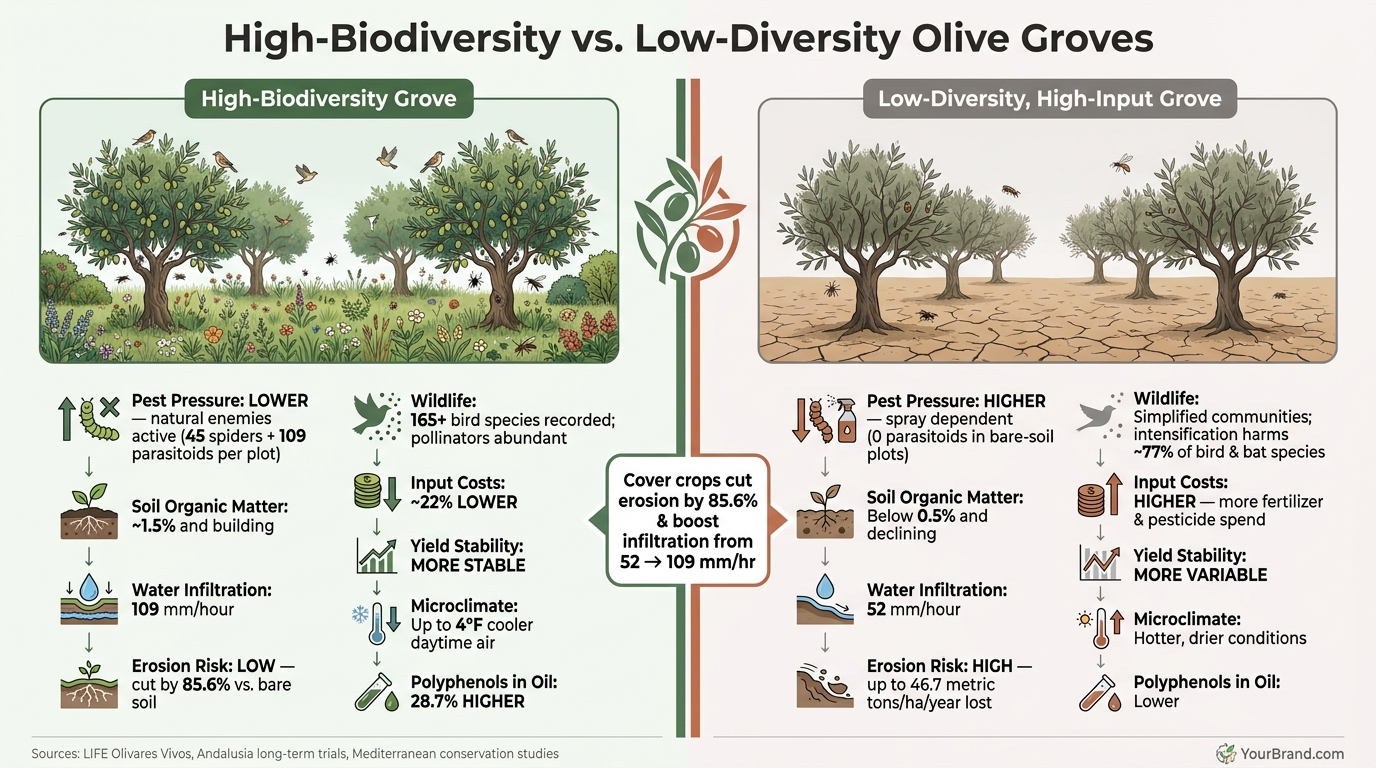
High-Biodiversity vs. Low-Diversity Olive Groves: Key Metrics Compared
The gains build on each other. Healthier soil holds more water, cuts drought stress, and helps keep yields steadier. And that doesn’t happen by luck. It comes from day-to-day management.
Side-by-side grove comparison table
| Factor | High-Biodiversity Grove | Low-Diversity, High-Input Grove |
|---|---|---|
| Pest pressure | Lower; natural enemies suppress pests | Higher; more spray dependence |
| Soil organic matter (SOM) | Higher and building; roughly 1.5% vs. below 0.5% | Lower and declining |
| Erosion risk | Low; cover protects soil | High; bare soil loses topsoil |
| Water retention | Stronger infiltration | Weaker infiltration |
| Wildlife & beneficial insects | Richer bird, bat, and pollinator communities | Simplified communities; intensification negatively associated with about 77% of bird and bat species studied |
| Pesticide & fertilizer costs | Lower | Higher |
| Yield stability | More stable | More variable |
The pattern is pretty clear: what growers do on the ground shapes these results. Ground cover, tillage, habitat, and soil care all push a grove in one direction or the other. The next section shows what that looks like in practice.
How Growers Can Build Biodiversity in Their Groves
These five practices make biodiversity part of day-to-day grove work. Start with ground cover. Then build out edge habitat, protect soil, and add organic matter.
Keep ground cover between tree rows
Keep living cover between rows and mow it instead of tilling. Clover, barley, and mixed grasses help shield soil, slow runoff, and give beneficial insects a place to live.
Once row middles stay covered, edge habitat helps keep those helpful species in the grove through the year.
Plant hedgerows and flowering strips
Plant hedgerows and flowering strips along grove edges and, where it fits, between rows. They feed pollinators, give natural enemies shelter, and support birds. Native, drought-tolerant shrubs and mixed flowering plants work well because they provide bloom and cover across the season.
Cut back on tillage to protect soil life
Use less tillage to protect soil organisms and help water move into the ground. Strip-till or shallow cultivation can be a good step for growers who are making the shift, especially on slopes before the rainy season.
When disturbance drops, organic inputs can help rebuild soil structure at a faster pace.
Add compost and organic amendments
After 17 years of olive-mill pomace co-compost application, β-glucosidase enzyme activity was 25 times higher and phosphatase activity 7 times higher in amended soils versus non-amended soils. Use olive-mill compost or chipped pruning residue to build organic matter, increase microbial activity, and support fruit and oil quality.
The grove gets stronger when the land around it stays linked instead of broken up.
Protect nearby natural habitat
Natural habitat and ground cover around olive groves have been shown to increase biological control of Prays oleae (olive moth), delivering an average economic benefit of €186.36 per hectare through reduced crop damage. Map field margins, riparian strips, and woodlots. Then protect those areas from drift, and avoid mowing or thinning during nesting periods.
Conclusion
Key takeaways from the 7 benefits
Biodiversity helps an olive grove do more on its own. It can cut pest pressure, build healthier soil, improve water use, reduce erosion, and help keep yields more even. Put together, these seven benefits lead to three outcomes that matter most to growers: lower risk, steadier yields, and better long-term grove performance.
The research is pretty clear here. Cover crops alone reduced soil erosion by 55.6% and increased total soil organic carbon by 46% compared with conventional tillage plots after six years.
What this means for olive oil quality
This kind of ecological stability can shape olive oil quality too. Projects like SOIL O-LIVE are looking at how soil biodiversity and grove management affect olive oil quality and safety. Early signals point in a practical direction: better soil biodiversity and soil function may lead to stronger chemical profiles and safer oils.
That matters on the market side as well. U.S. buyers are linking sustainable farming with quality more often, so biodiversity is not just good for the grove. It can also help support the product story behind the oil.
FAQs
How quickly can biodiversity improve an olive grove?
Biodiversity can improve an olive grove in a fairly short time. Research from the LIFE Olivares Vivos project found that cutting back on chemical use and restoring habitats can increase species diversity by 7% to 12% and species abundance by 40% within three years.
That shift gives helpful insects and local wildlife more room to thrive. And that, in turn, supports natural pest control and healthier soil.
Which biodiversity practice should growers start with first?
A strong first step is no-till farming paired with a diverse plant cover between tree rows. This combo helps shield the soil from erosion, hold onto more water, and support a healthier soil ecosystem.
Cutting back on tillage also gives beneficial insects and soil microbes a more stable place to live. That supports long-term olive farming that stays productive without wearing the land down.
Can biodiversity help olive groves during drought?
Yes. Biodiversity can help olive groves handle drought better.
Cover crops and ground cover improve soil structure, which helps rainfall sink deeper into the ground - down to 6.5 feet. That creates moisture reserves that olive roots can tap into during dry summer months.
These practices also help soil hold onto more water and cut evaporation by keeping the ground cooler. The result is better grove health and more efficient water use.