
Why Biodiversity Labels Matter for Olive Oil
Biodiversity labels on olive oil help you choose products made with farming methods that protect ecosystems. These certifications focus on reducing chemical use, preserving habitats, and improving soil and water management. Here’s why they matter:
- Farming practices impact the environment: Conventional olive farming often harms biodiversity, soil, and water resources. Intensive methods like monocultures and heavy irrigation degrade ecosystems.
- Labels ensure eco-friendly practices: Certifications like Olivares Vivos and Locus Olei verify that olive oil production supports healthier ecosystems through measures like ground cover, reduced pesticide use, and habitat restoration.
- Better farming, better oil: These practices not only safeguard nature but also improve olive oil quality, linking sustainable farming to richer flavors and higher standards.
When shopping for olive oil, look for certifications backed by independent audits and measurable results. Labels like Olivares Vivos and Locus Olei ensure you're supporting farming methods that balance production with ecosystem care. This approach benefits both the planet and the quality of the oil you enjoy.
Ecological Problems in Conventional Olive Oil Farming
How Monocultures and Industrial Farming Harm Ecosystems
The transition from traditional olive groves to large-scale monocultures has dramatically altered landscapes. Super-high-density (SHD) plantations - characterized by more than 800 trees per hectare (about 320 trees per acre), compared to fewer than 100 trees per hectare (roughly 40 trees per acre) in traditional groves - are rapidly expanding. In Andalusia, Spain, the area dedicated to SHD systems is increasing at a staggering rate of over 25% annually.
This shift comes with steep ecological consequences. The younger, smaller trees in these dense plantations provide significantly less habitat for birds, pollinators, and insects compared to the older, centuries-old trees they replace. Additionally, industrial farming practices prioritize a narrow range of cultivars, like Arbequina, which are suited for mechanical harvesting, sidelining traditional and diverse local varieties. Researcher José Guerrero-Casado highlights this issue:
"Super-high-density olive plantations reduce habitat heterogeneity and complexity, and the younger trees of these plantations impoverish habitat quality for farmland biodiversity."
This loss of biodiversity and habitat complexity signals deeper ecological disruptions tied to conventional olive oil farming.
Soil Degradation and Erosion
The visible presence of bare soil in many olive groves is a glaring indicator of the damage caused by conventional farming methods. Many growers rely on tillage and herbicides to eliminate weeds, stripping away the ground cover that stabilizes the soil. In Spain, over half of the olive-growing regions still operate without any vegetation cover.
The consequences are severe. Soil erosion rates in some Mediterranean groves have been recorded as high as 184 tons per hectare per year (about 74 tons per acre per year), far exceeding Europe's tolerable loss threshold of 0.3 to 1.4 tons per hectare per year (approximately 0.1 to 0.6 tons per acre per year). Furthermore, the practice of bare-soil management can reduce soil organic matter by as much as 41% compared to groves that preserve vegetative cover. This depletion of organic matter undermines the soil's ability to store carbon, retain fertility, and sustain long-term farming productivity.
Water Stress and Overuse
Traditional olive groves primarily relied on rainfall, but modern SHD systems depend heavily on drip irrigation, placing immense pressure on local water resources. Research shows that irrigated high-density systems use 3,805 times more water than traditional rainfed systems.
In Portugal's Alentejo region, the scale of water use is striking. Over 80% of the water drawn from the Alqueva reservoir, the largest artificial lake in Western Europe, is used to irrigate intensive olive and almond plantations. Pedro Horta, Policy Officer at ZERO, described the environmental toll of these practices:
"Given the scale of the transformation of the landscape, we can call this an ecocide."
The challenges are only expected to grow as climate change increases crop water demand by 5% to 21% while reducing water inflows to reservoirs by 5% to 10%. This creates a vicious cycle where intensive farming methods exhaust the very water resources they depend on. These mounting pressures highlight the urgent need for biodiversity-focused initiatives to encourage more sustainable farming practices. At Big Horn Olive Oil, our story is rooted in a commitment to these higher standards and traceable sourcing.
sbb-itb-4066b8e
How Pompeian Achieved Sustainably Grown® Certified Olive Oil
What Biodiversity Labels Mean for Olive Oil
Biodiversity labels are more than just stickers on a bottle. They represent a producer's verified commitment to safeguarding the ecosystems around their olive groves.
As ecological challenges grow, these labels acknowledge efforts to repair environmental damage and promote sustainable practices in olive farming.
Key Criteria Behind Biodiversity Labels
Biodiversity labels evaluate the entire farming system, focusing on practices that nurture the environment. Some common requirements include:
- Preserving semi-natural habitats like hedgerows, field margins, and small woodlands.
- Maintaining permanent ground cover to prevent soil erosion.
- Minimizing the use of synthetic pesticides and herbicides, such as glyphosate and oxyfluorfen.
- Restricting irrigation to emergencies and encouraging water-saving methods like rainwater collection or using reclaimed water.
Certain standards go even further. For instance, the Locus Olei certification, introduced in December 2025 by the World Biodiversity Association (WBA), has unique requirements. Groves must be at least 100 years old, harvesting must be done by hand, and historical features like dry-stone walls must be preserved. Additionally, producers are required to install wildlife-supporting structures such as nest boxes, amphibian ponds, and insect hotels.
How Biodiversity Labels Are Verified
The credibility of biodiversity labels lies in scientific measurement, not self-reported claims. A great example is the Olivares Vivos certification, developed by SEO/BirdLife and supported by the European Commission's LIFE program. This certification process begins with a baseline survey of flora and fauna before any certification is granted. Follow-up audits take place at 30 months, with a full biodiversity assessment at 60 months to confirm measurable improvements in species and habitat diversity.
Other certification programs rely on annual inspections using recognized Biodiversity Indices and ensure traceability from the grove to the final product. Some programs even offer an "In Transition" label for farms that have implemented at least 80% of their biodiversity action plan, allowing consumers to support farms that are actively improving their practices.
Linking Biodiversity Practices to Premium Olive Oil Quality
These practices not only protect the environment but also elevate the quality of olive oil. The way olive groves are managed directly impacts the oil they produce. Biodiversity labels emphasize this connection: for example, Olivares Vivos only certifies oils that meet Extra Virgin standards, ensuring that ecological responsibility aligns with top-tier quality.
"At Olivares Vivos, recovery of biodiversity and quality go together." - Olivares Vivos
Farms that maintain healthy soil, reduce chemical inputs, and preserve older trees often produce olives with richer flavors and higher polyphenol levels. These same conditions define Ultra Premium Extra Virgin Olive Oil, like the oils sourced by Big Horn Olive Oil (bhooc.com). By focusing on biodiversity, these farms create olive oil that reflects both exceptional quality and deep care for the environment, proving that sustainability and excellence are a perfect match.
How Biodiversity Labels Address Olive Oil's Ecological Problems
Biodiversity labels go beyond setting guidelines - they demand measurable outcomes. This shift from mere intentions to verified results offers a practical way to tackle the environmental harm caused by conventional olive farming. Below, we explore how these measures help protect wildlife, reduce chemical use, and improve soil and water management.
Protecting Habitats and Wildlife
One of the key goals of biodiversity labels is to restore and protect habitats. For example, the Olivares Vivos certification requires farms to rejuvenate non-productive areas like roadsides, gullies, and field boundaries, turning neglected spaces into thriving ecological corridors.
"The restoration of natural vegetation in unproductive areas of the olive grove - such as roadsides, stubble fields, gullies, or boundaries - is pivotal for biodiversity recovery." - José Eugenio Gutiérrez, Director of LIFE Olivares Vivos+
Between October 2015 and May 2021, the LIFE Olivares Vivos project restored around 3,604 hectares by planting 32,000 woody plants, building 11 amphibian ponds, and installing 406 nest boxes and 190 insect hotels to support biodiversity. These efforts have transformed certified groves into havens for wildlife, now home to 180 bird species, 204 bee species, and 775 plant species. Remarkably, even small interventions - affecting less than 1% of a farm’s total area - can significantly boost the diversity and abundance of local flora and fauna.
Cutting Back on Chemical Use
Biodiversity labels also aim to reduce the use of chemicals by promoting natural pest control methods. Certified farms encourage populations of birds, bats, and beneficial insects by installing nest boxes and insect hotels. This strategy is a cornerstone of Integrated Pest Management (IPM), which has been linked to a 22% drop in the use of fertilizers and pesticides. By relying less on chemicals, olive oil production can better coexist with the ecosystems it relies on.
Better Soil and Water Management
Conventional olive farming often depletes soil and water resources, but biodiversity labels push for changes that reverse this damage. Certified farms, for instance, must maintain permanent herbaceous ground cover between olive tree rows. This living cover helps prevent erosion, improves soil structure, and supports microbial activity - all of which are harmed by traditional tillage practices.
Water management is another critical focus. In intensive olive farming systems, irrigation can account for up to 77% of the total water footprint. Certification programs promote water-saving techniques like drip irrigation, rainwater harvesting, and the creation of water features such as ponds and troughs. The LIFE Olivares Vivos project, for example, constructed 30 water troughs along with 11 amphibian ponds, improving water availability and ecosystem health across certified farms.
How to Shop for Biodiversity-Friendly Olive Oil in the U.S.
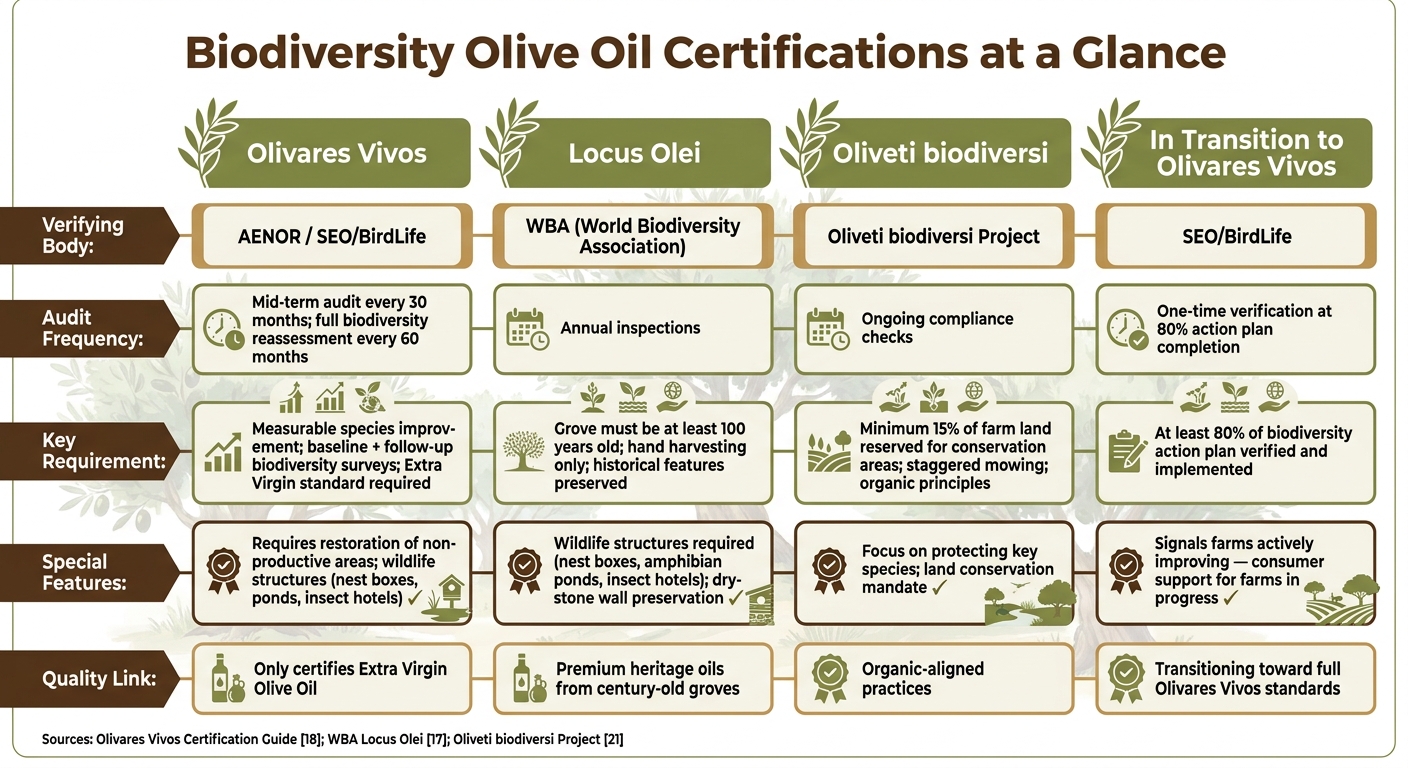
Biodiversity Olive Oil Labels Compared: Olivares Vivos vs Locus Olei vs Oliveti biodiversi
Reading Biodiversity Labels on Olive Oil
When shopping for olive oil in the U.S., it's common to see labels highlighting basic quality standards. However, if you're looking for oils that support biodiversity, you'll need to dig a little deeper and look for specific certifications.
One of the most prominent certifications is Olivares Vivos, which, as of late 2023, is carried by 36 EVOO brands. Another label to watch for is Locus Olei, introduced in December 2025 by the World Biodiversity Association (WBA). This certification is exclusive to oils from olive groves that are at least 100 years old, with annual inspections and biodiversity measurements to ensure compliance. For a Tuscan touch, Oliveti biodiversi requires farms to reserve at least 15% of their land for conservation areas aimed at protecting key species.
Additionally, farms actively working toward biodiversity goals can display an "In Transition to Olivares Vivos" label once they achieve 80% of their action plan.
How to Assess Label Credibility
Once you've spotted a biodiversity label, it's important to confirm its legitimacy. The most reliable labels are those that demonstrate measurable outcomes, not just promises of good practices.
"Olivares Vivos certifies not only good intentions nor practices, but real results." - Olivares Vivos Certification Guide
To ensure a label is credible, check if it's supported by independent scientific organizations or standardization bodies. Look for mandatory audits and measurable standards. For example, Olivares Vivos requires mid-term audits every 30 months and biodiversity reassessments every 60 months. Similarly, Locus Olei mandates annual inspections. Be cautious of labels that lack a clear verifying organization or an audit schedule.
Another tip: verify the harvest year along with the best-before date. This ensures you're purchasing fresh oil from a producer who values transparency.
These steps not only help you support sustainable practices but often lead to better-quality olive oil.
Biodiversity and Premium Olive Oil
Eco-friendly farming practices don’t just benefit the planet - they also enhance the quality of olive oil. For example, farms that focus on healthy soil, limit chemical use, and support pollinators often produce oils with richer flavors and improved nutritional value. Biodiversity-friendly methods directly contribute to the superior taste and quality of olive oil.
A case in point is Big Horn Olive Oil (bhooc.com), which exemplifies this connection between sustainability and quality. Their oils, known for their freshness and international acclaim, highlight how responsible farming practices can elevate both the product and the environment. Choosing a premium EVOO with this level of transparency ensures you're making a thoughtful and flavorful choice.
| Label | Verifying Body | Verification Standard |
|---|---|---|
| Olivares Vivos | AENOR / SEO/BirdLife | Scientific species measurement; audits every 30–60 months |
| Locus Olei | WBA (World Biodiversity Association) | Annual inspections; 100-year grove history required |
| Oliveti biodiversi | Oliveti biodiversi Project | 15% conservation land; staggered mowing; organic principles |
| In Transition to Olivares Vivos | SEO/BirdLife | 80% of biodiversity action plan verified and implemented |
Conclusion: Making Better Choices for Biodiversity
Every bottle of olive oil tells a story, and that story begins with the farming practices behind it. Biodiversity labels, like Olivares Vivos, make those stories clear and credible. These certifications go beyond promises, confirming tangible improvements in ecosystems, with documented increases in plant and animal life at the production source.
The good news? Consumers are paying attention. Studies show that shoppers are willing to spend up to 75% more on olive oils with local origin and sustainability certifications. This shift highlights a growing desire for purchases that carry meaning beyond just taste. It’s proof that responsible farming doesn’t just protect the environment - it can also boost productivity.
FAQs
Are biodiversity labels the same as organic?
No, they’re not the same. Organic certifications are all about how products are grown - focusing on practices like avoiding synthetic pesticides and fertilizers. Biodiversity labels, however, take a broader approach. They highlight efforts to protect ecosystems, encourage species diversity, and combat biodiversity loss.
While organic farming can contribute to healthier ecosystems, biodiversity labels zero in on preserving the natural balance of plants, animals, and habitats. Each label serves a different purpose, targeting separate aspects of environmental care.
How can I spot greenwashing on an olive oil label?
To steer clear of greenwashing, avoid relying on vague terms like eco-friendly or clean, as these often lack concrete evidence. Instead, focus on products with credible certifications, such as USDA Organic, which provide a stronger basis for trust. Pay attention to details like harvest dates and specific regional origins - these are signs of authentic sourcing.
Reputable producers typically offer clear traceability. For example, they might include information about the farm, harvesting practices, or methods like cold extraction. When evaluating labels, prioritize those with verifiable documentation over flashy imagery. This approach ensures you're making choices based on facts, not marketing fluff.
Do biodiversity-friendly olive oils actually taste better?
Research doesn't prove that olive oils produced with biodiversity-friendly practices taste better. However, studies reveal that labels emphasizing biodiversity can boost consumer preference and even their willingness to pay more for extra virgin olive oil. While these labels may elevate the perceived value of the product, there's no direct link between them and an actual improvement in flavor.