

Ceramic Pans for Olive Oil: Pros and Cons
Yes - ceramic pans can work with olive oil, but only if you keep the heat low to medium. If olive oil smokes, it can leave a sticky film, dull the surface, and make food stick sooner.
Here’s the short answer in plain English:
- 100% ceramic works best for gentle cooking and low heat
- Ceramic-coated aluminum heats fast, so oil can smoke sooner if you’re not careful
- Ceramic-coated stainless steel gives steadier heat, which helps with control
- PTFE nonstick usually lasts longer and handles olive oil with less residue at normal stovetop temps
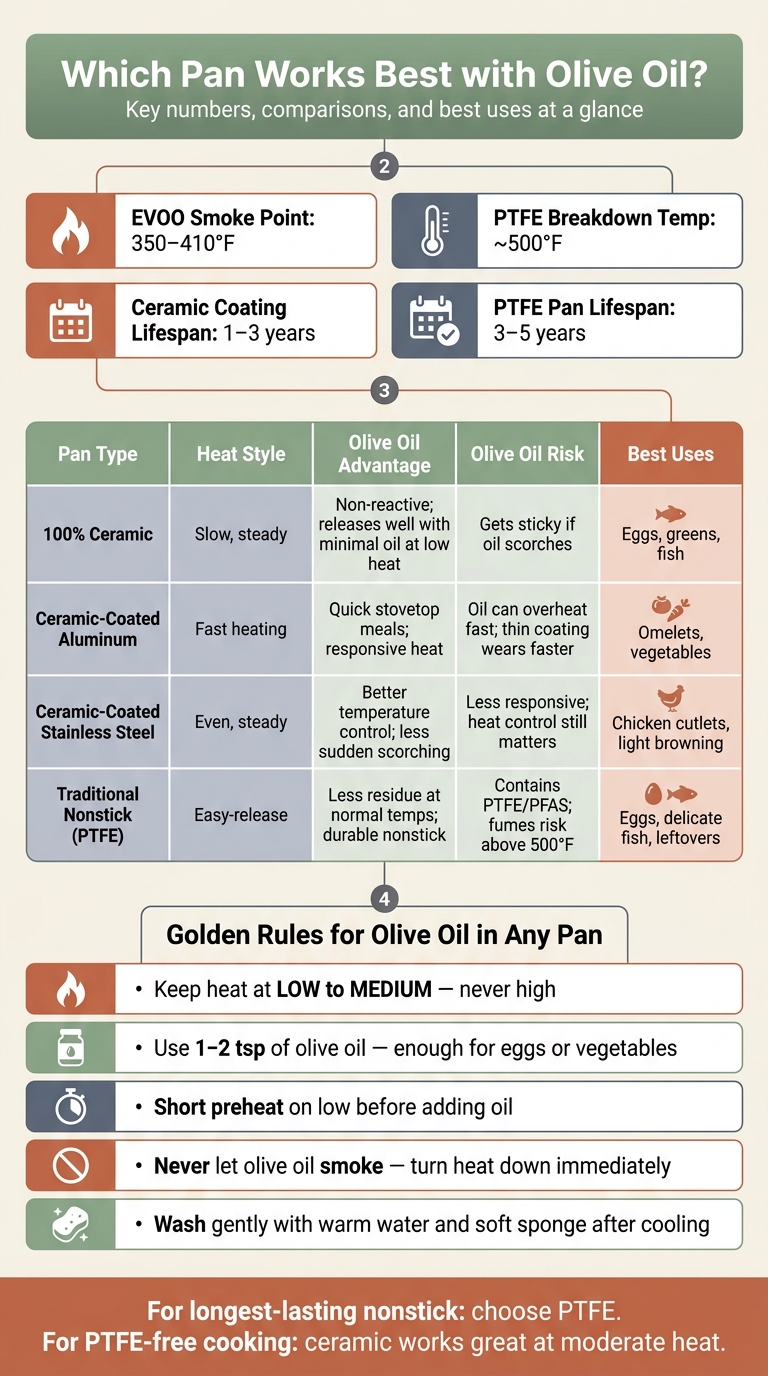
A few numbers matter here:
- EVOO usually smokes around 350–410°F
- PTFE starts to break down near 500°F
- Ceramic coatings often lose slickness in 1–3 years
- PTFE pans often last about 3–5 years with similar use
If I had to boil it down to one rule, it’s this: use olive oil for eggs, vegetables, fish, and light sautéing - not for high-heat searing in ceramic pans. Add oil early or after a short preheat, never let it smoke, and wash the pan gently after it cools.
Ceramic vs. Nonstick Pans with Olive Oil: Full Comparison
How to Care for Your Ceramic Non-Stick Pans | Crumble Cookware Tips
sbb-itb-4066b8e
Quick Comparison
| Pan type | Heat style | Main upside with olive oil | Main downside with olive oil | Best use |
|---|---|---|---|---|
| 100% ceramic | Slow, steady | Nonreactive surface; good at low heat | Can get sticky if oil scorches | Eggs, greens, fish |
| Ceramic-coated aluminum | Fast heating | Easy for quick stovetop meals | Oil can overheat fast | Omelets, vegetables |
| Ceramic-coated stainless steel | More even heating | Better temperature control | Coating still wears with burned oil | Chicken cutlets, light browning |
| PTFE nonstick | Easy-release cooking | Less residue in normal use | Not for very high heat | Eggs, delicate fish, leftovers |
Bottom line: if you cook with olive oil most days, ceramic can be a good fit for moderate heat. But if you want the longest-lasting slick surface, PTFE usually holds up longer.
1. 100% Ceramic Pans
A 100% ceramic pan is made from solid ceramic. There’s no metal core and no added coating. The surface is nonreactive, which makes it a good match for cooking with olive oil at moderate heat.
The tradeoff is pretty straightforward: good food release at lower heat, but the pan tends to wear out faster if you push it too hot.
Heat Compatibility
Stick to low or medium heat. EVOO starts to smoke at about 375°F, and virgin olive oil at about 390°F.
Don’t preheat the pan empty. Add the oil early, then keep the burner at medium or below. That simple habit can help you avoid scorched oil and extra wear on the pan.
Olive Oil Residue Risk
If olive oil gets too hot in ceramic, it can leave behind a sticky, carbonized film that’s tougher to clean later. EVOO is more likely to cause this than refined oil because its flavor compounds and tiny particles scorch sooner.
Wash the pan soon after cooking with warm water and a soft sponge. If you wait too long, that residue can cling like glue.
Nonstick Longevity
High heat over and over can wear down the pan’s release faster. Abrasive cleaning does the same thing.
A couple of simple rules help:
- Skip metal utensils
- Don’t use scouring pads
Best Cooking Uses
These pans are best for gentle, oil-based cooking. Think scrambled eggs, sautéed greens, mushrooms, fish fillets, and lightly cooked vegetables.
They’re not the best pick for high-heat searing. For that kind of job, cast iron or stainless steel usually does a better job. A fresh EVOO like Big Horn Olive Oil works well here because its flavor holds up nicely at moderate heat.
Next, compare it with ceramic-coated aluminum, which changes how fast the pan heats and how the oil behaves.
2. Ceramic-Coated Aluminum Pans
Compared with solid ceramic, this type heats up faster and gives you less room to recover if the burner runs hot. Ceramic-coated aluminum pans pair a light aluminum body with a ceramic nonstick surface. That aluminum base warms olive oil fast and evenly, but it also reacts fast, so you need to keep a close eye on the heat.
Heat Compatibility
Stick with low to medium heat. Preheat for a short time, then add oil when the pan starts to shimmer, not smoke.
Olive Oil Residue Risk
If EVOO gets too hot, it can leave behind a sticky film that makes the coating look dull and trap odors. Clean the pan while it’s still warm using a soft sponge and mild dish soap. It’s also smart to skip aerosol cooking sprays, since they can leave stubborn buildup on ceramic coatings.
Nonstick Longevity
Too much heat and rough scrubbing can wear down the coating sooner. Use silicone or wooden utensils, and wash with a soft sponge instead.
Best Cooking Uses
These pans work well for eggs, quick sautés, and light browning. For cooking on the stove, use refined olive oil. Then, once the pan is off the heat, finish with a drizzle of a high-quality EVOO like Big Horn Olive Oil for aroma and flavor.
Next, compare that with ceramic-coated stainless steel, which handles heat differently.
3. Ceramic-Coated Stainless Steel Pans
Ceramic-coated stainless steel combines a stainless-steel body with a ceramic nonstick surface. Compared with ceramic-coated aluminum, it gives you more even heat and fewer sudden temperature jumps.
Heat Compatibility
Stick with low to medium heat. The stainless-steel base helps smooth out hot spots, but olive oil can still burn if the pan gets too hot. A simple move helps: add the oil before the pan heats up. And if you need a bit more heat room, use refined olive oil instead of extra virgin.
Olive Oil Residue Risk
Olive oil can leave brown marks on pale ceramic coatings when it gets too close to its smoke point. If that happens, soak the pan in warm water with dish soap, then wash it with a soft sponge. Skip steel wool and abrasive scrubbers, since they can scratch the coating.
That brown film isn't just about looks. It can also make the surface lose its easy-release feel sooner.
Nonstick Longevity
Ceramic coatings on stainless steel hold up well, but the slick surface doesn't last forever. In most kitchens, the nonstick layer starts to lose slickness after 1 to 3 years of regular use. Too much heat and burned-on oil are two of the main reasons that happens early. So if you keep the heat moderate and clean the pan gently after each use, you give the coating a better shot at lasting longer.
Best Cooking Uses
These pans are a good fit for everyday cooking at moderate heat, especially when steady temperature matters. They work well for:
- eggs
- fish fillets
- chicken cutlets
The ceramic surface helps food release with less oil, while the stainless-steel base gives you enough control for light browning. For olive oil, there's a smart way to use it here: cook first, then finish the dish with fresh extra virgin olive oil after it's off the heat.
Traditional nonstick handles olive oil differently, with its own tradeoffs.
4. Traditional Nonstick Pans
Traditional nonstick pans use a PTFE coating to create a slick, easy-release surface. That makes them a good baseline when you're comparing how ceramic pans deal with olive oil. For day-to-day cooking, olive oil works well in PTFE pans, as long as you don't crank the heat too high.
Heat Compatibility
PTFE holds up at normal stovetop temperatures, but it starts to break down at around 500°F (260°C). Extra virgin olive oil usually begins to smoke somewhere between 350–410°F (177–210°C), so in most cases, the oil gives you a warning sign before the pan gets near its upper limit.
One mistake causes more trouble than anything else: preheating an empty nonstick pan over high heat. An empty pan can hit 500°F in just 2–5 minutes, which is fast enough to start damaging the coating before food even goes in.
Olive Oil Residue Risk
In normal use, olive oil leaves very little residue on PTFE. The trouble starts when the oil smokes again and again. That's when it can leave behind a sticky brown film. Usually, that residue stays on top of the coating and often loosens up after a 15–30 minute soak in warm, soapy water.
A simple wipe after cooking helps a lot. Remove extra oil after each use, and buildup is much less likely over time. If the oil never reaches the smoking stage, cleanup usually stays easy.
Nonstick Longevity
Olive oil itself does not shorten the life of PTFE pans. Repeated high-heat cooking does. Research has found no statistically significant difference in coating condition when pans are used with extra virgin olive oil compared with other cooking oils.
Best Cooking Uses
Traditional nonstick pans work best for foods that like to cling and don't need ripping-hot heat. Think:
- Eggs
- Delicate fish fillets
- Sautéed vegetables
These foods cook well in olive oil at around 300–400°F, where the oil stays under its smoke point and the coating stays unaffected.
Use traditional nonstick for gentle stovetop cooking, not hard searing. That's where this type of pan does its best work.
Pros and Cons of Ceramic Pans With Olive Oil
The main trade-off across these pans is pretty simple: easier food release now, shorter coating life later. Ceramic pans do well with olive oil over low to medium heat, but that ease comes with a shorter lifespan for the coating.
On the plus side, ceramic coatings are PTFE- and PFOA-free, which matters to many home cooks who want to avoid fluorinated compounds. They also let food release well with just 1 to 2 teaspoons of olive oil, which is often enough for eggs or vegetables.
The downside is wear over time. Ceramic coatings usually give you about 1 to 3 years of peak nonstick use, while PTFE-based pans often last around 3 to 5 years at similar price points. And if extra-virgin olive oil gets pushed past its smoke point - about 374°F (190°C) - again and again, it can carbonize on the surface. That leaves behind deposits, makes food stick, and speeds up coating wear.
Here’s what that looks like in day-to-day cooking:
| Pan Type | Olive Oil Advantage | Olive Oil Risk |
|---|---|---|
| 100% Ceramic | Non-reactive surface; releases well with minimal oil at low heat | Slower to heat and more sensitive to sudden temperature changes |
| Ceramic-Coated Aluminum | Heats quickly; responsive enough to keep oil below smoke point | Thin coating wears faster if olive oil is repeatedly overheated |
| Ceramic-Coated Stainless Steel | Steady heat helps prevent sudden oil scorching | Less responsive than aluminum, so heat control still matters |
| Traditional Nonstick (PTFE-based) | Durable nonstick; oil rarely leaves residue at normal cooking temps | Contains PTFE/PFAS; fumes risk if overheated above 500°F |
In practice, the rule is pretty straightforward: keep olive oil at low to medium heat, don’t preheat the pan empty, and wash it gently. The next section turns that into simple cooking rules.
Best Practices and Final Verdict
A few simple habits can help you get better results from any ceramic pan when you cook with olive oil.
Keep the heat at low to medium. Give the pan a short preheat on low to medium, then add the oil. If the oil starts to smoke, turn the heat down right away. For most day-to-day dishes, 1 to 2 teaspoons is enough. After cooking, let the pan cool all the way before washing it with warm water, mild dish soap, and a soft sponge. That helps reduce stress on the coating.
If you want the shortest answer, use this quick guide:
| Pan Type | Best Olive Oil Use Cases |
|---|---|
| 100% Ceramic | Low- to medium-heat sautéing, eggs, quick meals |
| Ceramic-Coated Aluminum | Vegetables, omelets, shallow frying |
| Ceramic-Coated Stainless Steel | Proteins, light browning, steady-heat cooking |
| Traditional Nonstick (PTFE) | Low- to medium-heat, easy-release cooking |
For high-heat searing or deep browning, stainless steel or cast iron is the better pick. Ceramic does best at moderate heat, and if you push it too far with olive oil, the coating can wear out faster.
FAQs
Which ceramic pan type is best for olive oil?
For cooking with olive oil in a ceramic-style pan, the best choice is a properly glazed clay or ceramic pot.
Use it with high-quality extra virgin olive oil (EVOO) that has a smoke point of at least 410°F (210°C). That pairing works well because clay’s porous design is better suited to slow cooking, and the higher smoke point helps cut down on burning during longer heating.
How can I keep olive oil from leaving residue?
Avoid overheating olive oil. When the oil gets too hot, it starts to break down and can burn fast. A good rule of thumb is to cook over medium or medium-high heat. If you notice the oil smoking, turn the heat down or take the pan off the burner for a moment.
After cooking, clean the pan while it’s still warm. That makes it much easier to wipe away oil and stuck-on food before buildup starts. Then dry the pan all the way before adding oil again, which can help reduce sticking.
When should I use refined olive oil instead of EVOO?
Use refined olive oil for deep frying or anytime you want a more neutral taste. Its smoke point usually falls between 390°F and 468°F.
High-quality Ultra Premium Extra Virgin Olive Oil from Big Horn Olive Oil also holds up well in most kitchen use, including sautéing, roasting, and even deep frying. Go with refined olive oil when you don't want EVOO's more distinct flavor to come through in the dish.