

Cheesecloth vs Coffee Filters for Infused Oil
Use cheesecloth for fast straining and a coffee filter for finer sediment. For herb, garlic, chili, or citrus oil, remove large pieces with cheesecloth first. Add a coffee filter only if small particles remain - and let the oil drain without squeezing.
The tradeoff? Finer filtering takes longer and can leave more oil behind.
Quick Comparison
| Factor | Cheesecloth | Paper coffee filter |
|---|---|---|
| Best for | Leaves, garlic pieces, chili, and peel strips | Fine herb bits, spice particles, and zest |
| Flow | Usually faster; depends on weave and layers | Usually slower; can clog |
| Oil left behind | Some stays in cloth and solids | Some stays in paper and residue |
| Batch size | Suits larger batches | Suits small batches or a final pass |
| Cleanup and cost | Reusable if washed thoroughly and dried; cost varies | Low cost per filter; discard after use |
Clearer oil does not mean safer storage. Filtering does not make infused oil shelf-stable. Keep nonacidified garlic or herb oils at 40°F or below, use within 2–4 days, or freeze for longer storage. Count from the preparation date - not the filtering date.
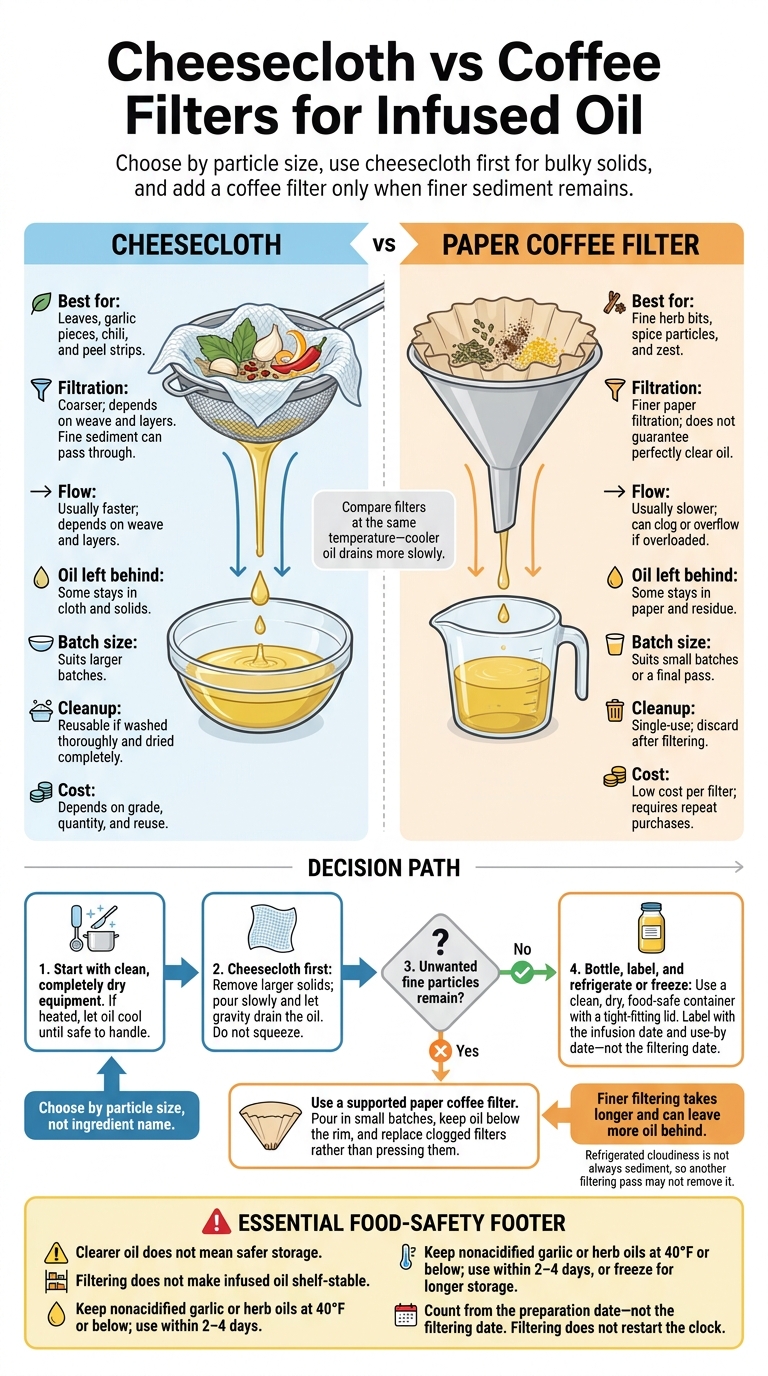
Cheesecloth vs Coffee Filters for Infused Oil
Straining Herbal Infused Oils
sbb-itb-4066b8e
Cheesecloth vs Coffee Filters: Main Differences
Results depend on the weave, number of layers, filter size, and oil temperature. Compare filters at the same temperature - cooler oil drains more slowly.
| Factor | Cheesecloth | Coffee filters |
|---|---|---|
| Filtration fineness | Coarser; depends on weave and layers | Finer paper filtration |
| Flow speed | Usually faster | Usually slower |
| Sediment removal | Catches herb bits, garlic, chili, and citrus peel; fine particles may remain | Catches finer herb, spice, and peel particles |
| Oil retention | Some oil stays in the cloth and solids | Some oil stays in the paper and residue |
| Batch capacity | Handy for larger batches of infused oil | Handy for small infusions or a finishing pass |
| Cleanup and reuse | Wash, dry, and reuse if clean | Single-use; discard after filtering |
| Cost | Depends on grade, quantity, and reuse | Low cost per filter; requires repeat purchases |
| Main limitation | Fine sediment can pass through | Can clog or overflow if overloaded |
These tradeoffs matter most when the oil contains herbs, garlic, chili, or citrus peel.
Cheesecloth: Faster Straining of Larger Solids
Place food-grade cheesecloth in a strainer or colander to catch herb leaves, chopped garlic, chili pieces, and larger citrus-peel fragments. The weave matters more than the label: tighter cloth catches more fine particles but drains more slowly.
Pressing can recover more oil, but it also pushes sediment through. If clarity matters, let the oil drain without squeezing. Before reusing the cloth, remove all oil and food residue, then dry it completely to prevent odors and flavors from carrying into the next batch.
Coffee Filters: Less Fine Sediment
Set a paper coffee filter in a funnel or strainer. Remove bulky solids first, then pour slowly, keeping the oil below the rim. If the filter clogs, replace it rather than pressing it.
Finer filtration doesn't guarantee perfectly clear oil. Cloudiness after refrigeration isn't always sediment, so another filtering pass may not remove it. Base your decision on unwanted particles, not cloudiness alone.
Choosing a Filter for Herbs, Garlic, Chili, and Citrus
Choose by particle size, not ingredient name. Start with cheesecloth to remove larger solids. Add a coffee filter only if fine sediment remains or you want clearer oil.
| Infusion ingredient | First filter | When to add a coffee filter |
|---|---|---|
| Herbs | Cheesecloth for leaves and stems | Fine bits remain or you want clearer oil |
| Garlic | Cheesecloth for chopped pieces | Small particles remain or you want clearer oil |
| Chili | Cheesecloth for pepper pieces and seeds | Fine flakes remain |
| Citrus peel | Cheesecloth for peel strips | Fine zest or pulp remains |
For chili oil with visible sediment, let the solids settle before using a coffee filter. Pour slowly, leaving the settled residue behind to reduce clogging. If a little sediment doesn't bother you, skip the extra pass. Clearer oil takes longer to filter, and some oil stays in the filter.
Filtering improves texture, but it does not make oil safe to store at room temperature. Refrigerate homemade oils made with fresh garlic or herbs at 40°F or below and use within four days, or freeze for longer storage.
How to Strain Infused Oil in 2 Stages
For faster straining and clearer oil, work in two passes.
Start with clean, completely dry strainers, containers, and lids. If you heated the oil, let it cool until it’s safe to handle. Don’t leave freshly infused oil at room temperature longer than needed.
Stage 1: Drain through cheesecloth. Line a strainer or funnel with food-grade cheesecloth and secure it over a food-safe container. Pour slowly and let gravity do the work. Don’t squeeze the cloth or force oil through it. That can push fine particles, moisture, and plant residue into the oil. If the cloth clogs, replace it.
If the oil looks clear enough after this pass, skip the second stage.
Stage 2: Use a coffee filter only if needed. Place a paper coffee filter in a supported funnel over a second clean, dry container. Pour in small batches, keeping the oil below the filter’s rim. Replace clogged filters rather than pressing, stirring, or scraping sediment through them.
Transfer the oil to a clean, dry, food-safe bottle or jar with a tight-fitting lid. Label it with the infusion date and use-by date - not the filtering date. Oregon State University Extension recommends recording the preparation date and a four-day use-by date for homemade mixtures covered by its guidance. Filtering doesn’t restart that clock. Once labeled, refrigerate or freeze the oil according to its ingredient-based use-by date.
Conclusion: Cheesecloth for Speed, Coffee Filters for Clarity
For herb, garlic, chili, and citrus infusions, match your filter to the sediment you want to remove. Start with cheesecloth for most infusions, then use a coffee filter if you need a finer finish.
| Main priority | Recommended choice |
|---|---|
| Fast straining of bulky solids | Cheesecloth |
| Finer sediment removal | Coffee filter |
| Two-stage filtration | Cheesecloth, then a coffee filter |
| Less cleanup | Disposable coffee filter |
| Reusable when fully cleaned | Cheesecloth |
Using both filters takes more time and leaves you with less finished infusion. The cost per batch depends on filter size and how often you reuse it.
Filtering improves texture, not shelf stability. Refrigerate your infusions and follow the storage limits for their ingredients.
FAQs
How many layers of cheesecloth should I use?
For the clearest infused olive oil, line a fine-mesh strainer with two or three layers of cheesecloth. Pour slowly, and don’t press too hard on the layers - this can force fine particles into the oil.
Will filtering change my infused olive oil’s flavor?
Filtering makes infused olive oil clearer and helps preserve it without changing its flavor much. It removes sediment and plant material that could lead to spoilage or unwanted bitterness over time.
The infusion process determines the flavor’s strength and character. Thorough straining gives the oil a smooth texture and lets those infused flavors stay in focus.
Why is my oil cloudy after refrigeration?
Olive oil often turns cloudy or thickens in the refrigerator because cold temperatures change its consistency. It should return to its usual appearance and liquid state at room temperature.
With infused oils, though, cloudiness can also signal spoilage or bacterial growth. Check for other warning signs, such as a rancid smell or mold. Don’t taste the oil to check for off-flavors.