

Chemical Changes in Olives During Storage
When olives are harvested, they undergo chemical reactions that can degrade oil quality. Factors like light, storage time, and handling significantly affect antioxidants, flavor, and shelf life. Key takeaways:
- Antioxidants decline fast: α-tocopherol drops by 79% in 4 months under light; total phenols fall 57–63% in 6 months.
- Acidity increases: Damaged olives release enzymes that raise free fatty acid levels, reducing oil quality.
- Oxidation accelerates over time: Once antioxidants are depleted, oils become prone to rancidity.
- Flavor deteriorates: Longer storage reduces fruity and green notes, while defects like rancidity emerge.
- Varieties matter: Some cultivars resist oxidation better, preserving quality longer.
Proper storage (cool, dark conditions) and immediate processing are critical to maintaining the oil’s quality. Delays or poor conditions lead to faster degradation, impacting both taste and health benefits.
For producers and consumers alike, prioritizing quick processing and careful storage ensures better oil quality.
Chemical Processes During Olive Storage
After olives are harvested, a series of chemical reactions begin that directly influence the freshness and overall quality of the oil. These reactions - hydrolysis, oxidation, and microbial activity - play a critical role in determining whether the oil maintains its premium status.
Hydrolysis and Rising Free Acidity
When olives are damaged during harvesting, handling, or storage, their cells release enzymes called lipases. These enzymes break down triglycerides into free fatty acids, a process known as hydrolysis. As free fatty acids build up, the oil's acidity increases. This is a major quality concern since higher acidity levels indicate lower oil quality. For an oil to qualify as extra virgin, its acidity must remain below 0.8%. Maintaining this standard requires rapid processing and careful handling to minimize damage and preserve the oil's premium classification.
Oxidation and Peroxide Development
Oxidation unfolds in two distinct stages. The first stage, called the induction period, is a slower phase where the oil's natural antioxidants - like polyphenols, tocopherols, and pigments - work to protect it. During this time, peroxide values and specific extinction coefficients (K₂₃₂ and K₂₇₀) gradually increase, serving as early signs of oil degradation.
As noted by F. Gutiérrez, a researcher at Instituto de la Grasa-CSIC:
"During the induction period or slow phase of oxidation, polyphenols, tocopherols, and pigments undergo the most important alterations."
Once these antioxidants are depleted, the oxidation process speeds up, leading to noticeable damage in flavor, aroma, and fatty acid composition. Interestingly, free acidity levels remain relatively unchanged during this phase, as they are primarily influenced by hydrolysis.
Microbial Activity Effects
Microbial activity during storage introduces another layer of complexity. Microorganisms can negatively impact the oil’s flavor and reduce its shelf life, further compromising the quality of the final olive oils.
sbb-itb-4066b8e
Phenolic Content and Antioxidant Changes
Phenolic compounds and antioxidants in virgin olive oil diminish over time, affecting both its health benefits and distinct flavors. Luciano Cinquanta from the Department of Agricultural, Food, Environmental and Microbiological Science and Technology highlights their importance:
"Phenolic compounds are of fundamental importance to the shelf life of virgin olive oils because of their antioxidative properties."
Here’s a closer look at how these compounds change during storage.
Total Phenol Reduction
The total phenolic content in virgin olive oil drops dramatically during storage. Under simulated consumer conditions, phenolic levels fell from 481.77 mg GAE/kg to just 96.02 mg GAE/kg within six months. That’s an 80% loss in a relatively short time.
Storing oil in the dark can slow the decline, though it doesn’t stop it entirely. Even without light exposure, total phenols decrease by 39–45% in six months and by 50–62% after a year. Complex phenols, particularly those in the FII fraction, degrade by 72% in six months when exposed to light and by 79% in darkness. Over time, simpler phenolic compounds like tyrosol become more prevalent as the more complex ones break down. This shift serves as a chemical indicator of oil aging.
The loss of phenolic compounds is accompanied by the degradation of other important antioxidants, such as α-tocopherol, which further affects the oil’s stability.
α-Tocopherol and Carotenoid Loss
α-Tocopherol (commonly known as vitamin E) deteriorates even faster than phenolics, particularly under light exposure. Studies show a 79% reduction in α-tocopherol levels within just four months under diffused light, while dark storage leads to a 39–45% decrease over six months.
The total antioxidant capacity of the oil mirrors this decline, plummeting from 215.93 mg TE/kg to a mere 11.21 mg TE/kg over the same period. These findings highlight how critical it is to process and store olive oil properly to preserve its quality and nutritional value.
How Different Cultivars Respond to Storage
Olive cultivars differ significantly in how well they resist chemical degradation during storage. While some varieties hold up under stress, others break down quickly, even under the same conditions.
Oxidation Resistance in Certain Cultivars
A 2024 study led by Mario Vendrell Calatayud and Selina C. Wang (UC Davis) examined eight Italian olive cultivars from southern Tuscany over a seven-month period. The findings highlighted clear differences in their ability to handle oxidative stress. Leccino, Moraiolo, and Pendolino stood out as the most stable, with minimal changes in peroxide values and K-indices. On the other hand, Bianchera and Caninese showed much higher degradation rates.
"A cultivar effect was observed, with Leccino, Moraiolo, and Pendolino showing less susceptibility to oxidation (low differences between Control and Stored). In contrast, others (Bianchera and Caninese) are more affected." - Calatayud et al., Researchers
For producers focused on creating premium oils, this genetic variation is crucial. Choosing cultivars with high oxidative stability ensures longer shelf life and retains the oil's health benefits. These differences are also linked to the retention of key antioxidants, as explored further below.
Higher Hydroxytyrosol and Tyrosol in Stable Cultivars
The cultivars with better oxidation resistance also tend to preserve higher levels of essential phenolic antioxidants. Phenolic compounds like hydroxytyrosol and tyrosol play a major role in protecting olive oil from degradation. According to the same 2024 study, Leccino, Moraiolo, and Pendolino retained higher concentrations of hydroxytyrosol, tyrosol, vanillic acid, caffeic acid, p-coumaric acid, and ferulic acid.
"Phenolics analysis supports this observation, revealing that samples with higher resistance to oxidation exhibit elevated levels of hydroxytyrosol, tyrosol, vanillic acid, caffeic acid, p-coumaric acid, and ferulic acid." - Mario Vendrell Calatayud et al.
In contrast, Bianchera and Caninese showed higher levels of rutin and pinoresinol - compounds that don’t offer the same protective benefits during storage. These differences in antioxidant profiles not only affect the oil's resistance to degradation but also influence its flavor and nutritional value. By understanding these cultivar-specific traits, producers can prioritize varieties that deliver oils capable of maintaining their quality over time.
Effects on Flavor and Quality Measurements
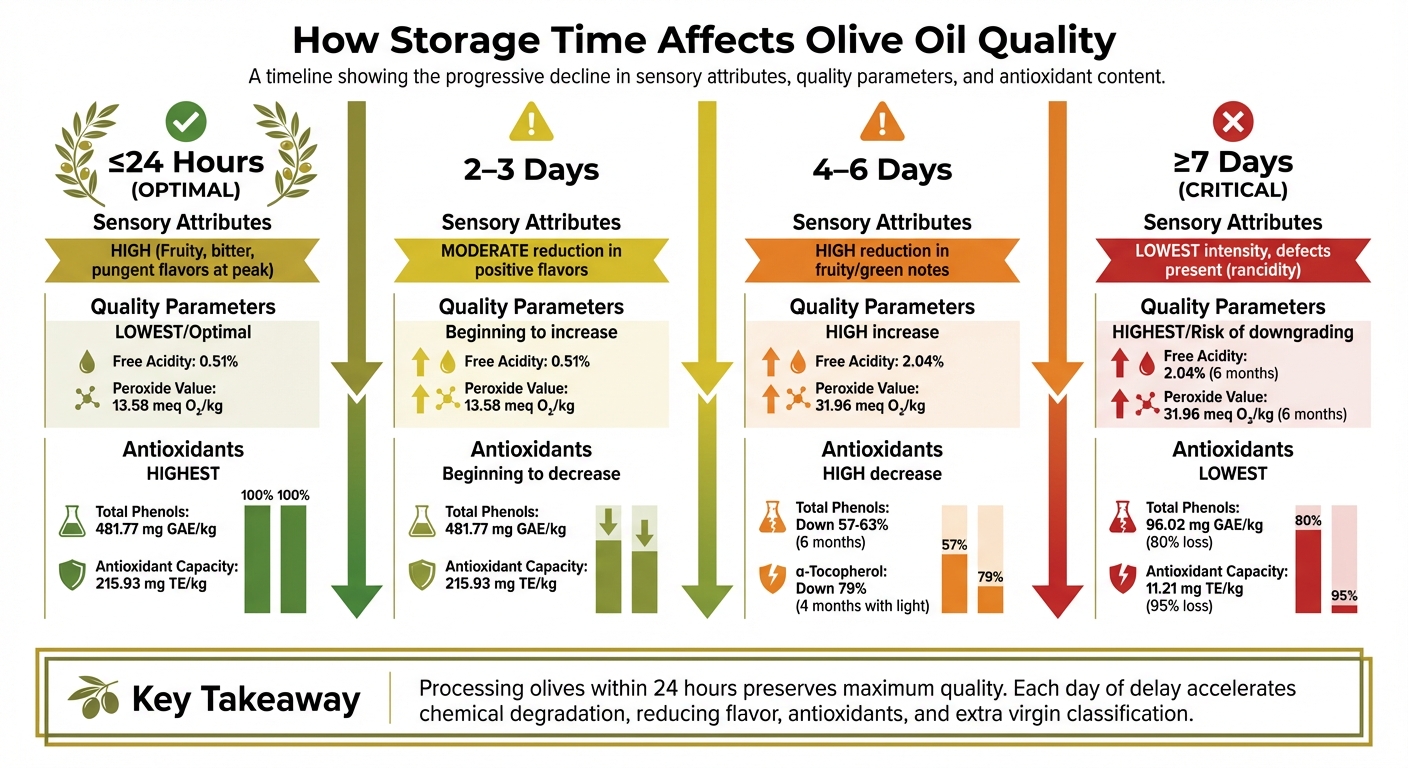
Chemical Degradation of Olive Oil During Storage: Key Quality Metrics Over Time
The chemical changes that occur during olive storage don’t just stay in the lab - they translate directly into noticeable shifts in flavor and measurable quality changes in the final oil. These changes, including oxidation and hydrolysis, impact both the sensory experience and the lab-tested parameters of the oil.
Storage Time and Flavor Changes
Between 2018 and 2021, Annalisa Rotondi and her team at the Institute for BioEconomy studied 228 batches of olives from seven industrial mills over three harvest seasons. Their findings revealed a clear trend: the longer olives were stored, the more their fruity and green flavors diminished, while undesirable defects became more pronounced. For instance, olives stored for over seven days showed a significant drop in positive sensory attributes compared to those processed within 24 hours.
"The main positive sensory attributes (olive fruity, green notes, bitter and pungency) underwent a statistically significant reduction with the increase in storage duration, while the intensity of defects increased."
– Annalisa Rotondi, Institute for BioEconomy
Another study in 2025 by Rosalba Tucci and her colleagues at the University of Bologna tracked the quality of monovarietal extra virgin olive oils over a 12-month period. One sample was downgraded from extra virgin to virgin due to a rancid defect. This defect was linked to a sharp increase in (E)-2-heptenal, an oxidation marker that exceeded its odor threshold by twenty times, directly correlating with noticeable flavor deterioration.
"The targeted SPME-GC–MS method showed an increase in volatile markers of lipid oxidation... in particular the (E)-2-heptenal reached a concentration twenty times higher than its odor threshold."
– Rosalba Tucci, University of Bologna
These flavor shifts align with measurable changes in key quality indicators, as outlined below.
Quality Parameter Changes Over Time
The decline in quality is also evident in laboratory measurements. As storage time increases, parameters such as free acidity, peroxide values, and K232 (a marker of primary oxidation) steadily rise. Meanwhile, beneficial compounds like total phenols, α-tocopherol (Vitamin E), lutein, and β-carotene decrease - further contributing to the oil's sensory and nutritional decline.
Table: Quality measurements reflecting flavor and chemical changes over storage time.
| Storage Duration | Sensory Attributes (Fruity, Bitter, Pungent) | Quality Parameters (Acidity, Peroxide Value) | Phenolic & Antioxidant Content |
|---|---|---|---|
| ≤24 Hours | High intensity maintained | Lowest levels (Optimal) | Highest levels |
| 2–3 Days | Moderate reduction | Increase | Decrease |
| 4–6 Days | High reduction | High increase | High decrease |
| ≥7 Days | Lowest intensity; defects present | Highest levels (Risk of downgrading) | Lowest levels |
Interestingly, while the fatty acid composition remains relatively stable, the loss of minor components, such as antioxidants, reduces the oil’s nutritional benefits and weakens its resistance to further degradation.
Methods for Preserving Olive Quality
Preserving the quality of olive oil requires swift action right after harvest. The chemical changes that occur in olives don’t wait, so every decision made post-harvest plays a crucial role in maintaining oil quality.
Storage Best Practices
Time is the biggest factor in olive oil degradation, even more so than temperature or light exposure. The longer olives are stored, the more their quality declines. For example, over six months of storage, free fatty acid levels can jump from 0.51% to 2.04%, while total phenolic content - key to the oil's health benefits - can drop by around 80%. Antioxidant capacity also takes a massive hit, decreasing by nearly 95%, from 215.93 mg TE/kg to just 11.21 mg TE/kg.
Although speed is the priority, maintaining stable temperatures and reducing light exposure can also help slow down the loss of beneficial compounds. Peroxide values, which signal primary oxidation, can more than double during prolonged storage, increasing from 13.58 to 31.96 meq O₂/kg.
These storage practices set the stage for the next crucial step: rapid processing.
Why Quick Processing Matters
Quick processing is just as important as proper storage. Delays between harvest and milling can lead to significant quality losses. Each passing day increases hydrolysis, promotes peroxide formation, and accelerates the decline of phenolic compounds. To retain the fruity, green, bitter, and pungent flavors that define high-grade extra virgin olive oil, speed is everything.
For both producers and consumers, choosing oils made from olives processed immediately after harvest is key. Companies like Big Horn Olive Oil emphasize freshness by sourcing Ultra Premium Extra Virgin Olive Oils from producers who understand that quality starts in the grove, not in the bottle.
Conclusion
The chemistry behind olive oil storage plays a critical role in determining its quality. From the moment olives are harvested, factors like temperature, time, and light exposure begin to influence whether the oil retains its extra virgin status or deteriorates into a lower grade.
Proper storage conditions are just as important as the initial processing. Keeping olive oil at or below 73°F (23°C) and away from light helps preserve its phenolic compounds, which are responsible for its antioxidant properties and flavor. On the other hand, storage at 86°F (30°C) or higher speeds up the formation of elenolic acid and other oxidized compounds, pushing the oil toward rancidity. Even within its typical 24-month shelf life, poor storage can significantly degrade the oil’s flavor and chemical stability.
As highlighted earlier, fast and efficient processing right after harvest is key to retaining the antioxidants and volatile compounds that make premium olive oil so distinctive. Once processed, proper storage ensures the oil’s unique chemical makeup and quality remain intact - something that cannot be replicated in oils stored under suboptimal conditions.
Big Horn Olive Oil tackles these challenges by sourcing Ultra Premium Extra Virgin Olive Oils that are cold-pressed within two hours of harvest and delivered fresh within three months. This dedication to rapid processing and careful handling ensures the oils retain their full antioxidant content, rich flavor, and health-enhancing properties.
Scientific studies back this up: freshness has a direct impact on oil quality. That’s why immediate processing and ideal storage conditions are non-negotiable for preserving both the flavor and health benefits of extra virgin olive oil.
FAQs
How soon should olives be milled after harvest?
Olives need to be milled within 24 hours of harvest to preserve their chemical properties and flavor. Waiting too long can lead to higher acidity and peroxide levels, while also reducing phenolic compounds. This impacts the oil's stability, taste, and potential health benefits.
What are the first signs that stored olives are harming oil quality?
The first indicators that stored olives are affecting oil quality include higher free acidity, increased peroxide values, and elevated K232 levels. Additionally, there's a drop in phenolic content, which can harm the oil's stability, taste, and nutritional properties.
Which olive varieties stay stable longest during storage?
Olive types that boast medium to high levels of secoiridoids and well-balanced phenolic profiles - often found in specific monovarietal oils - tend to hold up better during storage. These characteristics play a key role in maintaining the oil's flavor and its health-promoting qualities over time.