

How Climate Affects Olive Oil Quality
The quality of olive oil heavily depends on climate factors like temperature, rainfall, and humidity. These elements influence how olive trees grow, the composition of their oil, and its flavor and shelf life. Here's a quick breakdown:
- Temperature: Warmer climates can lower oleic acid levels, making oil less stable and prone to spoilage. Cooler climates produce oils with higher oleic acid, improving stability and flavor.
- Rainfall: Too little water reduces yield and increases acidity, while moderate stress can boost antioxidants. Excessive rain, however, can dilute quality.
- Humidity: High humidity fosters pests and diseases, harming oil quality. Balanced moisture is critical for healthy growth.
Regional climate differences also shape olive oil profiles, with cooler areas producing more stable, robust oils and warmer regions yielding fruity but less durable oils. Choosing the right olive cultivar for specific climates is key to maintaining oil quality.
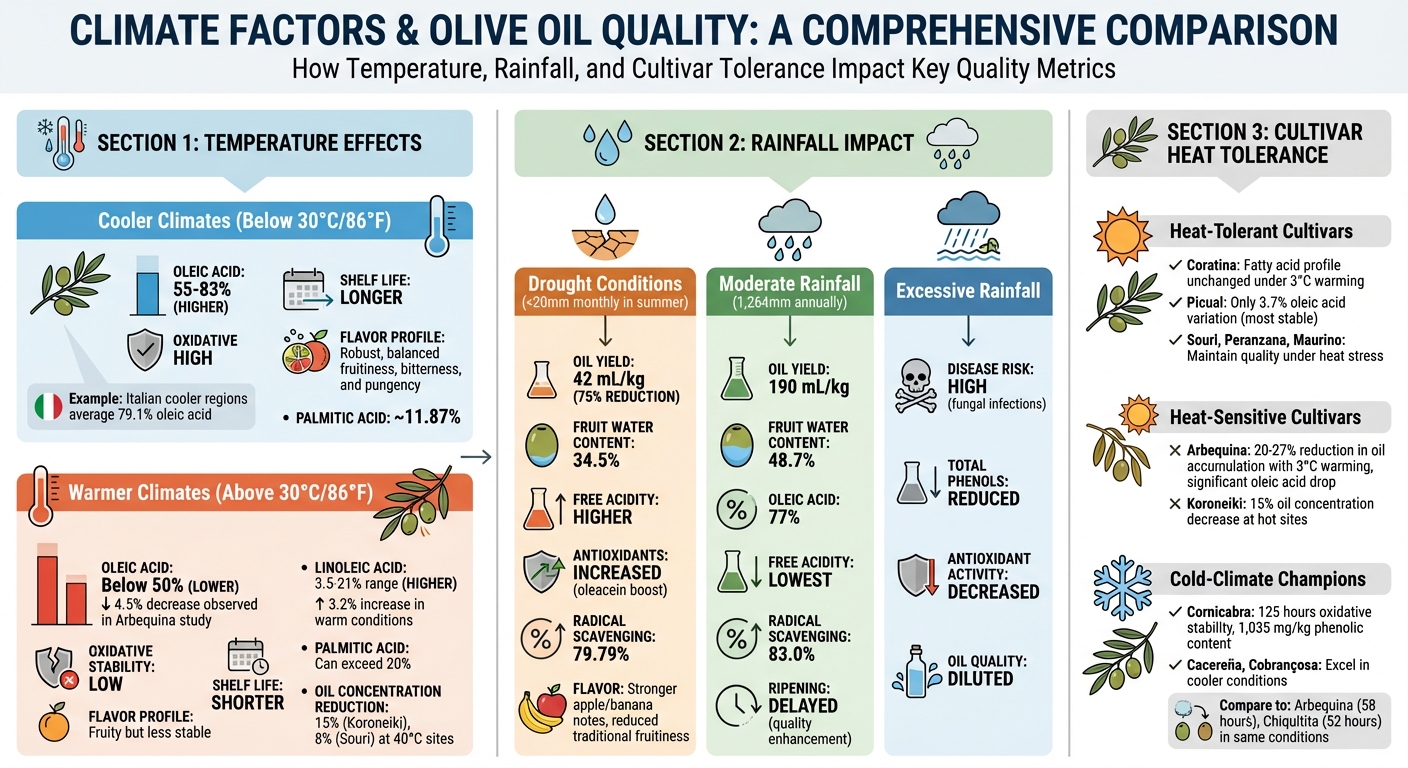
How Climate Factors Affect Olive Oil Quality and Composition
How Temperature Affects Olive Oil Composition and Flavor
The temperature during the growing season plays a key role in shaping the fatty acid profile of olive oil. This profile, particularly the ratio of oleic acid (a monounsaturated fat) to other fatty acids like linoleic and palmitic, affects not only the oil's nutritional benefits but also its shelf life.
Effects of High Temperatures
When temperatures rise above 86°F (30°C) during the critical stages of fruit development and oil accumulation, oleic acid levels drop noticeably. High heat disrupts the enzymes responsible for oleic acid production, leading to changes in the oil's composition.
For example, a 2014–2015 study revealed that 'Arbequina' trees subjected to a temperature increase of 2.7–3.6°C experienced a 4.5% decrease in oleic acid and a 3.2% increase in linoleic acid. This shift compromises the oil's oxidative stability, making it more prone to spoilage.
Interestingly, different olive cultivars respond differently to heat. Research from 2016–2017 compared five olive varieties grown in two Israeli locations: Tirat Zvi, where temperatures often exceeded 104°F (40°C), and the cooler Tzuba. Results showed that 'Koroneiki' and 'Souri' oils saw decreases in oil concentration by 15% and 8% respectively at the hotter site. However, 'Barnea' and 'Coratina' managed to maintain relatively stable oil concentrations under the same conditions.
Cooler climates, on the other hand, create a contrasting fatty acid profile.
Impact of Cooler Temperatures
Cooler conditions promote oils with higher oleic acid levels and improved oxidative stability. These temperatures slow down fruit ripening, allowing oleic acid to accumulate while limiting the presence of linoleic and palmitic acids. The result is an oil that resists rancidity and retains its flavor for longer periods.
Oils from Tunisian and Turkish cultivars grown in cool climates contained higher oleic acid and total phenols compared to oils produced in warm climate areas. - Rocco Mafrica et al., University Mediterranea of Reggio Calabria
However, cooler climates come with a trade-off: a longer growing season. While this extended timeline can enhance flavor development, it requires more patience. Oils produced in cooler regions typically have oleic acid levels ranging from 55% to 83%, whereas warmer climates tend to push linoleic acid levels toward the higher end of the 3.5–21% range.
Rainfall and Humidity: Key Factors in Olive Development
Rainfall plays a crucial role in shaping olive growth, especially during critical periods like flowering and fruit maturation. The amount of water olives receive during these stages directly impacts both the quantity and quality of oil a grove can produce.
Rainfall Requirements for Healthy Olive Growth
During the summer maturation phase, sufficient rainfall is essential for maintaining the fruit's water content and enabling oil accumulation. For example, in October 2017, a study of 30-year-old Cobrançosa olive trees in Suçães-Mirandela, Northern Portugal, highlighted the effects of drought. With less than 20 mm of monthly rainfall from June to September, trees without access to groundwater produced just 42 mL of oil per kilogram of fruit. This was over a 75% drop compared to the 190 mL/kg yield from well-watered trees.
The drought-stressed fruits also showed a significant decrease in water content, dropping to 34.5% compared to 48.7% in hydrated fruits. This lack of water not only reduced the overall yield but also altered the chemical makeup of the oil. While drought conditions increased certain bioactive compounds like oleacein, they also reduced radical scavenging activity (from 83.0% to 79.79%) and lowered levels of luteolin and oleuropein aglycon.
Interestingly, higher rainfall combined with cooler temperatures can slow fruit growth and delay ripening, which may enhance oil quality. Research on the Carolea cultivar in Calabria, Italy, between 2013 and 2015, demonstrated this. At Site C, where annual rainfall reached 1,264 mm (49.8 inches), the oil contained 77% oleic acid and had the lowest free acidity. In contrast, Site A, with only 828 mm (32.6 inches) of annual rainfall and just 20 mm (0.8 inches) during summer, experienced earlier fruit ripening and higher fruit drop.
Risks of Low or Excess Humidity
Humidity levels also play a critical role in olive production, and both extremes - too low or too high - pose challenges. Low humidity, combined with water stress during flowering, can reduce pollination success, leading to fewer fruits. Additionally, drought-stressed olives tend to produce oils with stronger "apple" and "banana" notes but lose the traditional "fruitiness", "bitterness", and "pungency" associated with well-hydrated olives.
"Climate stress events can reduce oil yield but stimulate the accumulation of bioactive compounds that improve oil quality and nutritional value."
– Maria Celeste Dias, Associate Laboratory TERRA
On the other hand, excessive humidity introduces its own set of problems. High moisture levels, particularly in coastal regions, increase the risk of leaf fungal infections. To combat this, growers in humid areas often thin branches to improve airflow and minimize disease risk. Moreover, erratic or heavy rainfall can harm oil quality by reducing total phenol content and antioxidant activity. Striking a balance is essential - too little water can devastate yields, while too much can lead to disease and diminish the oil's healthful properties. Proper drainage and moisture management are key to maintaining both healthy trees and high-quality oil.
Regional Climate Variations and Their Impact on Olive Oil Profiles
The Mediterranean basin spans a range of climates, each contributing to olive oil's distinct characteristics. Beyond temperature and humidity, regional climates shape the unique profiles of specific cultivars. Seasonal temperature shifts, for instance, can affect the oil's fatty acid composition, influencing both its flavor and shelf life. These regional differences complement earlier discussions on how temperature, rainfall, and humidity play a role in refining olive oil qualities.
Cooler Climates: Balanced and Stable Olive Oils
In cooler regions, olive oils often exhibit higher monounsaturated fat levels, particularly oleic acid. Cooler conditions significantly boost oleic acid content, as highlighted by a three-year study of the Carolea cultivar in Calabria, Italy. Oils from high-altitude, cooler sites reached 77.11% oleic acid, compared to 73.40% from the warmest coastal areas. This elevated oleic acid content enhances oxidative stability, helping oils stay fresh longer.
"Lower temperatures and higher rainfall slow down fruit growth and development and delay ripening."
– Rocco Mafrica et al., University Mediterranea of Reggio Calabria
Research across Mediterranean regions supports these findings, with cooler Italian climates producing average oleic acid levels of about 79.1%. Additionally, these regions tend to have lower palmitic acid levels - around 11.87%, compared to 14.21% in warmer areas. Slower ripening in such environments preserves aromatic compounds, pigments, and phenols, resulting in a flavor profile that balances fruitiness, bitterness, and pungency. This harmony is a hallmark of high-quality extra virgin olive oil.
While cooler climates promote stability and balanced flavors, warmer regions create oils with different characteristics.
Warmer Climates: Fruity but Less Stable Oils
In warmer climates, the fatty acid composition shifts notably. A study in La Rioja, Argentina, examined Arbequina and Coratina olive trees grown in open-top chambers warmed by about 3°C (5.4°F) above ambient temperatures. The findings revealed a 20% to 27% reduction in oil accumulation rates and significant changes in fatty acid composition.
Higher temperatures increase polyunsaturated fats, like linoleic acid, and saturated fats, such as palmitic acid, reducing the oil's stability. Oils from these regions may develop appealing fruity characteristics but become more prone to oxidation. In extreme heat or arid conditions, palmitic acid levels can exceed 20%, while oleic acid may drop below 50%, accelerating deterioration. This makes oils from warmer areas flavorful but less durable over time.
sbb-itb-4066b8e
Cultivar Selection and Climate Adaptability
Olive cultivars respond differently to climate conditions. Some maintain oil quality despite temperature fluctuations, while others are more sensitive, leading to rapid changes. This variability, referred to as phenotypic plasticity, determines whether an olive oil remains stable and flavorful or deteriorates quickly under stress.
Heat-Tolerant vs. Sensitive Cultivars
When it comes to heat resistance, Coratina shines. Between 2014 and 2016, researchers in La Rioja, Argentina, exposed young Coratina and Arbequina trees to experimental warming of about 5.4°F (3°C) above normal temperatures. While oil accumulation decreased in both, Coratina’s fatty acid profile remained unchanged. In contrast, Arbequina saw a noticeable drop in oleic acid and a rise in linoleic acid, reducing its oil stability.
Other cultivars like Picual and Koroneiki also show impressive stability. A 2019 study evaluating 113 cultivars across Italy, Spain, Morocco, Lebanon, and Argentina revealed that Picual had only a 3.7% variation in oleic acid content across different environments - the most stable performance among all tested varieties. Additionally, cultivars such as Souri, Peranzana, and Maurino maintain excellent oil quality even under heat stress.
For regions with cooler climates, cultivars like Cornicabra, Cacereña, and Cobrançosa excel. In cold-weather hedgerow systems in central Spain, Cornicabra produced oils with oxidative stability of 125 hours and a phenolic content of 1,035 mg/kg - far outperforming heat-adapted varieties like Arbequina (58 hours) and Chiquitita (52 hours) under the same conditions.
These findings highlight how critical it is to match olive cultivars to their specific climate conditions.
Selecting High-Quality EVOO for Flavor and Health
Producers carefully choose cultivars suited to their region to ensure high-quality olive oil. Heat-tolerant varieties like Coratina and Picual deliver high oleic acid content (often between 75% and 80%), which enhances shelf life and provides heart-health benefits. Meanwhile, cold-climate cultivars like Cornicabra produce oils rich in phenolic compounds, offering strong antioxidant properties and complex flavors.
Big Horn Olive Oil sources its Ultra Premium Extra Virgin Olive Oils from regions where climate and cultivar are perfectly aligned. These oils adhere to strict international freshness and quality standards, ensuring excellent stability, rich flavor, and health benefits. When selecting EVOO, check for harvest dates, phenolic content, and cultivar details. These indicators confirm whether the oil comes from well-matched climate-cultivar pairings, which are key to achieving exceptional quality, flavor, and health advantages.
Conclusion
Climate plays a crucial role in defining olive oil's quality, influencing everything from its fatty acid composition to its antioxidant levels and flavor. For example, temperature determines whether an oil is rich in oleic acid, which enhances stability, or has lower levels, making it prone to oxidation. Rainfall and humidity also impact both the oil's yield and its concentration of health-boosting compounds.
"Virgin olive oil composition is greatly influenced by climatic conditions. In a limited area, small differences in maximum and minimum temperatures could be the cause of significant differences in fatty acid profile." - Maria Paz Romero and Maria José Motilva, Researchers
These factors can guide your decisions when buying olive oil. Look for labels that include harvest dates and details about the cultivar. Oils harvested early in cooler regions often have higher phenolic content - sometimes exceeding 1,000 mg/kg in varieties like Cornicabra - and offer bold, peppery flavors. On the other hand, oils from warmer climates or later harvests may have milder flavors but shorter shelf lives. Oils with higher oleic acid content are ideal for both longevity and health benefits.
To maintain the quality, flavor, and nutritional value of extra virgin olive oil, proper storage is essential. Keep it at around 41°F (5°C) and away from light. Studies show that storing olive oil at 68°F (20°C) can increase acidity by 177% in just 20 days.
FAQs
How does the climate affect the quality and shelf life of olive oil?
Climate has a big impact on the quality and shelf life of olive oil. When temperatures climb too high or humidity lingers, oxidation speeds up. This process chips away at the oil’s freshness and stability, leaving it with higher acidity and fewer beneficial compounds, like polyphenols. Over time, this can cut its shelf life short.
To keep olive oil at its best, proper storage is key. Aim for a cool, dark spot - somewhere between 57°F and 70°F - and keep it away from direct sunlight and heat. At Big Horn Olive Oil, we take great care in crafting our Ultra Premium Extra Virgin Olive Oils to lock in their freshness. That way, you get to savor their bold flavors and health perks for as long as possible.
How does temperature impact different types of olive trees and their oil quality?
Temperature is a major factor in how different olive cultivars grow and develop, shaping the quality and flavor of the olive oil they yield. Each cultivar has its own genetic traits that determine how it reacts to conditions like heat or cold. These reactions influence the fatty acid composition, ripening process, and the oil’s flavor profile.
For example, some cultivars flourish in warmer climates, creating oils with bold, robust flavors. On the other hand, others perform better in cooler environments, producing oils with lighter, more delicate notes. Recognizing these distinctions is essential for crafting top-tier olive oil. Take Ultra Premium Extra Virgin Olive Oils from Big Horn Olive Oil, for instance - they carefully match climate and cultivar to deliver exceptional freshness and taste.
How should I store olive oil to keep it fresh and flavorful?
To keep your olive oil tasting its best, store it in a cool, dark, and dry place - somewhere between 50°F and 70°F. Heat, light, and air are the enemies of olive oil, so steer clear of stashing it near stoves, windows, or other heat sources that can compromise its quality.
Choose airtight, dark-colored containers like tinted glass, stainless steel, or ceramic to shield the oil from light and oxygen. Avoid clear glass or plastic containers, as they allow exposure that speeds up spoilage. While refrigeration can help extend the oil's shelf life, it might cause the oil to cloud or solidify. Don’t worry - its clarity and flavor will return once it warms back up to room temperature.
For peak freshness and flavor, aim to use opened olive oil within a month. Storing it properly ensures it stays as delicious and high-quality as when you first opened the bottle.