

Cold-Pressed Olive Oil: Certification Explained
“Cold-pressed” alone does not mean top-grade olive oil. If you want a bottle that meets extra virgin rules, I’d check three things right away: extraction below 80.6°F (27°C), third-party testing, and a harvest or crush date.
Here’s the short version:
- Cold-pressed describes how the oil was made
- Extra virgin describes the oil’s grade
- A bottle can be cold-pressed and still fail extra virgin standards
- In the U.S., “cold-pressed” is not checked the same way it is under tighter systems
- Third-party seals and lab reports help show whether the label matches the oil
One stat says a lot: a UC Davis Olive Center study found that 69% of imported oils labeled “extra virgin” in California stores failed IOC sensory standards. So if I’m buying olive oil, I don’t stop at the front label.
Here’s what I’d look for before I buy:
- Free acidity: 0.8% or less for extra virgin
- Peroxide value: 20 meq O₂/kg or less
- Sensory panel: no defects, with some fruitiness
- Cold extraction limit: under 80.6°F
- Proof: third-party seal or lab report
| What it says | What it means |
|---|---|
| Cold-pressed / cold-extracted | Made mechanically at under 80.6°F (27°C) |
| Extra virgin | Passed chemical and sensory tests |
| First cold pressing | Older term tied to press methods; now mostly historic |
| Third-party certified | Checked by outside labs and tasting panels |
So the main point is simple: don’t treat “cold-pressed” as proof of grade. I’d treat it as one part of the story, then look for test results, dates, and outside checks.
How to Choose REAL Extra Virgin Olive Oil: A Practical Guide
sbb-itb-4066b8e
Cold-Pressed vs. Extra Virgin Olive Oil
These terms don’t mean the same thing.
Extra virgin olive oil (EVOO) is a grade. It means the oil met set chemical and sensory standards. Cold-pressed or cold-extracted describes a process. It tells you how the oil was produced. So yes, an oil can be cold-pressed and still not qualify as extra virgin if it fails those tests.
That difference matters. Certification applies to the oil’s grade, not just the way it was extracted.
Cold Pressing, Cold Extraction, and First Cold Pressing Defined
First cold pressing is the older method. Olives are crushed into a paste, then pressed with hydraulic presses using mats or plates. If that paste stays below 27°C (80.6°F), the oil may be labeled “first cold pressing” under EU rules.
These days, that wording is mostly historical.
Cold extraction is the modern method used by most high-end producers. The olive paste is mixed in a temperature-controlled chamber, then the oil is separated by centrifugation or percolation. No solvents are used, and the paste still has to stay below 27°C. This setup gives producers tighter control over temperature, oxygen, and cleanliness.
Why the 27°C (80.6°F) Temperature Limit Matters
That 27°C limit helps protect aroma and overall quality during extraction. Push the heat too high, and the oil can lose aroma, shed polyphenols, and become less stable against oxidation.
When extraction stays cooler, the oil often starts out with lower peroxide values, more antioxidants, and a longer window of fresh flavor - often 18 to 24 months if stored the right way. In plain English: lower temperatures help hold onto the traits that grading systems are checking for.
| Aspect | Cold-Pressed / Cold-Extracted EVOO | Higher-Heat Extraction Olive Oil |
|---|---|---|
| Process | Mechanical only - crushing, malaxation, and separation; no solvents. | Mechanical processing that favors yield over sensory quality. |
| Temperature | Paste kept below about 27°C (80.6°F) during extraction. | Paste may exceed 27°C to increase flow and yield. |
These are the main differences buyers should expect. That’s why EU and IOC rules treat temperature, method, and quality testing as separate checks.
The Standards Behind the Label
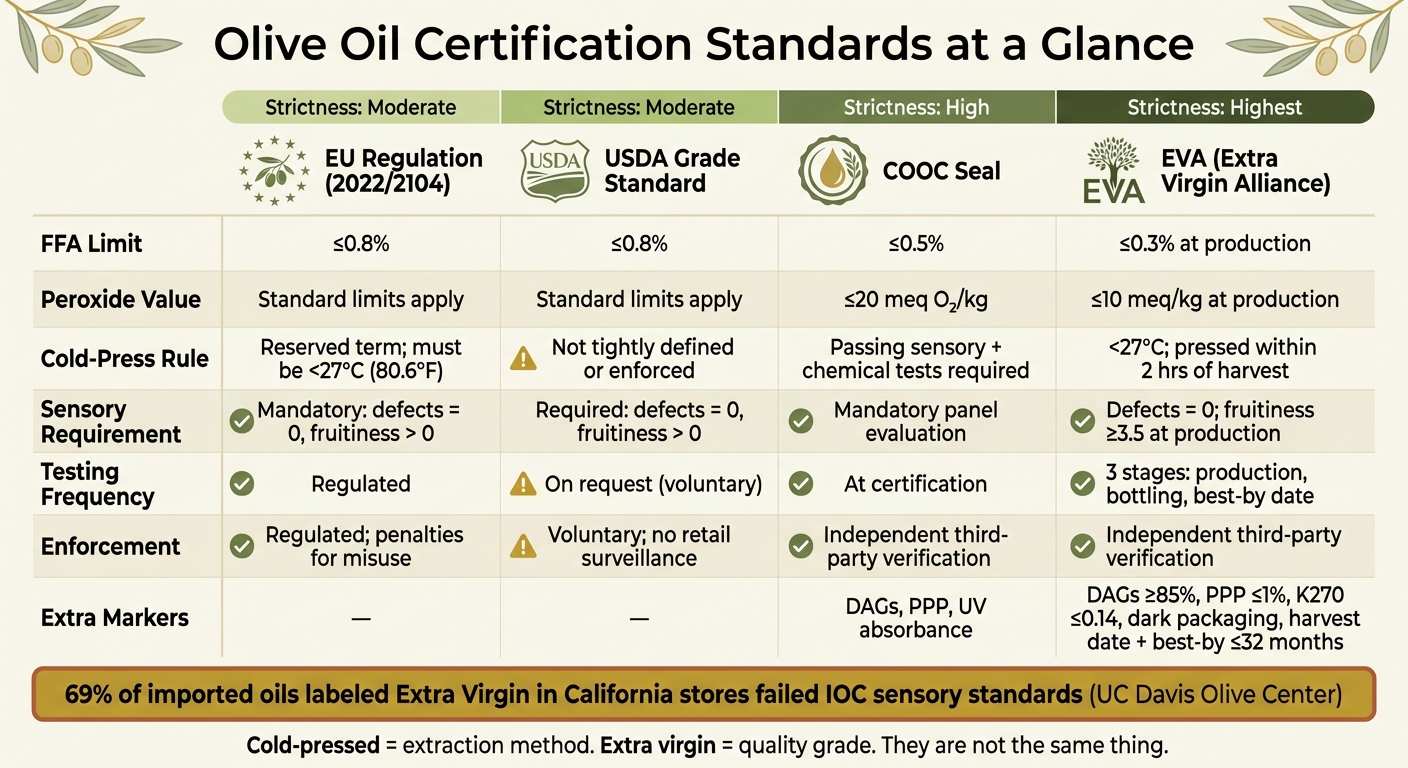
Olive Oil Certification Standards Compared: EU vs USDA vs COOC vs EVA
Not every bottle labeled "cold-pressed" or "extra virgin" plays by the same set of rules. The standards depend on where the oil is sold and who is checking those claims.
EU and IOC Rules as the Main Reference Points
This is where certification starts to matter. It turns the 27°C rule and label language into standards that can actually be checked.
The International Olive Council (IOC) sets widely used benchmarks for extra virgin olive oil. To qualify, an oil must have:
- Free acidity at or below 0.8%
- Specific limits for peroxide value and UV absorbance (K232, K270, and ΔK)
- A passing sensory result, with a median defect score of 0.0 and median fruitiness above 0.0
In the EU, the terms "first cold pressing" and "cold extraction" are reserved for virgin or extra virgin oils made below 27°C (80.6°F). If a producer misuses those terms, penalties can follow.
How US Labeling Differs from Stricter Certification Systems
The U.S. takes a looser approach.
The USDA grade standard for "U.S. Extra Virgin Olive Oil" uses similar limits: free fatty acids at or below 0.8%, median defects of zero, and median fruitiness above zero. But there's a catch: compliance is voluntary, and there is no required retail surveillance.
That leaves more room for fuzzy labeling. On U.S. shelves, "cold-pressed" often works more like marketing language than a tightly checked claim. Put simply, the same standards are not enforced as consistently in the U.S.
That gap helps explain why third-party seals carry more weight in the U.S. market. They give buyers one more way to check whether the bottle matches the label.
For example, the California Olive Oil Council Seal of Approval requires acidity at or below 0.5%, peroxide at or below 20 meq O₂/kg, and a passing sensory test. The North American Olive Oil Association (NAOOA) Certified Quality Seal is another program shoppers may see.
| Standard | Cold-Press Rules | Extra Virgin Chemical Limits | Sensory Requirement | Enforcement |
|---|---|---|---|---|
| EU (Reg. 2022/2104) | "First cold pressing" and "cold extraction" are reserved terms; oils must be produced below 27°C (80.6°F). | Free acidity ≤ 0.8%; peroxide and UV limits apply. | Mandatory; median defects = 0, fruitiness > 0. | Regulated; misuse can trigger penalties. |
| USDA Grade Standard | "Cold-pressed" is not tightly defined or consistently enforced. | Free fatty acids ≤ 0.8%; other parameters follow similar quality limits. | Required for grade; median defects = 0, fruitiness > 0. | Voluntary; no mandatory retail surveillance. |
| COOC Seal | Requires passing sensory and chemical tests. | Free acidity ≤ 0.5%; peroxide value ≤ 20 meq O₂/kg. | Mandatory panel evaluation. | Independent third-party verification. |
Certification Programs and Quality Checks
Common Certification Programs and What They Test
Once the rules are set, certification programs show how those rules play out in practice.
The USDA "U.S. Extra Virgin Olive Oil" grade uses limits similar to IOC standards. It’s voluntary, but producers have to request USDA review if they want to use the label. After enrollment, oils must meet free fatty acid (FFA) ≤0.8%, a median defects score of zero, and fruitiness above zero.
The NAOOA Certified Quality Seal takes a tighter FFA line. It tests member brands at least twice per year and uses an FFA threshold of ≤0.5%.
The Extra Virgin Alliance (EVA) looks at shelf life, not just a single snapshot. Instead of checking oil once and calling it done, EVA tests at production, at bottling, and again at the best-by date to make sure the oil still holds up over time. It also requires dark or opaque packaging that blocks light, a harvest year on the label, and a best-by date no more than 32 months from harvest.
| Program | FFA Limit | Sensory Requirement | Key Extras | Testing Frequency |
|---|---|---|---|---|
| USDA U.S. Extra Virgin Olive Oil | ≤0.8% | Median defects = 0; fruitiness >0 | USDA inspection required to use label | On request |
| COOC Seal | Extra virgin limit | Mandatory COOC panel evaluation | DAGs, PPP, peroxide, UV, impurities | As part of certification |
| NAOOA Certified Quality Seal | ≤0.5% | Sensory testing for EVOO | Ongoing market surveillance | At least 2× per year |
| EVA | ≤0.3% at production | Defects = 0; fruitiness ≥3.5 at production | 3-stage testing, single-harvest origin, dark/opaque packaging, harvest/best-by labeling | Production, bottling, best-by |
Each program combines lab work with sensory panel review. That matters because numbers alone don’t tell the whole story, and taste alone doesn’t either. The real test is whether the oil keeps meeting the mark from harvest through bottling.
From Harvest to Bottle: Quality Checks at Each Stage
These program rules only work if quality is checked at each step.
It starts at harvest. Olives picked at the right maturity index and milled soon after harvest usually show lower FFA and stronger DAG results. DAGs are a freshness signal: a score of 85% or higher at production points to very fresh oil, while values below 35% fall out of range. PPP moves in the other direction as oil gets older. A reading of 1% or less at production points to very little degradation.
During extraction, lower temperatures and less oxygen exposure help protect polyphenols and keep peroxide value under control. EVA sets a production limit of 10 meq/kg or less.
Packaging matters too. Dark or opaque bottles slow down light damage, which can show up in UV absorbance readings like K270. EVA allows K270 to move from ≤0.14 at production to ≤0.21 by the best-by date.
| Metric | What It Measures | Target Range (Production) | Out of Range |
|---|---|---|---|
| Free Acidity (FFA) | Cell damage, fermentation | ≤0.3% (EVA) / <0.5% (USDA commodity) | >0.8% |
| Peroxide Value (PV) | Early oxidation | ≤10 meq/kg (EVA) | Above the applicable limit |
| K270 (UV absorbance) | Secondary oxidation compounds | ≤0.14 (EVA) / ≤0.22 (USDA) | Above the applicable limit |
| K232 (UV absorbance) | Primary oxidation products | ≤1.9 (EVA) / <2.4 (USDA) | Above the applicable limit |
| DAGs | Freshness and authenticity | ≥85% at production | <35% |
| PPP | Age-related degradation | ≤1% at production | >17% |
| Polyphenols | Antioxidant content, flavor | Higher supports freshness and flavor | Low values can signal heat or age damage |
A COA with these metrics gives a fuller picture of oil quality. This is the kind of testing premium producers build into sourcing and bottling, because quality doesn’t hinge on one label claim or one lab result. It shows up across the whole chain.
How Big Horn Olive Oil Applies These Standards
Ultra Premium Standards and Rapid Cold Pressing at Big Horn Olive Oil
Big Horn Olive Oil gives a clear example of how these rules play out at the producer level.
Big Horn labels its oils Ultra Premium (UP). Under that program, the oil must be 100% olive, mechanically extracted, traceable by cultivar, and cold-pressed within 2 hours of harvest at under 27°C (80.6°F). The goal is simple: limit oxidation and protect flavor. For example, Big Horn's Estate Reserve Ultra Premium EVOO has an FFA of 0.21% and a peroxide value of 3.70 meq O₂/kg.
Each batch goes through testing by independent third-party labs across 25+ parameters. That includes FFA, peroxide value, DAGs, PPP, and UV absorbance values such as K232, K270, and ΔK. Big Horn also limits its oils to 14 months from the harvest or crush date to stay in the program.
For buyers, this kind of record is what matters most. It’s the clearest way to check that the bottle lines up with the label.
Conclusion: What to Look for in Certified Cold-Pressed Olive Oil
When you're checking a bottle, look past the front label. The details that matter are the harvest or crush date, temperature-control information, and third-party lab results. If a producer can’t share that, the label doesn’t tell you much.
- Harvest or crush date - confirms freshness and helps you check that the oil is still within its quality window
- Third-party lab report - shows FFA, peroxide value, DAGs, PPP, and UV absorbance results from an independent source
- Extraction temperature and time - shows the oil was cold-pressed at under 27°C (80.6°F) and processed soon after harvest
FAQs
How can I verify an olive oil is truly extra virgin?
Look for a recognized certification seal, such as COOC or an IOC-aligned program. Then check that the oil passed both chemical testing and blind sensory evaluation.
A few label checks matter most:
- Free acidity of 0.8% or less
- Required peroxide and UV limits
- No detectable defects
- Measurable fruitiness
- Harvest/crush dates and traceability on the label
That’s the basic filter. If an oil clears those marks, you’re not just taking the label at face value - you’ve got signs that the producer backed it up.
Does cold-pressed always mean higher quality?
No. In the United States, cold-pressed is a common marketing term, but it doesn’t automatically mean higher quality because it isn’t tightly regulated.
What matters more is proof. True quality is confirmed through chemical testing and sensory evaluation. Big Horn Olive Oil follows verified standards, including extraction below 80.6°F (27°C) and low acidity, which are stronger signs of a premium product.
Which certification seals should I look for?
Look for seals that verify quality, freshness, and where the oil comes from. In the U.S., the COOC seal means the oil is 100% California-grown and has passed chemical and sensory testing.
Other seals can help too. PDO and PGI point to geographic origin and time-tested production methods, while the USDA Organic seal refers to farming practices.