

Common Certification Myths Debunked
Most label claims answer just one question - not all of them. If I see Extra Virgin, USDA Organic, PDO/DOP/IGP, or aged on one bottle, I should read each one separately.
Here’s the short version:
- Extra virgin = olive oil grade, with chemical limits like free acidity at or below 0.8% and no sensory defects
- USDA Organic = rules for how the product was produced and handled
- PDO/DOP/IGP = place of origin and product rules tied to that place
- Harvest date, bottling date, and best-by date = timing, not grade or origin
- Dark glass, reserve, and premium = packaging or marketing terms, not proof by themselves
If I want to judge a bottle well, I ask 3 simple questions:
- What does this claim check?
- Who checked it?
- What proof is on the label?
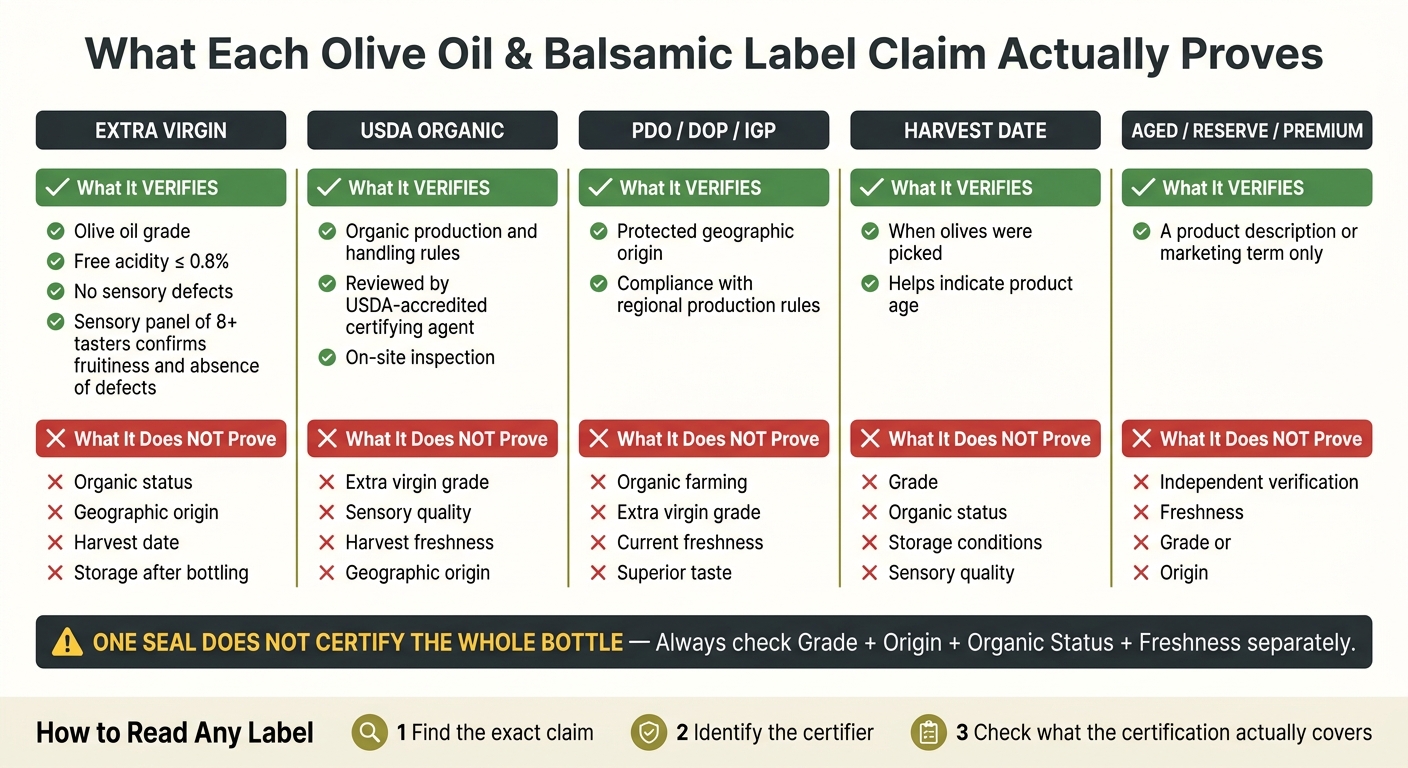
Olive Oil & Balsamic Label Claims: What Each Certification Actually Proves
You've Been Lied To About Olive Oil, But Not the Way You Think.
sbb-itb-4066b8e
Quick Comparison
| Claim or term | What it tells me | What it does not tell me |
|---|---|---|
| Extra Virgin | Olive oil grade | Organic status, origin, or storage after bottling |
| USDA Organic | Organic production and handling rules | Olive oil grade or sensory quality |
| PDO / DOP / IGP | Geographic source and product rules | Grade, product age, or storage |
| Harvest date | When olives were picked | Whether the oil meets extra virgin standards |
| Aged / Reserve / Premium | A product description or sales wording | Independent verification |
The main point is simple: one seal does not certify the whole bottle. I read labels best when I split grade, origin, organic status, product age, and storage into separate checks.
Myth 1: Certified Means High Quality in Every Way
“Certified” sounds comforting. But on its own, it doesn’t tell you much.
A certification only has meaning when you know what standard sits behind it. One label might speak to organic farming. Another might point to origin. Another might deal with grade. None of that, by itself, tells you everything about the oil in the bottle.
That’s the key point: a certification may cover one part of quality without saying anything about flavor, freshness, or how the oil was stored. So certified does not mean high quality in every way.
What Extra Virgin Actually Means
Extra virgin olive oil is a legally defined grade, not a marketing slogan. To qualify, it must meet chemical and sensory standards, including free acidity of no more than 0.8 g/100 g and no sensory defects.
Extra virgin status depends on both chemical analysis and sensory evaluation. A trained sensory panel uses at least eight tasters and checks for fruitiness and the absence of defects.
That matters because a low acidity number, by itself, is not enough. An oil can fall within the acidity limit and still have flavor defects that keep it from qualifying as extra virgin.
So when you see “extra virgin,” read it as a grade claim. Don’t read it as a blanket promise about every part of quality.
Why Separating Label Claims Helps Shoppers
A USDA Organic bottle without harvest data and a non-organic EVOO with a recent harvest date answer different questions. The organic bottle shows compliance with organic production and handling rules. The second may give you clearer proof of grade and fresher timing. Neither label alone proves overall quality.
The better way to shop is to look at grade, origin, organic status, production method, and freshness as separate checks, not one bundled promise.
| Claim | What it verifies | What it does not verify |
|---|---|---|
| Extra virgin | A defined grade with chemical and sensory requirements, including free acidity no more than 0.8 g/100 g | Harvest date, flavor intensity, or storage after bottling |
| USDA Organic | Compliance with organic production and handling rules | Extra virgin grade, sensory quality, or freshness |
| PDO/DOP/IGP | Connection to a specific geographic area | Sensory attributes, freshness, or handling after production |
Read each claim on its own terms. Each one answers a different quality question.
Myth 2: Organic, Extra Virgin, and Origin Seals Mean the Same Thing
Myth 2 picks up right where Myth 1 ends: a bottle can carry more than one valid claim at the same time, but each claim speaks to something different. USDA Organic, extra virgin, DOP, and IGP are not interchangeable. They do not mean the same thing.
USDA Organic Does Not Confirm Extra Virgin Grade
USDA Organic confirms certified organic production and handling, not extra virgin grade. In plain English, that seal tells you how the product was produced and handled. It does not tell you the olive oil grade.
Extra Virgin on the Label Is Not the Same as Independent Certification
When you see extra virgin olive oil on a label, that is a grade statement - a claim made by the producer or bottler. Extra virgin is a separate grade based on chemical and sensory standards. But the words alone are not proof that an outside group checked and confirmed the claim.
That’s why the rest of the label matters. A bottle gives you more to work with when it also includes:
- a harvest date
- a lot number
- origin details
- a recognized certification mark
Still, you need to check what that mark actually covers. One seal may speak to origin. Another may speak to production methods. Another may not address grade at all.
PDO, DOP, and IGP Verify Origin, Not Every Quality Attribute
Origin seals answer a different question: where did this product come from? Protected origin designations - PDO (Protected Designation of Origin), DOP (Denominazione di Origine Protetta, the Italian equivalent), and IGP (Protected Geographical Indication) - confirm that a product comes from a defined geographic area and follows specified production rules. They are not overall quality scores.
This matters a lot with balsamic vinegar. Aceto Balsamico di Modena IGP and Aceto Balsamico Tradizionale di Modena DOP are two separate regulated categories, not two labels for the same product. If a bottle says “aged” or “reserve,” that does not mean it qualifies for PDO/DOP or IGP status unless the full protected name appears on the label.
The same logic applies to olive oil. An origin seal tells you where the product was made and under which protected rules. It does not tell you, by itself, whether the oil is fresh, extra virgin, or organically produced.
Read the full label before treating any one seal as a complete quality claim.
Myth 3: Packaging and Marketing Terms Prove Certification or Freshness
Dark bottles and polished marketing words can help protect a product or sell it. But they do not prove freshness or grade.
A Seal Does Not Guarantee Freshness Over Time
A certification means the product met stated rules when it was tested or inspected. That’s all. Time still moves on, and oxygen, heat, and light still affect the oil. Dark or opaque packaging helps cut light exposure, and less oxygen in the bottle helps slow oxidation. Storing extra virgin olive oil at about 59°F (15°C) preserves quality better than storing it at 77°F (25°C).
You may see four kinds of dates on a label, and each one tells a different story:
| Date type | What it tells you | What it does not tell you |
|---|---|---|
| Harvest date | When the olives were picked | Whether the bottle was stored properly |
| Bottling date | When the oil was packaged | When the olives were harvested |
| Best-by date | The producer's expected quality window | Harvest timing or current quality |
| Certification date | When compliance was assessed | The oil's condition months or years later |
If you want the best clue, start with the harvest date. Before you buy, check the harvest date or at least the best-by date on the bottle.
Freshness is tied to time. So after that, look for a label that gives you an actual production date instead of vague wording.
Dark Glass, Aged, and Reserve Are Not Certified Claims on Their Own
Dark glass does help by cutting light exposure, and that matters. But it does not prove the oil is extra virgin, organically produced, or from a protected origin. A bottle from a recent harvest in less protective packaging can still be fresher than an older bottle that sat around or was stored badly.
Words like "aged", "reserve," and "premium" tell you even less. With olive oil, age usually works against freshness because oxidation slowly strips away the aromas and flavors people want. With balsamic vinegar, "aged" matters only when it appears as part of a regulated product name. Without that extra detail, it’s just marketing.
Once you separate packaging from proof, label reading gets a lot simpler. Look past the sales language and check for:
- product category
- harvest information
- origin
- a named certification body
That mix gives you evidence. A dark bottle labeled "premium reserve" with nothing else doesn’t.
How to Read Certification Claims Correctly
Use that distinction when you're standing in front of the shelf. Read each claim for what it says, not as a full stamp of approval.
What to Check on the Label Before You Buy
Read the label in a simple sequence.
First, find the exact claim. Terms like "USDA Organic", "Extra Virgin", "PDO", "DOP", "IGP," and "harvest date" do not mean the same thing. Each one points to a different part of the product.
Second, look for the certifier's name. If the bottle carries an organic claim, the label should identify the USDA-accredited certifying agent.
Third, check what the certification covers. Is it for this exact product, or does it only apply to the facility, the operation, or a broader product line? That's a key difference. A company may run an organic-certified operation and still sell items that are not organic.
Once you've done those three checks, move on to the details that sit outside the certification itself: harvest date, bottling date, lot number, and best-before date. Then read the ingredient list and take a quick look at the packaging and storage conditions.
The goal is simple: separate proof from marketing.
Comparison Table: What Common Label Claims Verify and What They Do Not
| Label claim | What it verifies | Evidence | What it does not prove |
|---|---|---|---|
| USDA Organic | Compliance with USDA organic production, handling, and labeling rules | USDA-accredited certifying-agent review; organic system records; on-site inspection | Extra virgin grade, harvest freshness, sensory quality, or geographic origin |
| Extra virgin olive oil grade | A quality grade tied to chemical and sensory characteristics | Voluntary USDA grading criteria: free acidity ≤ 0.8%, peroxide value ≤ 20 meq O₂/kg, no sensory defects | Organic status, PDO/IGP origin, harvest date, or continued freshness after bottling |
| PDO / DOP | Protected geographic origin and compliance with regional production rules | Registration and conformity with the designated product specification | Organic farming, current freshness, or superior taste |
| IGP | A protected geographic link meeting the applicable regional specification | Compliance with registered IGP rules and associated verification system | Organic status, extra virgin grade, or freshness at time of purchase |
| Harvest-date information | When the olives were harvested, which helps indicate product age | Producer's stated harvest period; lot and traceability records may support it | Grade, organic production, storage conditions, or sensory quality |
Conclusion: Read Each Claim on Its Own Terms
Certification, grade, origin, organic status, and freshness are five separate questions. That's the part many labels blur together.
A bottle can be USDA Organic without any independent check that it's extra virgin. It can have a PDO mark and still tell you nothing about when the olives were picked. And a harvest date, while helpful, doesn't tell you how the oil was stored after that.
The smartest move is to read the whole label instead of stopping at the biggest logo on the front. If the bottle spells out the grade, certifier, origin, and date, you have something solid to judge.
FAQs
How can I tell if an olive oil label was independently verified?
Look for official certification seals from groups like NAOOA, COOC, IOC, or EU-recognized PDO and PGI marks.
These seals mean the product went through third-party chemical analysis and sensory evaluation. That matters because a nice label can say almost anything, but independent testing adds a layer of trust.
You can also check the packaging for a certification number. If you find one, verify it on the certifying body’s official website.
Which date matters most when buying olive oil?
The harvest date is the date that matters most. A best-by date doesn't tell you much. But the harvest date tells you when the olives were picked, which makes it the clearest sign of freshness and quality.
For the best flavor and health perks, use olive oil within 12 to 18 months of harvest. Big Horn Olive Oil ships its products within 1 to 3 months of harvest and recommends using them within 9 months of the crush date.
Do PDO, DOP, and IGP mean better taste?
Not necessarily. PDO, DOP, and IGP tell you about origin, production rules, and how the product was made. They do not automatically mean it will taste better.
That said, these labels usually point to strict standards and careful workmanship. With balsamic vinegar, DOP also requires at least 12 years of aging. That often leads to a deeper, more layered flavor than blended IGP versions. But taste is still subjective.