

Study: Impact of Digital Tools on Byproduct Use
Digital tools can help olive mills cut waste, lower transport emissions, and get more use from pomace and wastewater. The clearest numbers in the research are a 14.6% drop in transport CO2 and a 30.8% profit increase in one Tunisia model when processing capacity was expanded.
Here’s the plain-English takeaway:
- Sensors help mills see byproduct volume and condition in real time.
- AI and planning models help decide when to harvest, which mill to use, and where waste should go.
- Blockchain and traceability systems help track who handled each batch and whether it meets quality rules.
- Digital twins help test routes and processing setups before mills change anything on the ground.
- The biggest limit is simple: software can plan more reuse than a mill can physically handle.
A few numbers stand out:
- Olive mill wastewater runs about 0.8 to 1.2 cubic meters per ton of olives processed.
- In one case, byproduct recovery was projected to move from 12.8% to 23.6% if valorization capacity doubled.
- Single-goal planning often gave up 35% to 65% in other performance areas, while multi-goal models reached 80% to 85% across cost, waste, and quality targets.
Quick Comparison
| Tool | Main job | What studies say |
|---|---|---|
| IoT sensors | Track storage and process conditions | Help mills react faster to quality shifts |
| AI / MILP models | Plan harvest, routing, and recovery | 14.6% lower transport CO2; profit up 30.8% with more capacity |
| Blockchain | Record chain of custody | Helps with transfer records and rule checks |
| Digital twins | Test scenarios | Show bottlenecks before rollout |
| Traceability platforms | Track batches end to end | Help connect routing, storage, and reuse |
If I boil the study down to one point, it’s this: data only helps when mills also have the staff, systems, and processing capacity to act on it.
sbb-itb-4066b8e
Digital Tools Most Often Studied for Byproduct Tracking and Reuse
A handful of digital tools show up again and again in olive oil byproduct research: IoT sensors, AI and analytics models, blockchain, digital twins, and traceability platforms. They each handle a different piece of the same job: turning byproduct data into routing and recovery decisions.
IoT Sensors and Traceability Platforms for Real-Time Data Capture
IoT sensors collect storage and process data in real time. That helps mills decide when a batch should be stored, moved, or recovered. Traceability platforms pull that information together so teams can follow the material from one step to the next.
One example is the Inwaste platform, developed by Betacom with the University La Sapienza in Rome. It used machine learning and olive color index analysis to predict byproduct yield and chemical properties. That, in turn, helped decide where pomace should go, including routes into biostimulants and fertilizers.
That stream of data can then feed predictive models for collection and recovery planning.
AI, Analytics, and Digital Twins for Recovery Planning
AI and analytics models help operators move from raw data to action. A Tunisia case study used a MILP model in Python and Gurobi to optimize harvest timing and mill allocation across 18 groves and 3 mills. The result: transport CO2 fell by 14.6%, and projected byproduct recovery climbed to 23.6% when valorization capacity doubled.
Digital twins push this further by simulating supply-chain flows before problems hit the ground. Think of it like a test run for the whole system. You can spot bottlenecks early, before they slow recovery or send material to the wrong outlet.
When byproducts pass through several handlers, though, another problem shows up: proving where a batch came from and who handled it along the way.
Blockchain for Chain-of-Custody Records
Blockchain is most useful when byproducts move across multiple handlers and need a tamper-resistant record of each transfer. Recent studies describe it as a shared record that is hard to alter, with each stage of byproduct handling documented, including PDO verification steps.
Smart contracts add tighter control. They can enforce quality thresholds, such as acidity or pesticide residue limits, before a batch is accepted at the next stage. In plain terms, the system can block material that doesn't meet the rules before it moves any farther.
The table below sums up what each tool monitors and the kind of decision it supports:
| Tool | What It Monitors | Decision It Supports |
|---|---|---|
| IoT Sensors | Temperature, moisture, acidity, chemical composition, storage conditions | When to redirect or process a byproduct |
| AI / MILP Models | Olive maturity, color index, wastewater volume, harvest timing | Collection windows, mill allocation, logistics |
| Blockchain / Smart Contracts | Chain-of-custody, PDO status, handling records, quality thresholds | Automated compliance and recovery approval |
| Digital Twins | Supply chain flows and operating scenarios | Infrastructure planning and bottleneck identification |
| Traceability Platforms | Movement, storage, and end-to-end tracking data | Routing pomace or wastewater to the right destination |
The next section looks at which of these tools show the clearest measured gains in waste reduction and recovery.
What Studies Report: Measured Effects on Waste Reduction and Byproduct Recovery
Direct Evidence From Olive Oil Research
Recent olive oil studies show clear, measured gains from digital optimization. In January 2026, Majdi Argoubi and Khaled Mili used an integrated MILP framework in Tunisia’s Henchir Chaal region, covering 18 groves and 3 mills. Their model reduced transport-related CO2 emissions by 14.6%. The sensitivity analysis also showed something important: if regional valorization capacity doubled, byproduct recovery could climb from 12.8% to 23.6%, while profits could improve by 30.8%.
The same study also made the planning trade-off hard to ignore. When operators used single-objective models - focusing only on profit or only on waste reduction - they usually gave up 35–65% of performance in the areas left out. Multi-objective digital frameworks did much better. They reached 80–85% performance across environmental, economic, and quality goals at the same time.
A separate study points to the same link between data and recovery in pomace processing. The Inwaste platform used machine learning to predict yield and chemical properties. That helped mills isolate oligosaccharides for biostimulants and natural pesticides, while also cutting operating costs.
Put simply, these studies show that digital tools do more than track data. They help mills connect routing, recovery, and compliance inside one working system.
The table below sums up the main measured outcomes by tool and focus:
| Digital Tool | Primary Focus | Reported Outcome |
|---|---|---|
| MILP Optimization | Olive mill wastewater (OMW) | 14.6% lower transport CO2; 30.8% profit gain with capacity expansion |
| Machine Learning | Pomace | Predicted yield and chemical properties; pomace converted to biostimulants and pesticides |
| Digital Twin (OLinWASTE) | Olive mill waste | Zero-emission system; waste-to-bioimmunostimulants and bioenergy |
| IoT Monitoring | Table olive effluents | Circular water reuse in irrigation; reduced soil salinity risk |
| Blockchain / RFID | Chain-of-custody records | Tamper-resistant chain-of-custody records; improved sustainability across economic, environmental, and social measures |
Transferable Findings From Broader Agri-Food Studies
Olive-specific data is still limited in some areas, so nearby agri-food research helps fill the gap. A 2024–2025 study of nine olive mills in Brazil found that early traceability adoption was linked to better economic, environmental, and social outcomes. It also found that organizational commitment mattered more than regulatory pressure.
Digital traceability can also cut non-compliance costs and support faster, more precise recalls when quality problems show up.
Comparing Tool Benefits and Practical Limits
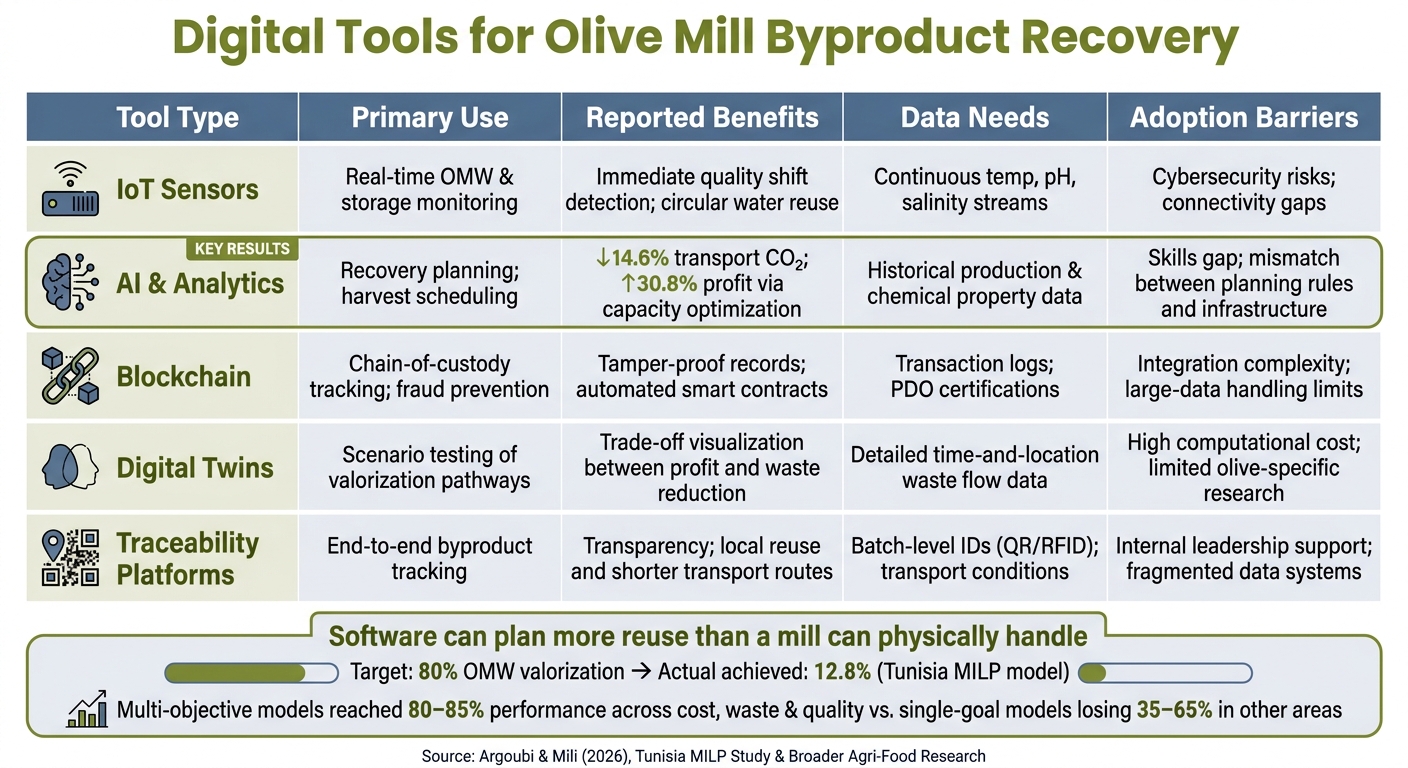
Digital Tools for Olive Mill Byproduct Recovery: Benefits, Data Needs & Barriers
Where Each Tool Works Best in Byproduct Operations
The big difference between these tools isn't whether they help. It's where they help most across monitoring, planning, verification, and simulation of byproduct flows.
| Tool Type | Primary Use | Reported Benefits | Data Needs | Adoption Barriers |
|---|---|---|---|---|
| IoT Sensors | Real-time OMW and storage monitoring | Immediate detection of quality shifts; circular water reuse | Continuous temp, pH, salinity streams | Cybersecurity risks; connectivity gaps |
| AI & Analytics | Recovery planning; harvest scheduling | 14.6% CO2 reduction; 30.8% profit improvement via capacity optimization | Historical production and chemical property data | Skills gap; mismatch between rules and infrastructure |
| Blockchain | Chain-of-custody tracking; fraud prevention | Tamper-proof records; automated smart contracts | Transaction logs; PDO certifications | Integration complexity; large-data handling limits |
| Digital Twins | Scenario testing of valorization pathways | Trade-off visualization between profit and waste | Detailed time-and-location waste flow data | High computational cost; limited olive-specific research |
| Traceability Platforms | End-to-end byproduct tracking | Transparency; local reuse and shorter transport | Batch-level IDs (QR/RFID); transport conditions | Internal leadership support; fragmented data |
Common Adoption Barriers Identified in the Studies
The reported gains look strong on paper. But mills only get those gains if they can back them up with the right setup on the ground.
The clearest problem is the gap between what digital systems can plan and what physical sites can actually do. A good example comes from the Tunisia MILP model: it targeted 80% OMW valorization, yet actual recovery reached just 12.8% because the processing capacity wasn't there. In plain terms, the software said one thing; the plant could only do another.
Then there's the people side of the equation. Smaller, family-run mills often don't have staff who can run AI systems or make sense of continuous sensor feeds. That makes training a big part of adoption, especially when workers are shifting from manual routines to data-based work. For traceability platforms, one study found something telling: internal organizational commitment mattered more than regulatory pressure. If leadership isn't on board, the tool often stalls.
Interoperability is another headache. Mill-level data, farm-level data, and downstream recovery data usually sit in separate systems. Pulling them together takes planning from day one, not a patchwork fix later.
Those limits shape what the current research can support, and they also show where the evidence is still thin.
Conclusion: What the Evidence Supports and What Still Needs Study
Most Supported Takeaways From Current Research
Taken together, the studies show a clear pattern: digital tools do the most good when sensing, planning, and traceability work as one system. Across the research reviewed, these tools make byproduct flows measurable. IoT sensors track waste in real time, traceability systems record chain of custody, and optimization models improve routing and recovery.
One study puts numbers behind that point. Integrated planning cut transport CO2 by 14.6% and increased projected profit by 30.8% when valorization capacity expanded.
That said, the results are uneven across mills and regions. Use is still at an early stage, and internal commitment appears to matter more than outside pressure. Broader agri-food research shows bigger waste cuts from circular systems, but those findings do not transfer neatly to olive milling.
Research Gaps to Watch
Just as important are the questions the studies still leave open. Reporting is inconsistent, which makes side-by-side comparison hard. Some studies use per-hectare figures, others use per-ton or per-mill figures. That needs to be standardized with shared metrics such as Utilization Efficiency (UE) and Net Economic Benefit (NB).
The economic side is also thin. Most studies stop before reporting cost per ton and payback periods. For mill operators, that’s a problem. Without steady metrics and clear cost data, it’s hard to compare systems or make the case for infrastructure upgrades. The picture looks promising, but the proof base is still incomplete.
FAQs
Which digital tool offers the biggest practical benefit for olive mills?
Real-time NIR spectroscopy for online monitoring offers the biggest practical gain for olive mills.
When it’s installed on the extraction line, it tracks pomace humidity and oil content moment by moment. That gives operators a clear read on what’s happening as it happens.
The payoff is simple: mills can cut oil losses in pomace and get tighter process control than they can with slower lab methods.
Why can recovery targets stay low even when digital planning improves?
Recovery targets for olive mill waste may still stay low because better digital planning doesn't solve infrastructure and regulatory gaps. Digital tools can spot places to improve, but bottlenecks often get in the way of real movement toward policy targets.
Large-scale byproduct valorization is still limited by technical and economic constraints, even when the recovery potential is clear.
What data do mills need before using AI or traceability tools?
Before using AI or traceability tools, mills need data from several parts of the operation, including:
- harvest scheduling
- processing allocation
- quality metrics
- environmental flows and waste quantities
That information gives decision support systems what they need to balance compliance, day-to-day performance, and profitability. Put simply, better inputs lead to better calls. If the data is thin or scattered, the system can’t do much. If the data is solid, mills have a much better shot at making choices that work on the floor and on the balance sheet.