

Policy Frameworks for Olive Oil Byproduct Use
Olive oil production creates massive waste - 40 million tons of biomass and 10–30 million cubic meters of wastewater annually. This waste, including olive mill wastewater (OMW) and pomace, harms soil, water, and ecosystems due to its toxic compounds. Managing it effectively is critical for environmental safety and resource recovery.
Key takeaways:
- Byproducts: OMW (highly acidic, salty, and organic-heavy) and pomace (solid residue with 70% moisture).
- Circular Economy: EU policies encourage reusing byproducts for bioenergy, cosmetics, and agriculture.
- EU Directive 2008/98/EC: Focuses on waste prevention, recycling, and energy recovery.
-
Country Strategies:
- Spain: Simplifies pomace classification for reuse.
- Italy: Promotes pomace oil extraction before bioenergy use.
- Portugal: Supports bioactive compound extraction and agricultural reuse.
Challenges include high treatment costs for small producers and complex regulations. Solutions like cooperatives, advanced tech, and partnerships can turn waste into profitable resources while reducing pollution.
AS Turning waste into nutrition: how the olive oil industry could repurpose their wastewater
sbb-itb-4066b8e
European Policy Frameworks for Olive Oil Byproduct Management
The European Union has implemented a comprehensive legal framework designed to reshape waste management practices across various industries, including olive oil production. At the heart of this effort is Directive 2008/98/EC, also known as the Waste Framework Directive. This directive focuses on safeguarding both the environment and public health by promoting efficient recovery and recycling processes to reduce the strain on natural resources. It also supports circular economy initiatives, encouraging the reuse of materials and improving resource efficiency.
For olive oil producers, the directive plays a pivotal role by offering flexible definitions for waste and by-products. This distinction significantly impacts how materials are regulated, as well as how easily they can be repurposed or transported.
EU Waste Framework Directive 2008/98/EC
The Waste Framework Directive is built around a five-step waste hierarchy, which serves as the foundation for waste legislation across Europe. This hierarchy prioritizes actions in the following order:
- Prevention
- Preparing for reuse
- Recycling
- Other recovery methods (like energy generation)
- Disposal as the last resort
For olive oil mills, this hierarchy emphasizes waste prevention first, followed by exploring opportunities to reuse materials such as pomace or stones before considering disposal options.
Article 5 of the directive outlines specific criteria to classify materials as by-products rather than waste. To qualify, the material must:
- Have a clear, intended use.
- Be usable without extensive processing beyond standard industrial practices.
- Be produced as an integral part of the production process.
- Comply with environmental and health safety standards.
Meeting these criteria reduces regulatory obstacles, making it easier for producers to transport and sell these by-products.
The directive also enforces the polluter-pays principle, requiring producers to bear the costs of waste management. This creates a financial incentive for olive oil mills to find productive uses for their residues, avoiding the expenses associated with disposal. Additionally, Article 2 introduces an important exemption: natural, non-hazardous agricultural materials used for energy production from biomass are excluded from stricter waste regulations, provided they do not harm the environment. This provision supports on-site energy recovery efforts, aligning with circular economy goals while minimizing bureaucratic hurdles.
"The framework aims to protect the environment and human health by emphasising the importance of proper waste management, recovery and recycling techniques to reduce pressure on resources and improve their use." - European Commission
In 2025, revisions to the directive further reinforced these principles by introducing binding food waste reduction targets. Member States are now required to cut waste in food processing and manufacturing by 10% by 2030. Considering the EU generates around 2.5 billion tons of waste annually - roughly 5 tons per person - these measures underscore a serious commitment to reducing waste and advancing circular economy practices.
Country-Specific Policy Examples
Mediterranean countries, building on the EU's directive, have developed policies tailored to their unique challenges with olive oil byproducts. Spain, Italy, and Portugal - key players in olive oil production - have each implemented strategies to turn mill residues into usable resources. These approaches offer a glimpse into how circular economy principles are applied in managing olive oil byproducts.
Spain: Order TED/92/2022
Spain is the global leader in both virgin olive oil and olive pomace oil production, with the 2018/2019 campaign alone yielding 1,790,309 tons of virgin olive oil and 4,459,208 tons of fatty pomace. To address the sheer volume of byproducts, Spain introduced Order TED/92/2022, reclassifying fatty pomace as a subproduct. This reclassification simplifies transportation and processing when the pomace is destined for crude olive pomace oil extraction.
The Order categorizes pomace into three types: wet fatty pomace (alperujo) from two-phase systems, fatty pomace from traditional three-phase systems, and dry fatty pomace. With 88% of Spanish mills now relying on two-phase systems, alperujo - characterized by low residual oil and high moisture - is the dominant byproduct.
To maintain its subproduct status, strict handling rules apply. Producers must avoid mixing pomace with other waste, store it in isolated facilities to prevent contamination, and submit monthly records to the Information System of Oil Markets (AICA) for traceability.
"This system obliges all operators in the olive industry to declare monthly the movements that occur in each facility... ensuring the traceability of that movement between facilities could prevent pomace from being dumped or coming into contact with soil or surface waters."
– Order TED/92/2022
Pomace used as fertilizer or animal feed falls under separate regulations (e.g., RD 506/2013 or EU Regulation 68/2013). By unifying national policies, Spain has streamlined the process of converting residues into crude oil and biomass, reducing the environmental risks linked to improper disposal.
Italy: Olive Mill Waste Regulations
Italy has long allowed olive mill wastewater (OMWW) and virgin pomace to be spread directly on farmland as organic fertilizer. For instance, applying 80 cubic meters (≈2,825 ft³) of OMWW per hectare (≈2.47 acres) enriches the soil with 3,000–6,000 kg (≈6,600–13,200 lb) of dry organic matter, along with essential nutrients like nitrogen, phosphorus, and potassium.
However, Italy is now shifting toward the "cascading use of biomass" principle, which prioritizes food-related applications over energy recovery. A pivotal ruling by the Italian Council of State introduced the "food first" principle, mandating that residual oil be extracted from pomace before it can be used for biomethane production to qualify for specific incentives.
"Before being sent to the biodigester, the pomace must be fully processed to remove residual oil... only then, as it is no longer used for food purposes, can it be eligible for the incentive if used for energy purposes."
– Francesco Cherubini, Editor, l'OlivoNews
This policy shift has major consequences: without "double counting" incentives for biodigesters, millers may now incur costs for pomace disposal rather than benefiting from free collection. To adapt, many mills are adopting Multi-Phase Decanters (MPD/DMF), which produce a pitted "paté" suitable for human consumption. Additionally, technologies like Reverse Osmosis (RO) are being used to recover up to 85% of fresh water from wastewater, with RO membranes effectively filtering out over 94% of ions.
Portugal: Legal Framework for Byproduct Management
Portugal has established a detailed legal framework governing the storage, treatment, and reuse of olive byproducts for agriculture and bioenergy. This framework addresses the significant byproduct volumes generated - such as 6.23 kg (≈13.7 lb) of pruning residues per liter of olive oil, as well as wet pomace from two-phase systems and drier pomace with wastewater from three-phase systems.
Beyond waste management, Portugal emphasizes extracting bioactive compounds like hydroxytyrosol, tyrosol, and oleuropein from these byproducts. These compounds have applications in pharmaceuticals, cosmetics, and food industries. By focusing on regulated treatment and resource recovery, Portugal showcases how materials once considered waste can serve as assets, aligning with broader goals of resource efficiency and sustainability.
Policy Framework Comparison
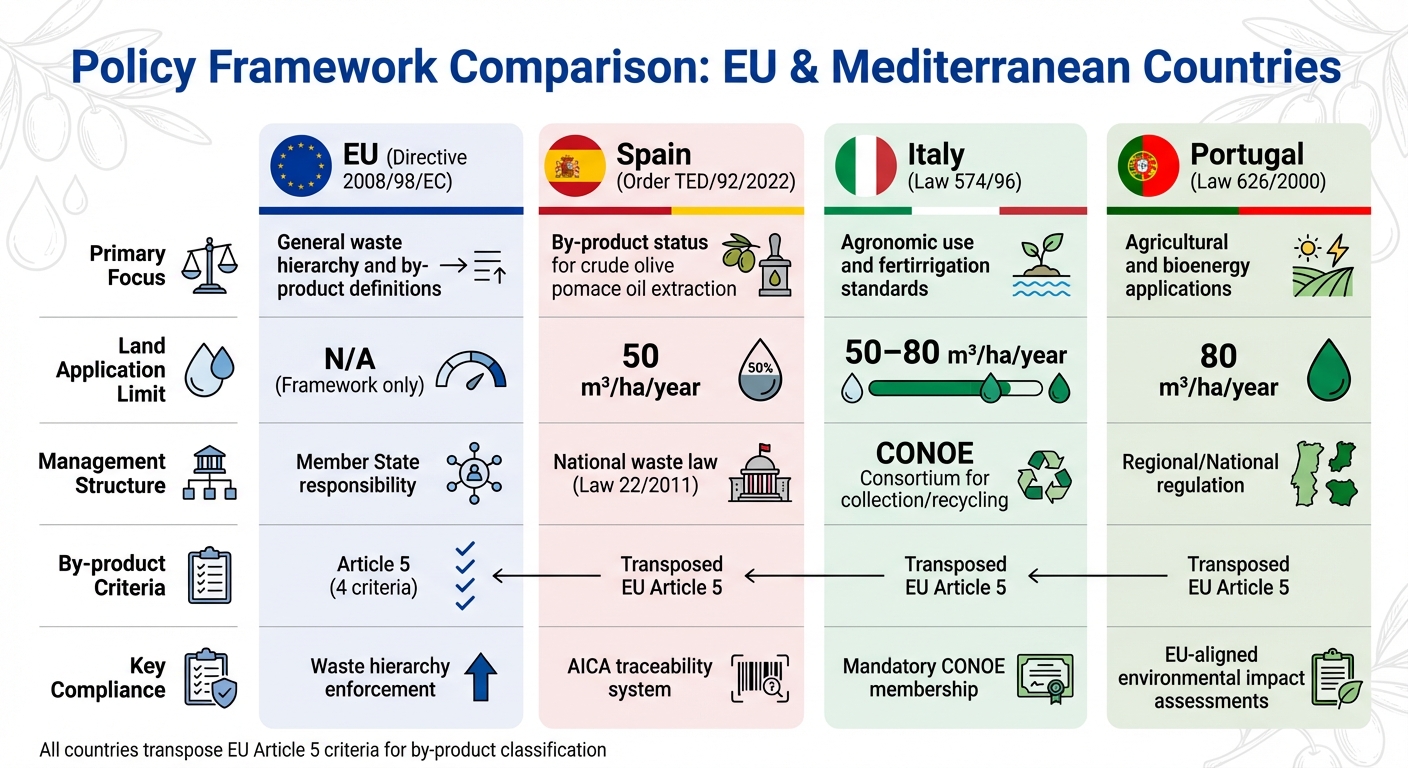
EU Olive Oil Byproduct Policy Comparison: Spain, Italy, and Portugal
This section takes a closer look at how Spain, Italy, and Portugal have adapted their national policies to manage olive oil byproducts, all of which are rooted in the EU Waste Framework Directive 2008/98/EC. This directive provides a foundation through its waste hierarchy and Article 5 criteria, which each country uses to classify olive residues as byproducts.
One key area of variation is land application limits for olive mill wastewater. Spain sets a limit of 50 m³/ha/year. Italy differentiates between traditional mills (50 m³/ha/year) and centrifugal three-phase systems (80 m³/ha/year). Meanwhile, Portugal allows up to 80 m³/ha/year across the board.
Institutional management also differs significantly. In Italy, the CONOE Consortium oversees the collection and recycling of used oils and fats, with around 90% of collected vegetable oils being converted into biodiesel. Spain’s approach integrates byproduct management into its national waste law (Law 22/2011) and uses the Information System of Oil Markets (AICA) for traceability. Portugal, on the other hand, adopts a decentralized model, relying on a mix of regional and national regulations for agricultural and bioenergy applications. These differences in management approaches play a crucial role in shaping how effectively each country implements circular economy principles for olive oil byproducts.
"The conditions for using, as a by-product, pomace from the pressing process in an olive mill... can exist with regard to its possible uses: selling it to olive pomace refineries for chemical processing to extract olive pomace oil; spreading it as fertilizer... as an additive in animal feed; for fuel."
– Maria K. Doula, Soil Science Institute of Athens
Policy Comparison Table
The table below outlines the key distinctions between the EU framework and the national policies of Spain, Italy, and Portugal.
| Feature | EU (Directive 2008/98/EC) | Spain (Order TED/92/2022) | Italy (Law 574/96) | Portugal (Law 626/2000) |
|---|---|---|---|---|
| Primary Focus | General waste hierarchy and by-product definitions | By-product status for crude olive pomace oil extraction | Agronomic use and fertirrigation standards | Agricultural and bioenergy applications |
| Land Application Limit | N/A (Framework only) | 50 m³/ha/year | 50–80 m³/ha/year | 80 m³/ha/year |
| Management Structure | Member State responsibility | National waste law (Law 22/2011) | CONOE Consortium for collection/recycling | Regional/National regulation |
| By-product Criteria | Article 5 (4 criteria) | Transposed EU Article 5 | Transposed EU Article 5 | Transposed EU Article 5 |
| Key Compliance | Waste hierarchy enforcement | AICA traceability system | Mandatory CONOE membership | EU-aligned environmental impact assessments |
These differences underscore how each country tailors EU directives to address specific needs in managing and repurposing olive oil byproducts.
Challenges and Opportunities in Byproduct Valorization
Overcoming Regulatory Barriers
Olive oil producers face a maze of regulations that vary across regions and countries. Without unified EU legislation for olive oil waste, companies must deal with conflicting rules that complicate compliance efforts. A key challenge lies in the classification of olive mill wastewater as "industrial wastewater", which imposes strict disposal standards. Meeting these standards often requires expensive treatment technologies. For small and medium-sized enterprises (SMEs) - which account for 56% of total business turnover in the EU - the cost of installing advanced waste treatment systems can be overwhelming. Additionally, many local regulations demand rigorous treatment for land application, such as reducing biological oxygen demand (BOD₅) and suspended solids, making compliance difficult for smaller mills.
Another hurdle is the gap between research and real-world application. Cutting-edge biotechnologies developed in academic settings often fail to reach olive oil producers due to weak knowledge transfer systems and insufficient financial support for circular business models. Despite these challenges, producers are exploring new technologies and cooperative strategies to address these issues.
New Solutions for Byproduct Utilization
On the innovation front, some exciting developments are taking shape. In March 2026, the Israeli startup PhenOlives began constructing a continuous production facility at the Shemen Shean olive oil mill. Using their patented Total Solution Impact (TSI) system, the facility transforms pomace into eco-friendly polymer pits, gluten-free flour, and antioxidant extracts. This groundbreaking project, supported by a €3 million fundraising round (including €1 million from the Yizra'el Group), highlights how byproducts can be effectively utilized to align with circular economy goals.
"Our system takes all parts of the pomace, including the pits, pulp and wastewater, and separates them into three main products... The process happens right next to the olive mills within 20 minutes of extraction to prevent olive oil from turning acidic and toxic." – CEO Chen Lev-Ari
The financial potential of byproduct utilization is impressive. For instance, processing powder biochar into briquettes or hookah charcoal can boost its value by up to 22.5 times. Integrated gasification systems are also gaining attention, as they combine electricity generation with thermal energy recovery. A system processing 970 lb/hr of biomass can generate 240 kW of electricity and 1,360 kW of thermal energy, with the waste heat supporting zero-liquid discharge processes.
Collaboration is another key strategy for success. By forming cooperatives, small and medium-sized mills can pool resources to invest in advanced waste treatment technologies, making byproduct valorization more economically viable. The adoption of two-phase extraction systems has also proven effective, cutting wastewater volume by up to 75% compared to traditional methods. On a global scale, partnerships are expanding. In November 2025, the International Olive Council and Italy's CREA signed a Memorandum of Understanding to promote research and technology transfer, further supporting sustainability in the olive oil sector.
Conclusion: The Path Forward for Byproduct Management
The future of byproduct management depends on aligning regulations across regions and fostering collaboration among stakeholders. At present, around 95% of olive byproducts in the EU are used for low-value purposes, which misses the chance to transform these materials into higher-value products like pharmaceuticals, cosmetics, or functional foods.
Shifting policies to prioritize high-value applications is essential. As Julio Berbel and Alejandro Posadillo (2018) explain:
"Biomass is most valuable when used as pharmaceuticals or fine chemicals... Using biomass as a source of energy is assigned the lowest priority".
This perspective emphasizes the importance of cascading use: extracting valuable polyphenols first, repurposing the leftover biomass for animal feed, and using it for energy recovery only as a last resort. Such a system not only maximizes resource value but also creates cost-effective opportunities for smaller producers.
For small and family-owned mills, the high costs of meeting strict treatment standards (like BOD₅ < 10 mg/L) are a significant barrier. Cooperative models and simplified compliance measures could make these requirements more manageable. Policies supporting controlled land application protocols offer a practical alternative, cutting greenhouse gas emissions by 50–60% compared to traditional disposal methods and providing an economic return of about $70 per hectare. This closed-loop approach aligns well with the principles of a circular economy, turning waste into resources.
The push for improved practices is gaining momentum. The updated EU Waste Framework Directive, which aims to reduce manufacturing waste by 10% by 2030, is driving olive oil producers to adopt circular strategies and strengthen public-private partnerships. Bridging the gap between researchers and producers is critical, as is fostering partnerships that encourage knowledge sharing and provide funding for innovative valorization technologies. By harmonizing regulations and embracing collaboration, the industry can unlock sustainable solutions for byproduct management.
FAQs
How do I know if pomace or OMW is a by-product or “waste” under EU rules?
Under EU regulations, pomace or olive mill wastewater (OMW) can be classified as a by-product if it meets specific conditions. It must be generated during a production process, have a defined reuse purpose, and comply with safety and environmental standards. For example, if OMW is repurposed for energy production, soil improvement, or extracting bioactive compounds without causing harm, it qualifies as a by-product. However, if it is discarded or poses risks, it is treated as waste.
What approvals are needed to spread olive mill wastewater on farmland?
Spreading olive mill wastewater on farmland comes with strict guidelines. You’ll need permits and must follow local regulations to ensure safe application. These rules are in place to manage the wastewater's high levels of organic pollutants and phytotoxicity, which can impact soil and water quality. Always consult local authorities to understand the exact requirements for your region.
What are the lowest-cost byproduct options for small olive oil mills?
Small olive oil mills can cut costs by finding new uses for byproducts like olive pomace and wastewater. Two popular approaches are natural land treatment and basic mechanical extraction. These methods not only help save money but also offer practical ways to manage waste responsibly.