

Digital Tools Fighting Olive Oil Fraud
Olive oil labels can be wrong, and a scan alone does not prove what’s in the bottle. If I want the short answer, it’s this: blockchain, QR, and NFC mostly check where the oil came from, while NIR, FTIR, Raman, and SORS help check what’s in the oil.
Here’s the simple breakdown:
- Blockchain platforms log supply-chain records from grove to shelf
- QR systems let shoppers check batch or bottle data with a phone
- NFC tags add tap-to-check ID and anti-tamper support
- Portable NIR/FTIR tools screen for mixed-in seed oils or lower-grade oil
- Portable Raman/SORS tools can screen even sealed bottles
A few points stand out right away:
- Some studies still found oils sold as extra virgin that failed grade tests
- One retail FT-NIR study flagged 61% of commercial EVOO samples as suspect
- Portable Raman methods have detected adulteration at around 5%
- SORS testing has reported error rates as low as 1.4% for sunflower oil in some setups
- Deoleo says that, as of 2026, more than 35% of its EVOO output is traceable through blockchain
What does that mean for you?
If I’m a shopper, I want QR or NFC because they are simple at the shelf.
If I’m a brand, I want traceability plus lab-linked records.
If I’m an inspector or importer, I want portable spectroscopy tools because they can flag suspect oil on-site.
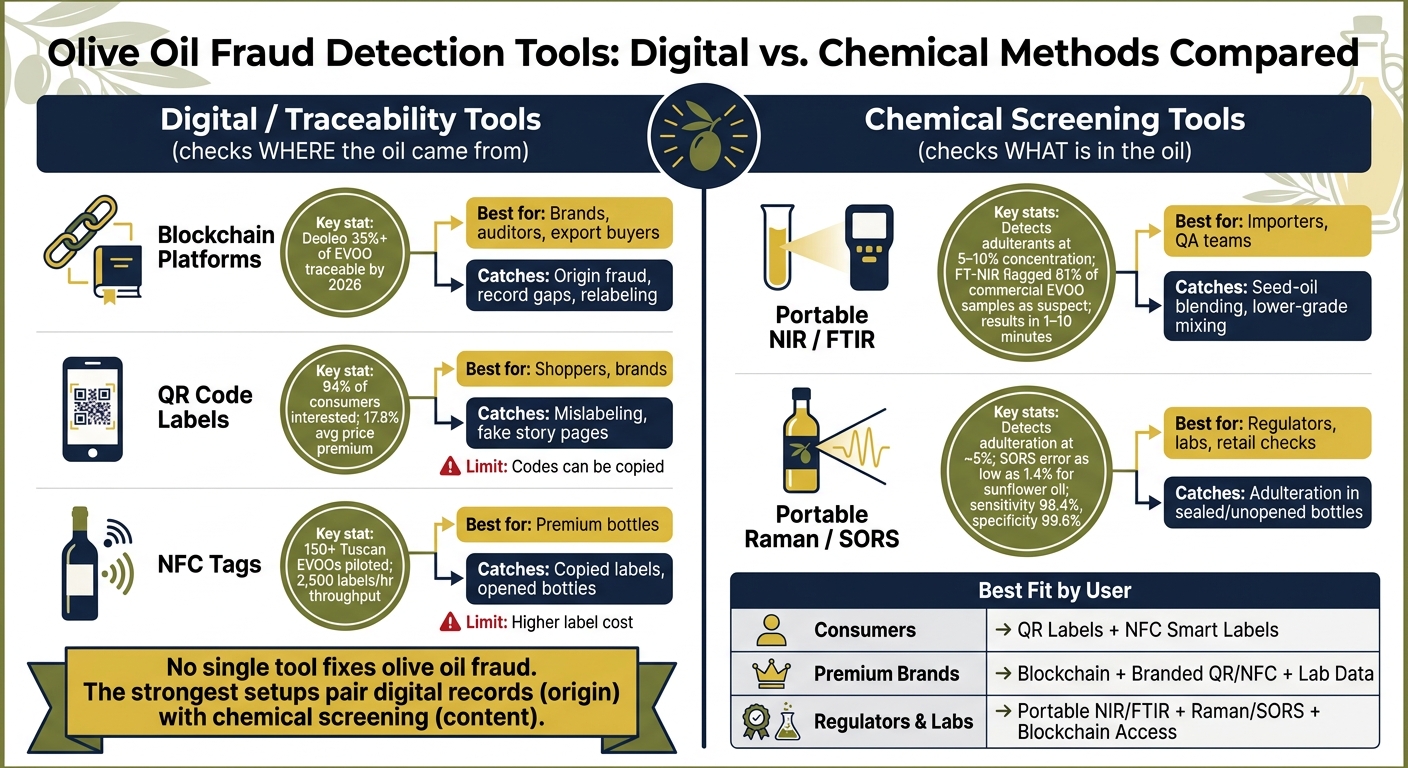
Olive Oil Fraud Detection Tools: Digital vs. Chemical Methods Compared
Quick Comparison
| Tool | Main job | Best at catching | Main limit | Best fit |
|---|---|---|---|---|
| Blockchain platforms | Record chain of custody | Origin claims, record gaps, relabeling | Does not test oil chemistry | Brands, auditors, export buyers |
| QR labels | Show batch or bottle info | Mislabeling, fake story pages | Codes can be copied | Shoppers, brands |
| NFC tags | Tap-to-check bottle ID | Copied labels, opened bottles | Higher label cost | Premium bottles |
| NIR / FTIR | Screen oil chemistry | Seed-oil blending, lower-grade mixing | Needs model calibration | Importers, QA teams |
| Raman / SORS | Screen sealed bottles | Adulteration in unopened units | Higher device cost | Regulators, labs, retail checks |
Bottom line: No single tool fixes olive oil fraud. The best setups pair digital records with chemical screening so you can check both the story on the label and the oil in the bottle.
1. IBM Food Trust Olive Oil Traceability Implementations
IBM Food Trust is a blockchain-based traceability platform that logs supply chain events in a shared ledger. Each step, from grove to shelf, can be recorded and linked to a bottle or batch. That matters because it turns brand claims into records shoppers can actually check.
Fraud Coverage
IBM Food Trust works best for origin fraud, false EVOO claims, and gaps in chain of custody. It does not chemically test the oil, so it works best alongside lab analysis.
Verification Depth
Shoppers can check a bottle by scanning a QR code on the label. That opens a provenance record tied to that batch. The record may include the grove, olive variety, milling, filtration, certifications, and test results.
Pietro Coricelli's June 2021 rollout started with its one-liter classic EVOO and gave shoppers QR access to the analyses used to certify the bottle. In plain terms, the same QR code can help shoppers in a store, auditors reviewing records, and export buyers checking product details.
Supply Chain Visibility
IBM Food Trust shows chain of custody across orchard → mill → bottling → retail. CHO's Terra Delyssa tracked eight quality checkpoints, and Deoleo later added bottle-by-bottle origin traceability in Spain.
Adoption Cost
The main costs come from system integration, label updates, and supplier onboarding. Coricelli folded the blockchain into its production cycle in just a few months for its best-selling EVOO bottle, which suggests a focused rollout can work when a brand controls a large part of its supply chain.
That makes IBM Food Trust a good fit for premium or mid-sized brands that can justify the cost through buyer trust, export sales, or certification transparency.
That shared-ledger setup sets the baseline for brand-level traceability systems that follow.
2. BRUSCHETTA EVOO Blockchain Framework
BRUSCHETTA is a research-led blockchain framework built for EVOO traceability. It was developed by Italian research groups to certify the full supply chain. The system runs on Hyperledger Fabric, a private, permissioned blockchain. In plain English, that means only approved participants - farmers, mills, bottlers, and certifiers - can add data, and each party can only view the information they're cleared to access.
That setup makes BRUSCHETTA more than a static record system. It gives supply-chain participants a shared ledger with tighter control over who can write, read, and verify records.
Fraud Coverage
BRUSCHETTA is designed to address several common fraud risks in olive oil: mislabeled quality grades, adulteration by blending with lower-cost oils, false origin claims, and document tampering. Because the ledger keeps a running history for each batch, changing that history after the fact becomes much harder.
That said, BRUSCHETTA is strongest as a traceability system. It helps show where a product came from, who handled it, and what records were attached to it. But it does not replace lab or chemical testing. It works best when paired with those checks, not used instead of them.
Verification Depth
BRUSCHETTA goes deep on process logging. IoT sensors record each stage of the chain - farming, harvesting, milling, packaging, storage, and transport - so the system can build a detailed chain-of-custody timeline.
It also stores certification and compliance records on-chain, which adds another layer to the audit trail. So instead of relying on scattered paperwork, auditors can review records tied directly to each batch and production step.
Supply Chain Visibility
One of BRUSCHETTA's biggest strengths is role-based access. Not everyone sees the same thing, and that's the point.
- Consumers can scan a QR code to view a simplified summary that includes origin, harvest date, key production steps, and quality checks.
- Producers and supply chain partners can access more detailed operating logs.
- Regulators and certifying bodies can review the full traceability record and certification history for audits and compliance checks.
This split view matters. It keeps sensitive business data private while still giving shoppers a clear, usable traceability snapshot.
Adoption Cost
The main cost drivers are IoT hardware, ERP integration, packaging changes, and onboarding supply-chain partners. For smaller producers, that's where things get tough - especially if they don't already have digital systems in place.
In practice, BRUSCHETTA-style setups make the most sense for premium and high-value EVOO brands, where stronger buyer trust may justify the upfront spend. Smaller producers may have a better shot through regional cooperatives or consortia, which can spread those costs across multiple participants.
Put simply, BRUSCHETTA leans more toward audit depth than consumer-first simplicity. Its mix of sensors, permissions, and on-chain records makes it a heavier-duty traceability framework.
3. AOVE Tradicional Blockchain App
Compared with the heavier traceability systems above, AOVE Tradicional is a more focused certification app built around registered grove data. It’s a blockchain traceability app for Spanish traditional-grove EVOO that links each batch to registered parcels and logged processing steps to deter origin fraud and substitution. In May 2023, UPA, Grupo Migasa, Wealize by Izertis, Lidl, and the University of Jaén were named participants.
Fraud Coverage
AOVE Tradicional is aimed at false origin claims, grade fraud, and substitution. To sell oil under the AOVE Tradicional certification, producers have to create blockchain records that connect the oil to registered traditional groves and documented processing steps. That makes blending or substitution much harder to hide. Its job is provenance control, not chemical detection.
Verification Depth
The system records six stages on-chain:
- harvesting
- transportation
- mill delivery
- grinding
- oil extraction
- packaging
A smart contract manages each step and creates an immutable, auditable log that ties bottled oil back to specific harvest lots and olive parcels. Farmers use a mobile app to register plots and log each harvest. Mills use a web app to record how incoming olive lots are turned into oil batches. Each entry is tied to a named participant, which creates an auditable chain.
Supply Chain Visibility
Consumers can open a consumer page with traceability details such as origin, harvest date, processing steps, and packaging information. Regulators and certifiers can check the underlying blockchain logs during inspections or origin certification reviews.
Farmers also get a structured digital record of production. That can help support premium pricing and make it easier to take part in certified traditional EVOO programs.
Adoption Cost
Farmers need a smartphone and stable internet access, and mills need to log events in the web app. The main adoption risk is data integrity at the point of entry. If bad data goes in, the blockchain preserves it. So physical audits and cross-checks against registered plot capacities are still needed.
Its value sits in batch-level provenance records, while the next tools move transparency closer to the label itself.
4. Infoliva QR Traceability App
Infoliva moves traceability beyond batch paperwork and down to the individual bottle. The platform, built in Italy for EVOO, connects RFID tags and QR codes with smartphone access and cloud-based records.
Fraud Coverage
Infoliva targets two common problems: label fraud and false claims about origin. It does that by linking each bottle to digital data on source and quality. Unique bottle or batch codes, server-side checks, and tamper-evident seals make fake scans and copied packaging much harder to pull off.
Verification Depth
What makes Infoliva more than a basic QR label is its use of NIR spectroscopy for fast, non-destructive checks alongside the digital record. In plain terms, the system doesn’t just show stored data. It can also help screen the product itself. That gives it two jobs in one setup: origin verification and quality screening.
Supply Chain Visibility
Access is split by role, so producers, cooperatives, consumers, and regulators don’t all see the same thing. A consumer scan can show harvest and milling details, such as dates, methods, and the identity of the mill. Supply-chain partners can view deeper operating logs, while regulators can inspect the full record.
Adoption Cost
Infoliva uses open-source hardware and software, plus QR codes, RFID, and smartphone-based access, which points to a moderate cost to put in place. That makes it a good fit for smaller cooperatives and consortia that want bottle-level checks without a huge upfront spend.
It sits in the middle ground between digital recordkeeping and on-pack verification, which is where the next tools push things further.
5. QR-Based Branded Olive Oil Transparency Platforms
Beyond standalone apps, many brands now put traceability right on the bottle with QR labels. That matters because the batch data sits on the package itself, which makes it much harder to pass off lower-grade or different-origin oil as premium extra virgin olive oil.
Fraud Coverage
These platforms mainly go after counterfeit and mislabeling risks. Each bottle gets a unique QR code tied to verified production data, giving brands a tamper-resistant record that is hard to copy without access to the system behind it.
Some systems add an extra check. BlockTac, for example, uses a double-layer label so the QR code and blockchain status can help flag bottles that have already been opened or were never registered in the first place.
Verification Depth
Verification depth can be pretty shallow or quite detailed. At the basic end, a QR code may lead to a simple brand page. At the deeper end, it connects to blockchain-backed records instead of pages controlled only by the brand, so harvest, milling, analysis, and certification data are logged in a tamper-resistant format.
Deoleo offers a clear example. As of 2026, more than 35% of its extra virgin olive oil production is traceable through blockchain, and QR codes on products like Carapelli 100% Italian take shoppers to verified origin data, supply chain routes, and lab certificates.
Consumer interest also looks strong. One study found that 94% of respondents were interested in traceability tools, and QR-based blockchain labels earned an average 17.8% price premium.
Supply Chain Visibility
The best platforms show a bottle's history step by step: harvest dates, milling details, bottling records, certifications, and sometimes even photos or videos of farms and producers. What shoppers usually see after scanning is a simpler snapshot, not the full internal supply-chain log.
For U.S. consumers, links to GS1 Digital Link and SmartLabel can add more context. That can include ingredients, Nutrition Facts, and allergen disclosures alongside the supply chain data.
That label-first setup leads naturally to NFC, which checks a bottle with a tap instead of a scan.
Adoption Cost
Printing QR codes is cheap. The bigger expense comes from the data side:
- platform access
- accurate batch entry
- lab result uploads
- record upkeep
Large brands usually handle those costs more easily. Smaller premium producers often begin with a lighter QR page or a third-party platform. For ultra-premium producers, where proof of origin is a big part of the sale, QR-based systems offer a direct way to show batch-level harvest data, chemical analysis results, and certification status to every customer who scans the bottle.
When QR labels need stronger anti-tamper protection, NFC adds a second layer of verification.
sbb-itb-4066b8e
6. NFC-Enabled Olive Oil Authentication Systems
NFC lets shoppers tap a bottle with their phone and check identity and traceability data on the spot. Compared with a printed QR code, it adds hardware-based anti-cloning protection.
Fraud Coverage
NFC tags contain a built-in chip ID that is hard to copy. That chip ID connects to records on a server, so a copied tag won't pass verification. Tamper-evident closures can also show if a bottle has been opened or resealed.
Verification Depth
In iOlive, used by several Tuscan producers, one tap can show sensory profiles, harvest dates, lot numbers, and production-chain data. The pilot covers more than 150 extra virgin olive oils from Tuscany, with each bottle carrying a Thinfilm SpeedTap™ NFC tag linked to quality and origin records.
There’s also a split in what each group can see. Producers and regulators can access lab data, while consumers get a summary.
Supply Chain Visibility
NFC doesn't stop at bottle checks. It can also log movement at each handling step.
Some academic NFC systems tag trees, farms, warehouses, and bottling lines. That creates event-level traceability across the chain, which gives teams a clearer view of where a product has been and when it changed hands.
Adoption Cost
NFC costs more than QR labels, but the Autentico system reports label application throughput of about 2,500 labels per hour. Most of the cost is in the backend: secure databases, batch records, and a consumer app.
What NFC does well is verify provenance and tamper status. What it does not do is test the oil's chemistry.
NFC authenticates the bottle; the next tools test the oil itself.
7. Portable NIR/FTIR Olive Oil Screening Tools
If NFC checks the bottle, NIR and FTIR check the oil inside.
NIR (near-infrared) and FTIR (Fourier-transform infrared) spectroscopy look at the sample’s chemistry. They read the oil’s chemical signature and can spot signs of adulteration.
Fraud Coverage
These tools can pick up common seed and nut oils mixed into EVOO, along with refined or lower-grade olive oil. Handheld ATR-FTIR devices have identified mixtures with as little as 5% to 10% adulterant oil, and predictive models have estimated adulterant content in the 5% to 45% range with about 3% error. One NIR study reported error limits of ±0.57% for corn oil and ±0.57% for hazelnut oil by weight.
Verification Depth
Results come fast - about 1 to 10 minutes per sample, depending on the device. The output can include an authenticity flag, an estimated adulteration level, and a confidence score. In one retail screening study, FT-NIR flagged 61% of commercial EVOO samples as suspect.
That makes these tools a high-confidence screening step. When a sample gets flagged, it’s usually sent to a lab for confirmatory analysis using official methods.
Supply Chain Visibility
NIR/FTIR do not track chain of custody. They answer a simpler question: does the oil in this sample match what it’s supposed to be?
When paired with digital traceability records, test results can be logged in a quality management system alongside batch numbers, supplier records, and test dates. If the same supplier gets flagged again and again, that can trigger an audit or a procurement review.
Adoption Cost
Compared with routine lab testing, the economics look good. Per-test operating costs are low because scans take seconds and do not need reagents or consumables. Portable NIR sensors such as the Nanoscan (Texas Instruments) and MicroNIR 1700 (Viavi) have been tested specifically for EVOO fraud detection.
For importers and premium brands, the practical upside is simple: they can screen lots in-house and save formal lab testing for flagged batches. The main recurring cost is calibration and model retraining as new oils and adulterants show up.
For deeper chemical confirmation, Raman and SORS add another screening layer.
8. Portable Raman/SORS Olive Oil Authentication Tools
If NIR and FTIR are good for open samples, Raman and SORS push that check one step further: they can assess oil in sealed retail bottles. Raman and SORS look at the oil itself, and SORS can do that without opening the package. That matters in stores, warehouses, and receiving areas where breaking seals creates its own problems.
These tools are at their best when the issue is adulteration with other vegetable oils, such as sunflower, soybean, canola, corn, or grapeseed oil mixed into EVOO. A portable Raman method published in 2009 could reliably tell genuine olive oils apart from samples containing 5% or more of several other edible oils. A portable SORS study from the University of Manchester in September 2021 reported prediction errors as low as 1.4% for sunflower oil, with a limit of detection usually in the 2%–14% range depending on the adulterant. So when packages need to stay intact, these methods give inspectors a practical way to screen them.
Raman and SORS check whether the contents fit the expected chemical profile. They do not verify the label or the chain-of-custody record. That distinction matters. You may learn that the oil looks wrong, but not where the problem entered the supply chain. Even so, the performance can be strong: a well-built portable Raman model reported average sensitivity of 98.4% and specificity of 99.6% for separating five EVOO brands.
The catch is the chemometric model behind the device. If the model was not trained on the adulterant you’re trying to catch, accuracy can drop. In plain terms, the instrument is only as good as the reference data and model design behind it.
SORS is especially useful when inspectors need to test sealed units at receiving docks, in warehouses, or right on store shelves. In February 2025, researchers published a SORS-based authentication method tested on 30 online retail samples, with the method built to handle different bottle and package types. Paired with batch records, these tools can sharpen fraud triage, though they still don’t replace provenance systems.
The main hurdles are hardware cost and model development. In many cases, the biggest expense is building a large reference library of authentic and adulterated oils. That means these systems make the most sense for:
- Premium brands
- Importers
- Labs
- Regulators
They’re a strong fit when teams need fast triage before sending samples to slower, higher-cost confirmatory testing such as GC or isotope-based analysis. They do not prove origin, but they can flag suspicious oil early and help decide what should go to formal lab testing next.
Strengths and Tradeoffs Across the Main Tool Categories
Blockchain, QR, and NFC are built to check origin. NIR, FTIR, Raman, and SORS are built to check chemical authenticity. That distinction matters because different fraud risks need different tools.
Traceability systems are a good fit for origin fraud and chain-of-custody issues. But there’s a catch: if bad data goes into the system, the record is still bad. NFC helps cut down on copied-label fraud, though it comes with a higher packaging cost.
Portable NIR can flag suspect oil in minutes. Still, its accuracy depends on calibration against a broad set of reference samples.
That tradeoff is clear in the comparison below:
| Tool Category | Core Strength | Key Weakness | Best Fit |
|---|---|---|---|
| Blockchain traceability | Immutable audit trail, chain-of-custody transparency | Only as reliable as the data entered; does not verify oil chemistry | Premium branding, regulator audits, origin verification |
| QR code platforms | Low-cost consumer access to provenance data | Codes can be copied; vulnerable to duplicate-code fraud | Consumer transparency, basic bottle-level verification |
| NFC systems | Tap-to-read authentication with tamper evidence | Higher packaging cost; requires compatible devices | Premium anti-tamper labeling |
| NIR / FTIR | Rapid, low-cost adulteration screening | Requires calibration models and trained operators | Warehouse inspection, customs screening, quality control |
| Raman / SORS | Checks sealed bottles without opening them | Fluorescence interference; higher cost and complexity | Retail shelf checks, non-invasive customs screening |
| Hybrid approaches | Covers both origin and chemical content | More complex and costly to deploy | High-value brands, certification schemes, regulators |
The main point is straightforward: no single tool closes the fraud gap. That’s why high-value programs often combine traceability with chemical screening.
For Big Horn Olive Oil, traceability helps build trust. Periodic spectroscopy adds a separate chemical check.
Best Fits for Consumers, Premium Brands, and Regulators
For consumers, the choice mostly comes down to speed and ease. QR-based transparency platforms and NFC smart labels are the best fit because both work with a standard smartphone and need no training. A quick scan or tap can show where the olives were grown, the harvest date, and whether the product matches the stated grade. That’s usually enough for someone to make a confident decision in the aisle. At this level, people interact with QR and NFC on the label, while blockchain works in the background behind those scans.
For premium and ultra-premium brands, the picture changes a bit. Here, the goal isn’t just helping someone shop. It’s proving the brand story. That’s where blockchain traceability paired with branded QR or NFC labels makes the most sense. A premium brand can point to verified harvest, milling, and freshness records to back up its sourcing claims. For a quality-focused producer like Big Horn Olive Oil, branded QR codes that link to a transparency portal would make that story visible and checkable for buyers instead of leaving it as a claim on the bottle.
For regulators and analytical labs, digital records alone aren’t enough. Once provenance is on record, enforcement depends on chemical screening. Portable NIR/FTIR and Raman/SORS devices let inspectors check chemical composition on-site at receiving points. In simple terms, digital records show where the oil is supposed to come from, while spectroscopy checks what’s actually in the oil. That matters because EU fraud data shows that dilution with cheaper oils is still common, and QR codes can’t catch that kind of problem.
The strongest setup combines all three, with each tool doing its own job.
| User Type | Primary Need | Best-Fit Tool Categories |
|---|---|---|
| Consumers | Authenticity and freshness | QR-based transparency apps; NFC smart labels |
| Premium Brands | Buyer trust, sourcing, lab data | Blockchain records; branded QR/NFC; integrated lab data |
| Regulators & Labs | Deeper fraud detection, enforcement | Portable NIR/FTIR and Raman/SORS; blockchain data access |
FAQs
Can a QR code prove olive oil is authentic?
Yes - if it’s tied to a secure system like blockchain.
Scan the code, and you can pull up a tamper-proof digital record. That record may include harvest dates, grove locations, milling details, and third-party quality certifications.
Some systems also mark codes as used after scanning. That can help flag duplicates or counterfeit products. In plain English, it gives you a simpler way to check that the oil matches its stated origin and quality.
Which tools check the oil itself, not just the label?
Producers don’t just check the label. They test the oil itself.
NIR and Raman spectroscopy read the oil’s chemical fingerprint. That includes compounds like phenols and sterols, which help confirm both purity and origin.
Portable DNA authentication adds another layer of proof. It uses genetic barcodes to identify olive cultivars and spot adulteration or mislabeling. In plain English, it helps show that the bottle matches the variety and geographic origin listed on the label.
What is the best anti-fraud setup for olive oil?
The best anti-fraud setup for olive oil uses more than one layer. Lab testing methods like HPLC, GC-MS, fluorescence spectroscopy, and PCR help check purity, spot adulteration, and confirm variety and origin.
Digital tools add another layer of supply chain protection. Blockchain, QR codes, and NFC labels can track each batch from orchard to bottle. They can also give consumers access to details like harvest dates, grove locations, and lab certificates.