

Efficient Irrigation: Lessons from Olive Farmers
Efficient water use is critical for olive farming, especially in arid regions where drought threatens yields and livelihoods. Modern irrigation methods like drip irrigation, regulated deficit irrigation (RDI), and water reuse systems are helping farmers conserve water while maintaining productivity. These techniques have shown water savings of up to 70% and improved profitability, with minimal impact on yields.
Key takeaways:
- Drip irrigation delivers water directly to tree roots, reducing waste. Moroccan farmers increased yields fivefold after switching from flood irrigation.
- RDI strategically reduces water during drought-tolerant growth phases, saving up to 72% of water.
- Water reuse systems utilize treated wastewater and rainwater, cutting groundwater reliance.
Farmers worldwide are adopting these methods to address water scarcity while producing high-quality olive oil. Success stories from Morocco, Spain, and Italy highlight how precise irrigation management can transform olive farming.
Talk #7: Optimized Irrigation Management in Olive with Giulia Marino
sbb-itb-4066b8e
Main Irrigation Methods for Olive Groves
Olive growers around the world have shifted from traditional flood irrigation to more efficient methods that conserve water while maintaining productivity. Three key approaches - drip irrigation, regulated deficit irrigation (RDI), and water reuse systems - are now widely used by successful farmers.
Drip Irrigation for Precision Watering
Drip irrigation delivers water directly to the root zone of trees through specialized dripper lines. These systems typically use drippers with a flow rate of 2.3 L/h, spaced 0.75 meters apart. This precise method has proven to increase yields and economic returns.
A compelling example comes from Bensadek El Mokhtar, a farmer in Morocco's Marrakech region. After switching from flood irrigation to a drip system, his olive yields increased fivefold. Previously limited to irrigating just two of his nine hectares due to water shortages, he now irrigates all nine. The water savings also allowed him to grow additional crops like potatoes and alfalfa for livestock. For even greater efficiency, subsurface drip irrigation (SDI) places water delivery below the soil surface. A 2022 trial in Morocco’s Tensift Basin found that SDI used just 194 mm (7.6 inches) of water compared to 320 mm (12.6 inches) for surface drip, with no difference in yield.
Converting older orchards to drip irrigation does require some upfront effort, such as deep plowing to prune shallow roots, which can temporarily reduce yields for about a year. However, the long-term benefits are clear: irrigation costs drop significantly, from 22% of the final selling price to just 8–11%.
Next, let’s look at a method that carefully manages water use during specific growth stages.
Regulated Deficit Irrigation (RDI)
Regulated Deficit Irrigation (RDI) is a method that strategically reduces water during certain growth phases when olive trees are naturally more drought-tolerant. The growing season is divided into three phases: Phase I (flowering and fruit set) gets full irrigation, Phase II (pit hardening) involves controlled water stress, and Phase III (pre-harvest) focuses on rehydrating the trees.
The pit hardening stage offers the most opportunity for water savings. During this phase, growers aim for a midday shaded water potential of -3.0 MPa, compared to -1.2 MPa during vegetative growth. Between 2010 and 2012, researchers tested RDI on a super-high-density 'Arbequina' orchard in Seville, Spain, with 1,667 trees per hectare (about 675 per acre). By meeting only 30% of the orchard’s total irrigation needs - applying 1,366 cubic meters per hectare (around 146,000 gallons per acre) annually - they saved 72% of water compared to full irrigation, with only a 26% reduction in oil yield.
The success of RDI depends on close monitoring of plant water status rather than sticking to fixed schedules. Farmers use tools like pressure bombs to measure midday shaded water potential weekly, adjusting irrigation as needed to keep trees within target stress levels. For instance, a commercial table olive orchard in Morón de la Frontera, Spain, used RDI from 2018 to 2020 with 'Manzanilla de Sevilla' trees. This approach produced larger fruits, improved the hedge’s external foliage, and saved 47 mm (1.9 inches) of water during the 2019 pit hardening phase.
Finally, let’s explore how water reuse systems are transforming olive farming.
Water Reuse Systems in Olive Farming
Water reuse systems are becoming an essential tool for olive farmers looking to protect water resources. These systems tap into alternative sources such as treated wastewater and captured rainwater, reducing reliance on increasingly scarce groundwater. While adoption depends on local regulations and resources, many farmers combine reuse systems with drip irrigation to ensure water quality and efficiency.
Farmer Success Stories: Efficient Irrigation in Practice
Stories from olive growers show how efficient irrigation can turn struggling orchards into thriving operations. Dealing with challenges like drought, rising costs, and water shortages, these farmers have used strategic irrigation methods to boost their productivity and profits.
Moroccan Olive Groves: Drip Irrigation Results
In Morocco, olive farmers faced persistent drought and steep energy costs, making traditional irrigation methods unsustainable. To address these issues, the Al Moutmir initiative launched 987 demonstration platforms across 24 provinces during the 2023–2024 season. Supported by research from Mohammed VI Polytechnic University, the program implemented smart drip irrigation systems paired with real-time soil moisture sensors. The results were impressive: yields improved by 19% to 38%, and profits rose to 30,363 dirhams per hectare (about $3,100), a 32% increase over conventional methods. Additionally, water productivity jumped by 11% to 25%, reaching 0.95 kg/m³.
"By integrating practices suited to the agro‐climatic specifics of each region, ICP optimized tree nutrition, improved water management, and enhanced orchard resilience to environmental stresses."
Another innovation came from the ICARDA Ultra‐Low Energy drip project, managed by Vinay Nangia in partnership with USAID and MIT. From 2016 to 2024, field trials near Marrakech tested ultra-low pressure drip systems that reduced pumping energy by 50%. These systems operated efficiently using solar power or low-pressure municipal water. By 2021, the project had conducted successful trials on olive and citrus trees, training 70 professionals from 30 countries.
While Moroccan farmers are reaping the benefits of advanced drip irrigation, growers in Jordan are refining their practices with regulated deficit irrigation.
Jordanian Orchards: Regulated Deficit Irrigation Results
In Jordan, where water resources are stretched thin due to competing municipal and industrial demands, olive farmers have adopted Regulated Deficit Irrigation (RDI). This method involves applying water during specific growth phases when trees can tolerate drought, ensuring efficient use of limited resources. By focusing on the trees' critical water needs, farmers have been able to maintain productivity even in one of the world's most water-scarce regions.
Meanwhile, Italian growers are taking irrigation efficiency to the next level with advanced sensor technology.
Italian Growers: Advanced Deficit Irrigation Methods
In Southern Italy, olive producers have embraced super high-density orchards with cultivars like "Arbosana" to improve efficiency. Over three growing seasons, researchers used sap flow sensors to monitor water use at both the tree and canopy levels. These sensors allowed farmers to apply between 202 mm and 267 mm of water per season under RDI, ensuring precise water delivery without compromising yields. By applying water only when the trees' physiological needs required it, growers avoided waste, even during periods of high atmospheric demand, despite adequate soil moisture.
Irrigation Methods Compared: Benefits and Drawbacks
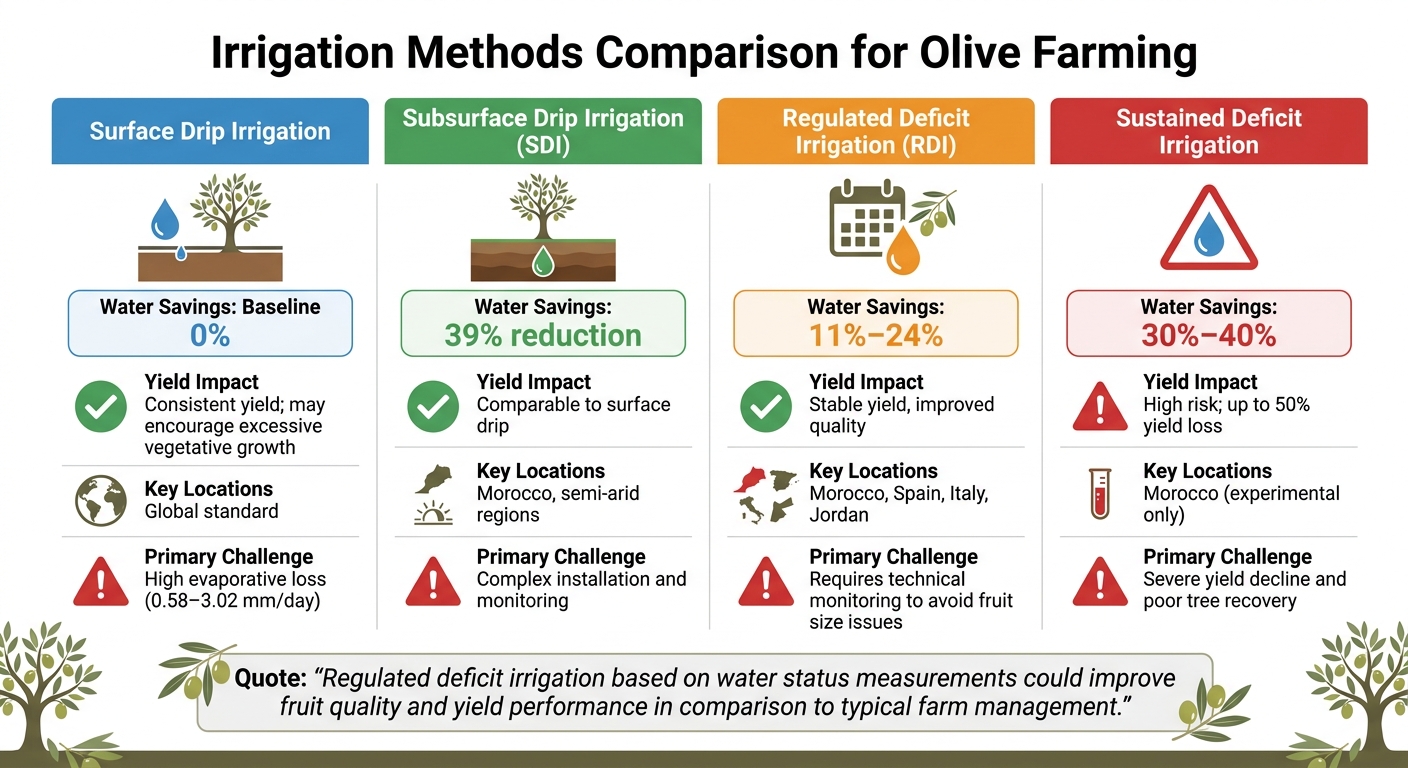
Olive Farming Irrigation Methods: Water Savings and Yield Comparison
This section breaks down the efficiency and challenges of various irrigation techniques, focusing on their impact on water conservation, crop yield, and operational requirements. Each method has its own strengths and limitations, making it crucial to understand how they fit specific farming needs.
Drip irrigation is the backbone of precise water delivery systems. By targeting the root zone with drippers, it ensures efficient water use. However, surface drip systems are prone to water loss through evaporation, especially in semi-arid regions, with rates ranging from 0.58 to 3.02 mm/day.
Regulated Deficit Irrigation (RDI) builds on drip irrigation but requires advanced management. For instance, a study conducted between 2018 and 2020 in a "Manzanilla de Sevilla" orchard in Morón de la Frontera, Spain, compared RDI to standard irrigation methods. Using midday shaded water potential measurements (targeting –3.0 MPa during pit hardening and –2.0 MPa during rehydration), the RDI approach led to larger fruits and better water efficiency. That said, it demands close technical oversight, making it more complex than fixed-schedule systems.
Subsurface Drip Irrigation (SDI) takes water efficiency to the next level. Research in Morocco's Tensift basin from May to October 2022 showed that SDI plots used only 194 mm of water compared to 320 mm for surface drip systems - a 39% reduction - while maintaining similar yields. However, SDI comes with challenges like intricate installation and the need for precise monitoring using TDR sensors.
These comparisons highlight how each method offers unique advantages and challenges, particularly in olive farming scenarios.
Irrigation Methods Comparison Table
| Method | Water Savings | Yield Impact | Key Locations | Primary Challenge |
|---|---|---|---|---|
| Surface Drip Irrigation | Baseline | Consistent yield; may encourage excessive vegetative growth | Global standard | High evaporative loss (0.58–3.02 mm/day) |
| Subsurface Drip Irrigation | 39% reduction | Comparable to surface drip | Morocco, semi-arid regions | Complex installation and monitoring |
| Regulated Deficit Irrigation (RDI) | 11%–24% | Stable yield, improved quality | Morocco, Spain, Italy, Jordan | Requires technical monitoring to avoid fruit size issues |
| Sustained Deficit Irrigation | 30%–40% | High risk; up to 50% yield loss | Morocco (experimental only) | Severe yield decline and poor tree recovery |
"Regulated deficit irrigation based on water status measurements could improve fruit quality and yield performance in comparison to a typical farm management." - Springer Nature
Choosing the right irrigation method depends heavily on local conditions and the expertise available. By weighing these trade-offs, farmers can better understand how to implement these techniques effectively in olive farming.
Lessons Learned from Olive Farmers
Some of the most successful olive farmers have shown that precision water management not only conserves water but also enhances the quality of their harvests.
Take the example of Oro del Desierto in Almeria, Spain. Rafael Alonso Aguilera's farm has gained recognition for its innovative use of subsurface irrigation. By placing irrigation pipes 16 inches (40 cm) underground, his farm reduces water evaporation and saves an impressive 40% of water compared to traditional surface systems.
"Our irrigation pipes are planted 40cm deep to stop the water from evaporating. This system alone helps us to save 40% of water compared to the pipes that are laid on the ground."
This 311-acre (126-hectare) farm operates with remarkable efficiency, using just 1,500 cubic meters of water per hectare annually. That’s only about 25% of the water consumed by nearby intensive farms. The results speak for themselves: the farm has earned 176 international awards for the exceptional quality of its olive oil.
In addition to irrigation, strategic tree spacing and advanced sensor technology play a key role in reducing water usage. At Oro del Desierto, trees are spaced 16 to 23 feet (5 to 7 meters) apart, limiting overall water demand while ensuring optimal growth. Humidity sensors monitor soil conditions and activate irrigation only when necessary - typically every 7 to 10 days, depending on the weather.
Aguilera’s approach also includes responsible water extraction. By limiting aquifer withdrawals to just 30% of capacity, the farm allows the water source to naturally recharge.
"We only take 30% of what's available in the aquifer to enable it to recharge and remain healthy."
This thoughtful combination of precision irrigation, careful tree spacing, and sustainable water practices demonstrates that conserving resources and producing high-quality olive oil can go hand in hand. It’s a model that highlights how efficiency and sustainability can coexist in agriculture.
FAQs
How do I choose between drip, subsurface drip, and RDI for my olive trees?
To decide between drip irrigation, subsurface drip irrigation, and regulated deficit irrigation (RDI), it's important to weigh factors like water efficiency, cost, and how they impact fruit quality.
- Drip irrigation: This method can lower water usage by 30-50%, enhance both yield and fruit quality, and allows for precise delivery of nutrients directly to the plants.
- Subsurface drip irrigation: By delivering water below the surface, it can reduce water consumption by as much as 60% while significantly improving efficiency.
- Regulated deficit irrigation (RDI): This approach conserves water by limiting irrigation during certain growth phases. However, it demands careful management to avoid putting unnecessary stress on the trees.
What equipment do I need to monitor tree water stress for RDI?
To keep tabs on tree water stress when using Regulated Deficit Irrigation (RDI), you'll need tools that track root activity and soil moisture. Plant-responsive irrigation systems are particularly effective, as they directly react to root signals, cutting down on the reliance on traditional sensors. While soil moisture sensors can be included for extra monitoring, they become less essential when plant-responsive systems are in place. This approach not only helps maintain the right water stress levels but also streamlines irrigation management.
Is treated wastewater safe to use for irrigating olive groves?
Treated wastewater can be safely used to irrigate olive groves when it undergoes the right processing. Studies confirm that it not only supports the healthy growth of olive trees but also aids in efficient water management. The key is ensuring the treatment process meets the necessary safety standards for agricultural purposes.