

5 EU Consumer Protections for Olive Oil Buyers
In the European Union, buying olive oil means you're protected by strict rules ensuring quality and transparency. Since November 24, 2022, two major regulations - Delegated Regulation (EU) 2022/2104 and Implementing Regulation (EU) 2022/2105 - have created a unified framework to safeguard consumers. Here's what you need to know:
- Labels Must Be Accurate: Olive oil categories like Extra Virgin and Virgin must meet specific standards, including acidity levels and clear descriptions.
- Origin Transparency: Labels must state where the olives were grown and processed for Extra Virgin and Virgin oils.
- Conformity Checks: EU member states conduct regular tests, including chemical and sensory analyses, to verify quality.
- Secure Packaging: Bottles must have tamper-proof closures and cannot exceed 5 liters in size.
- Fraud Prevention Systems: Strict penalties and traceability measures deter mislabeling and adulteration.
These protections ensure what’s on the label matches what’s in the bottle, giving you confidence in your purchase.
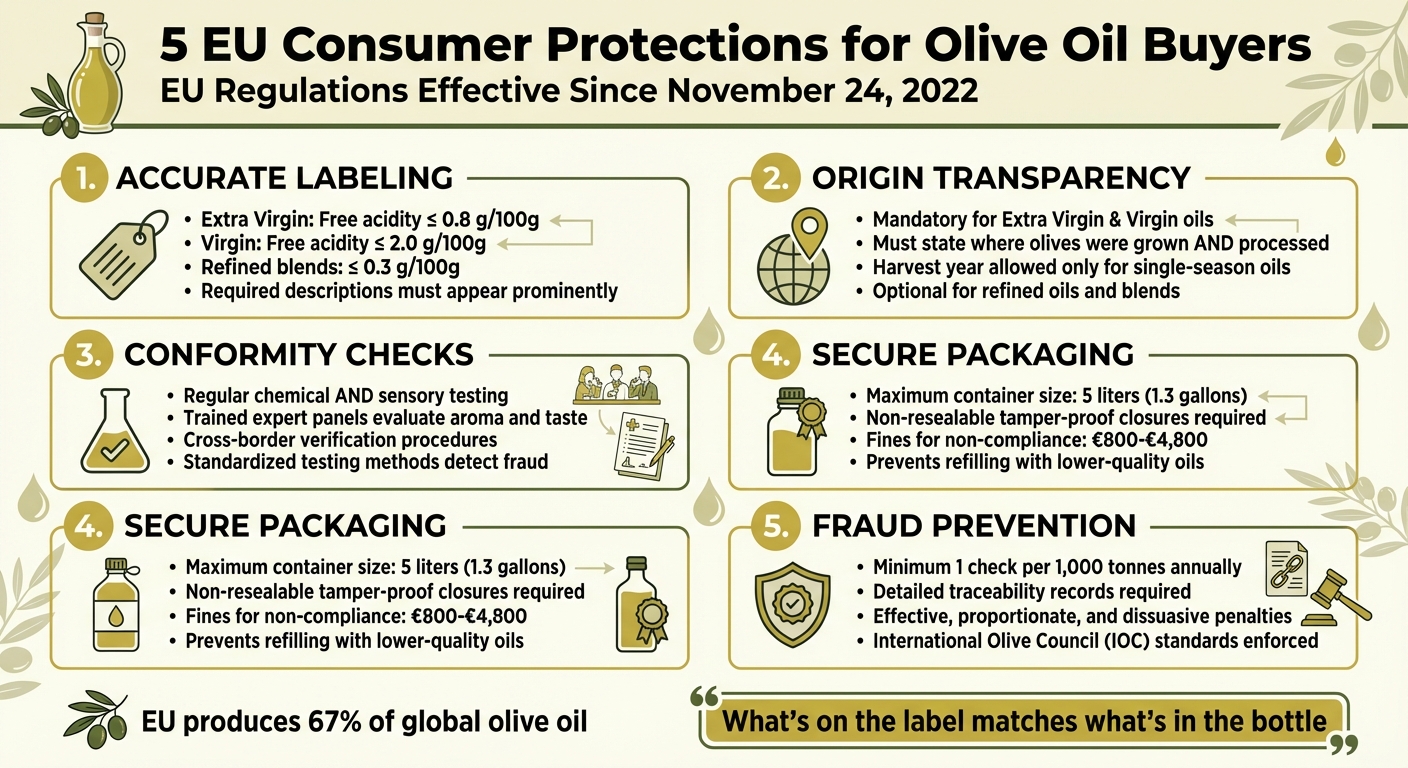
5 EU Consumer Protections for Olive Oil Buyers Infographic
1. Required Accurate Labeling of Olive Oil Categories
Transparency in Labeling
EU regulations require olive oil labels to clearly indicate the product's legal category. For Extra Virgin Olive Oil, the label must state: "superior category olive oil obtained directly from olives and solely by mechanical means." Similarly, Virgin Olive Oil labels must read: "olive oil obtained directly from olives and solely by mechanical means." These descriptions must appear prominently on the label to prevent producers from obscuring lower-quality oils with vague language. Additionally, optional terms like "first cold pressing" or "cold pressed" can only be used if the extraction process stays below 81°F (27°C) and meets specific chemical standards.
Quality Assurance Measures
Strict quality thresholds are in place to maintain olive oil standards. For Extra Virgin Olive Oil, free acidity must not exceed 0.8 g/100g, while for Virgin Olive Oil, the limit is 2.0 g/100g. Blends of refined oils must stay under 0.3 g/100g. Labels indicating a "collection campaign" or vintage are only allowed for oils from a single harvest, ensuring that producers cannot mislead consumers with blended harvest oils. These measures help uphold the integrity of olive oil quality across the EU.
Consumer Protection Against Fraud
"The stated objective is to simplify, clarify, and ensure greater transparency in the European olive oil market." – Dario Dongo, PhD in international food law, Great Italian Food Trade
To protect consumers and maintain trust, the EU enforces regular conformity checks to detect and prevent fraud. Member States are required to carry out annual checks per 1,000 tonnes of olive oil, focusing on operations flagged through risk analysis. Signs of potential fraud include unusually low pricing, suspicious blending practices, or prior non-compliance. If irregularities arise, formal cross-border verification procedures are implemented to ensure accountability.
sbb-itb-4066b8e
2. Origin and Harvest Information on Labels
Geographic Origin Transparency
When it comes to building trust with consumers, providing clear origin and harvest details plays a critical role. For extra virgin and virgin olive oils, origin labeling is legally required. This means labels must clearly indicate both where the olives were grown and where the oil was produced. If these two locations differ, both must be explicitly stated on the label. This rule prevents producers from masking the true origin of their product with vague claims about its geographic source. On the other hand, for other olive oil categories, such as refined olive oils or blends, origin labeling isn’t mandatory. This distinction makes it easier to identify products that prioritize transparency in their labeling practices.
Authenticity Verification
European Union regulations also enforce strict guidelines when it comes to harvest year claims. A harvest year can only be mentioned on the label if all the oil comes from olives harvested during that specific growing season. This prevents producers from blending oils from different years. To ensure compliance, packaging plants are required to maintain detailed storage records for each category of olive oil. These records create a clear paper trail, allowing authorities to verify the source and authenticity of the oil.
If you're looking for the freshest oil, focus on the harvest year printed on the label rather than the "best before" date. The harvest year confirms that the oil hasn’t been mixed with oils from other years, offering a more reliable indicator of quality and freshness.
| Olive Oil Category | Mandatory Origin Labeling |
|---|---|
| Extra Virgin | Yes |
| Virgin | Yes |
| Refined Olive Oil | No |
| Olive Oil (Blend) | No |
Quality Assurance Measures
Origin and harvest information isn’t just for consumer transparency - it’s also a tool for regulatory oversight. Authorities rely on this data to conduct targeted, risk-based inspections. Packaging plants can only receive approval if their storage systems allow for full traceability of oils requiring mandatory origin labeling.
If one Member State identifies issues with a product originating from another country, they are required to act quickly. Samples must be taken by the end of the following month, and results must be shared within three months. These steps ensure a coordinated effort to maintain quality and accountability across borders.
3. Conformity Checks and Sensory Testing
Quality Assurance Measures
To build trust with consumers, it's crucial that olive oil labels genuinely reflect the product's quality. In the European Union, national authorities are required to perform regular conformity checks to ensure olive oils meet the standards of their declared category. Under Implementing Regulation (EU) 2022/2105, these checks include both chemical and sensory analyses to confirm the oil's quality. This process ensures that oils labeled as "Extra Virgin" meet the high standards expected of this premium category.
For virgin olive oils, sensory testing plays a key role. Panels of trained experts evaluate the oil's aroma and taste, identifying flaws like rancidity or mustiness. This sensory evaluation complements chemical tests, catching issues that machines might miss.
Consumer Protection Against Fraud
"The olive oil marketing standards protect European Union (EU) consumers and businesses from misdescribed and adulterated olive oil products. The standards ensure olive oil is marketed fairly, facilitating trade, and provide a deterrent against fraud." - EUR-Lex
A major focus of these checks is preventing fraud, such as blending olive oil with cheaper vegetable oils or mislabeling lower-quality oils as premium. Standardized testing methods are designed to detect these issues before the products hit store shelves. Additionally, packaging plants must be officially approved, and they are required to maintain detailed records to support traceability and audits.
Authenticity Verification
When olive oil quality concerns arise in one EU country, a system of rapid cross-border communication ensures consistent enforcement across the region. National authorities follow strict timelines and procedures for sharing test results, which helps maintain uniform standards throughout the EU. This approach ensures traceability across the supply chain, giving consumers confidence that the label on the bottle matches the quality of the oil inside. These measures also strengthen protections against fraud and support quality certifications.
4. Secure Packaging and Anti-Tampering Requirements
Quality Assurance Measures
In the EU, packaging security plays a crucial role in safeguarding olive oil quality from production all the way to your table. To minimize fraud and ensure traceability, olive oil sold in the EU must be packaged in containers no larger than 1.3 gallons (5 liters). This packaging limit is just the start - manufacturers must also meet rigorous regulatory standards.
Facilities involved in packaging need formal approval from Member States. This involves maintaining secure storage systems and keeping detailed batch records. Regulatory authorities also conduct targeted inspections, focusing on facilities based on their production volume and any prior compliance issues.
Consumer Protection Against Fraud
Securing olive oil packaging goes beyond just container size. The EU has implemented specific anti-tampering measures to further protect consumers. One of the most notable requirements is that every bottle must include a non-resealable opening system. Under EU Regulation 2022/2104, olive oil packaging must feature closures that cannot be resealed after the first use. This ensures that premium bottles cannot be refilled with lower-quality or adulterated oils.
"European olive oil can never be sold in bulk: the package must always contain a closure system that maintains its integrity after the first opening." - European Olive Oil
In Italy, failing to comply with this regulation can result in fines ranging from €800 to €4,800 (around $850 to $5,100). Consumers should always check that the bottle’s seal is intact and tamper-proof before purchasing. Additionally, labels are required to provide storage instructions, such as keeping the oil away from heat and light, to help maintain its quality. These measures, combined with earlier-discussed sensory testing and conformity checks, reinforce the EU’s commitment to preventing fraud and preserving the integrity of olive oil.
Special Report 01/2026: Control systems for olive oil in the EU
5. Quality Certifications and Fraud Prevention Systems
Quality certifications add an extra layer of security to olive oil production, complementing strict packaging and conformity protocols. While packaging and conformity checks focus on maintaining product quality, certifications validate these efforts through thorough testing and meticulous record-keeping.
Authenticity Verification
To ensure authenticity, Member States are required to conduct at least one conformity check per 1,000 tonnes of olive oil annually. These checks involve tasting panels that adhere to International Olive Council (IOC) standards, with their performance reviewed every year. If an operator disputes the results of a sensory assessment, they can request up to two independent counter-assessments by approved tasting panels. Additionally, if the issue involves an operator from another Member State, cross-border administrative cooperation becomes mandatory to resolve the matter effectively.
Quality Assurance Measures
Traceability is a cornerstone of quality assurance. Operators are expected to maintain detailed records for each category of olive oil, covering every stage from milling to bottling. Member States may also approve packaging facilities that use storage systems capable of verifying the oil's origin. Authorities prioritize inspections based on risk factors, such as price anomalies compared to other vegetable oils, blending practices, or questionable quality assurance processes. To protect the oil's quality, samples must reach testing laboratories within five working days, and all analyses must be completed before the product's minimum durability date. These measures reflect the EU's dedication to safeguarding consumers.
Consumer Protection Against Fraud
The EU's marketing standards are designed to prevent lower-grade oils from being falsely marketed as premium products. According to Commission Implementing Regulation (EU) 2022/2105, "Member States shall apply effective, proportionate and dissuasive penalties to be determined in the light of the seriousness of the irregularity detected." Standardized IOC methods ensure consistent evaluation of physical and chemical properties across all Member States. This means that an Extra Virgin Olive Oil tested in Spain is held to the same stringent standards as one tested in Germany or France, ensuring uniformity and fairness for consumers.
Conclusion
The EU regulatory framework has become the gold standard for ensuring olive oil quality and trustworthiness. With the EU accounting for around 67% of global production, these rules guarantee that what’s on the label matches what’s in the bottle - whether it’s Extra Virgin Olive Oil with an acidity level of 0.8% or less, or accurately labeled blends. As the European Commission states, "The olive oil marketing standards protect European Union (EU) consumers and businesses from misdescribed and adulterated olive oil products".
A combination of protections works to create a fair and transparent market. Measures like mandatory labeling, origin disclosure, thorough conformity checks, and tamper-evident packaging all work together to prevent fraud and maintain the integrity of the product. These efforts highlight the EU's dedication to safeguarding quality.
For consumers, these standards do more than ensure quality - they empower informed choices. When buying olive oil, check for compliance with EU rules: look for the correct legal category name, origin details, and an intact tamper-evident seal. Additional information like the harvest year or extraction method can further confirm adherence to these rigorous standards.
At Big Horn Olive Oil, we take these principles seriously. Our Ultra Premium Extra Virgin Olive Oils are cold-pressed within just two hours and delivered fresh within three months, meeting the strictest global benchmarks. Whether it’s our Estate Reserve Ultra Premium EVOO or single-source varieties like Picual or Coratina, every bottle reflects the same commitment to quality and authenticity outlined by EU regulations.
From accurate labeling to protective packaging, these measures ensure both quality and trust. By choosing certified olive oils from reputable sellers, you’re not just purchasing a product - you’re supporting a transparent and reliable market while enjoying authentic olive oil with outstanding flavor and health benefits.
FAQs
How can I tell if an olive oil label is EU-compliant?
To ensure an olive oil label complies with EU standards, check for key details such as the product category (like extra virgin) and its origin. These EU marketing standards are in place to guarantee accurate labeling, safeguarding both the quality of the product and its authenticity. Regular updates to these rules help promote transparency and build trust with consumers.
What’s the difference between harvest year and “best before”?
The harvest year marks the time when the olives were picked, while the best before date reflects how long the olive oil is expected to retain its optimal quality. The best before date is a better indicator of freshness and shelf life since it considers factors such as storage conditions and processing methods.
What should I look for in a tamper-proof olive oil bottle?
To ensure the olive oil you’re buying is genuine and safe, choose a bottle with a secure seal, such as a shrink band or a tamper-evident cap. Additionally, check for a certification label or a Declaration of Compliance, which indicates the product meets EU standards. These details safeguard the oil’s quality and ensure its integrity.