

EU Olive Oil Traceability: Cross-Border Insights
If you buy olive oil across EU borders, the safest bets are usually Spain and Italy. Their digital registers make lot checks easier, while Greece, France, Germany, and Ireland rely more on mixed records, importer files, or label checks.
Here’s the short version:
- Spain has deep digital movement logs and pre-shipment bulk records.
- Italy has strict batch, grading, and harvest-year controls, plus heavy inspection activity.
- Greece is still building out its registry system, and export records can be uneven.
- France leans more on documents and label wording than on one olive-oil register.
- Germany and Ireland mostly depend on supplier records because they are downstream markets.
- Blends are the weak point. Single-country oils are easier to trace. Mixed-origin oils take more manual checking.
A few facts stand out:
- Italy reported 7,200+ inspections in 2025
- Italy seized 220,000 kg of EVOO in one case tied to record gaps
- Greece’s sampled irregularities reached nearly 15% in 2022
- Germany imported 71,609 tons of olive oil in 2024, worth €657 million
If I were buying for the U.S. market, I’d check three things first:
- Origin
- Harvest year
- Lot-level records before shipment
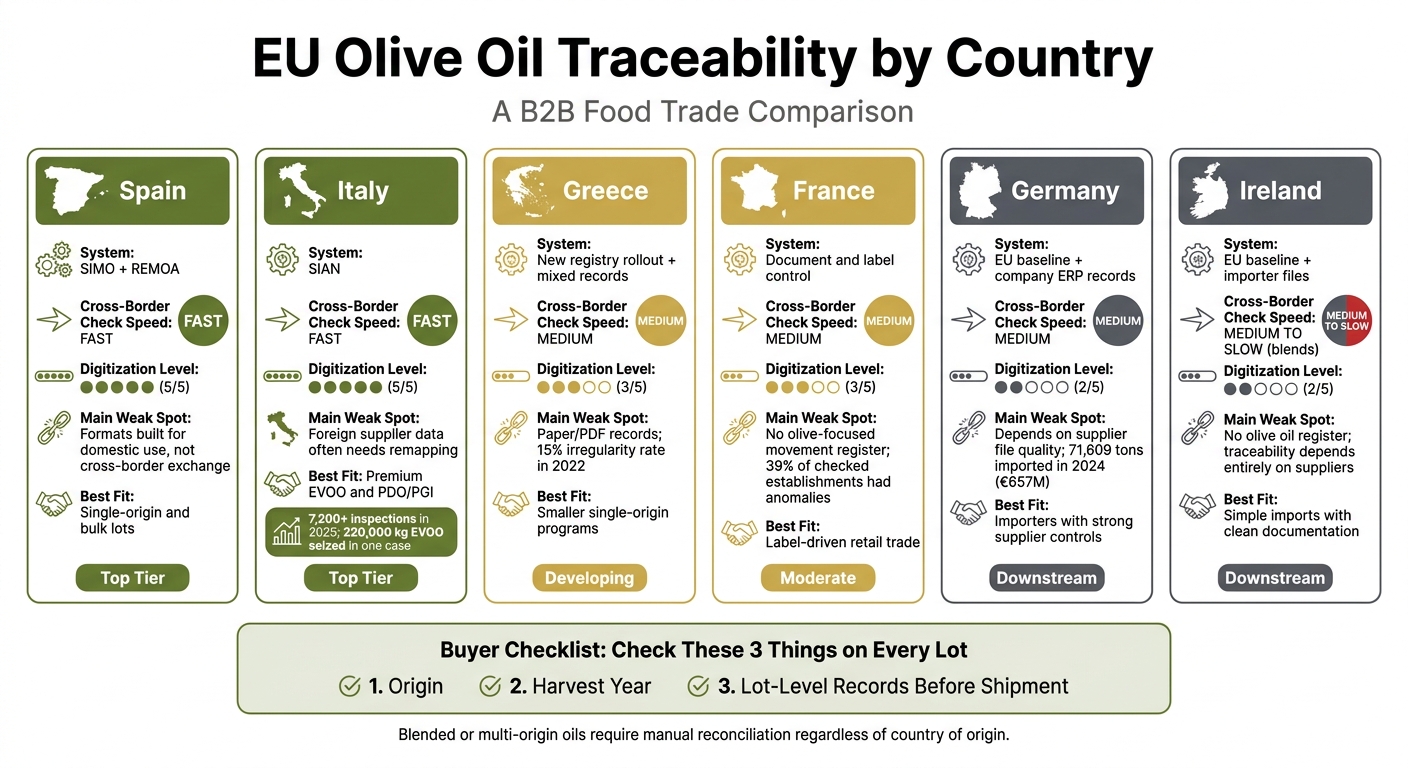
EU Olive Oil Traceability by Country: Speed, Strength & Weak Spots
Special Report 01/2026: Control systems for olive oil in the EU
sbb-itb-4066b8e
Quick Comparison
| Country | Main system | Cross-border check speed | Main weak spot | Best fit |
|---|---|---|---|---|
| Spain | SIMO + REMOA | Fast | Data format is built more for Spain than for other countries | Single-origin and bulk lots |
| Italy | SIAN | Fast | Foreign supplier data often needs remapping | Premium EVOO and PDO/PGI |
| Greece | New registry rollout + mixed records | Medium | Paper/PDF records and lower check depth | Smaller single-origin programs |
| France | Document and label control | Medium | No olive-focused movement register | Label-driven retail trade |
| Germany | EU baseline + company ERP records | Medium | Depends on supplier file quality | Importers with strong supplier controls |
| Ireland | EU baseline + importer files | Medium to slow for blends | No olive oil register; English label updates | Simple imports and re-export with clean docs |
Bottom line: I see one clear pattern here. The more digital and lot-based the national system is, the easier it is to support origin and harvest-year claims. Once oil is blended, re-bottled, or moved through countries with mixed record formats, the workload goes up and proof gets thinner.
So this article is less about olive oil labels and more about one plain question: can the supplier prove every claim on the bottle with records that match?
1. Spain
Spain runs one of the EU’s most centralized olive oil traceability setups. Two national systems are at the center of it: SIMO (Sistema de Información de los Mercados Oleícolas), which tracks production, stock, and output data, and REMOA (Registro de Movimientos de Aceite de Oliva y de Orujo de Oliva a Granel), which records bulk movements of olive oil and olive-pomace oil. Put together, they give regulators one shared view of domestic movements. That becomes especially important when oil moves across borders.
Register sophistication
What makes Spain stand out is the breadth of records it requires. Every movement has to be logged right away, including transfers inside the same facility. If oil is shipped outside the site, the movement must be registered in advance, before the product leaves the plant. That process creates a transport document that stays with the oil for the full trip. Operators also have to file annual compiled traceability reports that cover all entries, exits, and internal movements by oil category. In plain terms, Spain asks for far more detail than the basic EU rules.
Origin and harvest-year controls
Spain treats origin verification as a main checkpoint across the supply chain. Electronic registers connect each batch to the area where the olives were harvested and the mill where they were processed. In some regions, the link can go even further, down to the farm parcel. Harvest campaign details, such as 2024/2025, along with processing dates, are core fields in each batch traceability record. For importers, that means claims like “Product of Spain” or a named regional origin on extra virgin and virgin olive oil labels can be checked against recorded harvest and milling locations.
Cross-border data compatibility
Spain and Italy are the only EU member states that require electronic registers for every olive oil movement, but Spain’s formats were built for domestic control, not easy cross-border exchange. So what happens when a multi-origin EU blend includes Spanish oil and oil from a country using non-standardized or paper-based records? The importer has to line up the records by hand. That’s why Spanish lots are usually easier to verify than lots coming from less digitized systems.
Enforcement intensity
The Agencia de Información y Control Alimentarios (AICA) runs Spain’s digital movement register and monitors compliance across the supply chain, from mills and storage sites to refineries, packers, and traders. The Ministry of Agriculture uses SIMO and REMOA data to focus on higher-risk operators and issue anti-fraud guidance. Buyers still need REMOA movement documents and analysis bulletins for bulk shipments.
Spain is the benchmark for digitized traceability, but its system is not the same as Italy’s. That difference makes the comparison useful.
2. Italy
Italy is on par with Spain in digitization, but it goes further on classification and label accuracy. The backbone of that system is SIAN, a mandatory national register that tracks every olive-oil movement by facility. Since January 1, 2014, any operator that produces, stores, or sells olive oil or olive-pomace oil must record inbound and outbound movements in SIAN for each facility or depot. That includes mills, bulk traders, bottlers, refineries, pomace dealers, and growers who sell their own oil.
Register sophistication
Italy’s register covers all olive-oil categories, including PDO/PGI and pomace oils. And the timing rules are tight.
Olive deliveries to mills must be recorded within hours of purchase. New oil must then be graded as extra virgin, virgin, or lampante and entered into SIAN within days of milling. Once that classification is done, storage tanks have to be relabeled right away, so oil doesn’t sit for long under a vague “awaiting classification” status.
In practice, many operators rely on register-sync software to keep internal records lined up with SIAN deadlines. That matters because even small delays can create gaps between what’s in the warehouse and what shows up in the register.
Origin and harvest-year controls
Italy adds another layer with mandatory harvest-year labeling and pre-classification origin records for bulk oil. It also sets fixed deadlines for classifying oil from prior campaigns, which makes it harder to mix old and new oil without saying so.
For PDO/PGI extra virgin oils, the system gets tighter still. Italy uses numbered labels with security elements and QR codes tied to product information. If the label, invoices, and register data don’t match, that can trigger enforcement.
That’s the big idea here: the paper trail, the digital trail, and the physical product are all supposed to say the same thing.
Cross-border data compatibility
SIAN also tracks imports and re-exports, including oils moved under the Active Refinement Traffic (TPA) regime. Under TPA, foreign oil enters Italy for processing and is then re-exported. Register operation codes separate the acceptance, processing, and export of foreign oils, which helps stop false origin claims.
For foreign suppliers, this is often where things get messy. SIAN asks for batch-level detail on origin, quality category, and volume, and many international ERP systems don’t track that by default. So even when the oil is fine, the data may not be ready in the format Italy wants.
The usual fix is pretty practical:
- Match internal lot codes to Italian batch IDs
- Build data interfaces that send movement records into Italian partners’ register software before the filing deadlines
That setup helps foreign buyers too, but only if supplier systems can export lot data in a SIAN-ready format.
Enforcement intensity
Italy’s system is enforced by the Ispettorato Centrale della Tutela della Qualità e della Repressione Frodi (ICQRF), often working with the Guardia di Finanza. Controls on olive oil rose 21.1% from 2023 to mid-2026, and there were more than 7,200 inspections in 2025.
One case in Puglia shows how this works on the ground. ICQRF and the Guardia di Finanza seized 220,000 kg of extra virgin olive oil, worth about €1.3 million (around $1.4 million), after finding differences between electronic registry records and actual warehouse stocks.
For U.S. buyers, the most direct checks are simple:
- Ask for batch IDs
- Ask for campaign-year classification
- Ask for TPA status when it applies
Those details help confirm that what appears on the label matches what sits in the system.
Italy sets a tough standard with its register and label rules. Still, once oil moves across borders, verification depends on how well foreign records map into SIAN. Italy may run a tighter system at home, but when oil enters less digitized channels, manual reconciliation often comes back into the picture.
3. Greece
Unlike Spain’s more centralized setup and Italy’s tighter register rules, Greece is still pulling its traceability system together. The new Olive Registry will include groves with at least 21 olive trees and will require annual online harvest declarations starting October 1, 2026. A separate registry will track processing and packaging facilities.
That said, many smaller mills and cooperatives still use a mix of paper records and digital files. In practice, that makes stock movements harder to track in real time and leaves cross-border data sharing unsettled.
Register sophistication
For PDO/PGI oils, including Kalamata and Sitia, the controls are stricter. Producers have to keep records that connect each lot to registered groves inside the protected area. They must also file production declarations right after harvest, showing olive quantities by municipality and oil output by category.
Those records must be kept for five years. That gives PDO and PGI oils a stronger paper trail, but exporters still depend on the quality of those files once a shipment moves across borders.
Origin and harvest-year controls
For non-GI extra virgin and virgin oils, official checks are less detailed. Greek conformity checks usually follow a one-step-back model, meaning inspectors verify only the immediate supplier instead of tracing the full chain back to the farm.
For cross-border buyers, that’s a problem. If you need farm-level proof, the default control system may not give you enough.
Cross-border data compatibility
The main issue isn’t the data itself. It’s the format.
Smaller Greek exporters often send PDFs or scanned documents instead of structured digital records. So buyers pulling files from several EU suppliers still have to do extra manual work to standardize Greek records. Larger exporters and cooperatives are moving toward standardized digital interfaces, but the gap is still there.
U.S. buyers should ask for a full lot file that ties these records to the same lot code:
- mill records
- tank records
- bottling records
- commercial records
At that point, verification depends less on the law and more on how cleanly the supplier can hand over the data.
Enforcement intensity
EFET inspects olive oil for fraud, but recent EU audits have pointed to serious weak spots in Greece’s control system. Greek authorities fell below EU minimum check levels in most years from 2018 through 2023, with 2023 as the only exception.
By 2022, irregularities in sampled oils had climbed to nearly 15%, up from 9.4% in 2021. EU auditors also found that Greek conformity checks apply to oil produced for the domestic market, while imports and exports are left out. That creates a clear gap for cross-border traceability.
So for exported lots, official records by themselves don’t tell the whole story. High-value shipments should also be supported by third-party certification or private audits.
4. France
France puts less weight on movement registers and more on paperwork and label accuracy. In practice, that means inspectors focus on records and label claims instead of relying on one central olive-oil movement register.
Register sophistication
France's system is best described as moderate documentation control. Spain and Italy lean more heavily on movement registration. France leans more on documentary proof.
The Institut National de l'Origine et de la Qualité (INAO) oversees France's official quality and origin schemes, known as SIQO, including PDO and PGI designations. Those schemes come with tighter documentation and production-method controls than the basic EU standard. They are backed by state-approved rules and regular checks.
Origin and harvest-year controls
When the harvest country and milling country are not the same, labels must use exact wording, such as extra virgin olive oil obtained in [Member State] from olives harvested in [country]. That has a direct effect on cross-border shipments moving through France.
This is where things can get tricky. Blended lots and foreign-origin oils need document wording that matches the actual supply chain, not just what appears on the label. For importers and exporters, exact label language matters just as much as the physical route the oil takes.
Harvest-year claims are also strict: 100% of the oil must come from one harvest year.
Enforcement intensity
The DGCCRF, France's consumer protection and fraud control authority, carries out active, risk-based conformity checks across the olive oil supply chain. And the numbers are hard to ignore.
In one DGCCRF investigation, 39% of the 211 establishments checked had anomalies. On top of that, more than 80% of the 130 products analyzed had faults tied to labeling, declared origin, and mixed oils.
For cross-border shippers, France tends to reward one thing above all: fast, inspection-ready lot-level files.
5. Germany
Where France leans on paper trails and Spain and Italy rely on dense movement logs, Germany takes a different path. It sits at the downstream end of EU olive-oil trade, so it leans on the EU traceability baseline instead of running a national movement register.
Register sophistication
Spain and Italy go past EU minimum rules with mandatory electronic movement registers, while Germany stays closer to the baseline. On the ground, German importers and packers usually track batches through ERP systems, warehouse software, and digital archives at the company level.
That setup works inside Germany. But there’s a catch: it still depends on foreign suppliers sending clean, usable lot-level data. If that data is messy or incomplete, the whole chain gets harder to follow.
Origin and harvest-year controls
Germany applies EU marketing standards for olive oil, including origin labeling for extra virgin and virgin oils. Harvest year can appear only when 100% of the contents come from a single harvest.
In 2024, Germany imported 71,609 tons of olive oil worth €657 million, which shows just how much the market depends on cross-border paperwork and supplier records.
Cross-border data compatibility
The main issue isn’t whether records exist. It’s whether records from different countries line up in a usable format.
That’s where friction shows up. Spanish and Italian movement data often has to be translated into German importer systems, and that handoff can get clunky. The European Commission is pushing for compatible registers and cross-border data sharing through 2027–2028.
For now, German importers that work with upstream producers already using electronic registers have an edge. When authorities ask for documents, those businesses can usually pull records together with less scrambling.
Enforcement intensity
German authorities operate under EU official control rules and the German Food and Feed Code (LFGB), which gives them the power to inspect, sample, and audit. Enforcement is risk-based, and extra virgin olive oil, organic claims, and PDO/PGI labels tend to draw the closest review.
For exporters, the fastest way through a German compliance check is simple: have audit-ready certificates of analysis, certificates of origin, and batch records on hand.
6. Ireland
Ireland is probably the clearest downstream test of EU traceability. In practice, imports depend on supplier records rather than a national movement register. Because Ireland is mainly an importing and re-exporting market, it follows the EU’s baseline traceability rules, with enforcement led by the Food Safety Authority of Ireland (FSAI), instead of using a dedicated national olive oil register.
Register sophistication
Irish food businesses must keep supplier and customer traceability records under EU rules. But for olive oil, there’s no state-run electronic register. That means paper files, spreadsheets, and ERP systems are all fine, as long as the records can be retrieved when needed.
Some firms go a step further and use QR-based tools. Still, those tools are optional, not required.
Origin and harvest-year controls
Extra virgin and virgin olive oils must include the required origin wording, and the FSAI treats olive oil as a mandatory-origin food. Harvest-year claims are allowed only when 100% of the oil comes from a single harvest.
There’s also a practical label issue here. Imported products often need market-specific label text, or a sticker update, before they can be sold at retail. That’s because all food information has to appear in English.
Cross-border data compatibility
Ireland accepts EU traceability documents, but the main snag is data format, not the legal rules. Upstream batch numbers, origin documents, and lab analyses are folded into Irish importer records. The trouble is that some producing countries use detailed electronic registers, while others still rely on a mix of paper and digital files. That creates a gap in detail that can be hard to bridge.
Enforcement intensity
The FSAI and authorized officers can enter premises, inspect records, and take samples to check compliance. If a business falls short, the result can be relabeling, product withdrawal, or prosecution.
For cross-border trade, that puts the pressure squarely on two things: accurate labels and lot records that can be pulled up without delay.
Trade Impact, Compliance Friction, and Buyer Takeaways
These six national systems don't work as one smooth setup. Once olive oil crosses a border, the differences between them start to matter. In practice, that means delays, more paperwork, and more chances for a claim to get challenged. Spain and Italy tend to move fastest because both rely on fully digital systems. The biggest snags usually show up when oil is blended or re-bottled across borders.
Blending and re-bottling create a traceability checkpoint at every handoff. Labels need to state multi-origin status clearly, and harvest-year claims only apply when the full container comes from one harvest. That means both sides of the trade need clean blending logs and source records. EU auditors have also warned that cross-border traceability for blends is hard to verify under current systems, which makes origin claims tougher to confirm and fraud harder to spot across Member State borders. That's why buyers should ask for a complete lot file before shipment, not after.
For premium U.S. buyers, the bar is higher. A supplier should be able to support every label claim with a full traceability record. That usually includes harvest dates, extraction records, physico-chemical analyses like free acidity, peroxide value, and UV absorption, along with lot-level origin data. In plain terms, if a seller makes a claim, the paperwork should match it line by line.
That kind of file is usually easier to pull together from Spanish and Italian producers because their systems are more integrated and digital. It gets less clear with multi-origin blends put together in non-producing markets, where records may come from several sources and arrive in different formats.
The summary below shows how those gaps affect speed, workload, and export readiness.
| Country | Verification Speed | Docs Burden | Fraud Control | Premium Fit |
|---|---|---|---|---|
| Spain | Fast - fully digital | High; structured and standardized | Strong - sector-specific audits, PDO/PGI controls | Excellent |
| Italy | Fast - electronic register | High; farm-to-mill batch records required | Strong - PDO/PGI schemes, sensory panel checks | Excellent |
| Greece | Moderate - progressing digitally, but interoperability and language gaps remain | Moderate; cooperative systems vary | Good, but enforcement can vary regionally | Good for single-origin; variable for bulk |
| France | Moderate - general food law, no olive-specific register | Moderate; HACCP-based, not sector-specific | Good for retail fraud detection; weaker upstream | Moderate |
| Germany | Moderate - broad food safety framework | Moderate; importers must bridge format gaps | Good at retail level; relies on supplier data | Moderate |
| Ireland | Slower for complex blends - no national register | Lower for simple imports; higher for re-export | Dependent on upstream supplier quality | Variable; strong only with robust supplier docs |
You can see the pattern pretty fast. Countries with olive-specific digital records tend to verify faster and give buyers more confidence. Once the chain depends on mixed sources, importer-side assembly, or non-standard records, the workload climbs.
Pros and Cons by National Approach
The main trade-off is simple: the tighter the register, the stronger the proof - but the more work it takes to file and maintain it.
Spain and Italy run the EU's most detailed olive oil registers. That helps with fraud control, but it also adds more paperwork. Italy's telematic register is one of the most detailed national systems in the EU. Greece takes a lighter approach, which can make compliance easier for smaller producers, but it leaves real blind spots in fraud detection and deeper origin checks. France leans on general food-law controls instead of an olive-oil-specific register, and that has left gaps in origin-label enforcement. Germany and Ireland operate mostly farther down the supply chain, so compliance is more practical for their position, but they depend much more on the quality of records coming in from other countries.
Single-origin oil is usually the easiest to verify. Blends are where the cracks start to show.
The table below shows where each national approach helps buyers - and where it can slow things down.
| Country | Main Strengths | Main Weaknesses |
|---|---|---|
| Spain | Most granular digital traceability; high verification speed; high paperwork load | High administrative cost; national system limits cross-border interoperability |
| Italy | Electronic register; detailed origin verification | High administrative burden, especially for smaller operators |
| Greece | Lower compliance burden for small operators; simpler documentation requirements | Checks often limited to the first-level supplier; weaker fraud detection and cross-border tracing |
| France | Producing Member State with conformity controls; general food-law controls | No olive-specific register; enforcement gaps on origin labeling; weaker upstream traceability for blends |
| Germany | Lower administrative cost; import and retail-level controls | Limited upstream visibility; relies on documentation from other Member States |
| Ireland | Simpler compliance for straightforward imports | No dedicated olive oil register; traceability depth depends on supplier documentation |
One point from a European Court of Auditors case study stands out: single-member-state oils traced cleanly, while several blended and mixed-origin oils failed origin traceability. That's the pressure point. When an oil comes from one country, the paper trail is often straightforward. Once oils are mixed, weak spots between national systems become much easier to spot.
For buyers, the practical test is plain enough: can each claim be supported by lot-level records before shipment? For U.S. buyers, the takeaway is hard to miss: the farther an oil moves from Spain or Italy, the more of the paperwork you need to check on your own.
Conclusion
This trade friction comes down to one thing: can a lot be traced cleanly across borders? Spain and Italy set the bar for cross-border verification because their electronic registers create inspectable lot histories. That gives buyers documented proof to back up what the label says. Cross-border blends are tougher to verify, especially when oil passes through more than one jurisdiction.
The issue is not the rules themselves. The issue is uneven enforcement. Cross-border trade starts to crack when records are no longer interoperable. In practice, the same EU rule can lead to very different proof standards from one member state to another.
That’s why the buying decision should start with documents, not the bottle. For U.S. buyers, check three things on every lot:
- Origin
- Harvest year
- Lot-level records
For extra virgin and virgin olive oil, the label origin must match the harvest and milling locations, and a harvest-year claim is valid only when the entire container comes from one crop year. Any supplier should face the same checklist. If origin, harvest year, and documentation line up, traceability is clear. If even one piece is vague, pause the purchase.
FAQs
Why are Spain and Italy easier to verify?
Spain and Italy are often easier to verify because both countries have put serious money and effort into large-scale regulatory systems built to handle high production volumes.
Italy often uses advanced electronic systems and blockchain-ready databases to track olive oil from tree to bottle. Spain takes a layered approach, with strict export testing as part of the process. Both countries also use risk-based inspections and IMSOC to help coordinate cross-border investigations in an efficient way.
Why are blended olive oils harder to trace?
Blended olive oils are harder to trace because they combine oils from different groves, harvest dates, or olive varieties. Once that mixing starts, the supply chain gets more tangled. To keep the trail clear, producers need careful lot-by-lot records and strict batch separation.
They can also be harder to verify when fraud enters the picture. A blend that includes deodorized lampante or lower-cost seed oils can look a lot like a genuine product in standard testing.
What documents should I ask for before shipment?
Ask for documents that verify the oil’s origin, category, and quality for compliance.
That usually means checking records tied to the product itself, such as:
- Harvest dates
- Batch numbers
- Processing details, including temperature logs
- Chemical and sensory test reports that confirm the declared classification
It also helps to request administrative and accounting records that show the chain of custody from start to finish.
If the label uses PDO or PGI, ask for those certifications too.