

5 Ways Traceability Systems Improve Consumer Confidence
If a premium olive oil or balsamic vinegar claim can’t be checked, it’s just a label.
I see the main point like this: traceability systems help shoppers trust premium food by linking the bottle to records they can review. That matters in olive oil, where the U.S. uses 100 million+ liters a year and fraud remains a known issue. In this article, I cover five clear ways traceability supports buyer confidence:
- Verified origin so the stated source can be checked
- Fraud control to help limit dilution, substitution, and grade mix-ups
- Shared quality records so each step uses the same batch data
- QR access so shoppers can scan and view product details fast
- Documented proof so label claims are backed by records, not just words
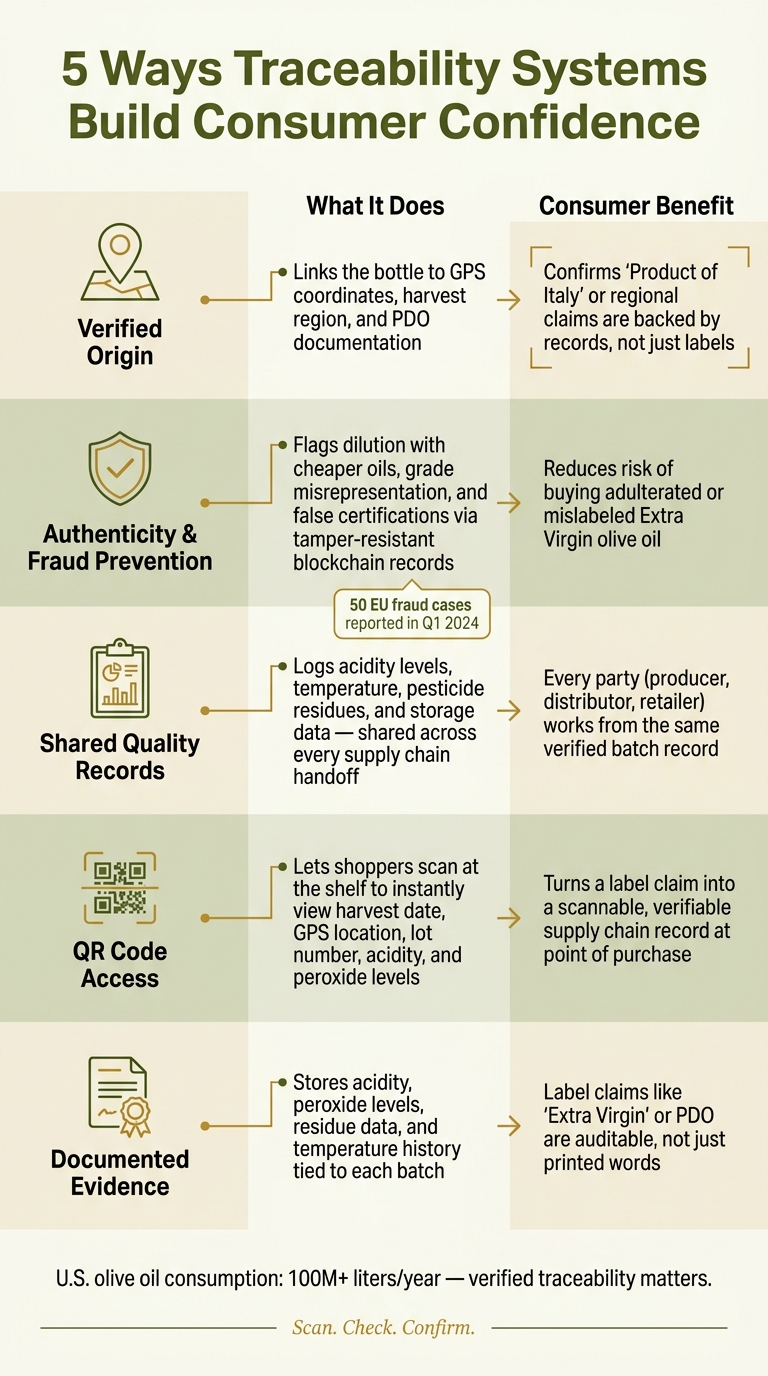
5 Ways Traceability Systems Build Consumer Confidence in Premium Olive Oil
Is your olive oil real or fake? How the Food Detectives can fight fraud using DNA tests
sbb-itb-4066b8e
Quick Comparison
| Traceability method | What I look for as a shopper | Why it helps |
|---|---|---|
| Origin records | Region, producer, harvest source | Shows where the product came from |
| Fraud checks | Lab data, lot tracking, sealed records | Helps spot mixing, false grade claims, and fake origin claims |
| Shared batch data | Acidity, storage, transport logs | Shows whether handling stayed within spec |
| QR code access | Scan-to-view history and certifications | Lets me check product info at the shelf |
| Claim support | Records tied to “Extra Virgin,” PDO, or source claims | Gives the label proof behind it |
The short version: when shoppers can scan, check, and match a product’s claims to recorded data, confidence is more likely to follow.
5 Ways Traceability Builds Consumer Trust: A Quick Overview
Before we get into the details, here’s the main point: each traceability system fixes a different trust problem, from where a product came from to whether its claims can be backed up. Put together, these tools turn supply chain data into proof shoppers can check for themselves.
| Traceability Mechanism | Consumer Benefit |
|---|---|
| Verified Origin | Confirms the product's source and stated region |
| Authenticity Checks | Helps prevent dilution, substitution, and grade mislabeling |
| Shared Quality Records | Shows how the product was handled throughout the supply chain |
| Scan-Accessible Product Info | Lets shoppers access history and certifications instantly |
| Documented Evidence | Supports label claims with verified records |
Digital traceability also makes fraud harder to hide because each key step is recorded.
The five sections below walk through each mechanism in order.
1. Verifies Where a Product Comes From
A label can say "Product of Italy," but traceability shows whether that claim is backed by records.
Origin Proof
The first trust test is simple: does the label line up with the documented source?
Traceability systems can log each step from grove or vineyard to bottle. That makes origin easier to check and harder to tamper with. And because records are tougher to change after the fact, the product history carries more weight.
"By securely recording every transaction and movement within the supply chain, blockchain can provide an unalterable history of a product's journey from producer to consumer." - Vassilios Vitaskos et al., Informatics Laboratory, Agricultural University of Athens
That matters in a market where olive oil fraud and mislabeling are still common. The European Union reported 50 cases in the first quarter of 2024.
Traceability can also show whether a PDO claim matches the stated region. For Big Horn Olive Oil's Modena balsamic vinegar, that record confirms origin.
Some brands put these records behind a QR code, so shoppers can scan and view source and certification details on the spot.
Once origin is checked, the next step is asking whether the product is authentic.
2. Confirms Product Authenticity and Reduces Fraud
Olive oil is one of the most adulterated foods in the world. That’s why proof of authenticity isn’t a nice extra. It’s a must.
Authenticity Verification
Fraud in olive oil usually shows up in a few common forms: mixing premium oil with cheaper seed oils, labeling lower-grade oil as Extra Virgin, or making false certification claims. Traceability systems help limit those risks by creating a tamper-resistant record that’s tough to change later.
| Fraud Type | Traceability Solution | Consumer Benefit |
|---|---|---|
| Dilution with cheaper oils | Lab-measured quality data + blockchain records | Authentic product |
| Grade misrepresentation | Acidity thresholds enforced at key checkpoints | Accurate Extra Virgin grade |
| False origin or PDO claims | GPS tracking + PDO verification | Verified origin |
| Counterfeiting | Unique QR codes + digital identifiers | Genuine packaging and brand |
Quality Record Sharing
Authenticity is only part of the picture. Handling data adds another layer of proof.
Traceability systems can also log acidity, temperature, and pesticide data. If a batch fails, it can be flagged before bottling. That matters because a label alone can say one thing, while the production record tells the full story.
Consumer-Visible Transparency
This proof matters most when shoppers can see it for themselves. QR-enabled traceability gives them a direct way to check the label on the spot.
A quick scan can show the harvest year, milling location, lot number, and lab results - turning a claim into proof.
For Big Horn Olive Oil's Modena balsamic vinegars, that record links the bottle to its source.
3. Shares Quality Data Across the Supply Chain
Once a product's origin is confirmed, the next step is simple: does everyone handling it see the same quality data?
Quality Record Sharing
Traceability helps producers log acidity, temperature, and lab results one time, then share that same batch record across the supply chain. Smart contracts can check incoming data against preset quality thresholds - for example, acidity limits for extra virgin olive oil - and can trigger alerts or stop a shipment if a batch falls short.
That means the product's quality story doesn't change from one stop to the next. The producer, distributor, retailer, and inspector all work from the same record.
Direct Consumer Access
At the shelf, a QR code can send shoppers straight to the batch record. In plain English, it gives them a direct look at what happened before that product reached the store.
Here's what that shared data usually includes:
| Data Category | What Gets Shared | Why It Matters |
|---|---|---|
| Batch Quality Checks | Acidity levels, pesticide residues, lab results | Confirms the product meets grade standards throughout the chain |
| Quality Records | Transport temperature, humidity logs, storage duration | Shows the product was handled correctly at every handoff |
| Certification IDs | Blockchain transaction IDs, organic certifications | Gives consumers direct access to verified batch documentation |
Everyone in the chain can check the same batch record.
4. Gives Consumers Direct Access to Product Information
Shared records only matter if shoppers can actually see them. That’s where QR codes come in.
When batch data moves through the supply chain, a quick scan can pull up the record on the spot. At the shelf, that gives buyers a direct way to check what’s behind the label instead of taking the brand’s word for it.
What a Scan Reveals
A QR code on an olive oil bottle can surface the supply chain record logged earlier in the process, including cultivar type, GPS coordinates, PDO verification, harvest date, and key quality metrics like acidity and peroxide levels. In plain English, shoppers can check origin right at the point of purchase.
One documented implementation showed consumers scanning a QR code on a 500 mL bottle to view the full supply chain history, including cultivar type, GPS location, and harvest maturity. A scratch-off layer protected the QR code so only the final buyer could access the unique digital certificate.
"With the adoption of blockchain technology, consumers gain full visibility into and assurance of the quality and safety of the food they consume." - MDPI
That shifts the label from a simple claim to a scannable record. For Big Horn Olive Oil's Ultra Premium EVOOs and Modena Balsamic Vinegars, that kind of access links the bottle straight to its verified source.
| Data Point Accessible via QR | What It Shows |
|---|---|
| GPS Location | Exact orchard coordinates and PDO/PGI verification |
| Harvest Date | The specific day olives were picked |
| Chemical Metrics | Acidity and peroxide levels confirming Extra Virgin grade |
Shoppers can check those claims for themselves. And the same scan-ready record backs up the documented proof behind safety and quality claims.
5. Backs Up Safety and Quality Claims with Documented Evidence
Once shoppers can scan the record, they want to know one thing: does the data back up what's on the label?
A bottle can say Extra Virgin. Traceability shows whether that claim holds up. It turns printed language into records people can check. And for premium olive oil and balsamic vinegar, that's what gives the label weight.
Origin records link the bottle to a verified region. That means claims like Product of Italy or PDO can be audited instead of taken at face value. Tamper-resistant records also make it easier to spot dilution, substitution, and grade mislabeling.
Batch records can store data such as:
- acidity
- peroxide levels
- residue data
- temperature history
That record helps show the product stayed within spec. And with QR codes or lot numbers, shoppers can pull up the supporting records themselves.
"Traditional management practices have proven insufficient to prevent widespread cases of adulteration, counterfeiting, and mislabeling in the global market." - Lucas Fonseca Muller, Federal University of Pelotas
When the proof is this easy to see, consumer confidence doesn't have to rest on claims alone.
Conclusion
Traceability turns label claims into proof people can verify. From origin and purity to quality, access, and paperwork, it gives shoppers evidence they can check for themselves. And in a category with a lot of fraud, that proof is what makes premium claims believable. When that information moves through the supply chain and shows up through QR codes, buyer confidence tends to follow.
Big Horn Olive Oil reflects that bar with Ultra Premium EVOO and Modena balsamic vinegars.
FAQs
How does traceability work?
Traceability follows olive oil from the grove to your table. The goal is simple: give people a clear view of where the oil came from and how it moved through production and shipping.
Each batch receives its own digital record. Producers update that record at each stage, from harvest and milling to bottling and distribution.
Consumers can check this information by scanning a QR code or entering a batch code online. Depending on the producer, the record may show:
- Harvest dates
- Grove locations
- Lab results
- Certifications
- Quality data, such as temperature and acidity
That means a bottle of olive oil isn't just a bottle on a shelf. It comes with a trackable history you can look up in seconds.
What should I check in a QR scan?
Check for details that point to quality and freshness, like the harvest date, grove or estate location, and producer information.
It also helps to look for lab results such as polyphenol levels, free fatty acidity, and peroxide values. Certifications, milling dates, and batch-specific test reports can also back up claims like single-estate sourcing or cold-pressed production.
Can traceability help prove Extra Virgin quality?
Yes. Traceability systems can help prove extra virgin quality by creating a verifiable, tamper-proof record from grove to table. That record helps confirm the oil meets the chemical and sensory standards tied to the label.
Consumers can check batch-specific details such as acidity, polyphenol content, harvest dates, and certified lab results. At Big Horn Olive Oil, this level of transparency helps confirm freshness and authenticity.